In the realm of family law, the New York Power of Attorney for a Child form serves as a vital tool for parents and guardians, allowing them to delegate specific responsibilities for their child to another trusted adult. This form is particularly useful in situations where parents may be temporarily unavailable, whether due to travel, medical emergencies, or other circumstances that require someone else to step in. By completing this document, a parent can grant authority over various aspects of a child's life, including making decisions about education, healthcare, and general welfare. Importantly, the form outlines the scope of the powers being transferred, ensuring that the designated individual understands their responsibilities and limitations. Additionally, it emphasizes the need for clear communication between all parties involved, helping to prevent misunderstandings. Understanding the nuances of this form is essential for anyone looking to ensure their child's needs are met in their absence, making it an important consideration for many families in New York.
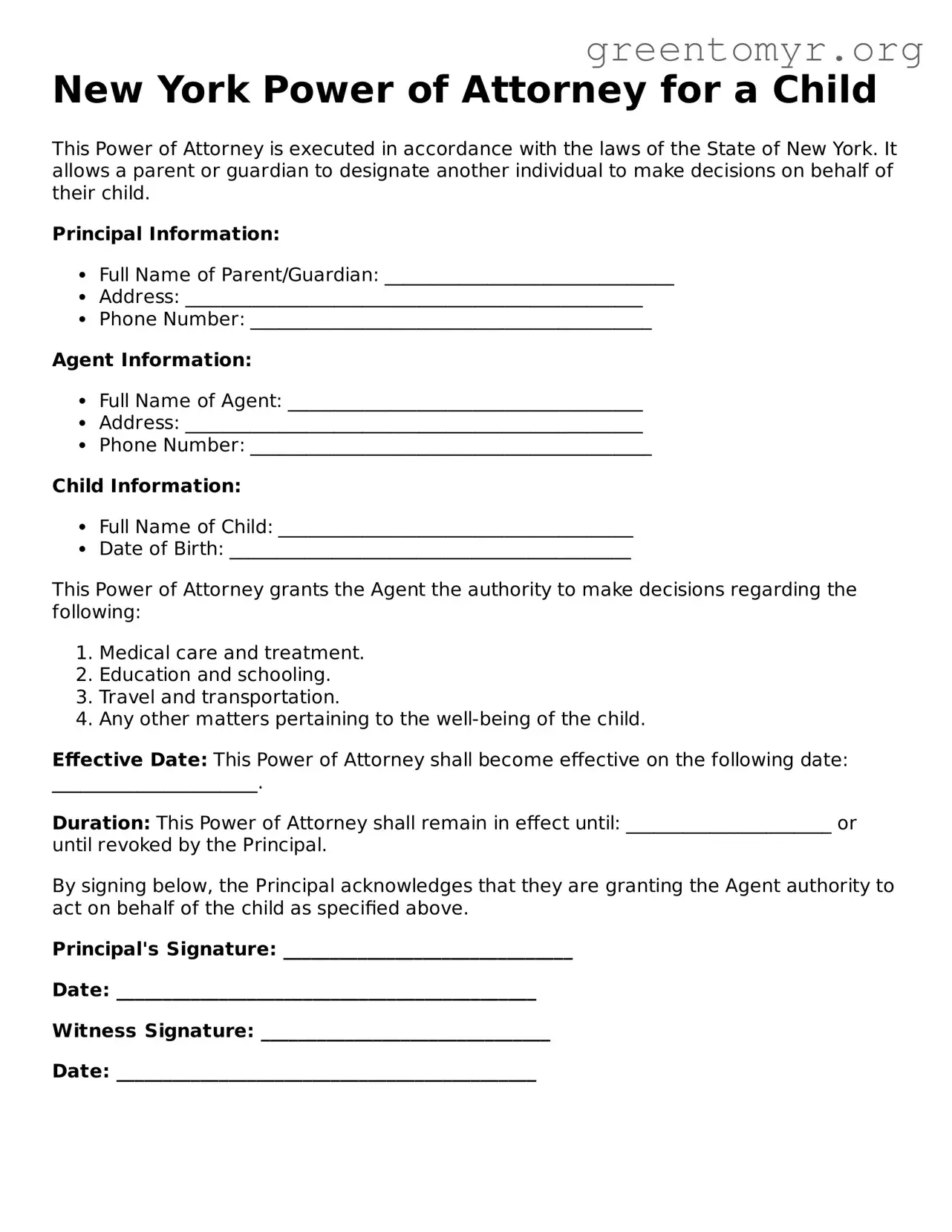
New York Power of Attorney for a Child
This Power of Attorney is executed in accordance with the laws of the State of New York. It allows a parent or guardian to designate another individual to make decisions on behalf of their child.
Principal Information:
Agent Information:
Child Information:
This Power of Attorney grants the Agent the authority to make decisions regarding the following:
Effective Date: This Power of Attorney shall become effective on the following date: ______________________.
Duration: This Power of Attorney shall remain in effect until: ______________________ or until revoked by the Principal.
By signing below, the Principal acknowledges that they are granting the Agent authority to act on behalf of the child as specified above.
Principal's Signature: _______________________________
Date: _____________________________________________
Witness Signature: _______________________________
Date: _____________________________________________
| Fact Name | Description |
|---|---|
| Purpose | The New York Power of Attorney for a Child form allows a parent or guardian to grant temporary authority to another adult to make decisions on behalf of their child. |
| Governing Law | This form is governed by New York State law, specifically under the New York General Obligations Law, Article 5, Title 15. |
| Duration | The authority granted through this form can be effective for a specific period or until revoked by the parent or guardian. |
| Eligibility | Any parent or legal guardian of a child can complete this form to designate another adult as an agent. |
| Agent's Responsibilities | The designated agent can make decisions regarding the child's education, health care, and general welfare. |
| Revocation | The parent or guardian can revoke the Power of Attorney at any time, provided they do so in writing. |
| Notarization | The form must be signed in the presence of a notary public to be legally valid. |
| Limitations | This form does not grant the agent the power to consent to the child's adoption or to make decisions regarding the child's religious upbringing. |
Filling out the New York Power of Attorney for a Child form is an important step in ensuring that a designated individual can make decisions on behalf of your child when necessary. This process requires careful attention to detail to ensure that all information is accurate and complete. Below are the steps to guide you through filling out the form.
After completing the form, keep a copy for your records. Provide the original to the designated individual. It is advisable to inform all parties involved about the arrangement to ensure smooth communication and decision-making.
A Power of Attorney for a Child is a legal document that allows a parent or guardian to appoint another adult to make decisions on behalf of their child. This can include decisions related to health care, education, and general welfare. It is particularly useful when a parent is unable to care for their child temporarily due to travel, illness, or other reasons.
The agent, or the person you designate to act on your behalf, must be at least 18 years old and capable of making informed decisions. This person can be a relative, family friend, or trusted individual who is willing to take on this responsibility. It's important to choose someone who you trust to act in the best interests of your child.
The agent can make a variety of decisions, including:
However, the agent cannot make decisions that require parental consent for things like marriage or adoption.
The Power of Attorney for a Child is typically effective until it is revoked or until a specified date, if indicated in the document. If the parent or guardian regains the ability to care for the child, they can revoke the power of attorney at any time. It’s advisable to clearly state the duration in the document to avoid any confusion.
Yes, in New York, the Power of Attorney for a Child must be signed in the presence of a notary public. This adds an extra layer of validation to the document, ensuring that it is legally binding. It is recommended to keep a copy of the notarized document for your records and provide copies to the designated agent and any relevant institutions, such as schools or medical providers.
Absolutely. As the parent or guardian, you have the right to revoke the Power of Attorney at any time. To do so, you should create a written notice of revocation and provide it to the designated agent and any institutions that were previously informed of the power of attorney. Keeping a record of the revocation is also advisable for your own protection.
Filling out the New York Power of Attorney for a Child form is a critical task that requires attention to detail. One common mistake is failing to specify the duration of the power of attorney. Without a clear start and end date, the authority granted may become ambiguous, leading to potential disputes or confusion. It is essential to define the timeframe to ensure that all parties understand the extent of the authority being granted.
Another frequent error involves neglecting to provide complete information about the child. This includes the child's full name, date of birth, and any relevant identification numbers. Incomplete information can hinder the effectiveness of the document and may complicate matters when the agent attempts to act on behalf of the child. Ensuring that all details are accurate and thorough is vital.
Many individuals also overlook the importance of having the form notarized. While notarization may seem like a minor step, it adds a layer of legitimacy to the document. Without a notary's signature, the power of attorney may be challenged or deemed invalid. It is advisable to seek notarization to reinforce the authority granted within the form.
Additionally, people often fail to discuss the responsibilities and expectations with the designated agent. Clear communication about the agent's role can prevent misunderstandings and ensure that the child's best interests are prioritized. Without this dialogue, the agent may not fully understand their obligations, which could lead to unintended consequences.
Lastly, individuals sometimes forget to review the form for any errors or omissions before submitting it. Even minor mistakes, such as typos or incorrect dates, can have significant implications. A thorough review is necessary to confirm that all information is correct and that the document accurately reflects the intentions of the parties involved.
When preparing a Power of Attorney for a Child in New York, you may find it helpful to have additional documents ready. These forms can support the authority granted and ensure that all legal bases are covered. Below is a list of commonly used forms and documents that often accompany the Power of Attorney for a Child.
Having these documents ready can make the process smoother and provide clarity for everyone involved. It's always wise to ensure that all necessary paperwork is in order to avoid any complications in the future.
When filling out the New York Power of Attorney for a Child form, it’s important to be careful and thorough. Here are some things to keep in mind:
Understanding the New York Power of Attorney for a Child form can be tricky. Here are seven common misconceptions about this important document:
Being informed about these misconceptions can help parents make better decisions regarding their children's care and ensure they have the necessary legal tools in place.
Filling out and using the New York Power of Attorney for a Child form can be a straightforward process, but it is important to understand its key aspects. Here are some essential takeaways:
Understanding these key points can help ensure that the Power of Attorney for a Child form is used effectively and responsibly.