In the world of finance and lending, a New York Promissory Note serves as a vital tool for documenting a loan agreement between a borrower and a lender. This straightforward yet essential document outlines the specific terms of the loan, including the amount borrowed, the interest rate, and the repayment schedule. It also details any penalties for late payments and the conditions under which the lender can demand full repayment. By clearly defining the rights and responsibilities of both parties, the Promissory Note helps prevent misunderstandings and disputes. Additionally, it can be tailored to suit various lending situations, whether for personal loans, business financing, or real estate transactions. Understanding the key elements of this form is crucial for anyone involved in a lending agreement in New York.
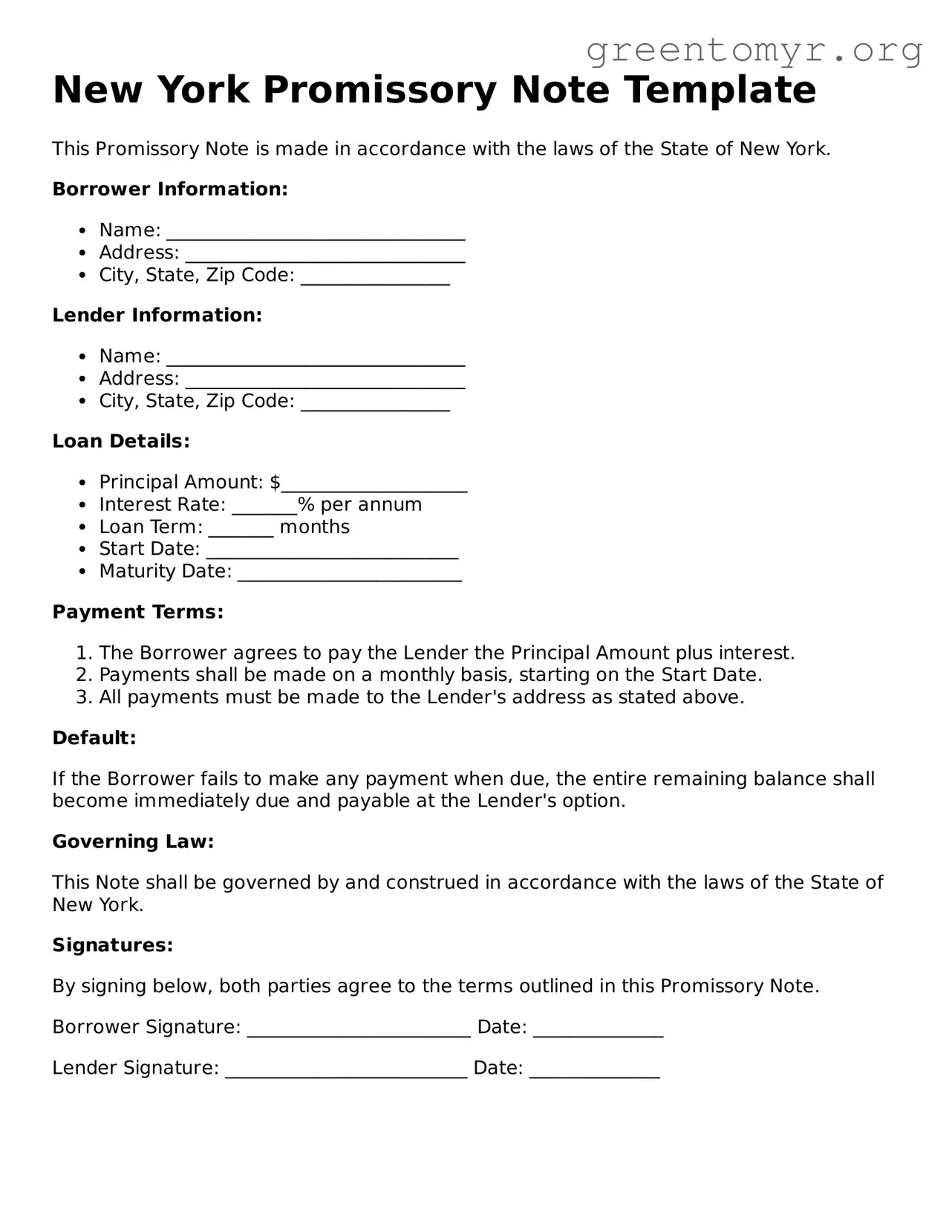
New York Promissory Note Template
This Promissory Note is made in accordance with the laws of the State of New York.
Borrower Information:
Lender Information:
Loan Details:
Payment Terms:
Default:
If the Borrower fails to make any payment when due, the entire remaining balance shall become immediately due and payable at the Lender's option.
Governing Law:
This Note shall be governed by and construed in accordance with the laws of the State of New York.
Signatures:
By signing below, both parties agree to the terms outlined in this Promissory Note.
Borrower Signature: ________________________ Date: ______________
Lender Signature: __________________________ Date: ______________
| Fact Name | Details |
|---|---|
| Definition | A promissory note is a written promise to pay a specified amount of money to a designated person or entity at a defined time. |
| Governing Law | The New York Uniform Commercial Code (UCC) governs promissory notes in New York. |
| Parties Involved | The two primary parties are the maker (borrower) and the payee (lender). |
| Key Components | Essential elements include the amount, interest rate, payment terms, and signatures of the parties. |
| Interest Rate | The interest rate can be fixed or variable, but it must be clearly stated in the note. |
| Payment Schedule | Payments can be structured as a lump sum or in installments, depending on the agreement. |
| Enforceability | To be enforceable, the note must be signed by the maker and contain all necessary terms. |
| Transferability | Promissory notes can be transferred to another party, allowing for the assignment of rights. |
After obtaining the New York Promissory Note form, you will need to complete it accurately to ensure it meets the necessary requirements. Follow the steps below to fill out the form properly.
Once the form is filled out completely and accurately, ensure that both parties retain a copy for their records. This document serves as a formal agreement between the borrower and lender regarding the terms of the loan.
A New York Promissory Note is a written agreement in which one party (the borrower) promises to pay a specific amount of money to another party (the lender) at a designated time or on demand. This document outlines the terms of the loan, including the interest rate, repayment schedule, and any penalties for late payment.
Any individual or business can use a Promissory Note in New York. It is commonly used by lenders and borrowers in personal loans, business loans, and real estate transactions. Both parties should be clear on the terms and conditions to avoid disputes later on.
A typical Promissory Note includes the following components:
While it is not mandatory to have a lawyer draft a Promissory Note, it is advisable, especially for larger loans or complex agreements. A legal professional can ensure that the document complies with New York laws and adequately protects your interests.
If the borrower fails to make payments as agreed, the lender has several options. They can initiate legal action to recover the owed amount, which may involve going to court. Additionally, the lender may also charge late fees or take possession of any collateral if the note is secured by assets.
Yes, a Promissory Note can be modified if both parties agree to the changes. It’s important to document any modifications in writing and have both parties sign the revised agreement. This ensures clarity and helps prevent misunderstandings in the future.
Filling out a New York Promissory Note form can seem straightforward, but many people make common mistakes that can lead to complications later. One frequent error is failing to include all the necessary parties. It’s essential to clearly identify both the borrower and the lender. Omitting a party can create confusion and potentially invalidate the agreement.
Another mistake involves incorrect or incomplete information about the loan amount. People sometimes write the amount in words but forget to include the numerical value, or vice versa. This inconsistency can lead to disputes over the actual amount owed. Always double-check that both representations match.
Many individuals overlook the importance of specifying the interest rate. If you don’t clearly state the interest rate, it can lead to misunderstandings. Some might assume it’s zero, while others may expect a different figure. Clearly outline the interest rate to avoid future conflicts.
Additionally, people often forget to include the payment schedule. A vague repayment plan can lead to confusion about when payments are due. Specify whether payments are due monthly, quarterly, or on another schedule. This clarity helps both parties understand their obligations.
Another common error is neglecting to sign the document. It might sound simple, but without signatures, the note lacks legal enforceability. Ensure that both parties sign and date the form. This step is crucial for the note to be valid.
Lastly, some individuals fail to have the document notarized when required. While not always necessary, notarization can add an extra layer of protection. It helps verify the identities of the parties involved and can be beneficial in case of disputes. Always consider whether notarization is appropriate for your situation.
The New York Promissory Note is a crucial document in lending transactions, outlining the borrower's promise to repay a loan under specific terms. Several other forms and documents often accompany this note to ensure clarity and legality in the lending process. Below are some of the key documents frequently used alongside a New York Promissory Note.
These documents collectively enhance the legal framework surrounding a loan transaction, ensuring that both parties understand their rights and obligations. Properly executed, they can help prevent disputes and facilitate smoother financial interactions.
A Promissory Note is a financial document that outlines a borrower's promise to repay a specified amount of money to a lender under agreed-upon terms. Several other documents share similarities with a Promissory Note, often serving related purposes in financial transactions. Here are six such documents:
Understanding these documents can help individuals navigate financial agreements more effectively and ensure they are fully aware of their rights and obligations.
When filling out the New York Promissory Note form, it's essential to follow specific guidelines to ensure accuracy and compliance. Here are five things you should and shouldn't do:
Understanding the New York Promissory Note form is essential for anyone involved in lending or borrowing money. However, several misconceptions often arise. Here are eight common misunderstandings:
By addressing these misconceptions, individuals can better navigate the lending process and understand their rights and responsibilities.
Filling out and using the New York Promissory Note form requires attention to detail. Here are some key takeaways to keep in mind:
Using the New York Promissory Note form correctly can help avoid misunderstandings and protect the interests of both parties involved.