The New York Quitclaim Deed form serves as a vital instrument in the transfer of real estate ownership, particularly when the granter wishes to relinquish any claim to a property without guaranteeing clear title. This legal document allows individuals to convey their interest in a property to another party, making it especially useful in situations such as family transfers, divorce settlements, or when property is gifted. Unlike other types of deeds, a quitclaim deed does not provide warranties or assurances regarding the property’s title, meaning that the recipient assumes the risk of any existing liens or encumbrances. It is essential for both parties to understand that the granter does not guarantee the legitimacy of their ownership, and the recipient may need to conduct thorough due diligence. Additionally, the form must be properly executed, notarized, and filed with the county clerk’s office to ensure that the transfer is legally recognized. Understanding the nuances of the New York Quitclaim Deed form can help parties navigate the complexities of property transactions with greater confidence.
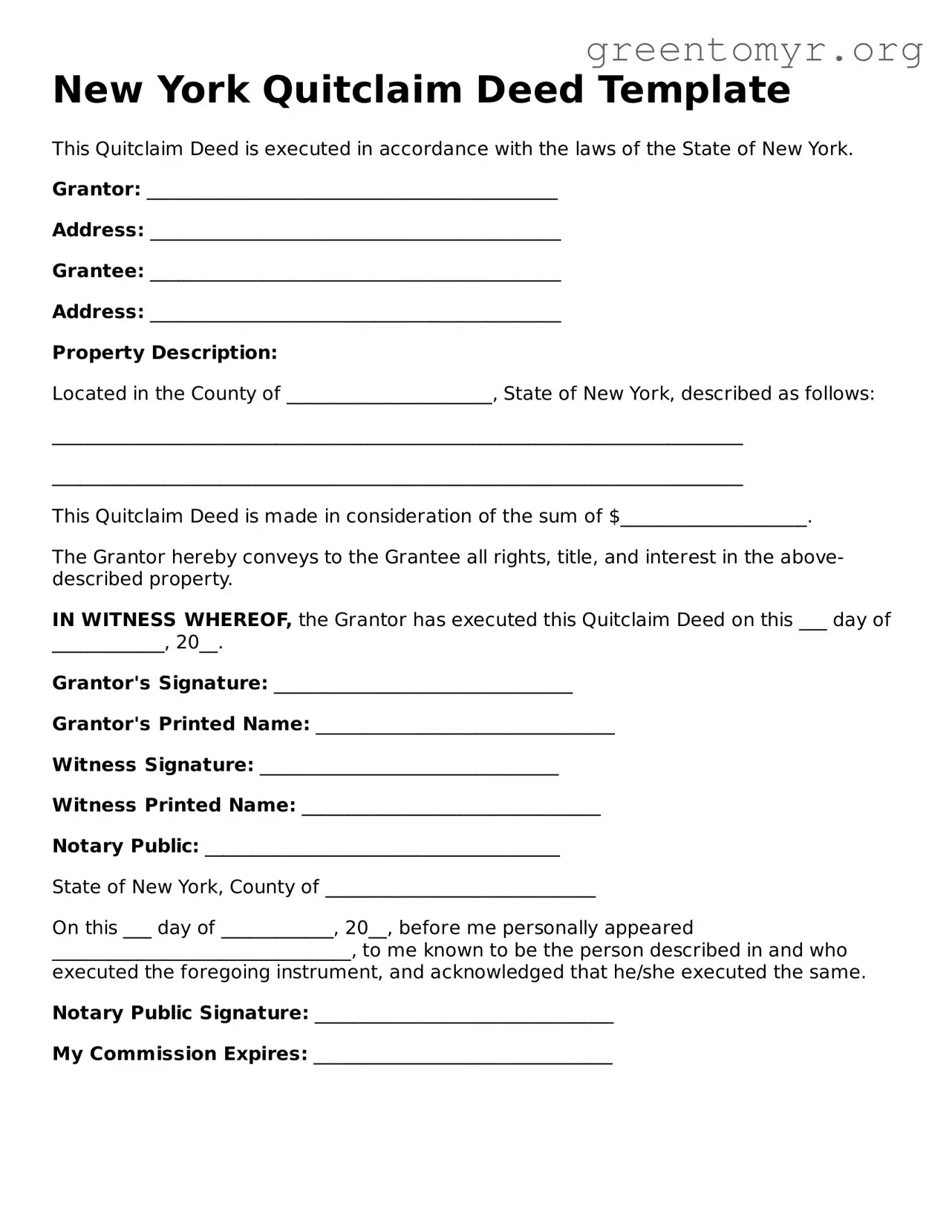
New York Quitclaim Deed Template
This Quitclaim Deed is executed in accordance with the laws of the State of New York.
Grantor: ____________________________________________
Address: ____________________________________________
Grantee: ____________________________________________
Address: ____________________________________________
Property Description:
Located in the County of ______________________, State of New York, described as follows:
__________________________________________________________________________
__________________________________________________________________________
This Quitclaim Deed is made in consideration of the sum of $____________________.
The Grantor hereby conveys to the Grantee all rights, title, and interest in the above-described property.
IN WITNESS WHEREOF, the Grantor has executed this Quitclaim Deed on this ___ day of ____________, 20__.
Grantor's Signature: ________________________________
Grantor's Printed Name: ________________________________
Witness Signature: ________________________________
Witness Printed Name: ________________________________
Notary Public: ______________________________________
State of New York, County of _____________________________
On this ___ day of ____________, 20__, before me personally appeared ________________________________, to me known to be the person described in and who executed the foregoing instrument, and acknowledged that he/she executed the same.
Notary Public Signature: ________________________________
My Commission Expires: ________________________________
| Fact Name | Description |
|---|---|
| Definition | A quitclaim deed is a legal document that transfers ownership of real estate without any warranty of title. |
| Governing Law | In New York, quitclaim deeds are governed by the New York Real Property Law. |
| Use Cases | Commonly used to transfer property between family members or to clear up title issues. |
| Consideration | While consideration is not required, it is often included to validate the deed. |
| Filing Requirements | The deed must be filed with the county clerk's office where the property is located. |
| Tax Implications | Transfer taxes may apply, depending on the value of the property being transferred. |
Once you have the New York Quitclaim Deed form, you can begin the process of filling it out. This form is essential for transferring property ownership. After completing the form, it will need to be signed and notarized before being filed with the appropriate county clerk's office.
A Quitclaim Deed is a legal document used to transfer ownership of real estate from one person to another. Unlike other types of deeds, it does not guarantee that the property is free from liens or other claims. Essentially, the grantor (the person transferring the property) relinquishes any interest they may have in the property to the grantee (the person receiving the property). This type of deed is often used among family members or in situations where the parties know each other well.
Consider using a Quitclaim Deed in several situations, including:
However, it is crucial to understand that this deed offers no warranties regarding the property’s title.
To complete a Quitclaim Deed, follow these steps:
Ensure all details are correct to avoid future complications.
No, a Quitclaim Deed is not the same as a Warranty Deed. A Warranty Deed provides a guarantee that the grantor holds clear title to the property and has the right to transfer it. In contrast, a Quitclaim Deed simply transfers whatever interest the grantor has, if any, without any guarantees. This makes Quitclaim Deeds riskier for the grantee.
Yes, there may be tax implications. While transferring property via a Quitclaim Deed may not trigger a capital gains tax, it can still have consequences for property taxes. In New York, a transfer of property may require the filing of a Real Property Transfer Report. It’s advisable to consult with a tax professional to understand the specific implications based on your situation.
Once a Quitclaim Deed is executed and recorded, it cannot be revoked unilaterally. If the grantor wishes to regain ownership, they would need to execute another deed to transfer the property back. This process can be complicated, and legal advice may be necessary to navigate it effectively.
While it is not legally required to have an attorney prepare a Quitclaim Deed, it is highly recommended. An attorney can ensure that the document is completed correctly, that all legal requirements are met, and that the interests of both parties are protected. This can prevent future disputes and complications.
The cost to file a Quitclaim Deed in New York varies by county. Generally, there is a filing fee that can range from $20 to $150. Additionally, there may be other associated costs, such as notary fees or fees for obtaining copies of the deed. Always check with your local county clerk’s office for the most accurate and up-to-date information on fees.
Filling out a New York Quitclaim Deed form can seem straightforward, but many people make common mistakes that can lead to complications down the line. One of the most frequent errors is failing to include all necessary parties. When transferring property, both the grantor (the person giving up their interest) and the grantee (the person receiving the interest) must be clearly identified. Omitting a party or misidentifying them can invalidate the deed.
Another common mistake involves the description of the property. The Quitclaim Deed must contain a clear and accurate description of the property being transferred. This includes not just the address, but also the lot number or any other identifying features. Relying on vague descriptions can lead to disputes or confusion about what exactly is being transferred.
People also often overlook the need for notarization. A Quitclaim Deed must be signed in front of a notary public to be legally binding. Without this step, the deed may not hold up in court or could be challenged later. It’s crucial to remember that just signing the form isn’t enough; the signature must be properly witnessed.
Another mistake is neglecting to record the deed after it has been completed. Once the Quitclaim Deed is signed and notarized, it should be filed with the county clerk's office where the property is located. Failing to record the deed can lead to issues with future buyers or lenders, as they may not have access to the updated ownership records.
Some individuals also make the error of not understanding the implications of a Quitclaim Deed. Unlike other types of deeds, a Quitclaim Deed does not guarantee that the grantor has clear title to the property. This means that if there are any liens or other claims against the property, the grantee may end up responsible for those issues. It’s important to know what you’re getting into.
Lastly, people often forget to check for any specific requirements set by their local jurisdiction. While the Quitclaim Deed form is standardized, local laws may have additional requirements or nuances. Always take the time to review local regulations to ensure compliance and avoid any potential pitfalls.
The New York Quitclaim Deed is a vital document used in real estate transactions to transfer ownership of property. Along with this deed, several other forms and documents may be necessary to ensure a smooth transfer of property rights. Below is a list of commonly used documents that often accompany a Quitclaim Deed in New York.
Understanding these accompanying documents is essential for anyone involved in a property transfer. Each plays a significant role in ensuring that the transaction is legally sound and that all parties are protected throughout the process.
A Quitclaim Deed is a unique legal document used in real estate transactions, but it shares similarities with several other documents. Here are five documents that are comparable to a Quitclaim Deed, along with explanations of how they are alike:
When filling out the New York Quitclaim Deed form, it is essential to follow certain guidelines to ensure the document is completed correctly. Here are some important dos and don'ts to keep in mind:
By adhering to these guidelines, you can facilitate a smoother process for your property transfer. Make sure to take your time and double-check your work for the best results.
Many individuals hold misconceptions about the New York Quitclaim Deed form. Understanding the truth behind these misconceptions can help clarify its purpose and use. Below are six common misconceptions.
This is false. A quitclaim deed transfers whatever interest the grantor has in the property, but it does not guarantee that the grantor actually owns the property or that there are no liens against it.
While often used in family transactions, quitclaim deeds can be utilized in various situations, including sales between unrelated parties or to clear up title issues.
This is incorrect. A warranty deed provides a guarantee of clear title, whereas a quitclaim deed does not offer any warranties regarding the property’s title.
While legal assistance can be beneficial, many individuals successfully complete quitclaim deeds without professional help, especially for straightforward transactions.
This is misleading. Once a quitclaim deed is executed and recorded, it cannot be revoked. However, the grantor can create a new deed to transfer ownership again if necessary.
In reality, quitclaim deeds can also be used to add or remove individuals from the title, making them useful for estate planning and divorce settlements.
Filling out and using the New York Quitclaim Deed form is a straightforward process, but it's essential to understand some key points. Here are five important takeaways:
By keeping these points in mind, you can navigate the quitclaim deed process more effectively and ensure a smooth transfer of property ownership.