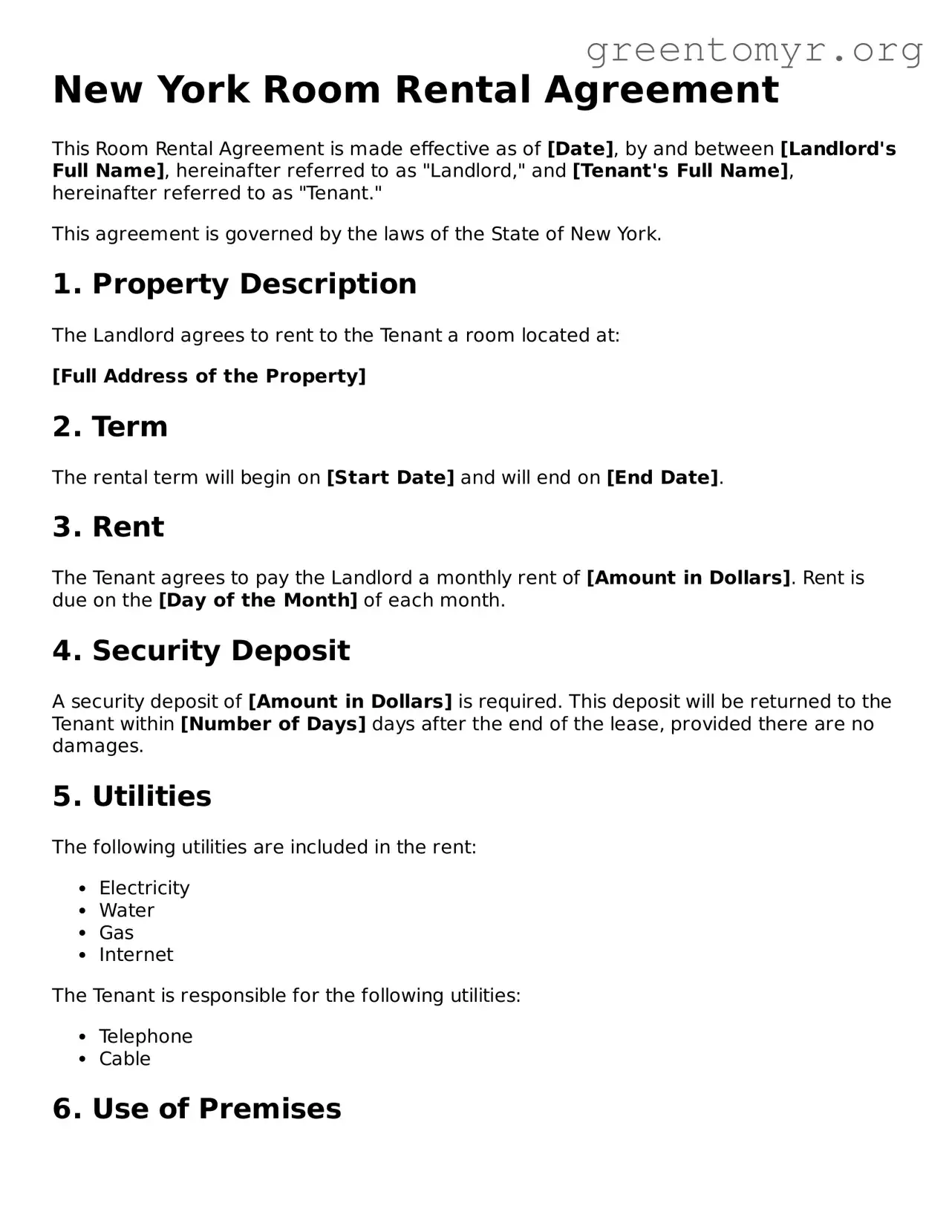
The New York Room Rental Agreement form is a crucial document for anyone looking to rent a room in the state of New York. This form outlines the responsibilities and rights of both the landlord and the tenant, ensuring that all parties understand their obligations. Key components include the rental amount, payment terms, and the duration of the lease. Additionally, it addresses security deposits, maintenance responsibilities, and rules regarding the use of common areas. By clearly defining these elements, the agreement helps prevent misunderstandings and disputes. It also includes provisions for terminating the agreement and the notice required for both parties. Overall, the Room Rental Agreement serves as a foundational tool for a successful rental experience in New York.
New York Room Rental Agreement
This Room Rental Agreement is made effective as of [Date], by and between [Landlord's Full Name], hereinafter referred to as "Landlord," and [Tenant's Full Name], hereinafter referred to as "Tenant."
This agreement is governed by the laws of the State of New York.
1. Property Description
The Landlord agrees to rent to the Tenant a room located at:
[Full Address of the Property]
2. Term
The rental term will begin on [Start Date] and will end on [End Date].
3. Rent
The Tenant agrees to pay the Landlord a monthly rent of [Amount in Dollars]. Rent is due on the [Day of the Month] of each month.
4. Security Deposit
A security deposit of [Amount in Dollars] is required. This deposit will be returned to the Tenant within [Number of Days] days after the end of the lease, provided there are no damages.
5. Utilities
The following utilities are included in the rent:
The Tenant is responsible for the following utilities:
6. Use of Premises
The Tenant agrees to use the premises solely for residential purposes. The Tenant shall not engage in any illegal activities on the property.
7. Maintenance and Repairs
The Landlord is responsible for maintaining the property in a safe and habitable condition. The Tenant must report any maintenance issues promptly.
8. Termination
Either party may terminate this agreement by providing [Number of Days] days written notice to the other party.
9. Governing Law
This agreement shall be governed by the laws of the State of New York.
10. Signatures
By signing below, both parties agree to the terms of this Room Rental Agreement.
__________________________
Landlord's Signature
[Landlord's Printed Name]
[Date]
__________________________
Tenant's Signature
[Tenant's Printed Name]
[Date]
| Fact Name | Description |
|---|---|
| Purpose | The New York Room Rental Agreement form outlines the terms of renting a room in a residential property. |
| Parties Involved | The agreement involves the landlord (property owner) and the tenant (individual renting the room). |
| Duration | The rental period can be specified as either short-term or long-term, depending on the agreement. |
| Rent Amount | The form must clearly state the amount of rent due, including payment due dates. |
| Security Deposit | Landlords can require a security deposit, typically not exceeding one month's rent. |
| Governing Laws | The agreement is governed by New York State laws regarding landlord-tenant relationships. |
| Utilities | The agreement should specify which utilities are included in the rent and which are the tenant's responsibility. |
| Termination Clause | Both parties can outline conditions under which the agreement may be terminated early. |
| Signatures | Both the landlord and tenant must sign the agreement for it to be legally binding. |
| Additional Terms | Any additional terms, such as pet policies or maintenance responsibilities, should be included in the agreement. |
Filling out the New York Room Rental Agreement form is an important step in formalizing the rental arrangement between a landlord and a tenant. By completing this form accurately, both parties can ensure clarity regarding the terms of the rental, which helps prevent misunderstandings in the future. Below are the steps to guide you through the process of filling out the form.
Once the form is completed, both parties should keep a signed copy for their records. This ensures that everyone has access to the agreed-upon terms and can refer back to them if necessary.
A New York Room Rental Agreement is a legal document that outlines the terms and conditions between a landlord and a tenant renting a room in a residential property. This agreement protects both parties by detailing responsibilities, rights, and expectations during the rental period.
The following elements are typically included in a Room Rental Agreement:
The validity of a Room Rental Agreement depends on the terms specified within the document. Agreements can be for a fixed term, such as six months or one year, or they can be month-to-month. Always check the agreement for its specific duration.
If a tenant wishes to leave before the end of the rental term, they should review the agreement for any early termination clauses. Often, tenants may be required to give notice and possibly forfeit their security deposit. Communication with the landlord is key.
A security deposit is not always required, but it is common practice. In New York, landlords can ask for a security deposit equal to one month’s rent. This deposit protects the landlord against potential damages or unpaid rent.
Landlords have several responsibilities, including:
Tenants also have specific responsibilities, such as:
Room Rental Agreement templates can be found online through various legal form websites, or you can consult with a local attorney for a customized document. Ensure that any template used complies with New York state laws.
Filling out the New York Room Rental Agreement can seem straightforward, but many people make common mistakes that can lead to misunderstandings later on. One frequent error is failing to include all required personal information. This includes not just names but also contact details. Omitting this information can create confusion when trying to reach out for important matters related to the rental.
Another mistake is neglecting to specify the rental terms clearly. This includes the duration of the lease, the rent amount, and payment due dates. When these details are vague or missing, it can lead to disputes between landlords and tenants. Clear communication of these terms is essential to avoid future conflicts.
Many individuals also overlook the importance of including security deposit details. Not stating the amount, the conditions for its return, or how it will be handled can create issues. Both parties should understand the expectations regarding the security deposit to prevent misunderstandings when the rental period ends.
People often forget to review the agreement for compliance with local laws. New York has specific regulations regarding rental agreements, and failing to adhere to these can render the agreement unenforceable. It’s crucial to ensure that the form aligns with legal requirements to protect both parties’ rights.
Another common oversight is not obtaining signatures from all necessary parties. A rental agreement is only valid when all involved parties have signed it. Without proper signatures, the document may not hold up in a dispute, leaving one party at a disadvantage.
Lastly, many individuals skip the step of keeping a copy of the signed agreement. After filling out the form, it’s essential to retain a copy for personal records. This helps in referencing the agreed-upon terms later, should any questions arise during the rental period.
When entering into a rental agreement, several other forms and documents may be needed to ensure a smooth process. These documents help clarify the terms of the rental, protect the rights of both parties, and provide necessary legal protections.
These documents work together to create a clear understanding between landlords and tenants. Having them in place can help prevent misunderstandings and protect the interests of both parties involved in the rental process.
When filling out the New York Room Rental Agreement form, it is essential to follow certain guidelines to ensure clarity and legality. Here are some do's and don'ts to consider:
Understanding the New York Room Rental Agreement form is crucial for both landlords and tenants. However, several misconceptions can lead to confusion. Here are ten common misconceptions and clarifications regarding this important document.
Many believe that a rental agreement is just a formality. In reality, once signed, it is a legally binding contract that outlines the rights and responsibilities of both parties.
Some think that only landlords must sign the agreement. However, both the landlord and tenant must sign for the contract to be valid.
Many assume that a verbal agreement is enough. In New York, written agreements are essential to protect both parties in case of disputes.
Some believe that all rental agreements are identical. Each agreement can differ significantly based on specific terms, conditions, and local laws.
It is a common misconception that security deposits are not required. In fact, landlords often require them to cover potential damages or unpaid rent.
Some tenants think landlords can impose any late fee. However, New York has specific laws regulating how much can be charged and under what circumstances.
Many assume that rent includes utilities. This is not always the case, and the rental agreement should specify what is included.
Some tenants believe they can alter the property at will. Most agreements require tenants to seek permission before making any changes.
It is a misconception that landlords can enter the rental property at any time. New York law requires landlords to provide notice before entering, except in emergencies.
Some think these agreements only apply to long-term rentals. However, they can also cover short-term arrangements, depending on the terms set by the landlord.
By addressing these misconceptions, both landlords and tenants can better understand their rights and responsibilities under the New York Room Rental Agreement form.
When filling out and using the New York Room Rental Agreement form, several important aspects should be considered to ensure clarity and legal compliance. Below are key takeaways that can help both landlords and tenants navigate this process effectively.
By paying attention to these key points, both landlords and tenants can foster a more positive rental experience and reduce the likelihood of conflicts.