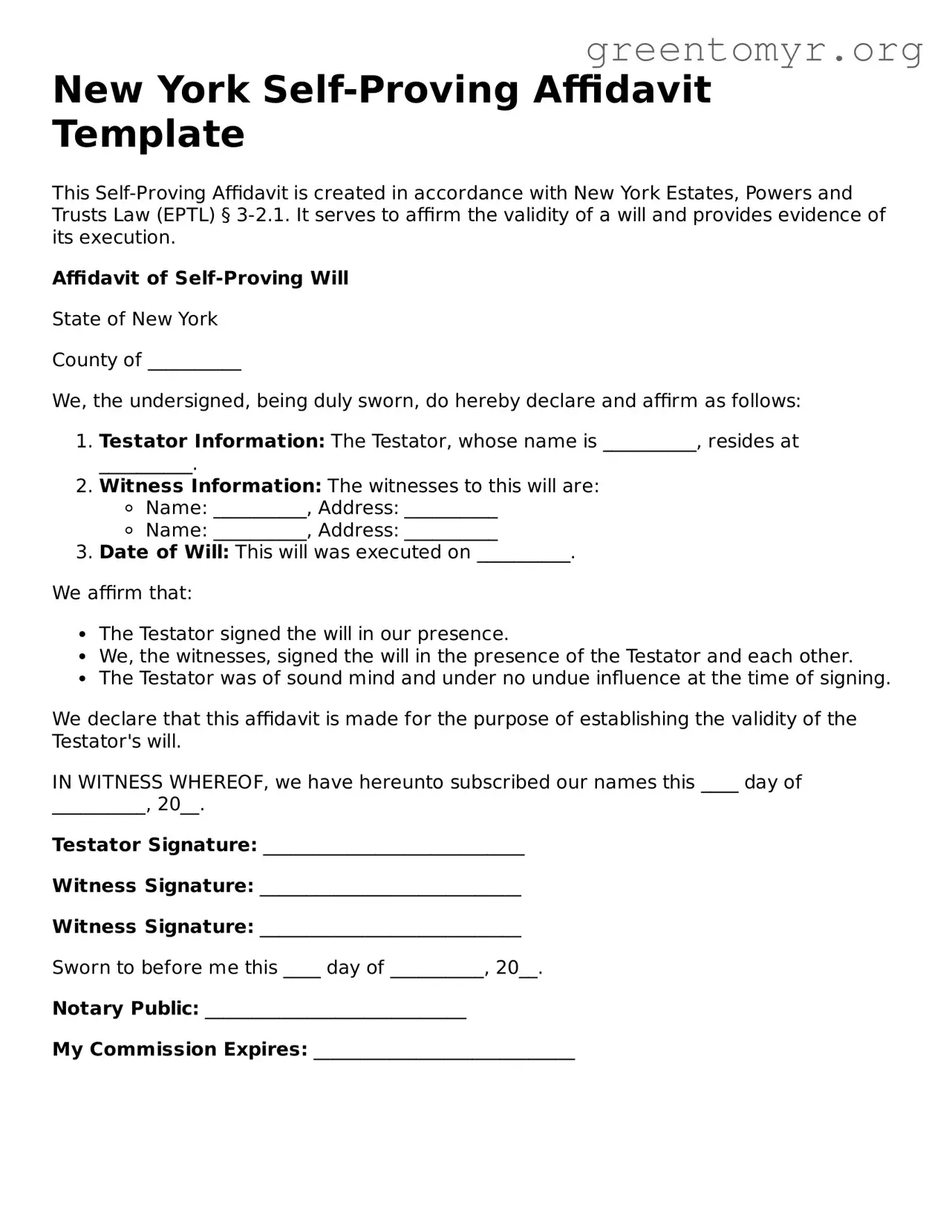
The New York Self-Proving Affidavit form serves as an essential tool in the estate planning process, particularly in the context of wills. This form allows testators to affirm the authenticity of their wills, streamlining the probate process. By including a self-proving affidavit, individuals can reduce the need for witnesses to testify about the will's validity after the testator's passing. The form typically includes details such as the testator's declaration, signatures of the testator and witnesses, and a notary public's acknowledgment. This document not only simplifies legal proceedings but also enhances the overall efficiency of will validation. Understanding the components and significance of the New York Self-Proving Affidavit form is crucial for anyone involved in estate planning, as it ensures that a person's final wishes are respected and upheld in a straightforward manner.
New York Self-Proving Affidavit Template
This Self-Proving Affidavit is created in accordance with New York Estates, Powers and Trusts Law (EPTL) § 3-2.1. It serves to affirm the validity of a will and provides evidence of its execution.
Affidavit of Self-Proving Will
State of New York
County of __________
We, the undersigned, being duly sworn, do hereby declare and affirm as follows:
We affirm that:
We declare that this affidavit is made for the purpose of establishing the validity of the Testator's will.
IN WITNESS WHEREOF, we have hereunto subscribed our names this ____ day of __________, 20__.
Testator Signature: ____________________________
Witness Signature: ____________________________
Witness Signature: ____________________________
Sworn to before me this ____ day of __________, 20__.
Notary Public: ____________________________
My Commission Expires: ____________________________
| Fact Name | Details |
|---|---|
| Purpose | The New York Self-Proving Affidavit allows a will to be validated without requiring witnesses to appear in court. |
| Governing Law | This form is governed by New York Estates, Powers and Trusts Law (EPTL) § 3-2.1. |
| Signature Requirement | The testator must sign the affidavit in the presence of two witnesses. |
| Witnesses | Two witnesses are required to sign the affidavit, confirming the testator's signature. |
| Format | The affidavit must be in writing and follow a specific format outlined in the law. |
| Validity | Once executed, the affidavit serves to validate the will in probate court without additional witness testimony. |
| Revocation | The self-proving affidavit does not revoke the will; it simply enhances its validity. |
| Storage | It is recommended to keep the affidavit with the original will for easy access during probate. |
Once you have the New York Self-Proving Affidavit form ready, you can begin the process of filling it out. This form requires specific information to be completed accurately to ensure it meets the necessary legal standards. Follow these steps to fill out the form correctly.
After completing the form, it is advisable to keep a copy for your records. You may also want to consult with a legal professional to ensure everything is in order before finalizing the document.
A New York Self-Proving Affidavit is a legal document that allows a will to be validated without the need for witnesses to testify in court. This affidavit is typically signed by the testator (the person who made the will) and witnesses, affirming that the will was executed properly and in accordance with state laws.
This affidavit simplifies the probate process. When a will includes a Self-Proving Affidavit, it can be accepted by the court without requiring the witnesses to appear. This can save time and reduce complications during the probate process.
Any person who is creating a will in New York can include a Self-Proving Affidavit. However, it must be signed in the presence of at least two witnesses who are not beneficiaries of the will. These witnesses must also sign the affidavit to confirm their presence during the signing of the will.
A Self-Proving Affidavit should include the following elements:
To execute a Self-Proving Affidavit, the testator and witnesses must be present together. The testator should declare that they are signing the will willingly. The witnesses then sign the affidavit, confirming that they witnessed the testator's signature. It is advisable to have the affidavit notarized to further validate its authenticity.
Yes, a Self-Proving Affidavit can be revoked if the testator decides to change their will or if they create a new will that does not include the affidavit. It is important to clearly indicate the revocation in writing to avoid any confusion during the probate process.
No, a Self-Proving Affidavit is not required to create a valid will in New York. However, including one can streamline the probate process and avoid potential disputes regarding the will's validity.
If a will does not include a Self-Proving Affidavit, the court may require the witnesses to testify about the circumstances of the will's execution during probate. This can lead to delays and additional legal complications.
While some states have similar self-proving affidavit provisions, it is advisable to use a New York-specific Self-Proving Affidavit. Each state has its own requirements, and using the correct form ensures compliance with New York laws.
Self-Proving Affidavit forms can typically be found online through legal resources, law firms, or state government websites. It is important to ensure that the form is up-to-date and complies with New York state laws.
Filling out the New York Self-Proving Affidavit can be a straightforward process, but many people stumble due to common mistakes. One frequent error is forgetting to include the date when the affidavit is signed. This detail may seem minor, but without a date, the validity of the affidavit could be questioned.
Another common mistake is not having the witnesses sign the affidavit in the presence of the testator. The law requires that witnesses observe the testator signing the will. If this step is overlooked, the affidavit may not hold up in court.
People often neglect to provide their full names and addresses. This information is essential for identifying the parties involved. Omitting it can lead to confusion or even challenges to the affidavit’s authenticity.
Additionally, some individuals fail to ensure that the affidavit is notarized. A notary public must witness the signatures to validate the document. Without notarization, the affidavit may not be recognized as legitimate.
Another mistake occurs when individuals use outdated forms. Legal documents can change over time, and using an old version of the Self-Proving Affidavit can lead to complications. Always check for the most current version before filling it out.
People sometimes rush through the form, leading to incomplete or unclear information. It’s important to take the time to read each section carefully and provide thorough responses. Incomplete forms can delay the probate process.
Some individuals also forget to include a statement of understanding. The affidavit should affirm that the testator understands the nature of the document being signed. This statement is crucial for establishing the testator’s intent.
Another mistake is failing to review the affidavit for accuracy after completion. Errors in names, dates, or other key details can render the affidavit ineffective. A careful review can prevent these issues.
Lastly, many people overlook the importance of keeping a copy of the signed affidavit. It’s essential to retain a copy for personal records and to provide it to the executor of the estate. Without it, proving the validity of the will could become challenging.
By avoiding these common mistakes, individuals can ensure that their New York Self-Proving Affidavit is completed correctly and stands up to scrutiny in the probate process.
The New York Self-Proving Affidavit is an important document in the estate planning process, ensuring that a will can be validated without the need for witnesses to testify. Alongside this form, several other documents are commonly utilized to support the execution and validity of a will. Below is a list of these related forms and documents, each serving a unique purpose in the estate planning framework.
Understanding these documents is essential for anyone involved in estate planning or the probate process. Each form plays a critical role in ensuring that an individual's wishes are honored and that their loved ones are supported during a challenging time.
The Self-Proving Affidavit form shares similarities with several other documents used in legal and estate planning contexts. Here’s a list of nine documents that are comparable:
When filling out the New York Self-Proving Affidavit form, there are important dos and don'ts to keep in mind. Following these guidelines will help ensure that the process goes smoothly and that your affidavit is valid.
The New York Self-Proving Affidavit form is often misunderstood. Here are ten common misconceptions about this important legal document:
Many believe that a Self-Proving Affidavit is mandatory for every will. In reality, it is optional but can simplify the probate process.
Some think they can sign the affidavit at any time. However, it must be signed at the same time as the will or shortly thereafter.
This is incorrect. New York law requires at least two witnesses to validate the will and the Self-Proving Affidavit.
While the affidavit can expedite the probate process, it does not eliminate the need for probate altogether.
Many assume that the Self-Proving Affidavit applies to all legal documents. It is specifically designed for wills.
Some think that using the Self-Proving Affidavit automatically ensures the will's validity. It still must meet all other legal requirements.
This is a misconception. The Self-Proving Affidavit can be beneficial for estates of any size.
While the affidavit is signed in front of witnesses, it does not need to be notarized in New York.
Only the testator (the person making the will) and the witnesses should complete the affidavit. Others should not fill it out.
This is misleading. A Self-Proving Affidavit has specific legal language and requirements that differ from a standard affidavit.
Understanding these misconceptions can help ensure proper use of the New York Self-Proving Affidavit form.
The New York Self-Proving Affidavit allows a testator's will to be validated without requiring witnesses to appear in court.
This affidavit must be signed by the testator and two witnesses in the presence of each other.
It is important to ensure that the affidavit is attached to the will at the time of probate to be effective.
Using this affidavit can expedite the probate process, as it eliminates the need for witness testimony.
Individuals should verify that the affidavit complies with New York State laws to avoid potential legal challenges.