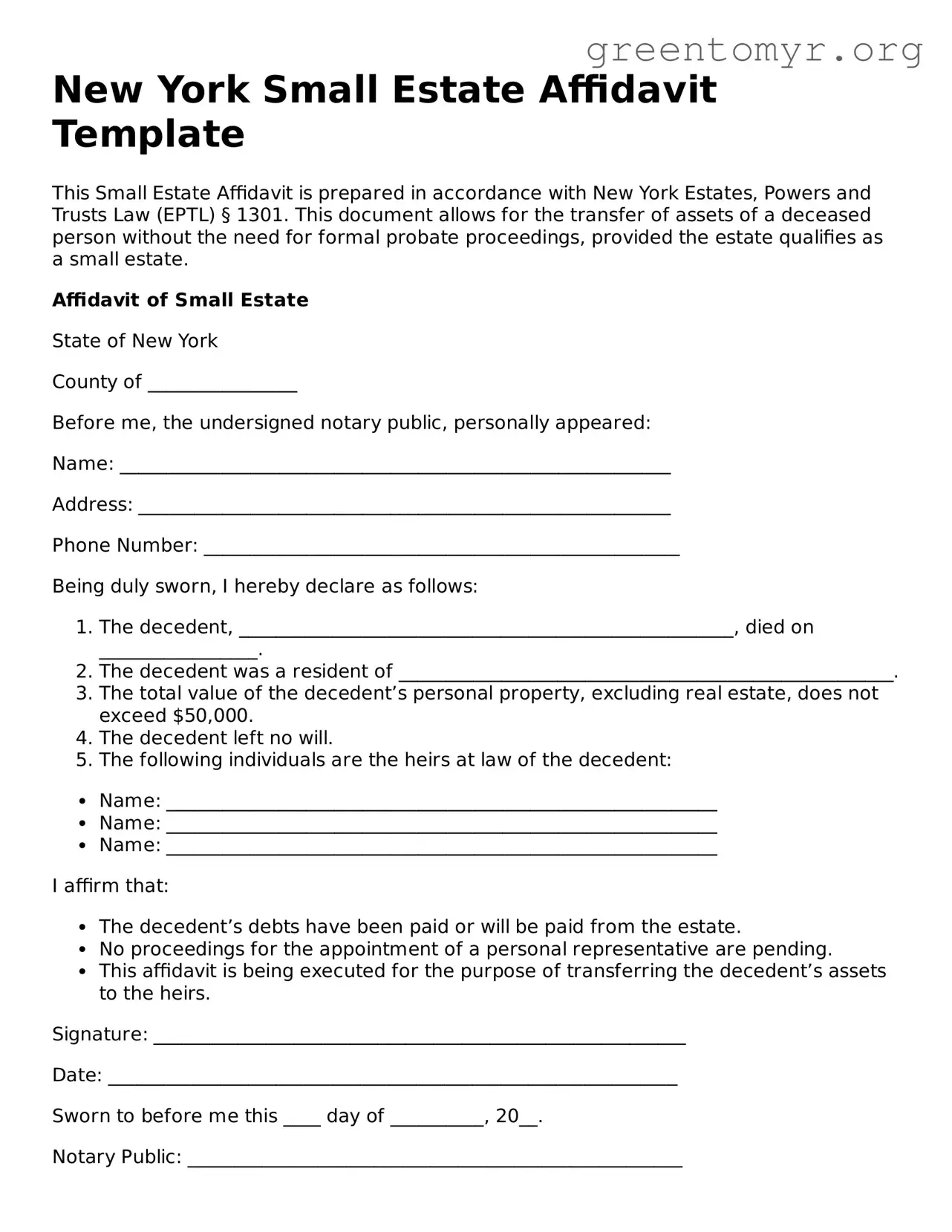
The New York Small Estate Affidavit form serves as a valuable tool for individuals dealing with the estate of a deceased person, particularly when the estate's total value falls below a certain threshold. This process allows heirs to bypass the lengthy and often complex probate proceedings, streamlining the transfer of assets. By completing this form, eligible individuals can claim personal property, such as bank accounts or vehicles, without the need for formal probate court intervention. The form requires specific information, including details about the deceased, the value of the estate, and the relationship of the claimant to the deceased. Additionally, it must be signed under oath, ensuring that the information provided is accurate and truthful. Understanding the requirements and implications of using the Small Estate Affidavit can greatly simplify the management of an estate and provide a more efficient means of asset distribution for those left behind.
New York Small Estate Affidavit Template
This Small Estate Affidavit is prepared in accordance with New York Estates, Powers and Trusts Law (EPTL) § 1301. This document allows for the transfer of assets of a deceased person without the need for formal probate proceedings, provided the estate qualifies as a small estate.
Affidavit of Small Estate
State of New York
County of ________________
Before me, the undersigned notary public, personally appeared:
Name: ___________________________________________________________
Address: _________________________________________________________
Phone Number: ___________________________________________________
Being duly sworn, I hereby declare as follows:
I affirm that:
Signature: _________________________________________________________
Date: _____________________________________________________________
Sworn to before me this ____ day of __________, 20__.
Notary Public: _____________________________________________________
My Commission Expires: ____________________________________________
| Fact Name | Description |
|---|---|
| Purpose | The New York Small Estate Affidavit allows heirs to claim assets of a deceased person without going through formal probate. |
| Eligibility | This form can be used when the total value of the deceased's assets is $50,000 or less, excluding real estate. |
| Governing Law | The Small Estate Affidavit is governed by New York Estates, Powers and Trusts Law (EPTL) § 1301. |
| Required Signatures | The affidavit must be signed by the person claiming the assets and by at least one witness. |
| Filing Process | No filing with the court is required. The affidavit is presented to the financial institution or entity holding the assets. |
| Assets Covered | The affidavit can be used for bank accounts, stocks, bonds, and personal property, but not for real estate. |
| Time Limit | There is no specific time limit to file the Small Estate Affidavit after death, but it is advisable to do so promptly. |
| Identification | The claimant must provide proof of identity, such as a driver's license or state ID, along with the affidavit. |
| Legal Advice | While the form is straightforward, consulting with a lawyer can help ensure all requirements are met. |
Once you have gathered the necessary information and documents, you're ready to fill out the New York Small Estate Affidavit form. This process involves providing specific details about the deceased individual and their estate. Follow these steps carefully to ensure accuracy.
After completing the form, you can submit it along with any required documents to the appropriate court or financial institution. This will initiate the process of settling the estate according to the instructions provided in the affidavit.
A Small Estate Affidavit is a legal document that allows individuals to claim assets from a deceased person's estate without going through the formal probate process. In New York, this option is available when the total value of the estate is below a certain threshold, making it a simpler and faster way to settle affairs.
As of 2023, the value limit for a Small Estate in New York is $50,000 for individuals who are not married. For married individuals, the limit is $100,000. If the estate's total value exceeds these amounts, the formal probate process will be required.
Generally, any person who is entitled to inherit from the deceased can use the Small Estate Affidavit. This often includes spouses, children, parents, or siblings. However, it's important to ensure that you meet the legal requirements and are indeed an eligible heir or beneficiary.
You can obtain a Small Estate Affidavit form from the New York State Unified Court System website or local court offices. The form is usually straightforward and requires information about the deceased, their assets, and the individuals claiming those assets.
To complete the Small Estate Affidavit, you will need to provide:
No, you do not need to file the Small Estate Affidavit with the court. Instead, you present it to the financial institutions or agencies holding the deceased's assets. They will review the affidavit and, if everything checks out, release the assets to you.
If disputes arise among heirs regarding the Small Estate Affidavit, it can complicate the process. In such cases, it may be necessary to seek legal advice or even initiate formal probate proceedings to resolve the issues. Open communication among heirs can often prevent disputes from escalating.
A Small Estate Affidavit cannot be revoked once it has been executed and used to claim assets. However, if it is found that the affidavit contained false information or was improperly used, legal action may be taken against the individual who submitted it. It's crucial to ensure all information is accurate and truthful before submitting the affidavit.
Filling out the New York Small Estate Affidavit form can be a straightforward process, but many people make common mistakes that can lead to delays or complications. One frequent error is not including all necessary information about the deceased. It is essential to provide the full name, date of birth, and date of death. Omitting any of these details can result in the form being rejected.
Another mistake is failing to list all the assets of the deceased accurately. The Small Estate Affidavit is intended for estates that are below a certain value threshold. If individuals overlook any assets, it may push the estate above that limit, requiring a different legal process. It’s crucial to be thorough and ensure that every asset is accounted for.
People often forget to sign the affidavit in the correct places. The form requires signatures from all individuals who will benefit from the estate. Neglecting to obtain these signatures can lead to delays in the distribution of assets. In some cases, a missing signature could invalidate the entire affidavit.
Another common issue arises from using outdated forms. Legal documents can change, and using an old version of the Small Estate Affidavit can lead to problems. Always check that you are using the most current version available to ensure compliance with the latest requirements.
Inaccurate or incomplete witness information is also a prevalent mistake. The affidavit must be witnessed by someone who is not a beneficiary. Failing to provide accurate details about the witnesses or not having the required number of witnesses can result in the affidavit being deemed invalid.
Lastly, individuals sometimes misinterpret the instructions provided with the form. Each section of the affidavit has specific requirements, and misunderstanding these can lead to incomplete or incorrect submissions. Taking the time to read and understand the instructions carefully can save a lot of time and trouble in the long run.
The New York Small Estate Affidavit is a valuable tool for individuals dealing with the estate of a deceased person when the estate's value is below a certain threshold. When utilizing this form, several other documents may also be required to ensure a smooth process. Here are five common forms and documents often used alongside the Small Estate Affidavit.
Having these documents prepared and organized can significantly streamline the process of settling a small estate in New York. Ensuring that all required paperwork is in order helps prevent delays and complications during the administration of the estate.
When completing the New York Small Estate Affidavit form, it's important to follow certain guidelines to ensure a smooth process. Here are five things you should and shouldn't do:
By following these tips, you can help streamline the process of settling the estate and avoid common pitfalls.
The New York Small Estate Affidavit is a useful tool for settling the estates of individuals who have passed away, but several misconceptions surround its use. Here are five common misunderstandings:
Understanding these misconceptions can help individuals navigate the estate settlement process more effectively. Always consider consulting with a legal professional for personalized advice.
When dealing with the New York Small Estate Affidavit form, understanding its purpose and proper use is essential. Here are five key takeaways to keep in mind:
By keeping these points in mind, you can navigate the Small Estate Affidavit process with greater confidence and efficiency.