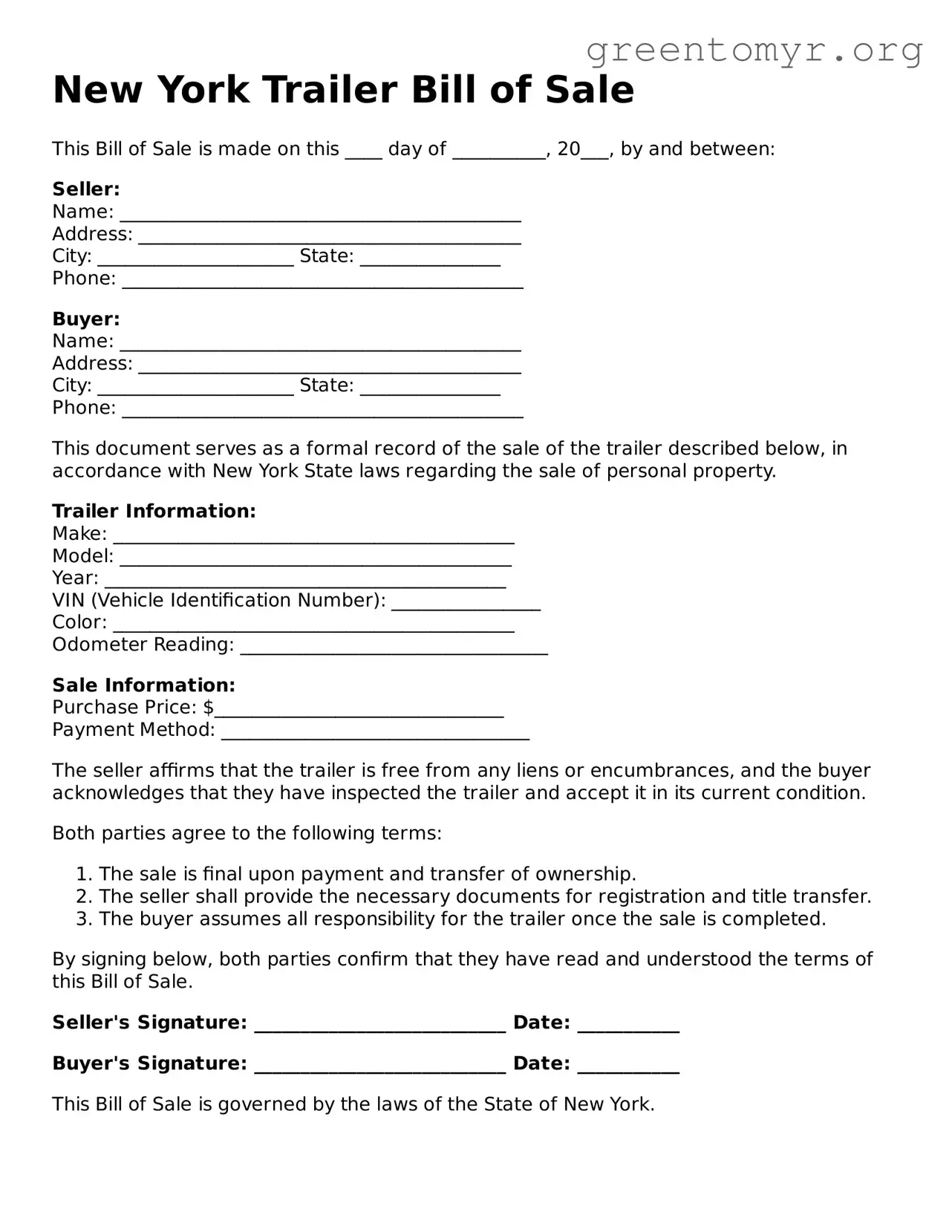
When it comes to buying or selling a trailer in New York, having the right documentation is crucial to ensure a smooth transaction. The New York Trailer Bill of Sale form serves as an essential record of the sale, capturing important details such as the buyer's and seller's information, a description of the trailer, and the sale price. This form not only protects the interests of both parties but also provides a legal proof of ownership transfer. By including specifics like the trailer's Vehicle Identification Number (VIN) and any relevant warranties, the bill of sale helps to clarify the terms of the sale and can be vital for future registrations or title transfers. Understanding the components and significance of this form can empower individuals to navigate the buying or selling process with confidence, ensuring that all necessary information is accurately documented and easily accessible.
New York Trailer Bill of Sale
This Bill of Sale is made on this ____ day of __________, 20___, by and between:
Seller:
Name: ___________________________________________
Address: _________________________________________
City: _____________________ State: _______________
Phone: ___________________________________________
Buyer:
Name: ___________________________________________
Address: _________________________________________
City: _____________________ State: _______________
Phone: ___________________________________________
This document serves as a formal record of the sale of the trailer described below, in accordance with New York State laws regarding the sale of personal property.
Trailer Information:
Make: ___________________________________________
Model: __________________________________________
Year: ___________________________________________
VIN (Vehicle Identification Number): ________________
Color: ___________________________________________
Odometer Reading: _________________________________
Sale Information:
Purchase Price: $_______________________________
Payment Method: _________________________________
The seller affirms that the trailer is free from any liens or encumbrances, and the buyer acknowledges that they have inspected the trailer and accept it in its current condition.
Both parties agree to the following terms:
By signing below, both parties confirm that they have read and understood the terms of this Bill of Sale.
Seller's Signature: ___________________________ Date: ___________
Buyer's Signature: ___________________________ Date: ___________
This Bill of Sale is governed by the laws of the State of New York.
| Fact Name | Description |
|---|---|
| Purpose | The New York Trailer Bill of Sale form is used to document the sale or transfer of ownership of a trailer. |
| Governing Law | This form is governed by New York State Vehicle and Traffic Law. |
| Parties Involved | The form requires information from both the seller and the buyer, ensuring clarity in the transaction. |
| Identification | It must include details about the trailer, such as its Vehicle Identification Number (VIN), make, model, and year. |
| Sales Price | The agreed-upon sales price must be documented to establish the value of the transaction. |
| Signatures | Both parties must sign the form to validate the sale and transfer of ownership. |
| Record Keeping | It is advisable for both the buyer and seller to keep a copy of the completed form for their records. |
After obtaining the New York Trailer Bill of Sale form, it is essential to complete it accurately to ensure a smooth transfer of ownership. Follow these steps carefully to fill out the form correctly.
Once the form is completed, both parties should retain a copy for their records. This will serve as proof of the transaction and ownership transfer.
A New York Trailer Bill of Sale form is a legal document used to transfer ownership of a trailer from one person to another. This form includes important details about the trailer, such as its make, model, year, Vehicle Identification Number (VIN), and the sale price. It serves as proof of the transaction and can be used for registration purposes with the New York Department of Motor Vehicles (DMV).
Both the seller and the buyer should complete the Bill of Sale. The seller needs it to document the sale and protect against future claims of ownership. The buyer requires it for registration and to establish legal ownership of the trailer. It is advisable for both parties to keep a copy for their records.
While a Bill of Sale is not legally required for all trailer sales in New York, it is highly recommended. Having this document helps clarify the terms of the sale and provides legal protection for both parties. If the trailer is being registered with the DMV, a Bill of Sale may be necessary to complete the registration process.
A typical Trailer Bill of Sale includes the following information:
This information ensures that both parties have a clear understanding of the transaction.
Once the Bill of Sale is signed by both parties, it is generally considered a binding agreement. Modifications can be made, but both parties must agree to the changes and initial any alterations. It is best to create a new document if significant changes are needed to avoid confusion.
After completing the Bill of Sale, both the buyer and the seller should keep a copy for their records. The buyer may need to present the Bill of Sale when registering the trailer with the New York DMV. It is not necessary to file the Bill of Sale with any government agency, but having it on hand is important for future reference.
Completing the New York Trailer Bill of Sale form can be straightforward, but many individuals make common mistakes that can lead to complications. One frequent error is failing to provide complete information about the trailer. The form requires details such as the make, model, year, and Vehicle Identification Number (VIN). Omitting any of this information can create issues when registering the trailer or transferring ownership.
Another mistake is not signing the form. Both the seller and the buyer must sign the document to validate the transaction. If either party neglects to sign, the bill of sale may be considered incomplete, which could hinder the transfer of ownership.
Inaccurate pricing is also a common pitfall. Buyers and sellers should ensure that the sale price is clearly stated and matches any agreed-upon amount. Discrepancies can lead to disputes later on, especially if the buyer needs to prove the value for tax purposes.
Some individuals forget to include the date of the sale. This detail is essential for record-keeping and may be required for tax reporting. Without a date, it can be challenging to establish when the transaction occurred.
Another mistake involves not providing adequate identification details. The form requires the seller's and buyer's names and addresses. Leaving out this information can complicate the ownership transfer process and may even lead to legal disputes.
Many people overlook the importance of keeping a copy of the completed bill of sale. After signing, both parties should retain a copy for their records. This document serves as proof of the transaction and can be crucial if any issues arise in the future.
Lastly, individuals sometimes fail to check local regulations regarding trailer sales. Different counties or municipalities may have specific requirements or additional forms that need to be completed. Ignoring these local regulations can result in fines or other legal complications.
When purchasing or selling a trailer in New York, several important documents accompany the Trailer Bill of Sale. Each document plays a crucial role in ensuring a smooth transaction and protecting the interests of both parties involved. Below is a list of forms and documents commonly used alongside the Trailer Bill of Sale.
Understanding these documents can make the process of buying or selling a trailer much easier. Each form contributes to a transparent and legally sound transaction, ultimately providing peace of mind for both buyers and sellers.
The Trailer Bill of Sale form shares similarities with several other documents used in the sale and transfer of vehicles or property. Here’s a list of eight documents that are comparable:
Each of these documents plays a crucial role in ensuring that transactions are conducted smoothly and legally, providing peace of mind to both buyers and sellers.
When filling out the New York Trailer Bill of Sale form, it is crucial to follow specific guidelines to ensure the document is completed correctly. Here are ten important do's and don'ts to consider:
Following these guidelines will help facilitate a smooth transaction and protect the interests of both parties involved. Ensure that you are thorough and attentive to detail.
When dealing with the New York Trailer Bill of Sale form, several misconceptions can lead to confusion. Here are four common misunderstandings:
When filling out and using the New York Trailer Bill of Sale form, keep the following key points in mind:
Following these guidelines will help ensure a smooth transaction and protect the interests of both the seller and the buyer.