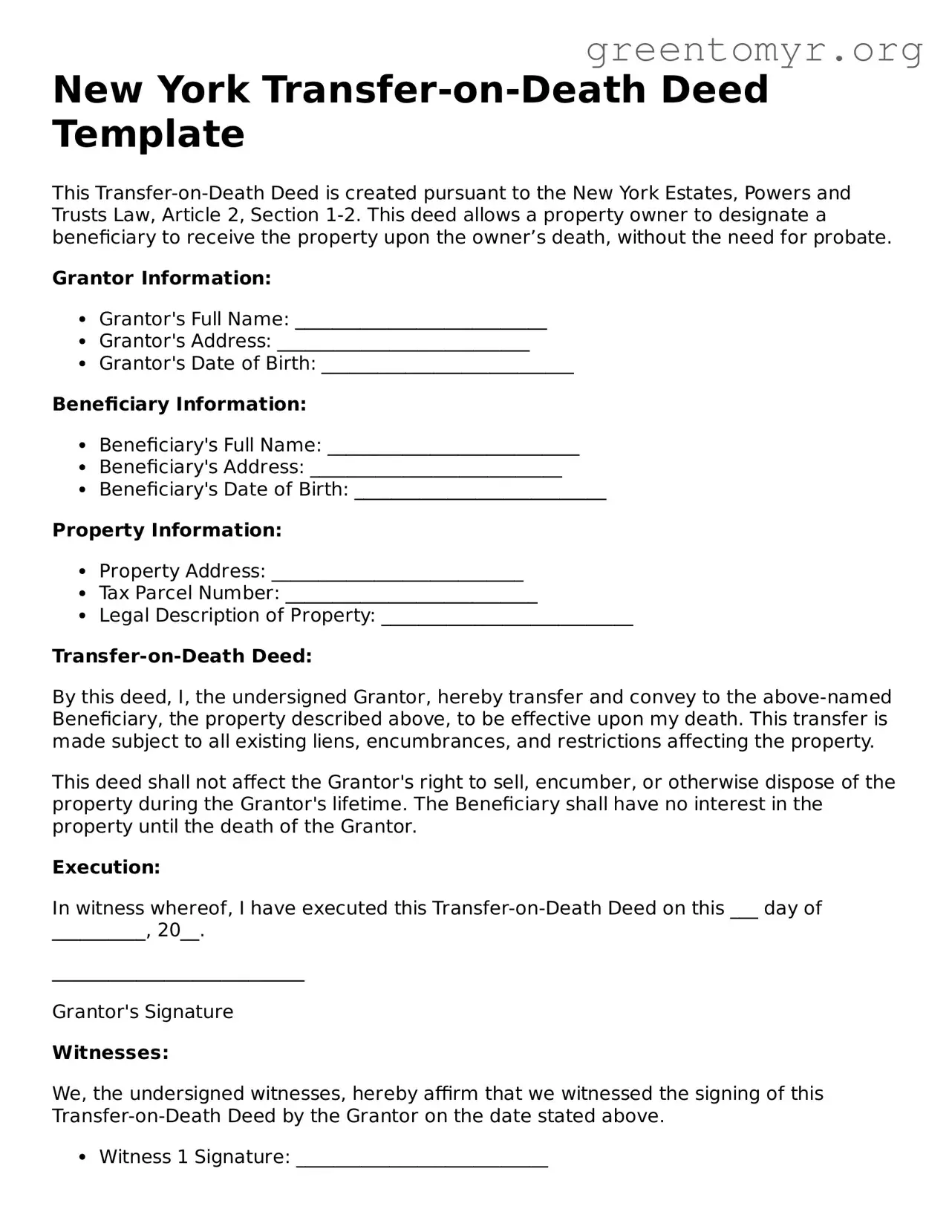
The New York Transfer-on-Death Deed (TOD) form offers a practical solution for property owners looking to streamline the transfer of real estate upon their passing. By utilizing this form, individuals can designate beneficiaries who will automatically receive the property, bypassing the often lengthy and costly probate process. This deed allows for a seamless transition of ownership, ensuring that loved ones inherit the property without the complications typically associated with estate management. Key features of the TOD include the ability to retain full control of the property during the owner's lifetime, as well as the flexibility to revoke or modify the deed at any time before death. Understanding the requirements and implications of this form is essential for anyone considering this option, as it can significantly impact estate planning and the distribution of assets. With the right information, property owners can make informed decisions that align with their wishes and support their beneficiaries effectively.
New York Transfer-on-Death Deed Template
This Transfer-on-Death Deed is created pursuant to the New York Estates, Powers and Trusts Law, Article 2, Section 1-2. This deed allows a property owner to designate a beneficiary to receive the property upon the owner’s death, without the need for probate.
Grantor Information:
Beneficiary Information:
Property Information:
Transfer-on-Death Deed:
By this deed, I, the undersigned Grantor, hereby transfer and convey to the above-named Beneficiary, the property described above, to be effective upon my death. This transfer is made subject to all existing liens, encumbrances, and restrictions affecting the property.
This deed shall not affect the Grantor's right to sell, encumber, or otherwise dispose of the property during the Grantor's lifetime. The Beneficiary shall have no interest in the property until the death of the Grantor.
Execution:
In witness whereof, I have executed this Transfer-on-Death Deed on this ___ day of __________, 20__.
___________________________
Grantor's Signature
Witnesses:
We, the undersigned witnesses, hereby affirm that we witnessed the signing of this Transfer-on-Death Deed by the Grantor on the date stated above.
Notarization:
State of New York, County of ________________
On this ___ day of __________, 20__, before me, a Notary Public, personally appeared ___________________________, known to me to be the person whose name is subscribed to this instrument, and acknowledged that they executed the same.
___________________________
Notary Public Signature
My Commission Expires: ________________
| Fact Name | Description |
|---|---|
| Purpose | The New York Transfer-on-Death Deed allows property owners to transfer real estate to beneficiaries upon their death without going through probate. |
| Governing Law | This deed is governed by New York Estates, Powers and Trusts Law (EPTL) § 13-16. |
| Revocation | Property owners can revoke the Transfer-on-Death Deed at any time before their death by executing a new deed or a revocation document. |
| Eligibility | The deed can be used for residential real estate and must be properly recorded with the county clerk to be effective. |
Once you have the New York Transfer-on-Death Deed form, you will be ready to fill it out. Completing this form accurately is essential for ensuring that your wishes regarding property transfer are clearly documented. Follow these steps carefully to ensure everything is completed properly.
After submitting the form, it will be processed by the county clerk’s office. You will receive confirmation once the deed is recorded. Keep a copy of the filed deed for your records, as it is important for future reference.
A Transfer-on-Death Deed (TOD Deed) allows property owners in New York to transfer real estate to a designated beneficiary upon their death, without going through probate. This deed ensures that your property goes directly to your chosen beneficiary, simplifying the transfer process and potentially saving time and money.
Any individual who owns real estate in New York can use a Transfer-on-Death Deed. This includes homeowners, co-owners, and even those with partial ownership. However, it's essential to ensure that the deed complies with state laws and that the property is eligible for transfer.
To create a TOD Deed, follow these steps:
Yes, you can change or revoke a TOD Deed at any time while you are alive. To do this, you would typically need to create a new deed that explicitly revokes the previous one or file a revocation form with the county clerk. Always ensure that the new deed is properly executed and filed.
If your designated beneficiary passes away before you do, the transfer will not occur. In this case, you may want to update the deed to name a new beneficiary or consider alternative arrangements for the property. It's crucial to keep your beneficiary information current to avoid complications.
Generally, a Transfer-on-Death Deed does not trigger immediate tax consequences. However, the property may be subject to estate taxes upon your death, depending on the value of your estate. Consulting a tax professional can provide clarity based on your specific situation.
No, a Transfer-on-Death Deed is not the same as a will. While both documents deal with the transfer of assets upon death, a TOD Deed specifically transfers real estate outside of probate. A will, on the other hand, outlines how all assets should be distributed and must go through the probate process.
A Transfer-on-Death Deed can only be used for real estate. It does not apply to personal property, bank accounts, or other assets. For those types of assets, you may want to consider other estate planning tools, such as trusts or wills.
While it is not legally required to have an attorney, consulting one can be beneficial. An attorney can help ensure that the deed is correctly filled out and filed, and they can provide guidance on how it fits into your overall estate plan.
You can find the Transfer-on-Death Deed form online through various legal resources, state government websites, or local county clerk offices. Ensure you are using the most current version of the form to avoid any issues.
Filling out the New York Transfer-on-Death Deed form can be a straightforward process, but many individuals encounter pitfalls that can lead to complications. One common mistake is failing to include the legal description of the property. This description is crucial as it identifies the property being transferred. Without it, the deed may be considered invalid, leading to potential disputes among heirs or beneficiaries.
Another frequent error involves not signing the deed in the presence of a notary public. New York law requires that the deed be notarized to be legally binding. If this step is overlooked, the transfer may not be recognized, leaving the property in limbo. It's essential to ensure that all signatures are properly witnessed and notarized to avoid future issues.
People often forget to update the deed after significant life changes, such as marriage, divorce, or the death of a beneficiary. Failing to amend the deed can lead to unintended consequences. For instance, if a beneficiary passes away before the owner, the property may not transfer as intended, causing confusion and potential legal battles.
Additionally, some individuals neglect to inform their beneficiaries about the existence of the Transfer-on-Death Deed. This lack of communication can result in surprises during the estate settlement process. Beneficiaries should be made aware of the deed and its implications to ensure a smooth transition of property ownership.
Lastly, many people overlook the importance of consulting with a legal professional before completing the form. While the deed may seem straightforward, legal advice can provide clarity on specific circumstances and help avoid costly mistakes. Engaging with an attorney can ensure that all aspects of the deed are properly addressed, safeguarding the interests of all parties involved.
The New York Transfer-on-Death Deed form is a useful tool for transferring property upon death without going through probate. However, several other documents may be needed to ensure a smooth transfer process. Below is a list of commonly used forms and documents that complement the Transfer-on-Death Deed.
Utilizing these documents alongside the New York Transfer-on-Death Deed can help facilitate a clear and efficient transfer of property. Proper preparation and organization are essential to ensure that all legal requirements are met.
The Transfer-on-Death Deed (TOD Deed) is a unique estate planning tool that allows individuals to transfer real estate to beneficiaries without the need for probate. However, several other documents serve similar purposes in estate planning. Here’s a look at seven documents that share similarities with the TOD Deed:
Each of these documents plays a critical role in estate planning, offering various ways to ensure that assets are transferred efficiently and according to the individual's wishes.
When filling out the New York Transfer-on-Death Deed form, it is essential to follow specific guidelines to ensure that the document is valid and effective. Below are five important do's and don'ts to consider.
By adhering to these guidelines, you can navigate the process of filling out the Transfer-on-Death Deed form with greater confidence and clarity.
Understanding the New York Transfer-on-Death Deed can be challenging due to various misconceptions. Here are ten common misunderstandings about this important legal document:
Addressing these misconceptions can help individuals make informed decisions about their estate planning needs.
When filling out and using the New York Transfer-on-Death Deed form, keep these key takeaways in mind:
By keeping these points in mind, you can effectively use the New York Transfer-on-Death Deed form to plan for the future.