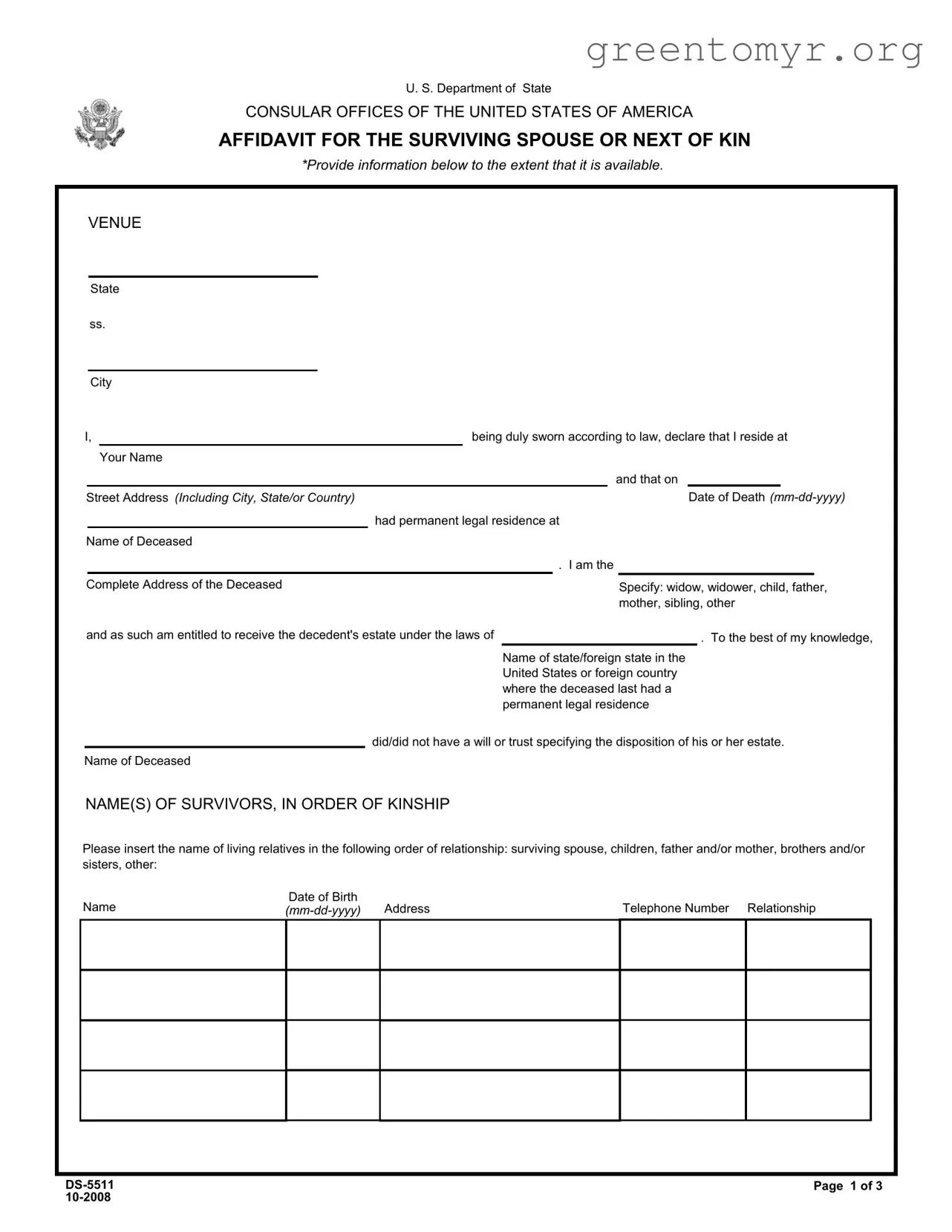
When a loved one passes away, navigating the aftermath can be overwhelming, especially if the death occurs abroad. One essential document that can help streamline this process is the Next Of Kin form. This form serves as a formal declaration of your relationship to the deceased and your eligibility to manage their estate. It requires you to provide basic information, including your name, address, and the deceased's details, such as their permanent legal residence and date of death. The form also asks for a list of surviving relatives in order of kinship, which helps establish the chain of inheritance. Additionally, it addresses whether the deceased left a will or trust, which can significantly affect how their estate is handled. Completing this affidavit is crucial, as it enables U.S. Consular Officers to fulfill their responsibilities regarding the personal effects of American citizens who die abroad. While providing this information is voluntary, failing to do so may complicate your ability to claim the deceased's estate. Understanding the importance of the Next Of Kin form can ease the burden during a difficult time.
U. S. Department of State
CONSULAR OFFICES OF THE UNITED STATES OF AMERICA
AFFIDAVIT FOR THE SURVIVING SPOUSE OR NEXT OF KIN
*Provide information below to the extent that it is available.
VENUE
State
ss.
|
|
City |
|
|
|
|
|
|
|
|
|
|
|
I, |
|
being duly sworn according to law, declare that I reside at |
|||||||||||
|
|
|
Your Name |
|
|
|
|
|
|
|
|
|
|
|
|
|
|
|
|
|
|
and that on |
|
|
|||
Street Address (Including City, State/or Country) |
|
|
|
|
|
|
Date of Death |
||||||
|
|
|
|
had permanent legal residence at |
|||||||||
Name of Deceased |
|
|
|
|
|
|
|
|
|
|
|||
|
|
|
|
|
|
|
. I am the |
|
|
||||
Complete Address of the Deceased |
|
|
|
|
|
Specify: widow, widower, child, father, |
|||||||
|
|
|
|
|
|
|
|
|
mother, sibling, other |
||||
and as such am entitled to receive the decedent's estate under the laws of |
|
|
|
|
|
. To the best of my knowledge, |
|||||||
|
|
|
|
|
|
Name of state/foreign state in the |
|||||||
United States or foreign country where the deceased last had a permanent legal residence
did/did not have a will or trust specifying the disposition of his or her estate.
Name of Deceased
NAME(S) OF SURVIVORS, IN ORDER OF KINSHIP
Please insert the name of living relatives in the following order of relationship: surviving spouse, children, father and/or mother, brothers and/or sisters, other:
Name |
Date of Birth |
Telephone Number Relationship |
Page 1 of 3 |
|
|

Name |
Date of Birth |
Address |
Telephone Number Relationship |
|
|
|
|
|
|
|
|
|
|
|
|
|
|
|
|
|
|
|
|
|
|
|
|
|
|
|
|
|
|
|
|
|
|
|
|
|
|
|
|
|
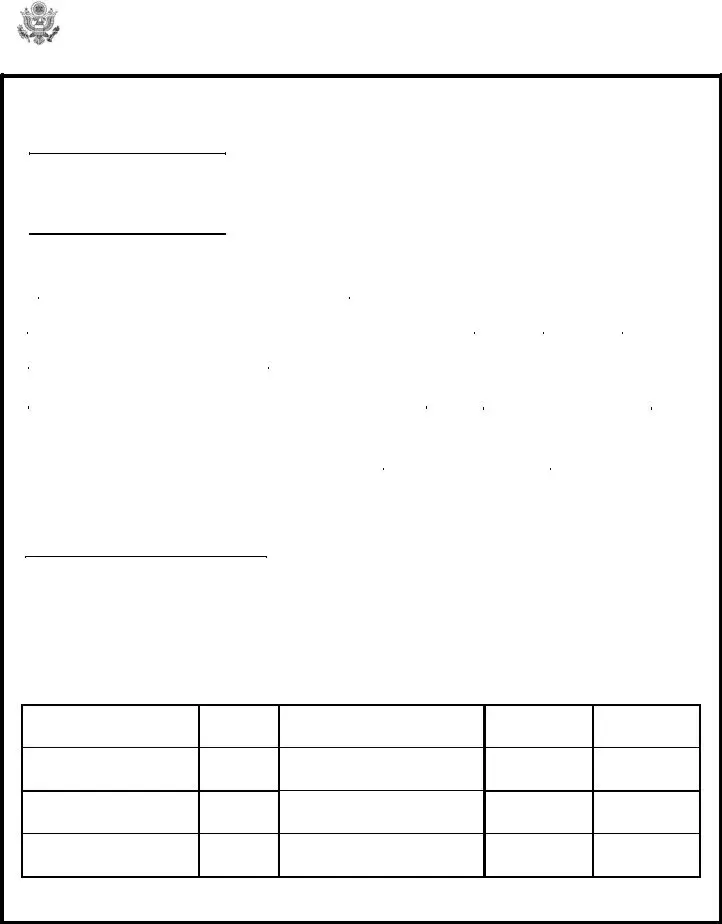
Subscribed and sworn to before me by
|
Signature of Affiant |
|
||||
|
|
|
|
|
|
|
Type Name of Affiant |
|
|
|
Date |
|
|
|
|
|
|
|
|
|
Address of Notary Public |
|
|
|
|
|
|
|
|
|
|
|
|
|
Signature of Notary Public |
|
|
|
Type Name of Notary Public |
|
|
Page 2 of 3 |

PRIVACY ACT STATEMENT
The information on this form is requested to assist U.S. Consular Officers to fulfill the requirements of 22 U.S.C. 2715c and determine the
Providing the information in the affidavit is voluntary, but, failure to complete this form will require the person claiming to be
ROUTINE USES: The information solicited on this form may be made available to federal, state, local, or foreign government entities for administrative or law enforcement purpose, including for the notification of kin or judicial matters involving contested estates and related issues.
Page 3 of 3 |
| Fact Name | Description |
|---|---|
| Purpose | The Next of Kin form helps U.S. Consular Officers identify the closest relatives of an American citizen who dies abroad. |
| Governing Law | This form is governed by 22 U.S.C. 2715c, which outlines the responsibilities of consular officers in such situations. |
| Eligibility | Only individuals who are legally recognized as next of kin, such as spouses or children, can complete this form. |
| Voluntary Information | Providing information on the form is voluntary, but failure to do so may lead to the need for alternative documentation. |
| Privacy Statement | The form includes a privacy statement indicating how the information may be used by government entities. |
| Notary Requirement | The form must be signed in the presence of a notary public to ensure its validity. |
Completing the Next Of Kin form is a straightforward process that requires accurate information regarding the deceased and their surviving relatives. After filling out the form, you will submit it to the appropriate consular office to facilitate the handling of the decedent's estate and personal effects.
The Next Of Kin form is used to identify the closest relatives of an American citizen who has died abroad. It helps U.S. Consular Officers fulfill their responsibilities regarding the deceased's estate and personal effects. This form is crucial when there is no legal representative available to manage the decedent's affairs.
The form should be completed by a person who is considered the next of kin. This can include a surviving spouse, child, parent, or sibling. It is important that the individual filling out the form has a direct relationship with the deceased.
The form requires several pieces of information, including:
If the deceased had a will or trust, this information should be noted on the form. It is essential to clarify whether a legal document exists that specifies how the deceased's estate should be handled. This can affect how the estate is administered.
Failure to complete the Next Of Kin form may lead to complications in managing the deceased's estate. In such cases, the person claiming to be next of kin may need to provide alternative documents, such as certified copies of Letters Testamentary or Letters of Administration, to prove their relationship and authority.
The information provided on the form is subject to privacy protections. However, it may be shared with federal, state, local, or foreign government entities for administrative or law enforcement purposes. This includes situations involving contested estates or notifications to other relatives.
Yes, in exceptional circumstances, a U.S. Consular Officer may serve as the administrator of the estate if there is no legal representative available. This is typically done to ensure that the deceased's personal effects are managed appropriately until a legal representative can be appointed.
The completed form should be submitted to the appropriate U.S. Consular Office. It is advisable to check the specific submission guidelines for the consulate or embassy, as procedures may vary. Ensure that all required information is filled out accurately to avoid delays.
Filling out the Next of Kin form is a crucial step in managing the affairs of a deceased loved one. However, many people make common mistakes that can lead to delays or complications. Understanding these pitfalls can help ensure that the process goes smoothly.
One frequent error is incomplete information. When individuals skip filling out required sections, it can create confusion and lead to unnecessary delays. Each field is designed to gather essential details about both the deceased and the next of kin. Omitting even a small piece of information can complicate the verification process.
Another mistake involves incorrect relationships. People sometimes misidentify their relationship to the deceased, which can create legal challenges. For instance, listing a distant relative instead of an immediate family member may result in complications when it comes to estate distribution. It’s important to carefully consider and accurately represent the relationship to avoid any disputes.
Many also fail to include current contact information. Providing an outdated phone number or address can hinder communication with consular officers. This can lead to delays in processing the estate or other critical matters. Always double-check that your contact details are current and accurate.
Another common oversight is not including the date of death. This date is vital for establishing legal timelines and determining the applicable laws regarding the estate. Without it, the form may be deemed incomplete, causing further delays in the process.
Some individuals neglect to mention whether the deceased had a will or trust. This information is crucial for the consular officer to understand how to proceed with the estate. If there is a will, it may dictate how assets should be handled, and failing to disclose this can lead to complications.
Additionally, many people forget to sign the form. A signature is essential for validating the affidavit. Without it, the form cannot be processed, and the entire effort may need to be restarted, wasting valuable time during a difficult period.
Another mistake is using inconsistent names. If the deceased’s name is listed differently in various documents, it can raise questions about identity. Always ensure that the name matches official records to avoid confusion.
Lastly, individuals sometimes ignore the privacy statement. Understanding how the information will be used is important. Not being aware of the implications can lead to concerns about privacy and data security. Familiarizing oneself with this statement can help alleviate any worries.
By being aware of these common mistakes, you can navigate the Next of Kin form process with greater ease and confidence. Taking the time to carefully fill out the form can save you and your family from unnecessary stress during an already challenging time.
The Next Of Kin form is an essential document used to establish the relationship between the deceased and their surviving family members. It often accompanies other important documents that help in managing the deceased's estate and ensuring that their wishes are honored. Below are four other forms and documents commonly used alongside the Next Of Kin form.
Understanding these documents can simplify the process of settling an estate after a loved one's passing. Each form plays a unique role in ensuring that the deceased's wishes are respected and that their estate is managed according to legal requirements. Being aware of these documents can help next of kin navigate what can often be a complex and emotional process.
When filling out the Next Of Kin form, it is important to approach the task with care. Below are seven essential tips to guide you in completing this form accurately and effectively.
Following these guidelines will help ensure that your submission is processed smoothly and efficiently. It’s understandable that this can be a difficult time, but taking these steps can make the process a bit easier.
Misconception 1: The Next of Kin form is only for spouses.
This form is applicable to a range of relationships, including children, parents, and siblings. Anyone who qualifies as next of kin can complete it, not just surviving spouses.
Misconception 2: Completing the form guarantees immediate access to the deceased's estate.
While the form is an important step, it does not automatically grant access to the estate. Legal processes must still be followed, and additional documentation may be required.
Misconception 3: The Next of Kin form is not legally binding.
On the contrary, the information provided in this form is sworn under oath. It carries legal weight and can affect the distribution of the deceased’s assets.
Misconception 4: The form can be completed without any supporting documents.
While the form itself can be filled out, it often requires supporting documents, such as proof of relationship or death certificates, to substantiate claims made within it.
Filling out the Next Of Kin form is an important step in managing the affairs of a deceased loved one. Here are key takeaways to consider:
Taking the time to fill out the Next Of Kin form accurately can ease the process of handling the estate and ensure that the wishes of your loved one are respected.