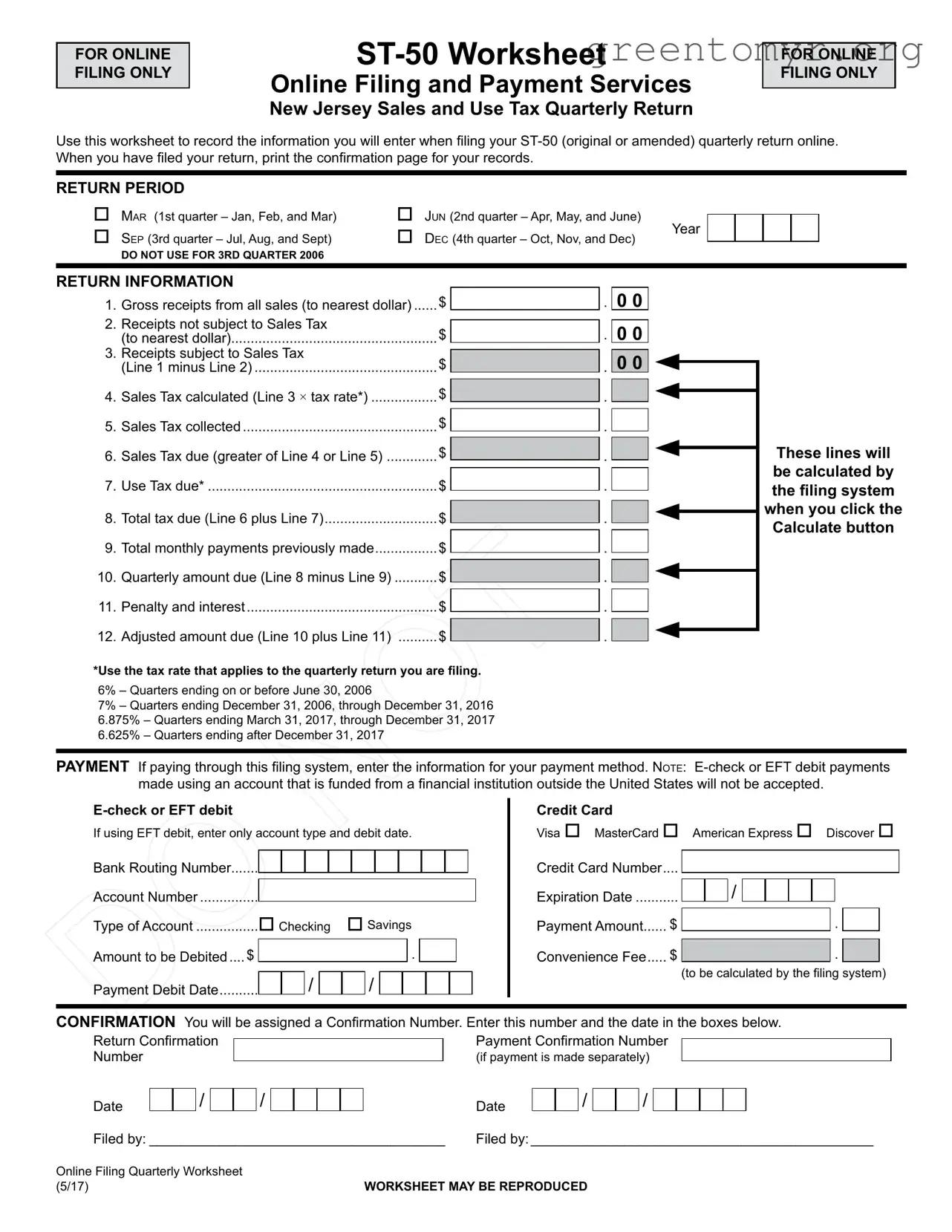
The New Jersey Sales Tax ST-50 form serves as a crucial tool for businesses and individuals who need to report their sales and use tax obligations on a quarterly basis. Designed specifically for online filing, this form simplifies the process of submitting tax returns by allowing users to input their financial data directly into a digital worksheet. The ST-50 form includes various sections that require information such as gross receipts from all sales, receipts exempt from sales tax, and the total sales tax due. Users must also calculate the use tax and account for any previous payments made during the quarter. The form outlines the tax rates applicable to different periods, ensuring that filers apply the correct rate based on the quarter they are reporting. Additionally, it provides fields for payment information, allowing taxpayers to submit their dues electronically, while also emphasizing the importance of retaining confirmation numbers for both the return and payment. Overall, the ST-50 form is designed to streamline the filing process, making it easier for taxpayers to comply with New Jersey's sales tax regulations.
FOR ONLINE FILING ONLY
Online Filing and Payment Services
New Jersey Sales and Use Tax Quarterly Return
FOR ONLINE FILING ONLY
Use this worksheet to record the information you will enter when filing your
RETURN PERIOD
|
Mar (1st quarter – Jan, Feb, and Mar) |
|
Sep (3rd quarter – Jul, Aug, and Sept) |
|
|
|
DO NOT USE FOR 3RD QUARTER 2006 |
|
Jun (2nd quarter – Apr, May, and June) |
Year |
|
Dec (4th quarter – Oct, Nov, and Dec) |
||
|
RETURN INFORMATION
1. |
Gross receipts from all sales (to nearest dollar) |
$ |
2. |
Receipts not subject to Sales Tax |
$ |
|
(to nearest dollar) |
|
3. |
Receipts subject to Sales Tax |
$ |
|
(Line 1 minus Line 2) |
|
4. |
Sales Tax calculated (Line 3 × tax rate*) |
$ |
5. |
Sales Tax collected |
$ |
6. |
Sales Tax due (greater of Line 4 or Line 5) |
$ |
7. |
Use Tax due* |
$ |
8. |
Total tax due (Line 6 plus Line 7) |
$ |
9. |
Total monthly payments previously made |
$ |
10. |
Quarterly amount due (Line 8 minus Line 9) |
$ |
11. |
Penalty and interest |
$ |
12. |
Adjusted amount due (Line 10 plus Line 11) |
$ |
. 0 0
. 0 0
. 0 0
.
.
.
.
.
.
.
.
.
These lines will be calculated by the filing system when you click the Calculate button
*Use the tax rate that applies to the quarterly return you are filing.
6% – Quarters ending on or before June 30, 2006
7% – Quarters ending December 31, 2006, through December 31, 2016 6.875% – Quarters ending March 31, 2017, through December 31, 2017 6.625% – Quarters ending after December 31, 2017
PAYMENT If paying through this filing system, enter the information for your payment method. Note:
If using EFT debit, enter only account type and debit date.
Bank Routing Number.......
Account Number................
Type of Account |
Checking |
Savings |
||||||||||||
Amount to be Debited..... $ |
|
|
|
|
|
|
|
|
|
|
|
|
|
|
|
|
|
|
|
|
|
|
|
. |
|
|
|
|
|
Payment Debit Date |
|
/ |
|
|
/ |
|
|
|
|
|
|
|
||
|
|
|
|
|
|
|
|
|
|
|||||
|
|
|
|
|
|
|
|
|
|
|
|
|
|
|
Credit Card
Visa MasterCard American Express Discover
Credit Card Number.... |
|
|
|
|
|
|
|
|
|
|
|
|
|
/ |
|
|
|
|
|
|
|
|
|
Expiration Date |
|
|
|
|
|
|
|
|
|
|
|
Payment Amount...... $ |
|
|
|
|
|||||||
|
. |
|
|
||||||||
Convenience Fee..... $ |
|
|
|
||||||||
|
|
|
|
|
|
|
. |
|
|
||
|
(to be calculated by the filing system) |
||||||||||
CONFIRMATION You will be assigned a Confirmation Number. Enter this number and the date in the boxes below.
Return Confirmation Number
Date/
/
Payment Confirmation Number
(if payment is made separately)
Date |
|
|
/ |
|
|
/ |
Filed by:_______________________________________ Filed by:_____________________________________________
Online Filing Quarterly Worksheet |
WORKSHEET MAY BE REPRODUCED |
(5/17) |
| Fact Name | Description |
|---|---|
| Purpose | The NJ Sales Tax ST-50 form is used for filing the quarterly sales and use tax return online. |
| Eligibility | This form is exclusively for online filing and should not be used for paper submissions. |
| Return Periods | It covers four quarters: January-March, April-June, July-September, and October-December. |
| Tax Rates | Different tax rates apply depending on the quarter, ranging from 6% to 6.875% based on the filing period. |
| Payment Methods | Payments can be made via e-check, EFT debit, or credit card, but international bank accounts are not accepted. |
| Confirmation | After filing, a confirmation number is assigned, which must be recorded for future reference. |
| Governing Law | The use of the ST-50 form is governed by the New Jersey Sales and Use Tax Act (N.J.S.A. 54:32B). |
Completing the NJ Sales Tax ST-50 form involves several straightforward steps. This form is essential for reporting sales and use tax for a specific quarter. After filling out the form, you will be able to submit it online and receive a confirmation for your records.
After completing these steps, you can proceed to the payment section. Here, you will enter your payment method details, whether it be an e-check, EFT debit, or credit card. Ensure that you have all necessary information ready for a smooth submission process.
The NJ Sales Tax ST-50 form is a quarterly return used to report sales and use tax in New Jersey. It is specifically designed for online filing and allows businesses to calculate their tax obligations based on their gross receipts and applicable tax rates.
Any business that sells taxable goods or services in New Jersey must file the ST-50 form. This includes retailers, wholesalers, and any entity that collects sales tax from customers. If your business has sales tax obligations, you are required to file this form quarterly.
To complete the ST-50 form, follow these steps:
The tax rate varies depending on the quarter you are filing for:
You can pay using an e-check, EFT debit, or credit card. Note that e-checks or EFT debits must be funded from a U.S. financial institution. If using a credit card, you can choose from Visa, MasterCard, American Express, or Discover.
After filing, make sure to print the confirmation page for your records. This page will include a confirmation number that you should keep for future reference. If you made a payment, also retain the payment confirmation number.
If you miss the filing deadline, you may incur penalties and interest on the amount due. It is crucial to file your ST-50 form on time to avoid additional charges. Check the New Jersey Division of Taxation website for specific details on penalties.
Yes, you can amend your ST-50 form if you discover an error after submission. Use the same online filing system to submit an amended return. Make sure to indicate that it is an amended return to ensure proper processing.
When filling out the New Jersey Sales Tax ST-50 form, individuals often encounter several common pitfalls that can lead to errors or complications. One of the most frequent mistakes is failing to select the correct return period. Each quarter has specific months associated with it, and choosing the wrong period can result in inaccurate calculations and potential penalties.
Another common error involves miscalculating gross receipts. It is crucial to report the total gross receipts accurately, as this figure serves as the foundation for determining sales tax liability. Some filers may overlook certain sales or misclassify transactions, which can lead to discrepancies in the reported amounts.
Additionally, individuals sometimes forget to account for receipts not subject to sales tax. This line is essential for calculating the taxable amount correctly. Neglecting to subtract these receipts from the gross total can inflate the sales tax due, leading to overpayment and unnecessary complications.
Many people also struggle with the sales tax calculation itself. The tax rate varies depending on the quarter being filed. Using the wrong rate can result in underpayment or overpayment of taxes, which may attract interest and penalties from the state. It’s important to double-check the applicable rate for the specific quarter.
Another mistake involves the total monthly payments previously made. Some filers may forget to include these payments when calculating the quarterly amount due. This oversight can lead to an inflated tax bill, causing confusion and potential issues with the tax authority.
Lastly, failing to keep a record of the confirmation number after filing can create problems down the line. This number serves as proof of submission and can be crucial if any disputes arise regarding the filed return. Always ensure that this information is noted and stored securely.
The New Jersey Sales Tax ST-50 form is a critical document for businesses reporting their sales tax obligations. Along with this form, several other documents are often required to ensure compliance with state tax regulations. Below is a list of these forms and documents, each serving a specific purpose in the sales tax process.
Understanding these documents and their purposes can help businesses navigate the complexities of sales tax compliance in New Jersey. Keeping accurate records and utilizing the correct forms will ensure a smoother filing process and reduce the risk of errors or penalties.
The New Jersey Sales Tax ST-50 form is essential for businesses to report their sales tax obligations. Several other documents share similarities with the ST-50 form, each serving specific purposes in tax reporting and compliance. Here’s a list of nine documents that are comparable to the ST-50 form:
Each of these documents serves a unique purpose, but they all share the common goal of ensuring accurate tax reporting and compliance. Understanding their similarities can help streamline the process of managing tax obligations.
When filling out the New Jersey Sales Tax ST-50 form, there are several important dos and don'ts to keep in mind. Following these guidelines can help ensure a smooth filing process.
By adhering to these guidelines, you can help ensure that your ST-50 form is completed correctly and submitted without issues.
Understanding the New Jersey Sales Tax ST-50 form can be challenging. Here are ten common misconceptions that people often have about this form:
By clarifying these misconceptions, individuals and businesses can better navigate the requirements of the ST-50 form and ensure compliance with New Jersey sales tax regulations.
When filling out the New Jersey Sales Tax ST-50 form, keep the following key takeaways in mind: