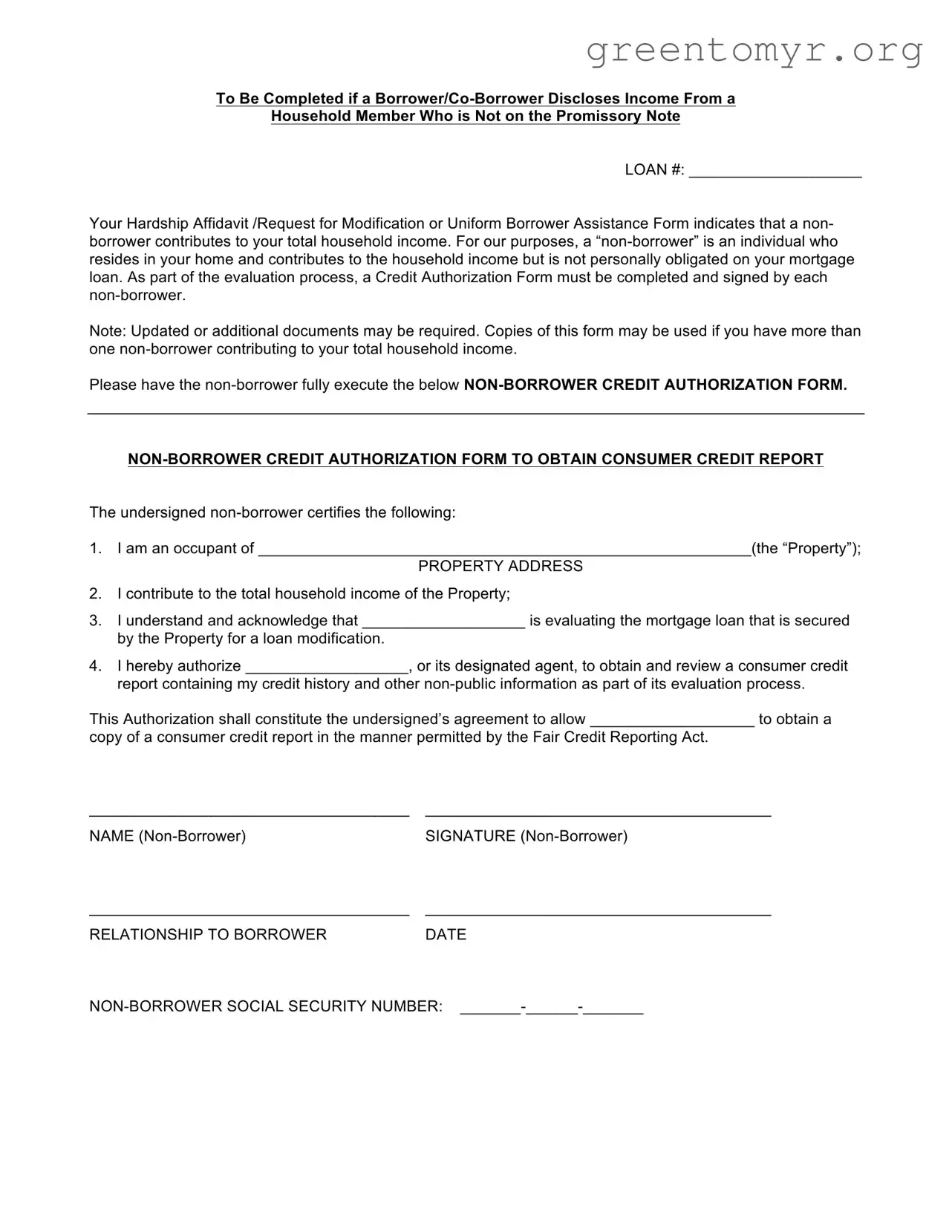
The Non Borrower Credit Authorization form plays a crucial role in the mortgage modification process for households where not all income contributors are listed on the loan agreement. When a borrower or co-borrower discloses income from a household member who is not on the promissory note, this form must be completed to facilitate the evaluation of the mortgage loan. A non-borrower is defined as someone who lives in the home and contributes to the overall household income but is not legally responsible for the mortgage. Each non-borrower must sign the form, which includes their consent to allow the lender to access their credit report. This step is essential for the lender to assess the financial situation accurately. The form also emphasizes that additional documentation may be necessary, especially if there are multiple non-borrowers contributing to the household income. By signing the Non Borrower Credit Authorization form, the non-borrower acknowledges their role in the household's financial landscape and grants permission for a thorough review of their credit history, ensuring a comprehensive evaluation of the loan modification request.

To Be Completed if a
Household Member Who is Not on the Promissory Note
LOAN #: ____________________
Your Hardship Affidavit /Request for Modification or Uniform Borrower Assistance Form indicates that a non- borrower contributes to your total household income. For our purposes, a
Note: Updated or additional documents may be required. Copies of this form may be used if you have more than one
Please have the
The undersigned
1.I am an occupant of _________________________________________________________(the “Property”);
PROPERTY ADDRESS
2.I contribute to the total household income of the Property;
3.I understand and acknowledge that ___________________ is evaluating the mortgage loan that is secured by the Property for a loan modification.
4.I hereby authorize ___________________, or its designated agent, to obtain and review a consumer credit report containing my credit history and other
This Authorization shall constitute the undersigned’s agreement to allow ___________________ to obtain a
copy of a consumer credit report in the manner permitted by the Fair Credit Reporting Act.
_____________________________________ |
________________________________________ |
NAME |
SIGNATURE |
_____________________________________ |
________________________________________ |
RELATIONSHIP TO BORROWER |
DATE |
| Fact Name | Description |
|---|---|
| Purpose | The Non Borrower Credit Authorization form is used to authorize the evaluation of a non-borrower’s credit history when they contribute to a household’s income. |
| Who Should Complete It | This form must be completed by any household member who is not listed on the mortgage but contributes financially. |
| Legal Compliance | This form complies with the Fair Credit Reporting Act, ensuring that non-borrowers' credit information is obtained legally. |
| State-Specific Laws | For states like California, the form is governed by the California Civil Code §1785, which regulates consumer credit reporting. |
Completing the Non Borrower Credit Authorization form is an important step when a non-borrower contributes to the household income. This form allows the lender to obtain a credit report for the non-borrower, which is necessary for evaluating the mortgage loan modification. Follow the steps below to fill out the form accurately.
The Non Borrower Credit Authorization form is used to gather information about individuals who live in your home and contribute to your household income but are not listed on the mortgage. This form allows the lender to obtain a credit report for these non-borrowers, which is necessary for evaluating your mortgage loan modification request.
Any non-borrower who contributes to your household income must complete this form. If multiple non-borrowers reside in your home and contribute financially, each one will need to fill out a separate form. This ensures that the lender has a complete understanding of your household's financial situation.
The form requires the following information:
Additionally, the non-borrower must provide their name, signature, relationship to the borrower, and social security number.
Once the Non Borrower Credit Authorization form is completed and submitted, the lender will use the information to assess the financial situation of the household. They will obtain the non-borrower's credit report as part of the evaluation process. Be aware that additional documents may be requested during this time.
While specific deadlines may vary based on the lender's policies, it is important to submit the form as soon as possible. Timely submission can help expedite the evaluation of your mortgage loan modification request. Check with your lender for any specific timelines they may have in place.
Filling out the Non Borrower Credit Authorization form is a crucial step in the loan modification process, yet many individuals make common mistakes that can hinder their applications. One frequent error occurs when the property address is not clearly written. It is essential to provide the complete and accurate address of the property in question. Omitting or miswriting even a single character can lead to confusion and delays in processing the application.
Another mistake involves the failure to fully complete the section regarding the non-borrower’s relationship to the borrower. This part of the form helps the lender understand the context of the financial arrangement. Leaving this section blank or providing vague descriptions can raise questions about the legitimacy of the income contribution. Clear and precise information is vital for a thorough evaluation.
Many individuals also overlook the importance of the signature. The form requires the non-borrower to sign it, indicating their consent to the credit report review. If the signature is missing or not dated, the form may be considered incomplete, leading to further complications. Ensuring that all required signatures are present is a simple yet critical step.
Additionally, some non-borrowers fail to provide their Social Security number. This information is necessary for the lender to obtain a credit report. Not including this detail can result in the inability to process the authorization effectively. It is advisable to double-check that this sensitive information is accurately filled out to avoid any unnecessary delays.
Another common oversight is the misunderstanding of the authorization's purpose. Some non-borrowers may not fully grasp that they are allowing the lender to access their credit history. This lack of understanding can lead to hesitation or refusal to sign the form. It is important for non-borrowers to recognize that this step is standard practice in the evaluation process and is intended to facilitate a fair assessment.
Lastly, individuals sometimes neglect to keep a copy of the completed form for their records. Retaining a copy can be beneficial for future reference or in case any issues arise during the processing of the application. It is always wise to have documentation on hand to clarify any discrepancies that may occur later in the process.
When dealing with mortgage modifications and household income evaluations, several forms and documents work alongside the Non Borrower Credit Authorization form. Each of these documents plays a crucial role in the overall process, ensuring that all necessary information is collected and assessed. Here’s a look at some of the key forms you might encounter:
Understanding these documents is essential for anyone involved in the loan modification process. Each form serves a specific purpose, ensuring that lenders have a comprehensive view of the borrower's financial situation and the contributions of non-borrowers. This collective information aids in making informed decisions regarding loan modifications.
The Non Borrower Credit Authorization form is similar to several other documents that serve to gather necessary information for financial evaluations. Here are seven documents that share similarities:
When filling out the Non Borrower Credit Authorization form, it is important to follow specific guidelines to ensure accuracy and compliance. Here are ten things you should and shouldn't do:
Understanding the Non Borrower Credit Authorization form is crucial for anyone navigating the mortgage modification process. However, several misconceptions often arise. Here are five common misunderstandings:
This is not accurate. The form is specifically designed for non-borrowers—individuals who live in the home and contribute to the household income but are not responsible for the mortgage. Their financial information is necessary for evaluating the loan modification.
This is incorrect. If there are multiple non-borrowers contributing to the household income, each one must complete and sign their own form. This ensures that all relevant financial information is taken into account.
In reality, the authorization is limited. It allows the lender to obtain a consumer credit report specifically for evaluating the mortgage loan. The process adheres to the Fair Credit Reporting Act, which protects consumer privacy.
This is misleading. While the form is a necessary step in the evaluation process, it does not guarantee that the loan modification will be approved. The lender will consider various factors, including the overall financial situation of the borrower and non-borrowers.
This is false. Non-borrowers must provide their name, relationship to the borrower, and Social Security number on the form. This information is essential for the lender to assess the contribution of the non-borrower to the household income.
Filling out the Non-Borrower Credit Authorization form is a crucial step for households seeking loan modifications when non-borrowers contribute to the total household income. Here are some key takeaways to consider:
By keeping these points in mind, you can navigate the process more effectively and ensure that all necessary steps are taken for a successful loan modification evaluation.