In North Carolina, an ATV Bill of Sale form serves as a crucial document for anyone buying or selling an all-terrain vehicle. This form captures essential details about the transaction, including the names and addresses of both the buyer and seller, the vehicle's identification number (VIN), and a description of the ATV, such as its make, model, and year. The bill of sale not only provides proof of ownership but also outlines the sale price and any terms agreed upon by both parties. Completing this form is important for ensuring a smooth transfer of ownership and for future reference, especially when registering the ATV with the state. By documenting the sale, both the buyer and seller protect their interests and create a clear record of the transaction, which can be beneficial in case of disputes or legal issues down the line.
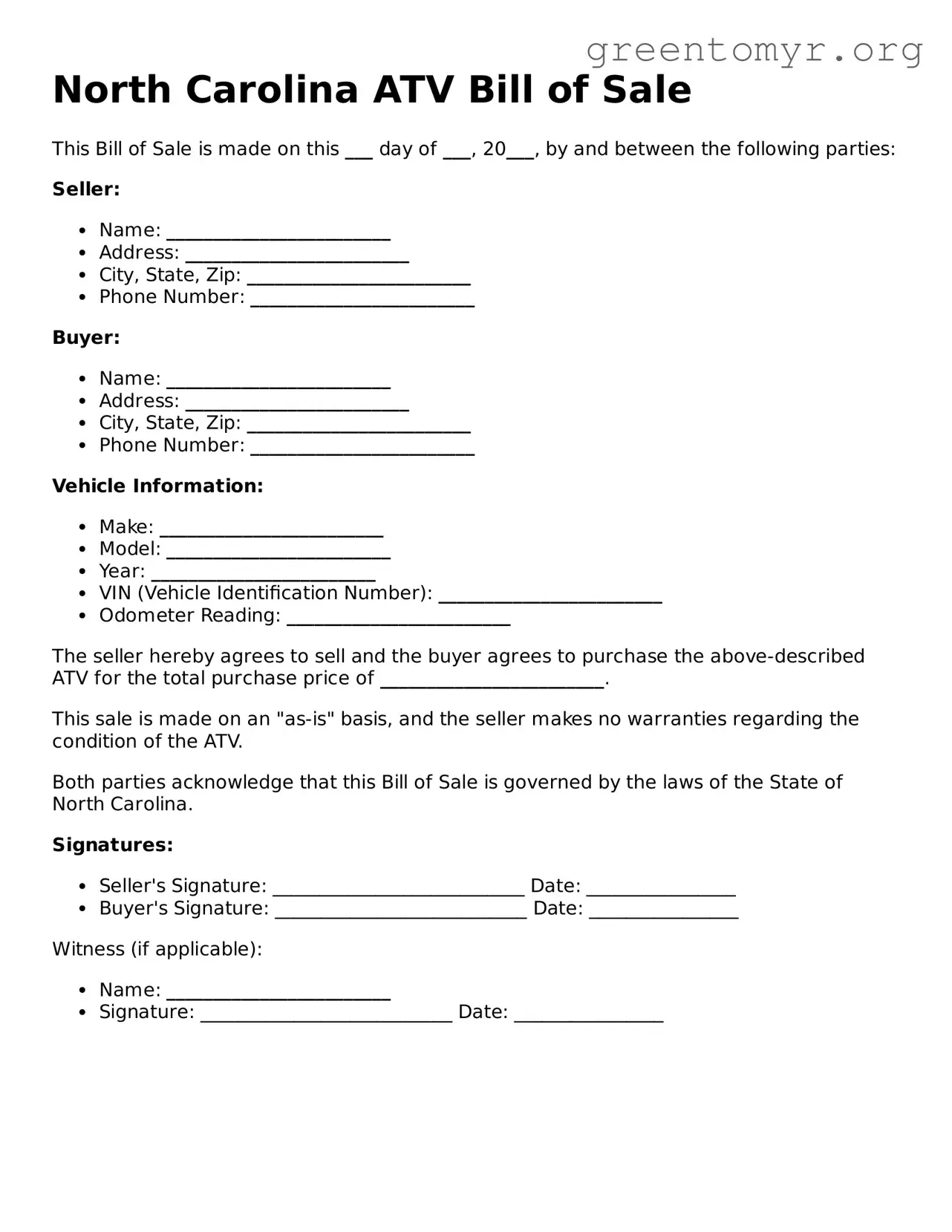
North Carolina ATV Bill of Sale
This Bill of Sale is made on this ___ day of ___, 20___, by and between the following parties:
Seller:
Buyer:
Vehicle Information:
The seller hereby agrees to sell and the buyer agrees to purchase the above-described ATV for the total purchase price of ________________________.
This sale is made on an "as-is" basis, and the seller makes no warranties regarding the condition of the ATV.
Both parties acknowledge that this Bill of Sale is governed by the laws of the State of North Carolina.
Signatures:
Witness (if applicable):
| Fact Name | Description |
|---|---|
| Purpose | The North Carolina ATV Bill of Sale form is used to document the sale and transfer of ownership of an all-terrain vehicle (ATV). |
| Governing Law | This form is governed by North Carolina General Statutes, specifically Chapter 20, which covers motor vehicles. |
| Required Information | The form typically requires details such as the seller's and buyer's names, addresses, ATV description, and sale price. |
| Signatures | Both the seller and buyer must sign the form to validate the transaction and transfer of ownership. |
| Record Keeping | It is advisable for both parties to keep a copy of the completed Bill of Sale for their records. |
Completing the North Carolina ATV Bill of Sale form is a straightforward process that ensures both the buyer and seller have a clear record of the transaction. Once you fill out the form, both parties should keep a copy for their records, as it serves as proof of the sale.
A North Carolina ATV Bill of Sale is a legal document that records the sale and transfer of ownership of an all-terrain vehicle (ATV) from one party to another. This form serves as proof of the transaction and includes important details about the ATV, the buyer, and the seller.
Having an ATV Bill of Sale is essential for several reasons:
Your ATV Bill of Sale should contain the following information:
No, a notary is not required for an ATV Bill of Sale in North Carolina. However, having the document notarized can add an extra layer of authenticity and may be beneficial if any disputes arise later on.
Yes, you can create your own ATV Bill of Sale. Just make sure to include all the necessary information mentioned earlier. Alternatively, you can find templates online that can guide you through the process.
If you lose your ATV Bill of Sale, you can create a new one. It’s advisable to keep a copy of the original for your records. If you need to prove ownership, you may also want to contact the seller for a duplicate.
Yes, after purchasing an ATV, you will need to register it with the North Carolina DMV. The Bill of Sale will be required for this process, so keep it handy.
While there is no specific format mandated by North Carolina law, the document should be clear and include all necessary details. As long as it contains the required information, it can be formatted in a way that is easy to read and understand.
The ATV Bill of Sale is specifically designed for all-terrain vehicles. While you can adapt the form for other vehicle types, it’s best to use a Bill of Sale tailored to the specific vehicle you are buying or selling, such as a motorcycle or car.
If the seller hasn’t signed the Bill of Sale, the sale is not legally binding. Make sure to obtain their signature before finalizing the transaction. If the seller is unavailable, you may need to wait until they can sign or consider other options.
When completing the North Carolina ATV Bill of Sale form, individuals often overlook important details that can lead to complications down the line. One common mistake is failing to provide accurate personal information. The names, addresses, and contact details of both the buyer and seller must be correct. Any discrepancies can create confusion and may even affect the transfer of ownership.
Another frequent error involves neglecting to include the Vehicle Identification Number (VIN). This unique number is essential for identifying the ATV and ensuring that the transaction is legitimate. Without the VIN, it becomes challenging to verify the vehicle's history or ownership, potentially leading to legal issues later.
People also sometimes forget to document the sale price. This amount should reflect the agreed-upon price between the buyer and seller. Omitting this detail can result in problems with taxation and registration, as the state may require proof of the sale price for tax purposes.
Additionally, some individuals do not sign the form. Both parties must provide their signatures to validate the transaction. A missing signature can render the Bill of Sale ineffective, leaving both parties vulnerable to disputes regarding ownership.
Another mistake is using outdated or incorrect forms. It is crucial to ensure that the latest version of the ATV Bill of Sale form is being used. Using an obsolete form may lead to complications with the registration process, as the Department of Motor Vehicles may not accept it.
People often overlook the need for witnesses or notarization. While not always required, having a witness or notarizing the document can provide additional legal protection. This step can help verify that both parties willingly entered into the agreement.
Failing to keep a copy of the completed Bill of Sale is another oversight. Both the buyer and seller should retain copies for their records. This documentation can be invaluable if any disputes arise in the future regarding the sale.
Some individuals may also forget to check for any liens on the ATV. It is essential to ensure that the vehicle is free of any financial obligations before completing the sale. A lien can complicate ownership transfer and may result in unexpected financial burdens for the buyer.
Lastly, not understanding the local laws regarding ATV sales can lead to missteps. Each state has its regulations, and North Carolina is no exception. Familiarizing oneself with these laws can prevent potential issues and ensure a smooth transaction.
When purchasing or selling an ATV in North Carolina, several additional forms and documents may be necessary to ensure a smooth transaction. These documents help establish ownership, verify the vehicle's condition, and comply with state regulations. Below is a list of commonly used forms that accompany the ATV Bill of Sale.
Having these documents prepared can facilitate a seamless transaction and provide peace of mind for both parties involved. It is essential to ensure that all paperwork is completed accurately and retained for future reference.
When filling out the North Carolina ATV Bill of Sale form, it is important to ensure accuracy and compliance with the state’s regulations. Here are some essential dos and don’ts to guide you through the process.
Following these guidelines will help ensure a smooth transaction and protect both parties involved in the sale of the ATV.
There are several misconceptions surrounding the North Carolina ATV Bill of Sale form. Understanding these can help ensure a smooth transaction when buying or selling an ATV.
Filling out and using the North Carolina ATV Bill of Sale form is an important step when buying or selling an all-terrain vehicle. Here are some key takeaways to keep in mind:
By following these guidelines, you can ensure a smooth transaction and protect your interests in the sale or purchase of an ATV in North Carolina.