Content Navigation

When engaging in the buying or selling of personal property in North Carolina, having a Bill of Sale form is essential for both parties involved. This document serves as a written record of the transaction, providing crucial details that protect the interests of both the buyer and the seller. Typically, the form includes information such as the names and addresses of both parties, a detailed description of the item being sold, and the sale price. Additionally, it may outline any warranties or guarantees associated with the item, ensuring clarity and transparency. By documenting the date of the transaction and any pertinent terms, the Bill of Sale helps to establish a clear understanding of the agreement, reducing the potential for disputes down the line. Whether you’re selling a vehicle, a piece of furniture, or any other personal property, utilizing this form can streamline the process and offer peace of mind for everyone involved.

North Carolina Bill of Sale Example

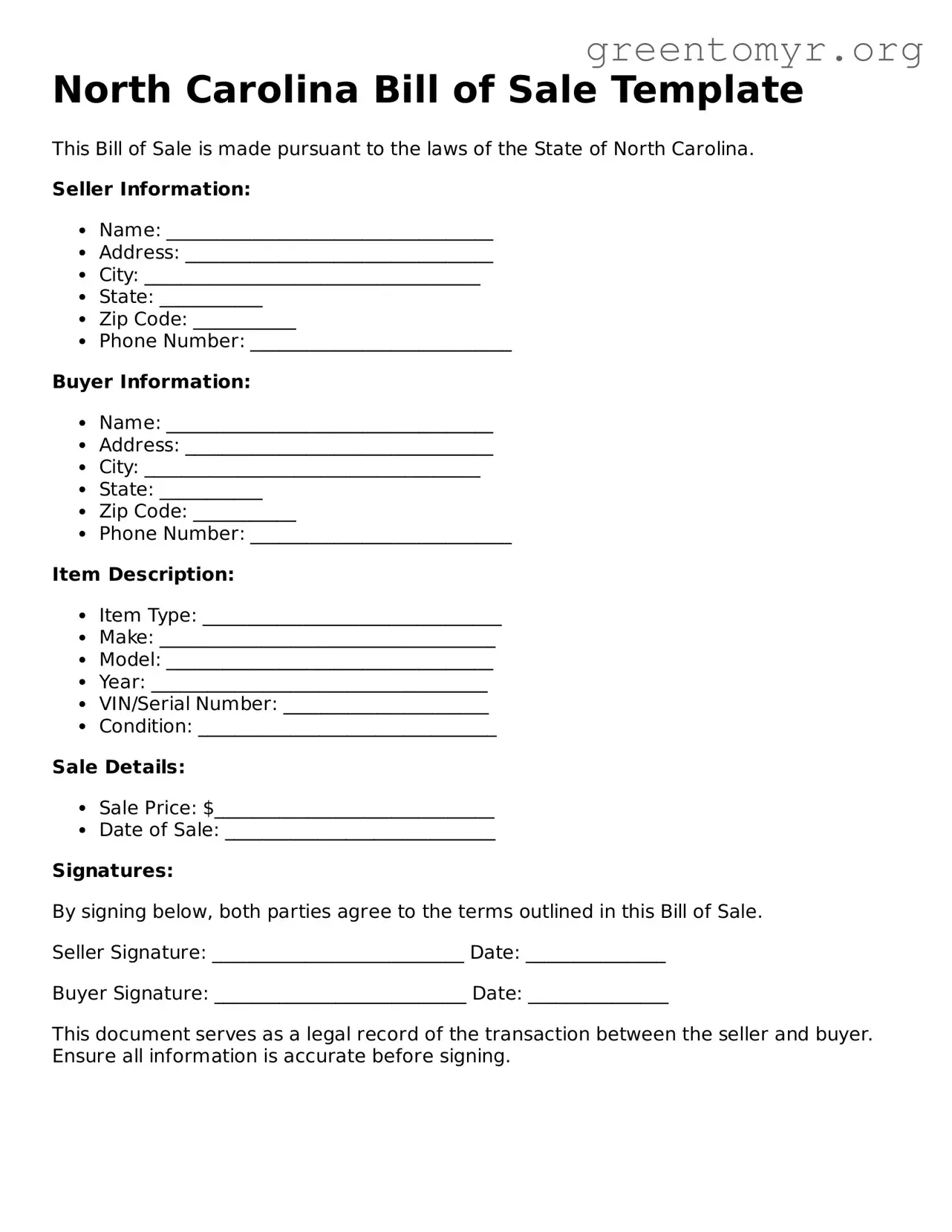
North Carolina Bill of Sale Template

This Bill of Sale is made pursuant to the laws of the State of North Carolina.

Seller Information:

  • Name: ___________________________________
  • Address: _________________________________
  • City: ____________________________________
  • State: ___________
  • Zip Code: ___________
  • Phone Number: ____________________________

Buyer Information:

  • Name: ___________________________________
  • Address: _________________________________
  • City: ____________________________________
  • State: ___________
  • Zip Code: ___________
  • Phone Number: ____________________________

Item Description:

  • Item Type: ________________________________
  • Make: ____________________________________
  • Model: ___________________________________
  • Year: ____________________________________
  • VIN/Serial Number: ______________________
  • Condition: ________________________________

Sale Details:

  • Sale Price: $______________________________
  • Date of Sale: _____________________________

Signatures:

By signing below, both parties agree to the terms outlined in this Bill of Sale.

Seller Signature: ___________________________ Date: _______________

Buyer Signature: ___________________________ Date: _______________

This document serves as a legal record of the transaction between the seller and buyer. Ensure all information is accurate before signing.

PDF Form Features

Fact Name Description
Purpose A Bill of Sale in North Carolina serves as a legal document that transfers ownership of personal property from one person to another.
Governing Law The Bill of Sale is governed by North Carolina General Statutes, particularly Chapter 25A, which outlines the rules for sales and transfers.
Required Information The form typically includes details like the names of the buyer and seller, a description of the item being sold, and the sale price.
Notarization While notarization is not required for all Bill of Sale forms, having it notarized can provide additional legal protection.
Use Cases This form is commonly used for vehicles, boats, and other personal property transactions, ensuring clarity in ownership transfer.

Guide to Using North Carolina Bill of Sale

After you have gathered all necessary information, you are ready to fill out the North Carolina Bill of Sale form. This document will need to be completed accurately to ensure a smooth transaction.

  1. Begin by entering the date of the sale at the top of the form.
  2. Provide the full names and addresses of both the buyer and the seller.
  3. Clearly describe the item being sold. Include details such as make, model, year, and any identification numbers, like a VIN for vehicles.
  4. State the purchase price of the item in both words and numbers.
  5. Include any warranties or guarantees, if applicable, and specify if the item is sold "as-is."
  6. Both the buyer and seller should sign and date the form at the designated areas.
  7. Make copies of the completed Bill of Sale for both parties' records.

Get Answers on North Carolina Bill of Sale

What is a Bill of Sale in North Carolina?

A Bill of Sale is a legal document that serves as proof of the transfer of ownership of personal property from one individual to another. In North Carolina, this document is often used for the sale of items such as vehicles, boats, and other personal belongings. It outlines the details of the transaction, including the names of the buyer and seller, a description of the item being sold, and the sale price. This document helps protect both parties by providing a record of the sale and ensuring that the transaction is clear and legally binding.

What information is typically included in a North Carolina Bill of Sale?

A North Carolina Bill of Sale generally includes several key pieces of information to ensure clarity and legality. This information typically encompasses:

  • The full names and addresses of both the buyer and seller.
  • A detailed description of the item being sold, including make, model, year, and any identifying numbers.
  • The sale price of the item.
  • The date of the transaction.
  • Signatures of both parties, indicating their agreement to the terms of the sale.

Including this information helps prevent misunderstandings and provides a clear record of the transaction.

Is a Bill of Sale required in North Carolina?

While a Bill of Sale is not legally required for all transactions in North Carolina, it is highly recommended. For certain items, such as vehicles, a Bill of Sale may be necessary for registration purposes. Even when not mandated, having a Bill of Sale can be beneficial for both the buyer and seller. It serves as a receipt and can be used as evidence in case of disputes or issues regarding the transaction in the future.

How can I create a Bill of Sale in North Carolina?

Creating a Bill of Sale in North Carolina can be done easily. You can find templates online or draft your own document. To ensure that it meets all necessary requirements, follow these steps:

  1. Gather all relevant information about the transaction, including details of the item and the parties involved.
  2. Use a clear and simple format to write down the information, making sure to include all essential elements.
  3. Review the document for accuracy and completeness.
  4. Both the buyer and seller should sign the document to confirm their agreement.

Having a completed Bill of Sale can provide peace of mind for both parties involved in the transaction.

Common mistakes

Filling out the North Carolina Bill of Sale form requires careful attention to detail. One common mistake people make is failing to include all required information. This includes the names and addresses of both the buyer and the seller, as well as a complete description of the item being sold. Omitting any of these details can lead to confusion or disputes later on.

Another frequent error is not providing the correct date of the transaction. The date is essential for establishing when the sale took place, which can affect ownership and liability issues. If the date is missing or incorrect, it may complicate future transactions or legal matters regarding the item.

Many individuals also overlook the necessity of obtaining signatures from both parties. A Bill of Sale is not legally binding without the signatures of both the buyer and seller. This oversight can render the document ineffective, leaving both parties vulnerable in case of a disagreement.

Lastly, some people fail to make copies of the completed Bill of Sale. Keeping a copy for personal records is crucial. Without a copy, one party may later claim that the sale did not occur or that the terms were different from what was agreed upon. Having documentation helps prevent misunderstandings and provides proof of the transaction.

Documents used along the form

A Bill of Sale is a crucial document for recording the transfer of ownership of personal property. In North Carolina, this form is often used alongside other important documents to ensure a smooth transaction. Below is a list of additional forms and documents that may accompany the North Carolina Bill of Sale.

  • Title Transfer Document: This document is necessary for transferring the title of a vehicle or property from the seller to the buyer. It officially records the change of ownership and is often required by the DMV.
  • Vehicle Registration Application: When purchasing a vehicle, this application must be completed to register the vehicle in the new owner’s name. It typically includes details about the vehicle and the new owner.
  • Odometer Disclosure Statement: This statement is required for vehicle sales to document the mileage at the time of sale. It helps prevent fraud and protects both parties in the transaction.
  • Affidavit of Title: This sworn statement is used when the original title is lost or unavailable. It confirms the seller’s ownership and their right to sell the vehicle or property.
  • Proof of Insurance: Buyers may need to provide proof of insurance coverage for the newly acquired vehicle. This document ensures that the vehicle is insured before it can be legally driven.
  • Purchase Agreement: This contract outlines the terms of the sale, including the price, payment method, and any conditions agreed upon by the buyer and seller. It serves as a formal agreement between both parties.
  • Inspection Report: For vehicles, an inspection report may be provided to show that the vehicle has passed safety and emissions tests. This document can reassure the buyer about the vehicle’s condition.
  • Notarized Signature: In some cases, having the Bill of Sale notarized adds an extra layer of authenticity. It can help verify the identities of the parties involved and the legitimacy of the transaction.

Understanding these additional documents can facilitate a more efficient and secure transaction process. Each form plays a specific role in protecting the interests of both the buyer and the seller, ensuring a clear and legal transfer of ownership.

Similar forms

A Bill of Sale is a crucial document that serves as proof of a transaction between a buyer and a seller. However, several other documents share similarities with a Bill of Sale in terms of their purpose and function. Below are seven documents that are comparable to a Bill of Sale:

  • Purchase Agreement: This document outlines the terms and conditions of a sale, including the price and the items being sold. Like a Bill of Sale, it serves as a record of the transaction.
  • Lease Agreement: While primarily used for renting property, a lease agreement can also include terms about the sale of items. It documents the agreement between the lessor and lessee, similar to how a Bill of Sale records ownership transfer.
  • Title Transfer Document: When transferring ownership of a vehicle, this document is essential. It officially changes the title from the seller to the buyer, much like a Bill of Sale does for various goods.
  • Sales Receipt: This is a proof of purchase that details what was bought, the price, and the transaction date. It functions similarly to a Bill of Sale by confirming the sale took place.
  • Gift Deed: This document is used when property is given as a gift rather than sold. It also serves to transfer ownership, paralleling the function of a Bill of Sale.
  • Warranty Deed: Often used in real estate transactions, a warranty deed guarantees that the seller has clear title to the property. It acts as a formal record of ownership transfer, akin to a Bill of Sale.
  • Contract for Deed: This is a type of seller financing where the buyer makes payments directly to the seller. It outlines the terms of the sale and serves as a record of the agreement, similar to a Bill of Sale.

Each of these documents plays a vital role in confirming transactions and protecting the interests of both parties involved. Understanding their similarities can help in choosing the right document for a specific situation.

Dos and Don'ts

When filling out the North Carolina Bill of Sale form, attention to detail is crucial. Here are some important dos and don'ts to keep in mind:

  • Do ensure that all required fields are filled out completely.
  • Do provide accurate descriptions of the item being sold, including make, model, and VIN if applicable.
  • Do include the date of the transaction to establish a clear timeline.
  • Do have both the buyer and seller sign the document to validate the transaction.
  • Don't leave any fields blank, as this can lead to confusion or disputes later.
  • Don't use abbreviations or slang that might not be understood by all parties involved.
  • Don't forget to make a copy of the completed Bill of Sale for your records.
  • Don't rush through the process; take your time to ensure accuracy.

Misconceptions

When discussing the North Carolina Bill of Sale form, various misconceptions often arise. Understanding these misconceptions can help individuals navigate the legal landscape more effectively. Below are nine common misunderstandings about this important document.

  1. A Bill of Sale is only necessary for large transactions. Many people believe that a Bill of Sale is only required for high-value items, such as vehicles or real estate. In reality, it is advisable to use a Bill of Sale for any significant transaction, regardless of the item's value, to provide proof of the exchange.
  2. Verbal agreements are sufficient. Some individuals think that a simple verbal agreement suffices for the sale of goods. However, without written documentation, disputes may arise, making it difficult to prove the terms of the agreement.
  3. Only the seller needs to sign the Bill of Sale. It is a common belief that only the seller’s signature is required. In fact, both the buyer and the seller should sign the document to confirm their mutual agreement.
  4. The Bill of Sale is not legally binding. Many assume that a Bill of Sale holds no legal weight. On the contrary, it serves as a binding contract that can be enforced in a court of law, provided it meets certain legal criteria.
  5. All Bill of Sale forms are the same. Some people think that any Bill of Sale form can be used for any transaction. However, the specifics of the form may vary depending on the type of item being sold and the laws of the state, making it essential to use the correct version.
  6. A Bill of Sale is only for tangible items. There is a misconception that Bills of Sale apply only to physical goods. However, they can also be used for intangible assets, such as intellectual property or digital products.
  7. Once signed, a Bill of Sale cannot be changed. Some believe that after signing, the document is set in stone. In reality, amendments can be made if both parties agree, but it is advisable to document any changes formally.
  8. A Bill of Sale does not need to be notarized. While notarization is not always required, many people think it is unnecessary. Notarizing a Bill of Sale can add an extra layer of authenticity and may be required for certain transactions.
  9. Using a Bill of Sale is optional. Some individuals feel that using a Bill of Sale is merely a formality. However, it is a crucial tool for protecting both the buyer and seller in any transaction, providing legal recourse if issues arise.

By addressing these misconceptions, individuals can better understand the importance of the North Carolina Bill of Sale form and ensure that their transactions are conducted smoothly and legally.

Key takeaways

When filling out and using the North Carolina Bill of Sale form, there are several important points to keep in mind. This document serves as proof of a transaction between a buyer and a seller, and understanding its components can help ensure a smooth process.

  • Purpose: The Bill of Sale is primarily used to document the sale of personal property, such as vehicles, boats, or equipment.
  • Identification: Both the buyer and seller should provide their full names and contact information to avoid any confusion.
  • Description of the Item: Clearly describe the item being sold, including make, model, year, and any identifying numbers, such as a VIN for vehicles.
  • Sale Price: Specify the amount for which the item is being sold. This ensures both parties agree on the transaction's value.
  • As-Is Condition: Indicate whether the item is sold "as-is," meaning the seller does not guarantee its condition or functionality.
  • Date of Sale: Include the date when the transaction takes place. This is important for record-keeping purposes.
  • Signatures: Both parties must sign the document to make it legally binding. Ensure signatures are dated as well.
  • Witness or Notary: While not always required, having a witness or notarization can add an extra layer of validity to the document.
  • Keep Copies: Both the buyer and seller should retain copies of the Bill of Sale for their records. This can be helpful for future reference or disputes.

By following these key takeaways, individuals can effectively utilize the North Carolina Bill of Sale form to document their transactions with clarity and security.