The North Carolina Deed form serves as a crucial document in real estate transactions, providing a legal means for property owners to transfer ownership rights. This form outlines essential details such as the names of the grantor and grantee, a precise description of the property, and any specific terms associated with the transfer. It also includes vital information regarding the type of deed being executed, whether it be a general warranty deed, special warranty deed, or quitclaim deed. Each type has its own implications for the level of protection offered to the grantee. Additionally, the form requires signatures and may need to be notarized to ensure its validity. Understanding these components is essential for both buyers and sellers, as they navigate the complexities of property ownership in North Carolina. Whether you are a first-time homebuyer or a seasoned investor, grasping the nuances of the Deed form can facilitate a smoother transaction process and help avoid potential disputes in the future.
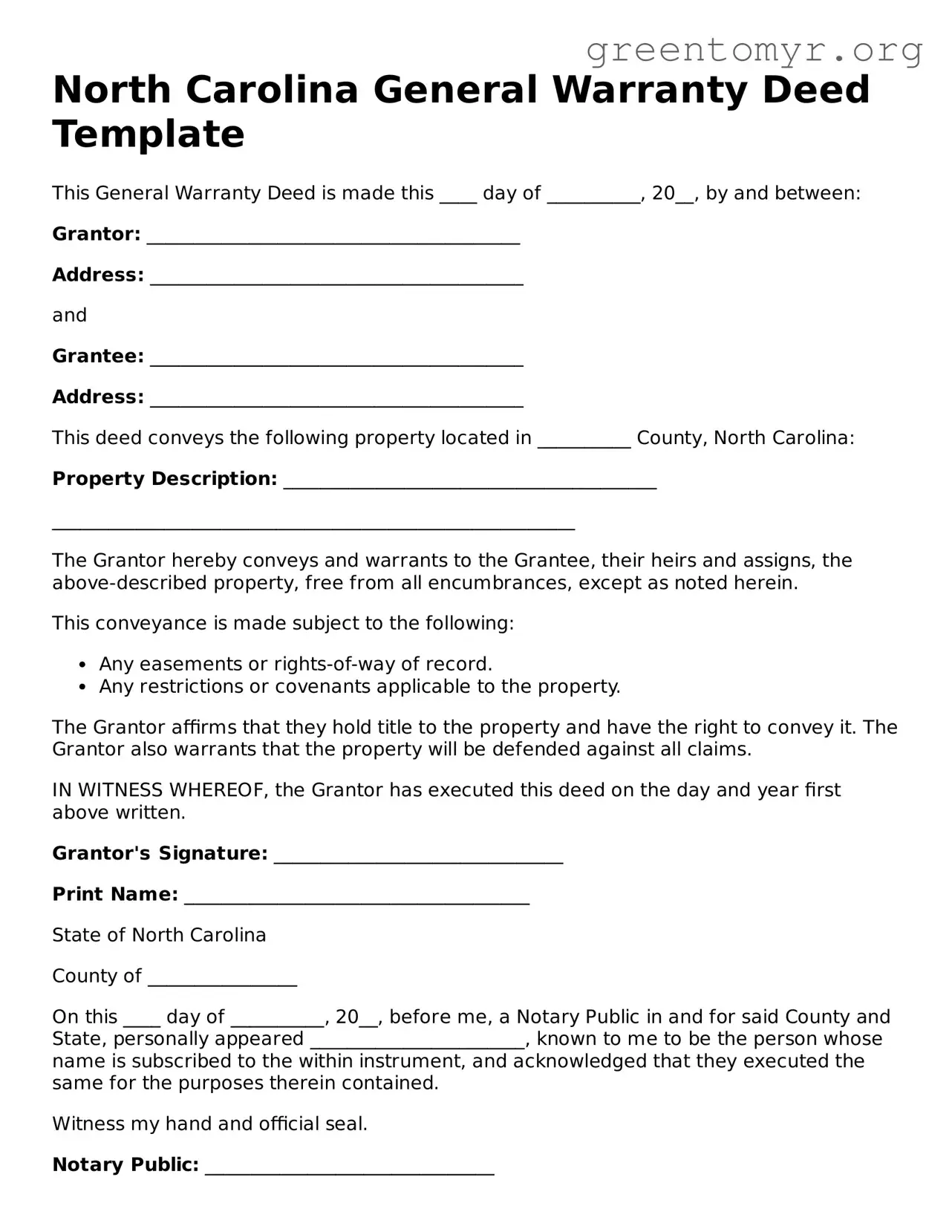
North Carolina General Warranty Deed Template
This General Warranty Deed is made this ____ day of __________, 20__, by and between:
Grantor: ________________________________________
Address: ________________________________________
and
Grantee: ________________________________________
Address: ________________________________________
This deed conveys the following property located in __________ County, North Carolina:
Property Description: ________________________________________
________________________________________________________
The Grantor hereby conveys and warrants to the Grantee, their heirs and assigns, the above-described property, free from all encumbrances, except as noted herein.
This conveyance is made subject to the following:
The Grantor affirms that they hold title to the property and have the right to convey it. The Grantor also warrants that the property will be defended against all claims.
IN WITNESS WHEREOF, the Grantor has executed this deed on the day and year first above written.
Grantor's Signature: _______________________________
Print Name: _____________________________________
State of North Carolina
County of ________________
On this ____ day of __________, 20__, before me, a Notary Public in and for said County and State, personally appeared _______________________, known to me to be the person whose name is subscribed to the within instrument, and acknowledged that they executed the same for the purposes therein contained.
Witness my hand and official seal.
Notary Public: _______________________________
My Commission Expires: ______________________
| Fact Name | Description |
|---|---|
| Governing Law | The North Carolina Deed form is governed by the North Carolina General Statutes, specifically Chapter 47. |
| Types of Deeds | North Carolina recognizes several types of deeds, including warranty deeds, quitclaim deeds, and special purpose deeds. |
| Execution Requirements | The deed must be signed by the grantor (the person transferring the property) and must be notarized to be valid. |
| Recording | To provide public notice of the property transfer, the deed must be recorded at the county register of deeds office. |
| Consideration | The deed should state the consideration, or the amount paid for the property, although it can be nominal. |
| Legal Description | A complete legal description of the property being conveyed must be included in the deed to ensure clarity. |
Once you have the North Carolina Deed form in hand, you are ready to fill it out. Completing this form accurately is essential for the transfer of property. After filling it out, the next step will typically involve having it signed, notarized, and then recorded with the appropriate county office.
A North Carolina Deed form is a legal document used to transfer ownership of real estate from one party to another within the state of North Carolina. It outlines the details of the transaction, including the parties involved, the property description, and any terms of the transfer.
North Carolina recognizes several types of deeds, including:
To complete a North Carolina Deed form, follow these steps:
While it is not legally required to have a lawyer prepare a deed in North Carolina, it is often advisable. A lawyer can ensure that all legal requirements are met and that your interests are protected. If you are unsure about any aspect of the deed or the transfer process, consulting a legal professional can provide peace of mind.
Yes, there is typically a fee to record a deed in North Carolina. The fee can vary by county, so it’s best to check with your local register of deeds for the exact amount. Generally, the fee is based on the number of pages in the document being recorded.
If a deed is not recorded, the transfer of ownership may not be recognized by third parties. This could lead to disputes over property ownership and make it difficult for the new owner to sell or finance the property in the future. Recording the deed provides public notice of the ownership change and protects the buyer's rights.
Once a deed has been recorded, it cannot be changed. If you need to correct an error or modify the terms, you will need to create a new deed. This new deed should reference the original deed and clarify the changes being made. It is also advisable to record the new deed to ensure that the changes are officially recognized.
If you lose your deed, don’t panic. You can obtain a copy of the recorded deed from your local county register of deeds office. There may be a small fee for this service. Having a copy of the deed is important for proving ownership, especially if you plan to sell or refinance the property in the future.
Filling out a North Carolina Deed form can seem straightforward, yet many individuals make common mistakes that can lead to complications down the line. One frequent error involves the incorrect spelling of names. It is crucial to ensure that all names are spelled accurately, as even a minor mistake can create legal challenges when transferring property ownership. Double-checking names against official documents can help avoid this pitfall.
Another common mistake is failing to provide a complete legal description of the property. A legal description is more than just an address; it must include specific details about the property's boundaries and dimensions. Omitting this information can render the deed ineffective. To prevent this, individuals should refer to previous deeds or consult with a professional to ensure all necessary details are included.
People often overlook the importance of including the correct date of the transaction. This date is significant as it marks when the ownership transfer takes effect. If the date is missing or incorrect, it may lead to disputes or confusion regarding ownership rights. Always verify the date before finalizing the form to ensure clarity and accuracy.
Another mistake involves not having the deed properly notarized. In North Carolina, a deed must be signed in front of a notary public to be valid. Skipping this step can lead to the deed being challenged in the future. It is advisable to schedule a meeting with a notary to ensure that the signing process is completed correctly.
Lastly, individuals sometimes neglect to record the deed with the appropriate county register of deeds. Recording the deed is essential for establishing public notice of the property transfer. Failing to do so can result in complications, especially if future disputes arise regarding ownership. It is wise to follow up after completing the deed to ensure it has been recorded properly, safeguarding your interests in the property.
In North Carolina, several documents often accompany a deed form during real estate transactions. Each of these forms serves a specific purpose and helps ensure a smooth transfer of property ownership. Below is a list of commonly used documents that may be required alongside the North Carolina Deed form.
Understanding these documents can significantly aid in navigating the complexities of real estate transactions in North Carolina. Each form plays a crucial role in protecting the interests of both buyers and sellers, ensuring a transparent and legally sound transfer of property ownership.
When filling out the North Carolina Deed form, it's important to approach the task with care. Here are some essential dos and don'ts to keep in mind:
Following these guidelines can help ensure that your deed is completed accurately and effectively.
Understanding the North Carolina Deed form is crucial for anyone involved in real estate transactions in the state. However, several misconceptions can lead to confusion and potentially costly mistakes. Here are nine common misconceptions about the North Carolina Deed form:
Many people believe that all deeds serve the same purpose. In reality, there are different types of deeds, such as general warranty deeds, special warranty deeds, and quitclaim deeds, each with distinct legal implications.
A deed transfers ownership of property, but it does not guarantee the title is free of defects. A title search is necessary to confirm ownership and any encumbrances.
Some individuals mistakenly think that notarizing a deed is unnecessary. In North Carolina, a deed must be notarized to be valid and enforceable.
Failing to record a deed can lead to disputes over property ownership. Recording provides public notice and protects the interests of the new owner.
While it is advisable to seek legal assistance, individuals can prepare their own deeds in North Carolina, provided they follow the correct format and legal requirements.
Some people believe that every transfer of property necessitates a new deed. However, certain transfers, such as those between spouses or in cases of inheritance, may not require a new deed.
While a deed is a legal document, it can be amended or revoked under certain circumstances, such as mutual agreement between parties or through legal proceedings.
Property transfers can have tax consequences, including transfer taxes and potential capital gains taxes. Consulting a tax professional is wise to understand these implications.
A deed may be invalidated if it was signed under duress, if the grantor lacked capacity, or if it fails to meet legal requirements. Awareness of these factors is essential.
Being informed about these misconceptions can help individuals navigate the complexities of property transactions in North Carolina more effectively. It is crucial to approach the process with clarity and diligence.
Filling out and using the North Carolina Deed form requires attention to detail and an understanding of the requirements set forth by state law. Here are five key takeaways to consider:
By adhering to these guidelines, individuals can navigate the process of completing and utilizing the North Carolina Deed form effectively.