Content Navigation

In the realm of family law, navigating the complexities of divorce can be daunting, but understanding the North Carolina Divorce Settlement Agreement form is crucial for anyone embarking on this journey. This form serves as a pivotal document that outlines the terms agreed upon by both parties regarding the dissolution of their marriage. It addresses vital issues such as the division of marital property, child custody arrangements, and spousal support, ensuring that both individuals have a clear understanding of their rights and responsibilities moving forward. By detailing these agreements, the form aims to minimize conflicts and provide a structured approach to what can often be an emotionally charged process. Additionally, it is important to recognize that this document not only reflects the couple's mutual decisions but also serves as a legally binding contract that can be enforced in court. Therefore, completing this form accurately and comprehensively is essential for achieving a fair and equitable resolution, paving the way for a smoother transition into the next chapter of life.

North Carolina Divorce Settlement Agreement Example

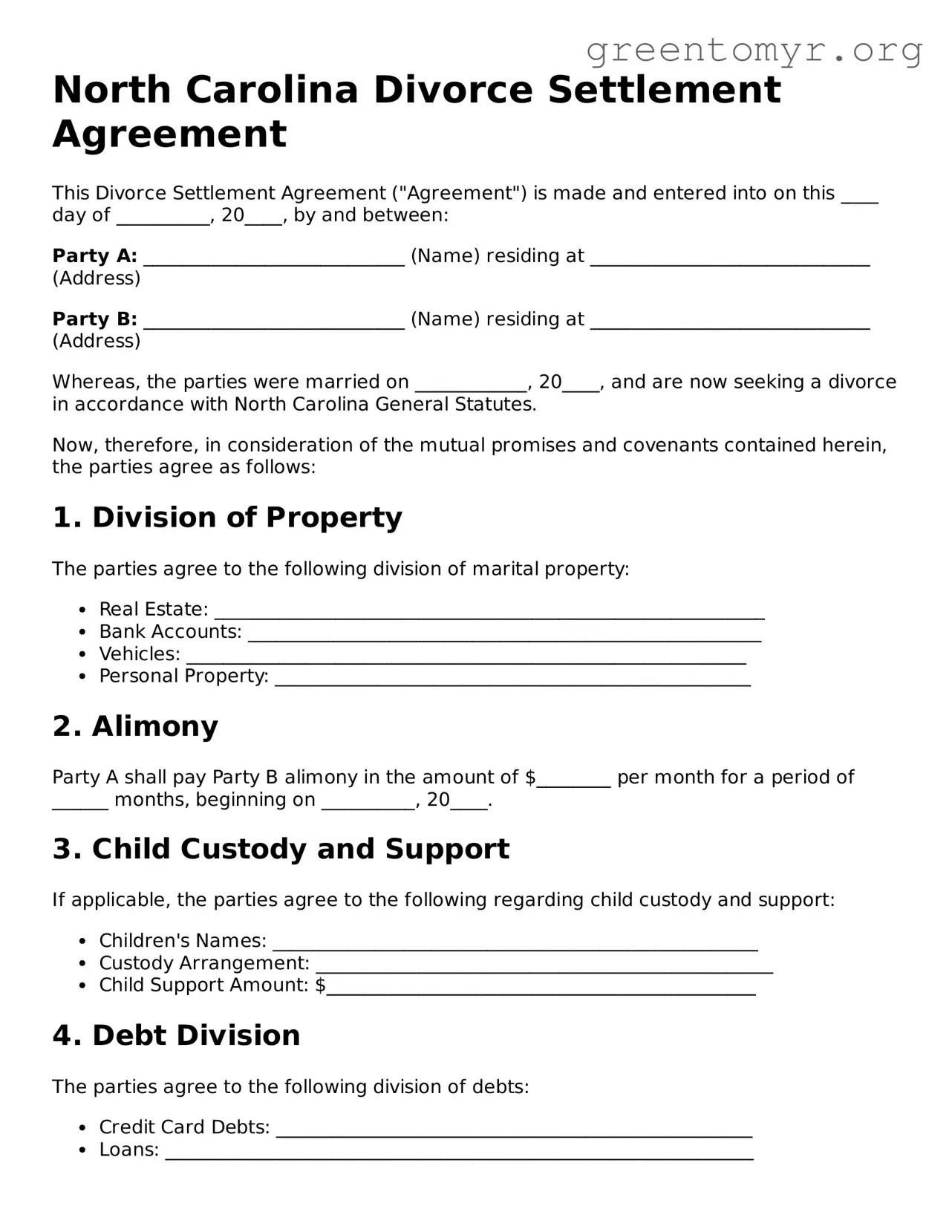
North Carolina Divorce Settlement Agreement

This Divorce Settlement Agreement ("Agreement") is made and entered into on this ____ day of __________, 20____, by and between:

Party A: ____________________________ (Name) residing at ______________________________ (Address)

Party B: ____________________________ (Name) residing at ______________________________ (Address)

Whereas, the parties were married on ____________, 20____, and are now seeking a divorce in accordance with North Carolina General Statutes.

Now, therefore, in consideration of the mutual promises and covenants contained herein, the parties agree as follows:

1. Division of Property

The parties agree to the following division of marital property:

  • Real Estate: ___________________________________________________________
  • Bank Accounts: _______________________________________________________
  • Vehicles: ____________________________________________________________
  • Personal Property: ___________________________________________________

2. Alimony

Party A shall pay Party B alimony in the amount of $________ per month for a period of ______ months, beginning on __________, 20____.

3. Child Custody and Support

If applicable, the parties agree to the following regarding child custody and support:

  • Children's Names: ____________________________________________________
  • Custody Arrangement: _________________________________________________
  • Child Support Amount: $______________________________________________

4. Debt Division

The parties agree to the following division of debts:

  • Credit Card Debts: ___________________________________________________
  • Loans: _______________________________________________________________

5. Miscellaneous

This Agreement constitutes the entire understanding between the parties regarding the matters addressed herein. Any modifications must be in writing and signed by both parties.

By signing below, both parties acknowledge that they have read and understood this Agreement and agree to its terms.

Party A Signature: ____________________________ Date: ____________

Party B Signature: ____________________________ Date: ____________

Witness Signature: ____________________________ Date: ____________

PDF Form Features

Fact Name Description
Governing Law The North Carolina Divorce Settlement Agreement form is governed by North Carolina General Statutes Chapter 50.
Purpose This form is used to outline the terms of a divorce settlement between spouses, including property division, alimony, and child custody.
Filing Requirement It must be filed with the court as part of the divorce proceedings to ensure that the agreement is legally recognized.
Mutual Agreement Both parties must voluntarily agree to the terms outlined in the settlement agreement for it to be valid.
Notarization The form may require notarization to confirm the identities of the parties and their agreement to the terms.
Modification Once filed, the terms can only be modified through mutual consent of both parties or by court order.
Legal Advice It is advisable for both parties to seek independent legal counsel before signing the agreement to ensure their rights are protected.

Guide to Using North Carolina Divorce Settlement Agreement

Filling out the North Carolina Divorce Settlement Agreement form is an important step in the divorce process. Once completed, this form will help outline the terms of the divorce, including asset division, child custody, and support arrangements. After you fill out the form, it will need to be filed with the appropriate court.

  1. Start by entering your name and the name of your spouse at the top of the form.
  2. Provide the date of your marriage and the date of separation.
  3. List any children from the marriage, including their names and birth dates.
  4. Detail the arrangement for child custody, including physical and legal custody terms.
  5. Specify child support obligations, including the amount and frequency of payments.
  6. Outline the division of marital property, including real estate, vehicles, and personal belongings.
  7. Include any debts that need to be divided between both parties.
  8. Discuss alimony, if applicable, including the amount and duration of payments.
  9. Both parties should review the completed form for accuracy and completeness.
  10. Sign and date the form in the designated areas.

Get Answers on North Carolina Divorce Settlement Agreement

What is a North Carolina Divorce Settlement Agreement?

A North Carolina Divorce Settlement Agreement is a legal document that outlines the terms of a divorce between two parties. It details how assets, debts, child custody, and support will be handled after the divorce. This agreement is crucial for ensuring both parties have a clear understanding of their rights and responsibilities moving forward.

How do I create a Divorce Settlement Agreement?

Creating a Divorce Settlement Agreement involves several steps:

  1. Gather all necessary financial documents, including income statements, bank statements, and property deeds.
  2. Discuss and negotiate terms with your spouse regarding asset division, debt responsibility, and any child-related matters.
  3. Draft the agreement, ensuring all terms are clearly stated and mutually agreed upon.
  4. Consider having the agreement reviewed by an attorney to ensure it meets legal standards.
  5. Both parties should sign the agreement in the presence of a notary public.

Is a Divorce Settlement Agreement legally binding?

Yes, once both parties sign the Divorce Settlement Agreement, it becomes legally binding. This means that both individuals are obligated to adhere to the terms outlined in the document. If one party fails to comply, the other party may seek enforcement through the court.

What happens if we cannot agree on the terms?

If the parties cannot reach an agreement, they may consider alternative dispute resolution methods such as mediation. Mediation involves a neutral third party who helps facilitate discussions and negotiations. If mediation fails, the case may go to court, where a judge will make decisions regarding the divorce terms based on state laws.

Common mistakes

Filling out the North Carolina Divorce Settlement Agreement form can be a daunting task. Many people make mistakes that can lead to delays or complications in their divorce process. Understanding these common errors can help ensure a smoother experience.

One frequent mistake is not providing complete information. When individuals leave sections blank or fail to include necessary details, it can create confusion. Each party should take the time to fill out every relevant section fully. This attention to detail can prevent unnecessary back-and-forth with the court.

Another common error is misunderstanding asset division. People sometimes overlook how to accurately list and divide their assets and debts. It’s important to clearly identify what belongs to whom. Misunderstanding these terms can lead to disputes later on.

Additionally, some individuals fail to consider tax implications of their agreements. Certain decisions made during the divorce can have tax consequences. It’s wise to consult a financial advisor or tax professional to understand these factors before finalizing the agreement.

Not addressing child custody and support issues can also be a significant oversight. Parents must clearly outline custody arrangements and support payments. Leaving these matters vague can lead to misunderstandings and conflicts in the future.

People sometimes forget to include a date for the agreement. This detail may seem minor, but it is crucial for the legal validity of the document. Without a date, the court may question the agreement’s timeline and enforceability.

Finally, some individuals neglect to review the agreement thoroughly before submission. Taking the time to read through the entire document can help catch errors or unclear language. A careful review ensures that both parties fully understand and agree to the terms laid out in the settlement.

Documents used along the form

When navigating a divorce in North Carolina, several forms and documents often accompany the Divorce Settlement Agreement. These documents help outline various aspects of the divorce process, ensuring that both parties are clear on their rights and responsibilities. Below is a list of commonly used forms that may be relevant.

  • Complaint for Divorce: This document initiates the divorce process. It outlines the reasons for the divorce and requests the court to grant a dissolution of the marriage.
  • Financial Affidavit: This form provides a detailed account of each party's financial situation. It includes income, expenses, assets, and liabilities, which helps in determining alimony and property division.
  • Child Custody Agreement: If children are involved, this document outlines the custody arrangements. It addresses physical and legal custody, visitation rights, and child support obligations.
  • Separation Agreement: This is a legally binding document that outlines the terms of the separation before the divorce is finalized. It can cover issues like property division, alimony, and child support.
  • Notice of Hearing: This document informs both parties of the scheduled court hearings related to the divorce. It ensures that everyone is aware of the timeline and can prepare accordingly.

These documents play a crucial role in the divorce process, helping to clarify and formalize the arrangements between the parties involved. Properly completing and filing these forms can contribute to a smoother and more efficient resolution of divorce-related matters.

Similar forms

  • Separation Agreement: Much like a Divorce Settlement Agreement, a Separation Agreement outlines the terms under which a couple will live apart. It addresses issues such as property division, child custody, and financial responsibilities, providing a framework for the couple's separation before a divorce is finalized.
  • Child Custody Agreement: This document focuses specifically on the arrangements for children following a divorce or separation. It details custody arrangements, visitation schedules, and decision-making responsibilities, ensuring that both parents are clear on their roles and obligations.
  • Property Settlement Agreement: Similar in purpose, this agreement specifically addresses the division of marital property and debts. It serves to clarify who gets what, reducing the potential for disputes during the divorce process.
  • Spousal Support Agreement: This document outlines the terms of financial support one spouse may provide to the other after separation or divorce. It specifies the amount, duration, and conditions under which support will be paid, ensuring financial stability for the lower-earning spouse.
  • Prenuptial Agreement: While created before marriage, a prenuptial agreement shares similarities with a Divorce Settlement Agreement in that it outlines how assets and debts will be divided in the event of a divorce. It can help set expectations and prevent conflicts later on.
  • Postnuptial Agreement: Like a prenuptial agreement, a postnuptial agreement is established during the marriage. It serves to clarify financial responsibilities and asset division, similar to a Divorce Settlement Agreement, but is executed while the couple is still together.

Dos and Don'ts

When completing the North Carolina Divorce Settlement Agreement form, it's important to approach the process with care. Here are some guidelines to consider:

  • Do read the entire form carefully before starting. Understanding what information is required will help you fill it out correctly.
  • Do provide accurate and complete information. Double-check names, dates, and financial details to avoid delays.
  • Do seek help if you have questions. Consulting with a legal professional can clarify any uncertainties.
  • Do keep a copy of the completed form for your records. This will be useful for future reference.
  • Don't rush through the form. Taking your time can prevent mistakes that may complicate the process later.
  • Don't leave any sections blank. If a question doesn’t apply, indicate that clearly rather than skipping it.

Misconceptions

Understanding the North Carolina Divorce Settlement Agreement form is crucial for anyone navigating the divorce process. However, several misconceptions can lead to confusion. Here are nine common misconceptions:

  1. The form is only for couples with children. Many believe that the Divorce Settlement Agreement is necessary only for those with children. In reality, it is applicable to all couples seeking a divorce, regardless of whether children are involved.
  2. It can only be filled out by attorneys. Some think that only legal professionals can complete this form. In fact, individuals can fill it out themselves, provided they understand the requirements and implications.
  3. Once signed, it cannot be changed. There is a belief that after both parties sign the agreement, it is set in stone. However, modifications can be made if both parties agree and follow the proper legal procedures.
  4. The form covers everything related to the divorce. Many assume that the Divorce Settlement Agreement addresses all aspects of the divorce. While it covers key issues like asset division and support, other matters may require separate documentation.
  5. It is only necessary in contested divorces. Some think that the form is only relevant for contested divorces. In reality, it is beneficial for both contested and uncontested divorces to clarify agreements between parties.
  6. Filing the form is the last step in the divorce process. There is a misconception that submitting this form concludes the divorce process. In fact, it is one of several steps that must be completed, including court approval.
  7. It is a one-size-fits-all document. Many believe that the same Divorce Settlement Agreement can be used for all cases. Each situation is unique, and the form should be tailored to fit the specific circumstances of the couple.
  8. Only one party needs to sign the form. Some think that only one spouse's signature is required. Both parties must sign the agreement for it to be valid and enforceable.
  9. It guarantees a fair outcome. There is a misconception that using the form ensures a fair division of assets and responsibilities. Fairness is subjective, and the outcome largely depends on the negotiations between the parties.

By addressing these misconceptions, individuals can approach the Divorce Settlement Agreement with a clearer understanding, leading to a more informed and effective process.

Key takeaways

When filling out and using the North Carolina Divorce Settlement Agreement form, it’s important to keep several key points in mind. These takeaways can help ensure that the process goes smoothly and that all necessary details are covered.

  • Understand the Purpose: This form outlines the terms of your divorce, including asset division, child custody, and support obligations.
  • Complete All Sections: Every section of the form must be filled out completely to avoid delays in the divorce process.
  • Be Clear and Specific: Use clear language to define terms and conditions. Ambiguities can lead to misunderstandings later on.
  • Review Financial Disclosures: Ensure that all financial information is accurate and complete. This includes income, debts, and assets.
  • Consider Legal Advice: Consulting with an attorney can provide valuable insights and help protect your interests.
  • Sign in Front of a Notary: Most agreements require notarization to be legally binding. Make sure to have your signatures notarized.
  • Keep Copies: After filing the agreement, retain copies for your records. This can be helpful for future reference.

By keeping these points in mind, individuals can navigate the divorce settlement process more effectively and ensure that their rights and interests are protected.