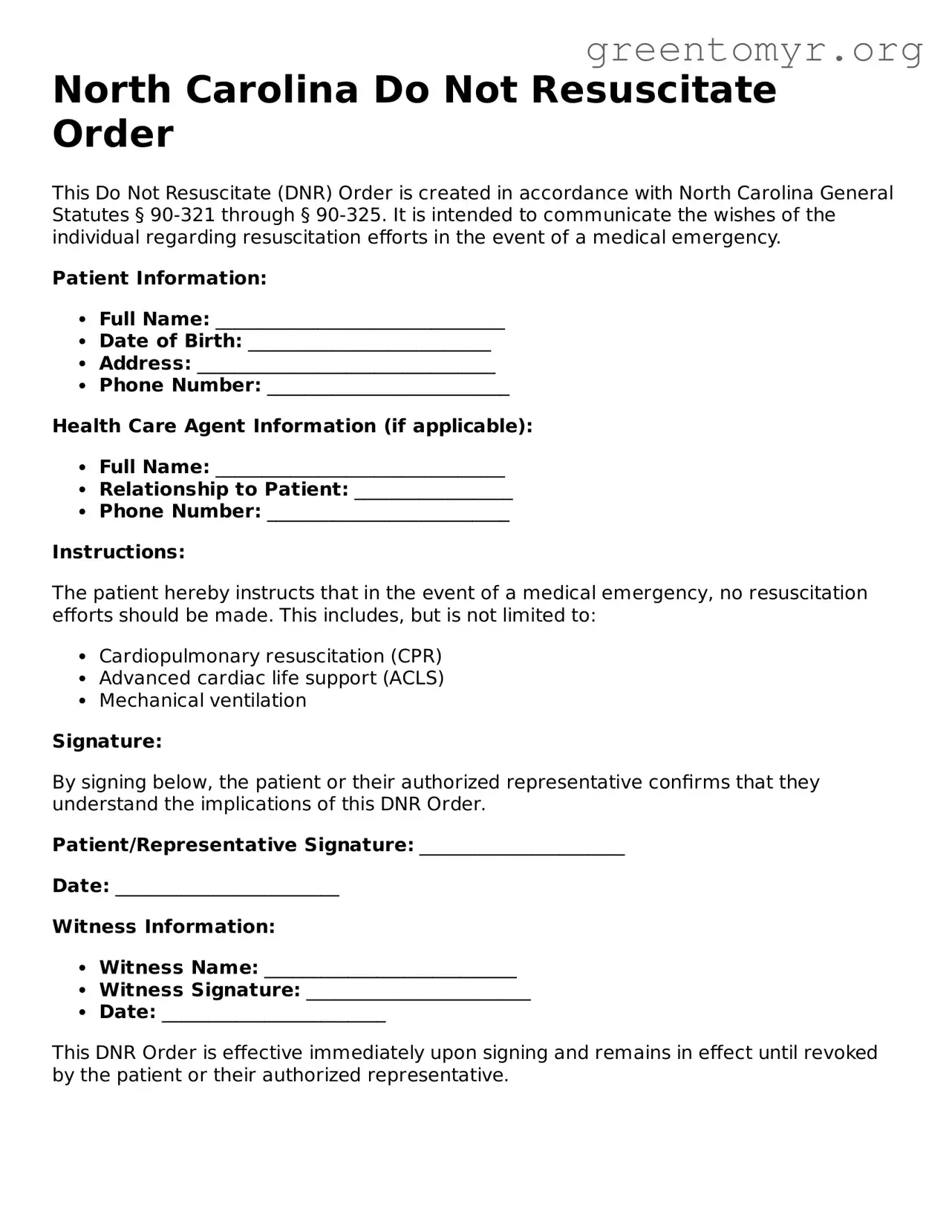
In North Carolina, the Do Not Resuscitate (DNR) Order form serves as a crucial document for individuals who wish to express their preferences regarding resuscitation efforts in the event of a medical emergency. This form empowers patients to make informed decisions about their end-of-life care, ensuring that their wishes are respected by medical personnel. Key components of the DNR Order include the patient's information, a clear statement indicating their desire not to receive cardiopulmonary resuscitation (CPR), and the signatures of both the patient and a physician. Additionally, the form must be completed in accordance with state regulations to be legally binding. Understanding the implications of this document is vital for patients, families, and healthcare providers alike, as it can significantly impact the course of treatment during critical moments. The urgency of completing and communicating these preferences cannot be overstated, as it directly influences the quality of care received during life-threatening situations.
North Carolina Do Not Resuscitate Order
This Do Not Resuscitate (DNR) Order is created in accordance with North Carolina General Statutes § 90-321 through § 90-325. It is intended to communicate the wishes of the individual regarding resuscitation efforts in the event of a medical emergency.
Patient Information:
Health Care Agent Information (if applicable):
Instructions:
The patient hereby instructs that in the event of a medical emergency, no resuscitation efforts should be made. This includes, but is not limited to:
Signature:
By signing below, the patient or their authorized representative confirms that they understand the implications of this DNR Order.
Patient/Representative Signature: ______________________
Date: ________________________
Witness Information:
This DNR Order is effective immediately upon signing and remains in effect until revoked by the patient or their authorized representative.
| Fact Name | Details |
|---|---|
| Definition | A Do Not Resuscitate (DNR) Order is a medical order that prevents healthcare providers from performing cardiopulmonary resuscitation (CPR) if a patient stops breathing or their heart stops beating. |
| Governing Law | The DNR Order in North Carolina is governed by N.C. Gen. Stat. § 90-321. |
| Eligibility | Any adult may request a DNR Order. It is typically used by individuals with terminal illnesses or severe health conditions. |
| Form Requirements | The DNR Order must be signed by a physician and the patient or their legal representative. |
| Placement | The DNR Order should be placed in a visible location, such as on the refrigerator or in a medical file, to ensure it is easily accessible to emergency responders. |
| Revocation | A DNR Order can be revoked at any time by the patient or their legal representative. This can be done verbally or in writing. |
| Emergency Services | Emergency medical services (EMS) must honor a valid DNR Order. They are trained to recognize and respect these orders. |
| Advance Directives | A DNR Order is considered a type of advance directive, which outlines a person's preferences for medical treatment in the event they cannot communicate. |
| Legal Protections | Healthcare providers who follow a DNR Order are protected from liability, as long as the order is valid and properly executed. |
Completing the North Carolina Do Not Resuscitate Order form is a straightforward process. This document allows you to express your wishes regarding resuscitation in a medical emergency. Follow these steps to ensure that your form is filled out correctly.
Once you have completed the form, ensure that it is easily accessible to your healthcare providers and loved ones. This will help ensure your wishes are respected in a medical emergency.
A Do Not Resuscitate Order is a legal document that allows a person to refuse certain life-saving medical interventions, specifically cardiopulmonary resuscitation (CPR), in the event of cardiac arrest or respiratory failure. In North Carolina, this order is recognized by healthcare providers and is intended to honor the wishes of individuals regarding their end-of-life care.
In North Carolina, a DNR Order can be requested by an adult who is capable of making their own healthcare decisions. Additionally, a legally authorized representative, such as a healthcare proxy or an agent under a power of attorney, may also initiate the request on behalf of someone who is unable to do so.
The DNR Order form can be obtained from various sources, including:
It is important to ensure that the form is the official state version to avoid any legal complications.
The DNR Order form requires several key pieces of information, including:
This information ensures that the order is valid and can be easily recognized by medical personnel.
No, a DNR Order specifically applies to situations involving cardiac arrest or respiratory failure. It does not prevent other forms of medical treatment, such as pain management or comfort care. Patients can still receive other necessary medical interventions as outlined in their care plan.
Yes, a DNR Order can be revoked at any time. The individual who created the order, or their legally authorized representative, can verbally communicate the revocation to medical personnel or provide a written notice. It is advisable to inform healthcare providers and ensure that any existing copies of the DNR Order are updated or destroyed.
In North Carolina, a DNR Order is recognized across various medical settings, including hospitals, nursing homes, and emergency medical services. However, it is crucial for individuals to communicate their wishes clearly to family members and caregivers to ensure that the order is honored consistently.
If you have questions or concerns about your DNR Order, it is essential to consult with your healthcare provider. They can provide guidance on the implications of the order, help you understand your options, and ensure that your wishes are accurately documented and communicated.
There is no specific age requirement for a DNR Order in North Carolina. However, individuals must be able to make informed decisions about their healthcare. For minors, a parent or legal guardian can request a DNR Order on their behalf, following appropriate legal guidelines.
Filling out the North Carolina Do Not Resuscitate Order (DNR) form can be a daunting task. Many individuals make critical mistakes that can lead to confusion or even unwanted medical interventions. Understanding these common errors can help ensure that your wishes are respected.
One frequent mistake is failing to provide clear and complete information. The form requires specific details, including the patient's name, date of birth, and signature. Omitting any of this information can render the document invalid. Always double-check that every field is filled out accurately before submitting.
Another common error involves not having the form properly signed and witnessed. In North Carolina, the DNR form must be signed by the patient or their legal representative. Additionally, it requires the signatures of two witnesses. If these signatures are missing, healthcare providers may not honor the DNR wishes, leading to unnecessary resuscitation efforts.
Some individuals also overlook the importance of discussing their DNR wishes with family members and healthcare providers. A DNR order is a significant decision that should not be made in isolation. By communicating your preferences, you can ensure that your loved ones understand your choices and can advocate for you if necessary.
Additionally, people sometimes forget to keep copies of the completed DNR form in accessible locations. It’s crucial to have the document readily available in case of a medical emergency. Store copies in places like your medical file, with your primary care physician, or even on your refrigerator for easy access by emergency responders.
Lastly, individuals may neglect to review and update their DNR orders as circumstances change. Life events, such as a new diagnosis or a change in health status, may warrant a reevaluation of your DNR wishes. Regularly revisiting the document ensures that it accurately reflects your current preferences.
When considering end-of-life decisions, the North Carolina Do Not Resuscitate (DNR) Order form is an important document. However, it is often accompanied by other forms and documents that help clarify a person's wishes regarding medical care and treatment. Below is a list of some commonly used documents that can complement the DNR Order.
Understanding these documents and how they work together can empower individuals and families to make informed decisions about healthcare preferences. Each form serves a unique purpose and can help ensure that a person's wishes are respected during critical moments.
The Do Not Resuscitate (DNR) Order form shares similarities with several other legal documents that guide medical decisions. Below is a list of these documents, highlighting how they relate to the DNR Order form.
When filling out the North Carolina Do Not Resuscitate Order form, it's essential to approach the process thoughtfully. Here are some important dos and don'ts to consider.
By following these guidelines, you can ensure that your wishes are clearly communicated and respected in a medical emergency.
In North Carolina, the Do Not Resuscitate (DNR) Order form is an important document that allows individuals to express their wishes regarding resuscitation in the event of a medical emergency. However, several misconceptions surround this form that can lead to confusion. Here are four common misunderstandings:
Understanding these misconceptions can help individuals make informed decisions about their healthcare preferences and ensure their wishes are respected in critical situations.
Filling out and using the North Carolina Do Not Resuscitate (DNR) Order form is a significant decision that requires careful consideration. Below are key takeaways to keep in mind:
Understanding these key points can help individuals navigate the process of filling out and utilizing the North Carolina DNR Order form effectively.