In North Carolina, the Durable Power of Attorney (DPOA) form serves as a vital tool for individuals seeking to manage their financial and legal affairs when they can no longer do so themselves. This form grants a designated person, often referred to as an agent or attorney-in-fact, the authority to make decisions on behalf of the principal, the person who creates the DPOA. One of the key features of the DPOA is its durability; it remains effective even if the principal becomes incapacitated. This means that your chosen agent can step in and handle everything from paying bills to managing investments, ensuring that your financial matters are in trusted hands. Importantly, the DPOA can be tailored to fit your specific needs, allowing you to grant broad powers or limit them to particular tasks. Additionally, understanding the nuances of this form can help prevent potential disputes among family members and ensure that your wishes are honored. With the right knowledge, you can confidently navigate this important legal document, safeguarding your interests for the future.
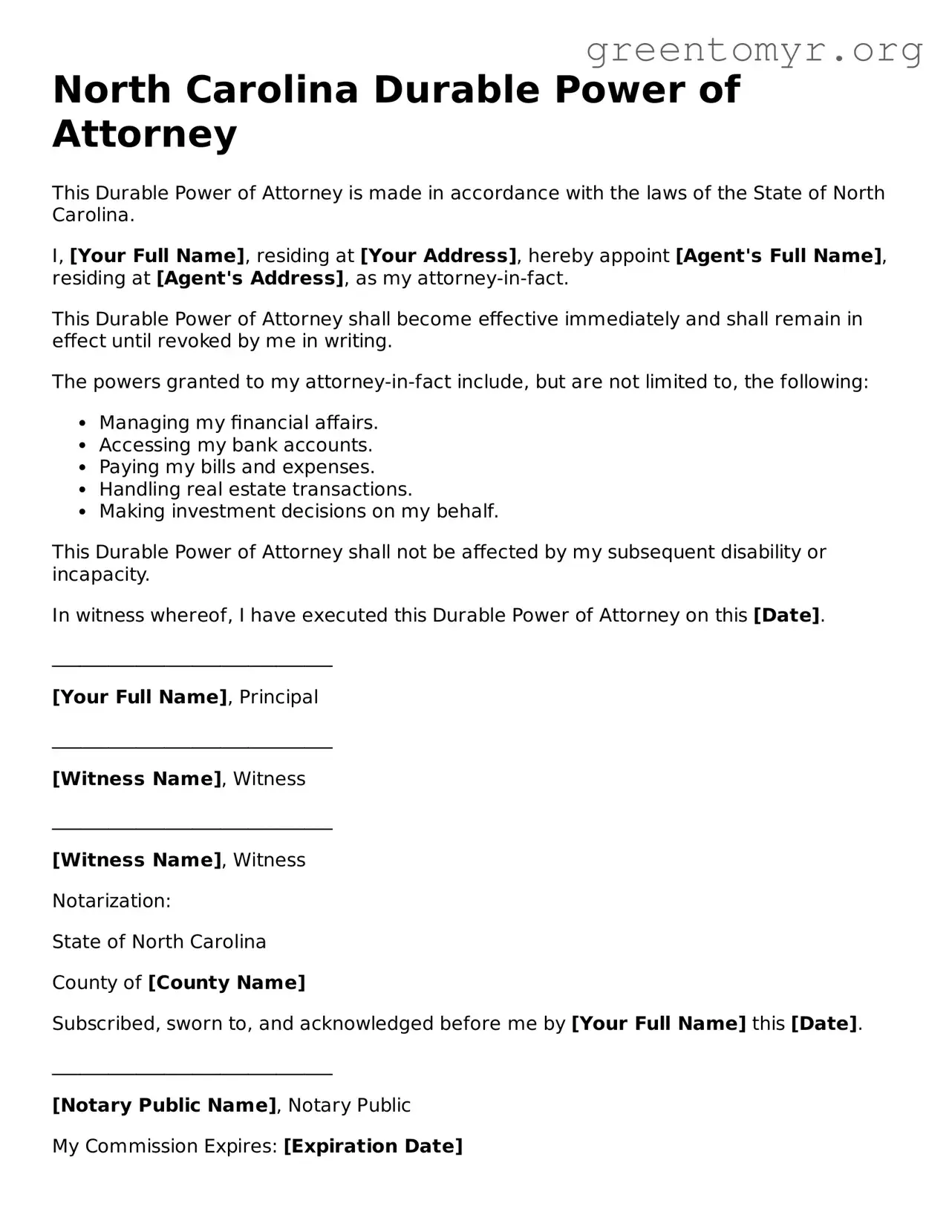
North Carolina Durable Power of Attorney
This Durable Power of Attorney is made in accordance with the laws of the State of North Carolina.
I, [Your Full Name], residing at [Your Address], hereby appoint [Agent's Full Name], residing at [Agent's Address], as my attorney-in-fact.
This Durable Power of Attorney shall become effective immediately and shall remain in effect until revoked by me in writing.
The powers granted to my attorney-in-fact include, but are not limited to, the following:
This Durable Power of Attorney shall not be affected by my subsequent disability or incapacity.
In witness whereof, I have executed this Durable Power of Attorney on this [Date].
______________________________
[Your Full Name], Principal
______________________________
[Witness Name], Witness
______________________________
[Witness Name], Witness
Notarization:
State of North Carolina
County of [County Name]
Subscribed, sworn to, and acknowledged before me by [Your Full Name] this [Date].
______________________________
[Notary Public Name], Notary Public
My Commission Expires: [Expiration Date]
| Fact Name | Description |
|---|---|
| Definition | A Durable Power of Attorney allows an individual to designate someone to make financial and legal decisions on their behalf, even if they become incapacitated. |
| Governing Law | The Durable Power of Attorney in North Carolina is governed by Chapter 32A of the North Carolina General Statutes. |
| Durability | This form remains effective even if the principal becomes mentally incapacitated, making it a powerful tool for planning. |
| Principal | The individual who creates the Durable Power of Attorney is referred to as the principal. |
| Agent | The person designated to act on behalf of the principal is known as the agent or attorney-in-fact. |
| Signature Requirements | The principal must sign the document in the presence of a notary public for it to be legally binding. |
| Revocation | The principal can revoke the Durable Power of Attorney at any time, as long as they are mentally competent. |
| Limitations | Agents must act in the best interest of the principal and cannot use the power for their own benefit. |
| Types of Authority | The form can grant broad or limited powers, depending on the principal's wishes. |
| Healthcare Decisions | This form is distinct from a healthcare power of attorney, which specifically addresses medical decisions. |
Filling out the North Carolina Durable Power of Attorney form is an important step in ensuring that your financial and legal matters are managed according to your wishes in the event that you are unable to make decisions for yourself. Follow these steps carefully to complete the form accurately.
Once the form is completed and properly signed, it is advisable to keep the original document in a safe place while ensuring that your appointed agent and any relevant parties have access to a copy. This will help facilitate the execution of your wishes when needed.
A Durable Power of Attorney is a legal document that allows you to appoint someone to make decisions on your behalf if you become incapacitated. This authority remains effective even if you are unable to make decisions for yourself due to illness or injury.
You can appoint any competent adult as your agent. This can be a family member, friend, or a trusted advisor. It is essential to choose someone you trust to act in your best interest.
You can grant a wide range of powers to your agent, including:
Be specific about the powers you wish to grant to ensure your agent understands their responsibilities.
Yes, the document must be signed in the presence of a notary public to be valid in North Carolina. This adds a layer of authenticity and helps prevent fraud.
Yes, you can revoke a Durable Power of Attorney at any time, as long as you are mentally competent. To revoke, you should create a written notice stating your intent to revoke and provide copies to your agent and any institutions that have a copy of the original document.
If you do not have a Durable Power of Attorney and become incapacitated, the court may appoint a guardian or conservator to manage your affairs. This process can be lengthy and may not reflect your wishes.
No, they are different documents. A Durable Power of Attorney typically covers financial matters, while a Healthcare Power of Attorney specifically addresses medical decisions. You may want to consider creating both to ensure comprehensive coverage.
To ensure effectiveness, follow these steps:
Taking these steps will help safeguard your interests and ensure your wishes are honored.
Filling out a Durable Power of Attorney form in North Carolina can be straightforward, but mistakes can happen. One common error is not specifying the powers granted. It's important to clearly outline what decisions the agent can make on your behalf. If the powers are vague or too broad, it can lead to confusion and potential disputes later on.
Another mistake people often make is failing to sign the document properly. In North Carolina, the principal must sign the form in the presence of a notary public. If this step is skipped or done incorrectly, the document may not be valid. Always double-check that signatures are in place and that the notary has completed their part correctly.
Additionally, individuals may overlook the need to appoint an alternate agent. Life can be unpredictable, and your first choice may not always be available when needed. By designating an alternate, you ensure that someone can step in and act on your behalf if the primary agent is unable or unwilling to do so.
Lastly, not reviewing the form after completion can lead to errors going unnoticed. It's wise to read through the entire document carefully before finalizing it. This helps catch any mistakes or unclear language that could cause issues in the future. Taking the time to review can save a lot of trouble later on.
In North Carolina, individuals often utilize a Durable Power of Attorney form to designate an agent who can make financial and legal decisions on their behalf. This form is crucial for ensuring that one's wishes are honored, particularly in situations where they may become incapacitated. However, there are several other important documents that may complement the Durable Power of Attorney, enhancing its effectiveness and addressing various aspects of an individual's personal and financial affairs.
Each of these documents serves a distinct purpose, and together they can provide comprehensive support for an individual's legal and financial needs. It is advisable for individuals to consider their unique circumstances and consult with legal professionals to ensure that their wishes are clearly articulated and legally binding.
The Durable Power of Attorney (DPOA) form is a vital legal document that allows one person to make decisions on behalf of another, especially in financial or medical matters. Several other documents share similarities with the DPOA, each serving specific purposes. Here’s a list of nine documents that are similar to the Durable Power of Attorney:
Each of these documents serves a unique function but shares the common goal of ensuring that someone can make decisions on behalf of another person when necessary. Understanding these similarities can help individuals choose the right document for their specific needs.
When filling out the North Carolina Durable Power of Attorney form, it is essential to approach the task with care. This document grants someone the authority to make decisions on your behalf, so accuracy is crucial. Here are some dos and don'ts to consider:
By following these guidelines, you can ensure that your Durable Power of Attorney form is completed correctly, helping to protect your interests and those of your loved ones.
Understanding the Durable Power of Attorney (DPOA) in North Carolina is crucial for effective estate planning. However, several misconceptions can lead to confusion. Here are four common misunderstandings:
This is not true. A DPOA can be beneficial for anyone, regardless of age, who wants to ensure their financial and medical decisions are managed by someone they trust in case they become incapacitated.
While a DPOA does give the agent significant authority, it is limited to the powers specified in the document. Individuals can tailor the DPOA to fit their needs, including restricting certain powers.
This is correct; however, many people mistakenly believe that the DPOA can continue to operate after death. In fact, the authority granted by a DPOA ends when the principal passes away, and the estate will then be handled according to the will or state laws.
This is false. A principal can revoke or modify a DPOA at any time, as long as they are mentally competent. It is important to review and update the document as circumstances change.
When filling out and using the North Carolina Durable Power of Attorney form, keep these key takeaways in mind: