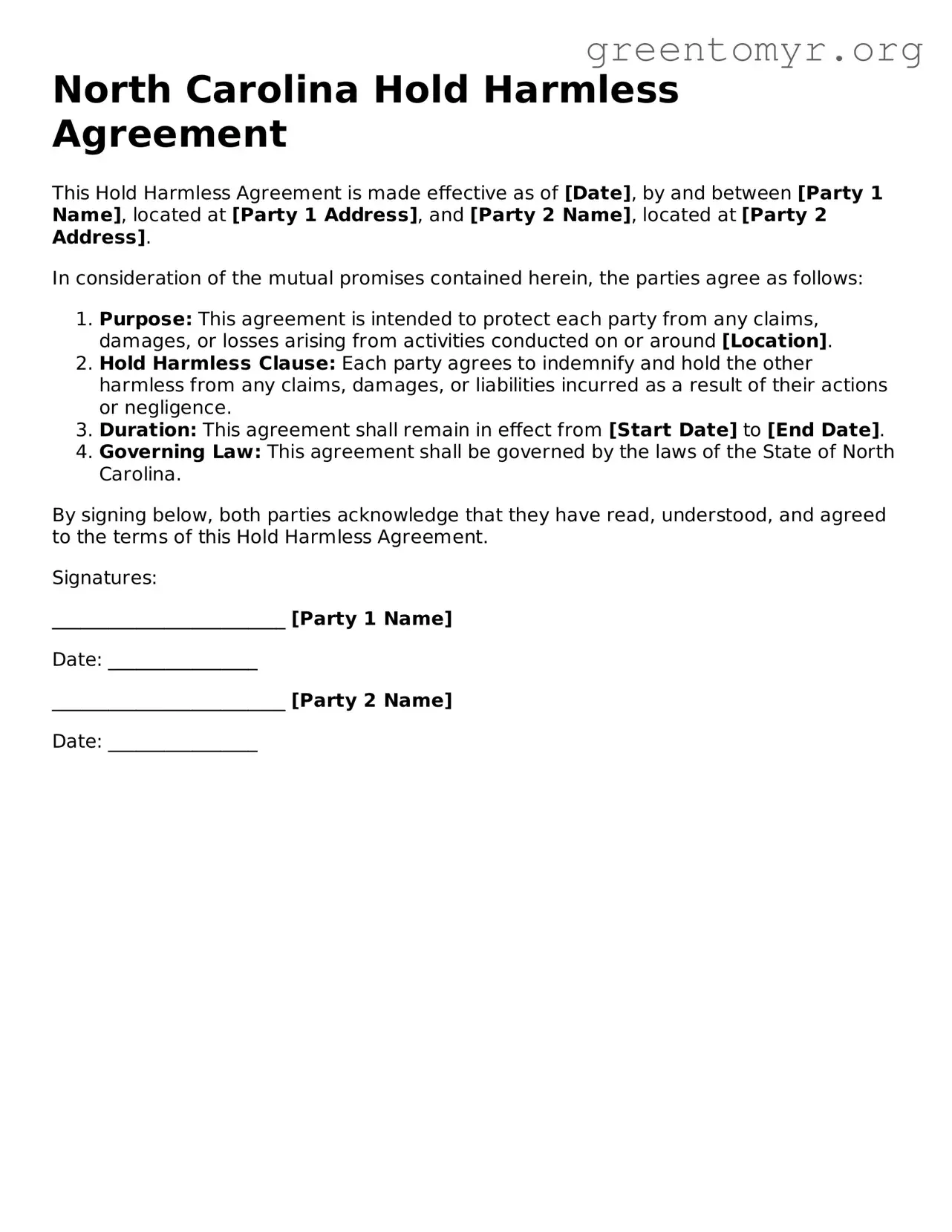
The North Carolina Hold Harmless Agreement form serves as a crucial legal document designed to protect parties from liability in various situations. This agreement is often utilized in contexts such as construction projects, rental agreements, and event planning, where one party may seek to limit their exposure to claims or damages arising from the actions of another. By signing this form, individuals or organizations agree to assume responsibility for any potential risks associated with an activity or event, thereby shielding the other party from legal repercussions. Key elements of the agreement include the identification of the parties involved, a clear description of the activities covered, and the specific liabilities that are being waived. It is important for all parties to fully understand the implications of the agreement, as it can affect their legal rights and responsibilities. The Hold Harmless Agreement not only fosters a sense of security but also encourages cooperation and trust among participants, making it an essential tool in various professional and personal scenarios.
North Carolina Hold Harmless Agreement
This Hold Harmless Agreement is made effective as of [Date], by and between [Party 1 Name], located at [Party 1 Address], and [Party 2 Name], located at [Party 2 Address].
In consideration of the mutual promises contained herein, the parties agree as follows:
By signing below, both parties acknowledge that they have read, understood, and agreed to the terms of this Hold Harmless Agreement.
Signatures:
_________________________ [Party 1 Name]
Date: ________________
_________________________ [Party 2 Name]
Date: ________________
| Fact Name | Details |
|---|---|
| Definition | A Hold Harmless Agreement is a legal document where one party agrees not to hold another party liable for any damages or losses. |
| Purpose | This agreement is commonly used to protect one party from legal claims resulting from the actions of another party. |
| Common Uses | It is often used in rental agreements, construction contracts, and event planning. |
| Governing Law | The Hold Harmless Agreement in North Carolina is governed by state contract law. |
| Enforceability | These agreements are generally enforceable in North Carolina, provided they are clear and specific. |
| Mutual vs. Unilateral | Hold Harmless Agreements can be mutual, where both parties agree, or unilateral, where only one party is protected. |
| Limitations | In some cases, the agreement may not protect against gross negligence or willful misconduct. |
| Signature Requirement | For the agreement to be valid, it typically requires signatures from all involved parties. |
| Consultation | It is advisable to consult with a legal professional when drafting or signing a Hold Harmless Agreement. |
Once you have obtained the North Carolina Hold Harmless Agreement form, the next step involves carefully filling it out to ensure that all necessary information is accurately provided. This process requires attention to detail, as the information you include will be essential for the agreement's validity.
After completing these steps, review the form for any errors or omissions before submitting it to the appropriate party. Proper completion of the Hold Harmless Agreement will help protect all involved parties in the event of unforeseen circumstances.
A Hold Harmless Agreement is a legal document that protects one party from liability or claims that may arise from certain activities or events. In North Carolina, these agreements are often used in various contexts, including real estate transactions, construction projects, and recreational activities. By signing this agreement, one party agrees to assume responsibility for any potential damages or injuries, thereby shielding the other party from legal repercussions.
Hold Harmless Agreements are commonly used by:
These agreements serve to clarify the responsibilities of each party and reduce the risk of legal disputes.
A comprehensive Hold Harmless Agreement should include the following elements:
Including these details helps ensure that the agreement is enforceable and clearly understood by all parties.
Yes, Hold Harmless Agreements are generally enforceable in North Carolina, provided they meet certain legal requirements. The agreement must be clear, specific, and voluntarily signed by all parties. However, there are limitations. For instance, these agreements cannot protect a party from liability arising from gross negligence or willful misconduct. Courts may scrutinize the language and intent of the agreement to determine its enforceability.
A Hold Harmless Agreement can be revoked or modified if all parties agree to the changes. This typically requires a written amendment signed by all involved. However, if one party wishes to revoke the agreement unilaterally, they may face legal challenges, especially if the agreement has already been executed and the other party has relied on it. It is advisable to consult with a legal professional before attempting to revoke or alter any existing agreements.
When filling out the North Carolina Hold Harmless Agreement form, many individuals make common mistakes that can lead to complications down the line. One frequent error is failing to read the entire document carefully. This form contains important details that outline responsibilities and liabilities. Overlooking any section can result in misunderstandings or unintended consequences.
Another mistake often seen is the omission of necessary information. Individuals may forget to include essential details such as the names of the parties involved or specific dates. This can create ambiguity and may render the agreement unenforceable. Always ensure that every required field is filled out completely and accurately.
Additionally, people sometimes do not fully understand the implications of the agreement they are signing. A Hold Harmless Agreement is designed to protect one party from claims or damages that may arise from the actions of another. Without a clear understanding of what this means, individuals may unintentionally agree to terms that could expose them to greater risk.
Another common pitfall is failing to consult with a legal professional. While the form may seem straightforward, having an attorney review it can provide peace of mind. They can offer insights into the language used and ensure that the terms are fair and reasonable for all parties involved.
Finally, neglecting to keep a copy of the signed agreement is a mistake that can lead to confusion in the future. It’s essential to retain a copy for personal records. This ensures that all parties have access to the same information and can refer back to the agreement if any disputes arise.
The North Carolina Hold Harmless Agreement is often used in various contexts to protect parties from liability. When utilizing this agreement, several other forms and documents may also be relevant. Below is a list of commonly associated documents that can complement the Hold Harmless Agreement.
These documents serve different purposes but can enhance the protection offered by the Hold Harmless Agreement. Understanding each document's role can help parties navigate their responsibilities and liabilities more effectively.
When filling out the North Carolina Hold Harmless Agreement form, it is essential to approach the task with care and attention to detail. Below are four important do's and don'ts to keep in mind.
When it comes to the North Carolina Hold Harmless Agreement form, many people have misconceptions that can lead to confusion or misinterpretation. Here are nine common misunderstandings:
Many believe that signing this agreement completely removes any responsibility from the other party. In reality, it often limits liability to certain situations and does not cover gross negligence or willful misconduct.
While businesses frequently use hold harmless agreements, individuals can also utilize them. Anyone entering into a potentially risky activity can benefit from this form.
Though generally enforceable, a hold harmless agreement may not hold up in court if it is deemed unconscionable or if it violates public policy.
This agreement typically covers specific claims and does not provide blanket protection. It’s essential to understand the scope of what is covered.
Notarization is not a requirement for a hold harmless agreement to be valid. However, having it notarized can add an extra layer of authenticity.
Each hold harmless agreement should be tailored to the specific situation. Generic templates may not address unique circumstances effectively.
For the agreement to be enforceable, it should be in writing. Verbal agreements can lead to misunderstandings and are harder to prove.
While a hold harmless agreement can provide some protection, it should not replace adequate insurance coverage. Both serve different purposes.
Although this form is specific to North Carolina, similar agreements exist in other states. It’s important to understand the laws in your jurisdiction.
Understanding these misconceptions can help individuals and businesses navigate the complexities of liability and protection more effectively.
Here are some important points to consider when filling out and using the North Carolina Hold Harmless Agreement form: