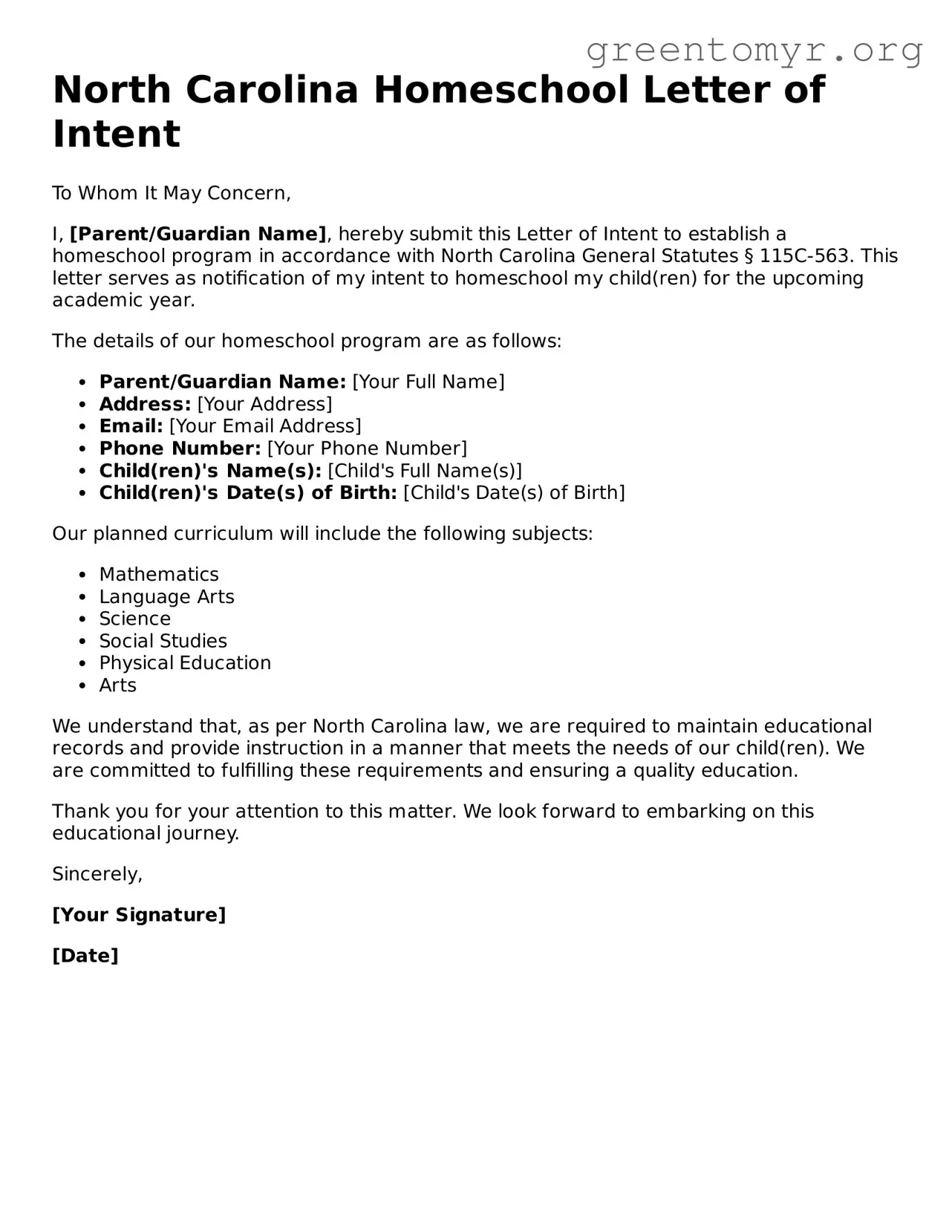
In North Carolina, families who choose to homeschool their children must complete a specific process to ensure they comply with state regulations. One of the first steps in this journey is submitting a Homeschool Letter of Intent form. This form serves as an official notification to the state that you intend to educate your child at home. It requires essential information such as the names and ages of the children being homeschooled, as well as the address where the homeschooling will take place. Additionally, parents must provide their own names and signatures, confirming their commitment to take on the educational responsibilities. Understanding how to properly fill out this form is crucial, as it lays the groundwork for your homeschooling journey and ensures that you meet the legal requirements set forth by the state. Failure to submit the form correctly or on time can lead to complications down the road, so it’s important to pay attention to every detail. With the right information and guidance, completing the Homeschool Letter of Intent can be a straightforward process that opens the door to a personalized education for your children.
North Carolina Homeschool Letter of Intent
To Whom It May Concern,
I, [Parent/Guardian Name], hereby submit this Letter of Intent to establish a homeschool program in accordance with North Carolina General Statutes § 115C-563. This letter serves as notification of my intent to homeschool my child(ren) for the upcoming academic year.
The details of our homeschool program are as follows:
Our planned curriculum will include the following subjects:
We understand that, as per North Carolina law, we are required to maintain educational records and provide instruction in a manner that meets the needs of our child(ren). We are committed to fulfilling these requirements and ensuring a quality education.
Thank you for your attention to this matter. We look forward to embarking on this educational journey.
Sincerely,
[Your Signature]
[Date]
| Fact Name | Description |
|---|---|
| Purpose | The North Carolina Homeschool Letter of Intent form is used to officially notify the state of a parent's intent to homeschool their child. |
| Governing Law | The form is governed by North Carolina General Statutes, specifically G.S. 115C-563 and G.S. 115C-566. |
| Submission Timeline | Parents must submit the Letter of Intent within 30 days of beginning the homeschool program. |
| Required Information | The form requires basic information, including the name and age of the child, and the name of the parent or guardian. |
| Annual Renewal | While the Letter of Intent does not require annual renewal, parents must maintain educational records and submit an annual assessment of the child’s progress. |
Once you have gathered the necessary information, it's time to fill out the North Carolina Homeschool Letter of Intent form. Completing this form is a crucial step in officially notifying the state of your intent to homeschool your child. Follow these steps carefully to ensure that all required information is provided.
After submission, keep a copy of the form for your records. You will receive confirmation from the state regarding your intent to homeschool. Be prepared for any follow-up communications if necessary.
The North Carolina Homeschool Letter of Intent form is a document that parents or guardians must submit to officially notify the state of their decision to homeschool their children. This form is a crucial first step in establishing a home education program and ensures compliance with state regulations.
Any parent or guardian who wishes to homeschool a child in North Carolina must submit the Letter of Intent. This includes families with children of any age who are not enrolled in a public or private school. If you are starting a new homeschool program or transitioning from another educational setting, this form is necessary.
The Letter of Intent should be submitted within 30 days of beginning the homeschool program. If you are withdrawing a child from a public or private school, it is advisable to submit the form before starting your homeschooling journey to ensure a smooth transition.
The Letter of Intent typically requires the following information:
Make sure all information is accurate to avoid any delays in processing your application.
You can submit the Letter of Intent to your local school district office. Each district may have its own preferred method for submission, whether by mail, email, or in person. It’s a good idea to check with your district for specific instructions.
No, there is no fee associated with submitting the North Carolina Homeschool Letter of Intent. This form is a free notification to the state about your homeschooling plans.
After submitting the Letter of Intent, you should receive confirmation from your local school district. This may take a few weeks. Once confirmed, you can begin your homeschooling program without any additional steps required by the state.
Yes, if you decide to discontinue homeschooling or enroll your child in a traditional school, you can do so at any time. However, it is a good practice to notify your local school district about any changes in your educational plans to keep your records up to date.
When completing the North Carolina Homeschool Letter of Intent form, individuals often encounter several common mistakes that can lead to delays or complications. One frequent error is omitting required information. The form requests specific details such as the names and addresses of the children being homeschooled. Failing to provide this information can result in the form being rejected or returned for corrections.
Another mistake involves incorrect or incomplete signatures. The form must be signed by the parent or guardian who is taking responsibility for the homeschool program. If the signature is missing or does not match the name printed on the form, it can create issues with the submission process. Ensuring that all signatures are present and accurate is crucial.
Some individuals also misinterpret the deadlines associated with the form. The Letter of Intent must be submitted within a certain timeframe, typically within 30 days of beginning the homeschool program. Missing this deadline can lead to complications with compliance and may require additional steps to rectify the situation.
Additionally, people sometimes provide inaccurate information regarding their educational plans. The form includes a section where parents outline their intended curriculum and educational approach. Providing vague or unrealistic descriptions can raise questions about the legitimacy of the homeschool program. It is important to be clear and specific about educational goals.
Finally, neglecting to keep a copy of the submitted form is a common oversight. After sending the Letter of Intent, parents should retain a copy for their records. This practice can be beneficial if there are any questions or issues that arise in the future regarding the homeschool status.
When embarking on the journey of homeschooling in North Carolina, submitting the Homeschool Letter of Intent is just the first step. To ensure compliance with state regulations and to facilitate a smooth educational experience, several other forms and documents are often needed. Below is a list of important documents that can accompany the Homeschool Letter of Intent.
By preparing these documents alongside the Homeschool Letter of Intent, you can create a solid foundation for your homeschooling journey. Staying organized and informed will not only help you meet legal requirements but also support your child's educational success.
When filling out the North Carolina Homeschool Letter of Intent form, it's important to approach the process with care. Here are some key do's and don'ts to keep in mind:
Following these guidelines will help ensure a smooth and successful submission of your Homeschool Letter of Intent.
Many people have misconceptions about the North Carolina Homeschool Letter of Intent form. Understanding the truth can help you navigate the homeschooling process more smoothly. Here are seven common misconceptions:
This is not true. Homeschooling is legal in North Carolina, provided that families follow the state's regulations and submit the necessary forms.
In North Carolina, parents do not need a teaching degree to educate their children at home. What matters is your commitment to provide an adequate education.
Actually, once you submit your Letter of Intent, you do not need to submit it again unless you change your address or your child's status.
While a curriculum is important, North Carolina allows parents to choose how and what to teach. Flexibility is a key feature of homeschooling.
There are numerous resources available for homeschooling families in North Carolina, including local support groups and online communities.
Many public schools allow homeschool students to participate in extracurricular activities, such as sports and clubs. Policies may vary by district.
The process is straightforward and can often be completed quickly. You simply fill out the form and submit it to the appropriate authorities.
By clearing up these misconceptions, you can feel more confident in your decision to homeschool in North Carolina.
When filling out and using the North Carolina Homeschool Letter of Intent form, keep these key takeaways in mind: