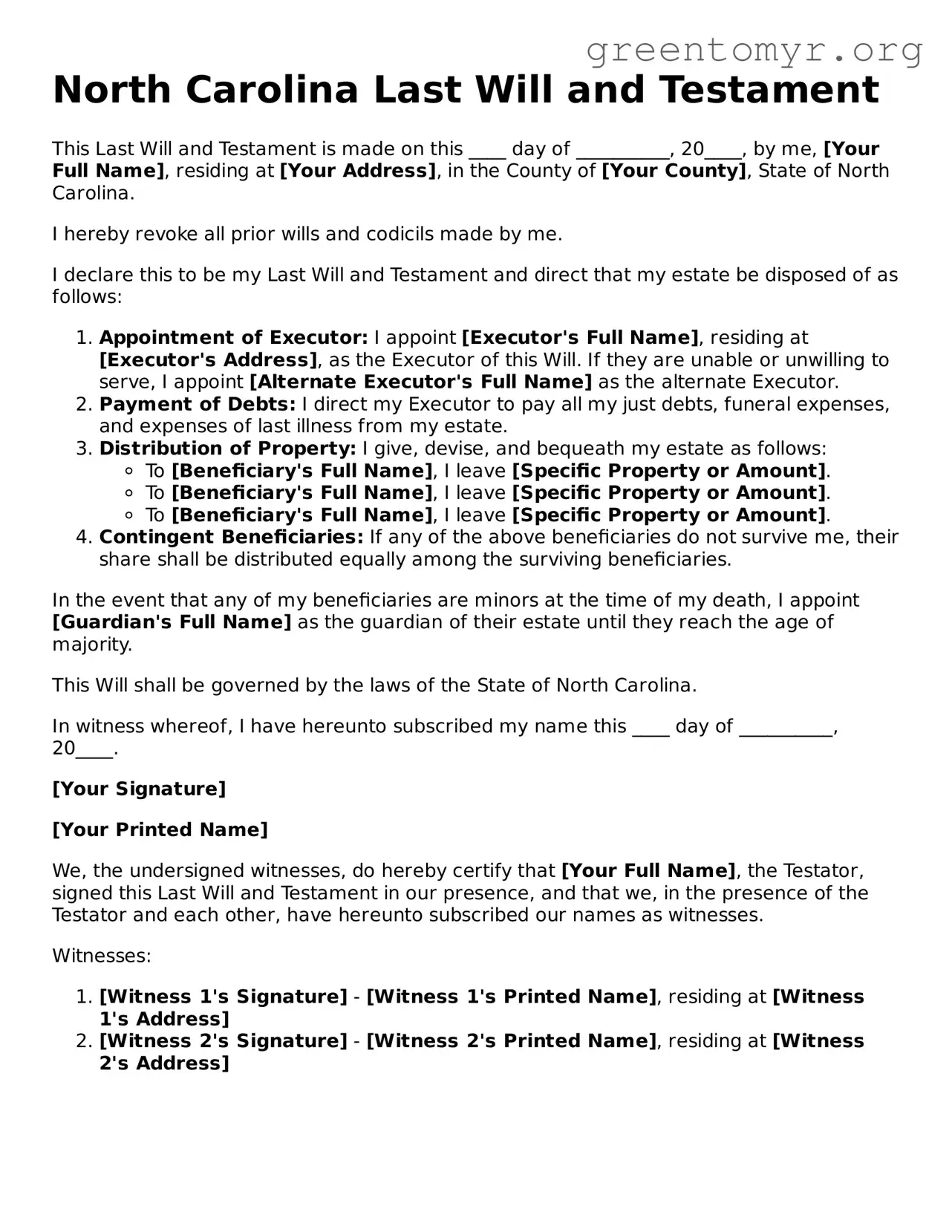
In North Carolina, the Last Will and Testament form serves as a crucial legal document that outlines an individual's wishes regarding the distribution of their assets after death. This form allows individuals to specify who will inherit their property, appoint guardians for minor children, and designate an executor to manage the estate. By clearly articulating these intentions, the will can help prevent disputes among family members and ensure that the decedent's desires are honored. Additionally, the form must adhere to specific state requirements, such as being signed by the testator in the presence of at least two witnesses, who must also sign the document. This process not only formalizes the will but also provides a layer of protection against potential challenges. Furthermore, the North Carolina Last Will and Testament can be revoked or amended as circumstances change, allowing for flexibility in estate planning. Understanding these elements is essential for anyone considering how to create a valid and effective will in North Carolina.
North Carolina Last Will and Testament
This Last Will and Testament is made on this ____ day of __________, 20____, by me, [Your Full Name], residing at [Your Address], in the County of [Your County], State of North Carolina.
I hereby revoke all prior wills and codicils made by me.
I declare this to be my Last Will and Testament and direct that my estate be disposed of as follows:
In the event that any of my beneficiaries are minors at the time of my death, I appoint [Guardian's Full Name] as the guardian of their estate until they reach the age of majority.
This Will shall be governed by the laws of the State of North Carolina.
In witness whereof, I have hereunto subscribed my name this ____ day of __________, 20____.
[Your Signature]
[Your Printed Name]
We, the undersigned witnesses, do hereby certify that [Your Full Name], the Testator, signed this Last Will and Testament in our presence, and that we, in the presence of the Testator and each other, have hereunto subscribed our names as witnesses.
Witnesses:
| Fact Name | Details |
|---|---|
| Governing Law | The Last Will and Testament in North Carolina is governed by Chapter 31 of the North Carolina General Statutes. |
| Age Requirement | Individuals must be at least 18 years old to create a valid will in North Carolina. |
| Witness Requirement | A will must be signed by at least two witnesses who are present at the same time. |
| Signature Requirement | The testator must sign the will at the end of the document. |
| Revocation | A will can be revoked by a subsequent will or by physically destroying the original document. |
| Self-Proving Will | A will can be made self-proving by including a notarized affidavit from the witnesses. |
| Intestacy | If someone dies without a will, their estate will be distributed according to North Carolina intestacy laws. |
| Holographic Wills | North Carolina recognizes holographic wills, which are handwritten and do not require witnesses. |
| Durable Power of Attorney | A will can be accompanied by a durable power of attorney to manage affairs if the testator becomes incapacitated. |
| Filing Requirement | A will must be filed with the probate court after the testator's death to initiate the probate process. |
After obtaining the North Carolina Last Will and Testament form, it’s essential to complete it accurately to ensure your wishes are honored. This form allows you to outline how you want your assets distributed and who will manage your estate after your passing. Following the steps below will help you fill out the form correctly.
A Last Will and Testament is a legal document that outlines how a person's assets and affairs should be handled after their death. In North Carolina, this document allows individuals to specify who will inherit their property, appoint guardians for minor children, and designate an executor to manage the estate. It ensures that your wishes are honored and can help avoid disputes among family members.
In North Carolina, any person who is at least 18 years old and of sound mind can create a Last Will and Testament. This means you must be able to understand the nature of the document and its implications. Additionally, it is important to ensure that the will is executed properly according to state laws to be considered valid.
To ensure that a Last Will and Testament is valid in North Carolina, the following requirements must be met:
It is advisable to have the will notarized, although it is not a legal requirement. Notarization can help simplify the probate process.
Yes, you can change your Last Will and Testament at any time while you are alive and of sound mind. To make changes, you can either create a new will that revokes the previous one or add an amendment called a codicil. A codicil must be executed with the same formalities as the original will. It’s important to keep your will updated to reflect any changes in your circumstances, such as marriage, divorce, or the birth of children.
Filling out a Last Will and Testament form in North Carolina can be a straightforward process, but there are common mistakes that people often make. One frequent error is failing to properly identify themselves. It’s crucial to include your full name and address. If this information is missing or incorrect, it can lead to confusion about the validity of the will.
Another mistake is not being clear about the beneficiaries. People sometimes list beneficiaries without specifying their relationship to the testator. This can create ambiguity and may lead to disputes among family members after the testator passes away. Always clarify who each beneficiary is and their connection to you.
Additionally, some individuals forget to sign the will. In North Carolina, a will must be signed by the testator in the presence of at least two witnesses. If the will is not signed correctly, it may not hold up in court. It’s important to ensure that all signatures are in place before considering the document complete.
Not having the will witnessed properly is another common pitfall. Witnesses must be at least 18 years old and should not be beneficiaries of the will. If they are, it could invalidate their portion of the inheritance. Ensuring that your witnesses meet these criteria is essential for the will's validity.
Some people also neglect to update their will after major life events, such as marriage, divorce, or the birth of a child. Failing to make these updates can lead to unintended consequences. For instance, if you do not remove an ex-spouse as a beneficiary, they may inherit despite your wishes.
Another mistake is not including a residuary clause. This clause addresses what happens to any assets not specifically mentioned in the will. Without it, any leftover assets may be distributed according to state law, which may not align with your intentions.
People sometimes overlook the importance of clearly outlining funeral arrangements. While not a legal requirement, including your wishes can help alleviate stress for your loved ones during a difficult time. It’s a thoughtful addition that can guide your family in making decisions.
Some individuals also fail to consider the tax implications of their estate. Not understanding how taxes will affect your beneficiaries can lead to unexpected burdens. Consulting with a financial advisor can help clarify these issues and ensure that your loved ones receive what you intend for them.
Lastly, many individuals do not store their will in a safe place. It’s important to keep the will in a secure location and inform trusted family members or friends about its whereabouts. If the will cannot be found after your passing, it may be treated as if you died intestate, which means your assets will be distributed according to state law rather than your wishes.
When creating a Last Will and Testament in North Carolina, there are several other important documents that can complement it. These forms help ensure that your wishes are clearly communicated and legally binding. Below is a list of commonly used forms that often accompany a will.
These documents work together to create a comprehensive estate plan. They help protect your interests and ensure that your wishes are honored. Consider consulting with a legal professional to determine which forms best suit your needs.
The Last Will and Testament is an important legal document that outlines how a person's assets and affairs should be handled after their death. Several other documents serve similar purposes or share key characteristics with a will. Here are four such documents:
When filling out the North Carolina Last Will and Testament form, it’s important to follow certain guidelines to ensure that your will is valid and reflects your wishes. Below is a list of things you should and shouldn't do:
Following these guidelines will help ensure that your Last Will and Testament is properly executed and honored. Always consider consulting with a legal professional for additional advice.
When it comes to creating a Last Will and Testament in North Carolina, there are several misconceptions that can lead to confusion. Understanding these can help individuals make informed decisions about their estate planning. Here are eight common misconceptions:
Many people believe that a will must be notarized to be valid. In North Carolina, this is not the case. A will can be valid without a notary, provided it is signed by the testator and witnessed by at least two individuals.
This is a common myth. North Carolina recognizes handwritten wills, also known as holographic wills, as valid if they are signed by the testator and the material provisions are in the testator's handwriting.
People often think that a will is set in stone once it is drafted. In reality, individuals can amend their wills or create a new one at any time, as long as they follow the legal requirements.
Many assume that all assets will automatically go through probate. However, certain assets, like those held in a trust or with designated beneficiaries, can bypass this process.
This misconception overlooks the fact that everyone, regardless of wealth, can benefit from having a will. It ensures that personal wishes are honored and can simplify the process for loved ones.
While many people include their funeral wishes in their wills, these wishes may not be legally binding. It is better to communicate these preferences directly to family members or create a separate document.
In North Carolina, while a spouse does have significant rights, they do not automatically inherit everything if there are children from a previous relationship or other heirs involved.
This is a misconception that can lead to inadequate planning. Young adults, especially those with children or significant assets, should also consider creating a will to ensure their wishes are respected.
By addressing these misconceptions, individuals can approach the process of drafting a Last Will and Testament with greater clarity and confidence.
When filling out and using the North Carolina Last Will and Testament form, it is essential to understand several key points to ensure your wishes are honored and legally recognized.
Taking these steps can help ensure that your Last Will and Testament is effective and reflects your true intentions.