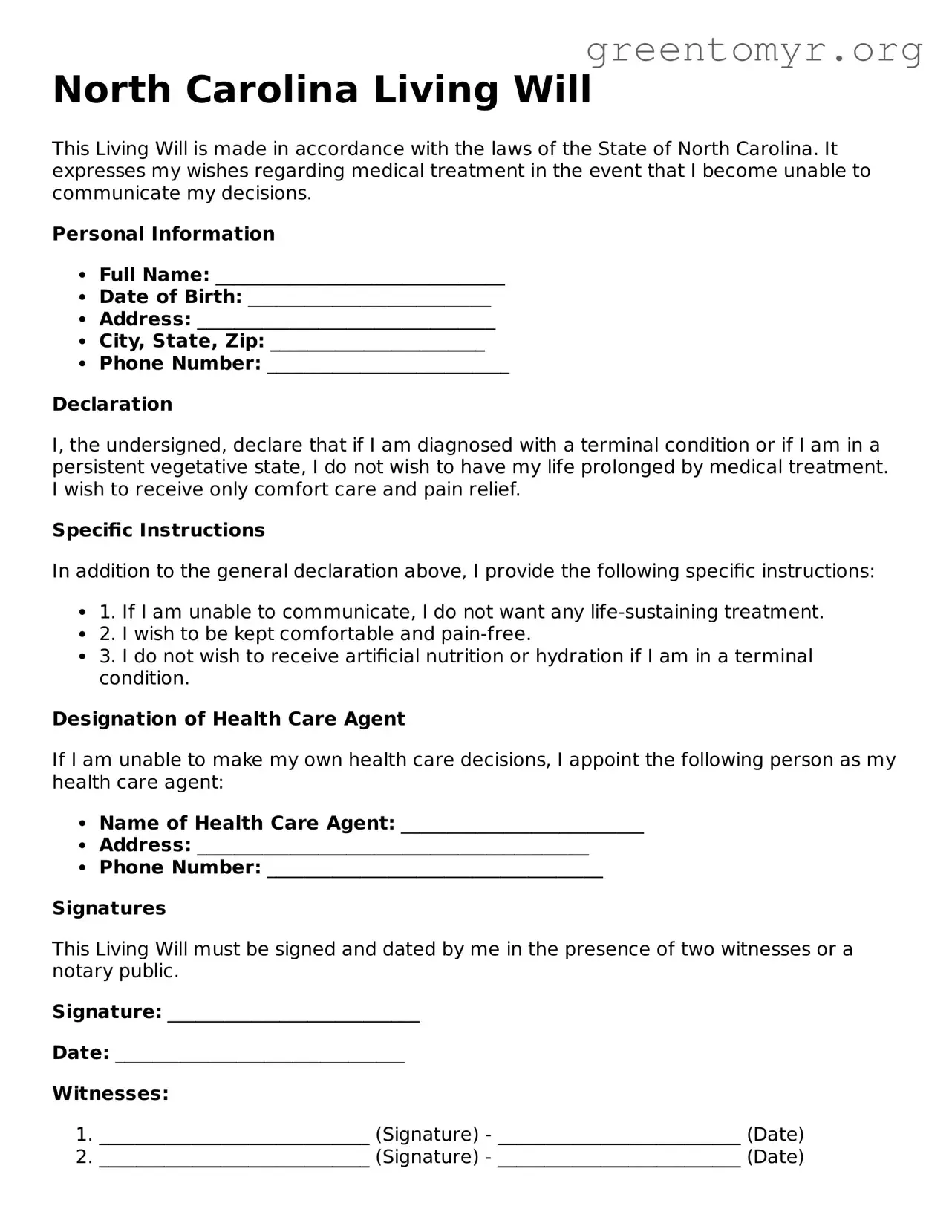
In North Carolina, the Living Will form serves as a vital tool for individuals who wish to express their healthcare preferences in advance, particularly in situations where they may be unable to communicate their wishes due to a medical condition. This legal document outlines specific instructions regarding the types of medical treatments one desires or does not desire, especially in end-of-life scenarios. By clearly stating preferences about life-sustaining measures, such as resuscitation and artificial nutrition, individuals can ensure their values and wishes are respected. The form also allows for the appointment of a healthcare agent, who can make decisions on behalf of the individual if they are incapacitated. Understanding the importance of this document is crucial, as it provides peace of mind for both the individual and their loved ones, guiding healthcare providers in making choices that align with the patient’s desires. In a world where medical technology can prolong life in ways that may not align with personal beliefs, the Living Will becomes an essential expression of autonomy and care planning.
North Carolina Living Will
This Living Will is made in accordance with the laws of the State of North Carolina. It expresses my wishes regarding medical treatment in the event that I become unable to communicate my decisions.
Personal Information
Declaration
I, the undersigned, declare that if I am diagnosed with a terminal condition or if I am in a persistent vegetative state, I do not wish to have my life prolonged by medical treatment. I wish to receive only comfort care and pain relief.
Specific Instructions
In addition to the general declaration above, I provide the following specific instructions:
Designation of Health Care Agent
If I am unable to make my own health care decisions, I appoint the following person as my health care agent:
Signatures
This Living Will must be signed and dated by me in the presence of two witnesses or a notary public.
Signature: ___________________________
Date: _______________________________
Witnesses:
This document is intended to provide guidance to my family and healthcare providers regarding my wishes. It is important that it be honored as per North Carolina law.
| Fact Name | Details |
|---|---|
| Purpose | A Living Will allows individuals to outline their preferences for medical treatment in case they become unable to communicate their wishes. |
| Governing Law | The North Carolina Living Will is governed by the North Carolina General Statutes, specifically Chapter 90, Article 3. |
| Eligibility | Any adult who is at least 18 years old can create a Living Will in North Carolina. |
| Signature Requirement | The document must be signed by the individual and witnessed by two individuals who are not related to the individual or entitled to any part of their estate. |
| Revocation | A Living Will can be revoked at any time by the individual, either verbally or in writing. |
| Healthcare Proxy | While a Living Will outlines medical preferences, it does not appoint a healthcare proxy. A separate document is needed for that purpose. |
| End-of-Life Decisions | The Living Will specifically addresses situations such as terminal illness, coma, or irreversible conditions where life-sustaining treatment may be withheld or withdrawn. |
| Distribution | It is advisable to provide copies of the Living Will to healthcare providers, family members, and anyone involved in the individual's care. |
After obtaining the North Carolina Living Will form, you will need to complete it accurately to ensure your wishes are clearly communicated. Follow the steps below to fill out the form correctly.
A Living Will is a legal document that allows individuals to express their wishes regarding medical treatment in the event they become unable to communicate those wishes themselves. It specifically addresses situations where a person is terminally ill or in a persistent vegetative state, outlining the types of medical interventions they do or do not want to receive.
In North Carolina, any adult who is at least 18 years old and of sound mind can create a Living Will. This means you should understand the implications of your decisions and be able to communicate your wishes clearly. It’s important to think carefully about your preferences regarding end-of-life care.
Your Living Will should include specific instructions regarding your medical treatment preferences. Common elements to consider include:
To create a Living Will, you can follow these steps:
No, you do not need a lawyer to create a Living Will in North Carolina. However, consulting with a legal professional can be beneficial, especially if you have complex medical situations or specific concerns. A lawyer can help ensure that your document is properly completed and meets all legal requirements.
Yes, you can change or revoke your Living Will at any time as long as you are of sound mind. To revoke it, simply destroy the original document and inform your healthcare providers and family members of your decision. If you wish to make changes, create a new Living Will that clearly states your updated preferences.
If you do not have a Living Will, your healthcare providers will follow standard medical protocols in emergencies. This may lead to treatments that you would not have wanted. Additionally, your family may be left to make difficult decisions without knowing your wishes, which can create stress and conflict among loved ones.
Once you have completed your Living Will, store it in a safe but accessible place. Inform your family members and healthcare providers about its location. It’s also a good idea to carry a copy with you or have a digital version available, so it can be easily accessed in case of an emergency.
Filling out a Living Will form in North Carolina is a significant step in ensuring that one's healthcare wishes are respected. However, many individuals make common mistakes that can lead to confusion or even invalidate the document. Recognizing these pitfalls can help ensure that the form accurately reflects one’s intentions.
One frequent error occurs when individuals fail to specify their preferences clearly. A Living Will should articulate specific wishes regarding medical treatment, but vague language can lead to misinterpretation. For example, stating “I don’t want any life-prolonging treatment” is clearer than simply saying “I don’t want treatment.” Clarity is key to avoiding potential disputes among family members or healthcare providers.
Another mistake is neglecting to date the form. A Living Will should be dated to establish its validity and to indicate that it is the most current expression of one’s wishes. Without a date, there may be uncertainty about whether the document is still relevant, especially if multiple versions exist.
Some people overlook the importance of signatures. In North Carolina, a Living Will must be signed by the individual creating it. Additionally, having witnesses sign the document is crucial. Failing to include the required number of witnesses can render the Living Will invalid. It’s essential to ensure that witnesses are not related to the individual or beneficiaries under the will.
Moreover, individuals sometimes forget to review the document after filling it out. Life circumstances and personal beliefs can change, and it is wise to revisit the Living Will periodically. Regular reviews ensure that the document continues to reflect current wishes and can help avoid confusion in the future.
Another common oversight involves not informing family members about the existence of the Living Will. It is vital for loved ones to know where the document is stored and what it entails. This communication can prevent misunderstandings during critical moments when decisions need to be made.
Some individuals may also fail to consider the implications of their choices. A Living Will should not only express desires regarding life-sustaining treatment but also take into account the potential outcomes of those choices. Understanding the medical conditions that may arise can lead to more informed decisions.
In addition, people sometimes mistakenly assume that a Living Will is the same as a Power of Attorney for Healthcare. While both documents serve important roles in healthcare decision-making, they have different functions. A Living Will outlines specific wishes regarding medical treatment, while a Power of Attorney designates someone to make decisions on one’s behalf if they are unable to do so.
Lastly, individuals may not realize that state laws can change. Keeping abreast of any legal updates regarding Living Wills in North Carolina is crucial. Laws can affect how documents are interpreted or enforced, and staying informed can help ensure that the Living Will remains valid and effective.
When considering end-of-life decisions, a North Carolina Living Will is an important document that outlines your preferences regarding medical treatment. However, there are several other forms and documents that can complement your Living Will, ensuring your wishes are respected and that your loved ones are informed. Below is a list of five additional documents often used alongside a Living Will.
Having these documents in place can provide peace of mind for both you and your loved ones. They ensure that your healthcare preferences are clearly communicated and respected, allowing for a more compassionate approach during difficult times. It is advisable to discuss these documents with your family and healthcare providers to ensure everyone is on the same page regarding your wishes.
A Living Will is an important document that outlines your preferences for medical treatment in case you are unable to communicate your wishes. Several other documents serve similar purposes in the realm of healthcare and end-of-life decisions. Here are four documents that are similar to a Living Will:
When filling out the North Carolina Living Will form, it is important to follow certain guidelines to ensure that your wishes are clearly communicated. Here are eight things to keep in mind:
Understanding the North Carolina Living Will form is essential for making informed decisions about healthcare preferences. However, several misconceptions can lead to confusion. Here are five common misconceptions:
This is not true. A Living Will specifically outlines your wishes regarding medical treatment in the event you become unable to communicate. In contrast, a Power of Attorney designates someone to make decisions on your behalf, which can include financial and healthcare decisions.
Many believe that a Living Will is only necessary during a terminal illness. In reality, anyone over the age of 18 can create a Living Will to express their healthcare preferences, regardless of their current health status.
While a Living Will is a legal document, its enforceability can depend on various factors, such as state laws and the specific circumstances of your healthcare situation. Medical professionals must also interpret your wishes in line with current medical standards.
This misconception is misleading. You have the right to modify or revoke your Living Will at any time, as long as you are mentally competent. It's important to communicate any changes to your healthcare providers and loved ones.
Assuming that family members will understand your healthcare preferences can lead to misunderstandings and conflict. A Living Will clearly documents your wishes, ensuring that they are followed even if family members disagree.
Filling out and using the North Carolina Living Will form is an important step in planning for your healthcare wishes. Here are some key takeaways to keep in mind:
Taking these steps can help ensure that your healthcare preferences are honored when it matters most.