Content Navigation

In North Carolina, when it comes to buying or selling a mobile home, having the right documentation is crucial for a smooth transaction. One of the key documents involved in this process is the Mobile Home Bill of Sale form. This form serves as a legal record of the sale, capturing essential details such as the names and addresses of both the buyer and seller, the mobile home’s identification number, and its make, model, and year. Additionally, it outlines the purchase price and any terms or conditions agreed upon by both parties. By completing this form, both the buyer and seller can protect their interests and ensure that the transfer of ownership is clear and legally binding. It's important to note that this document not only facilitates the sale but also plays a vital role in future transactions, as it may be required for titling or registering the mobile home with the state. Understanding the components of this form can help both buyers and sellers navigate the process with confidence.

North Carolina Mobile Home Bill of Sale Example

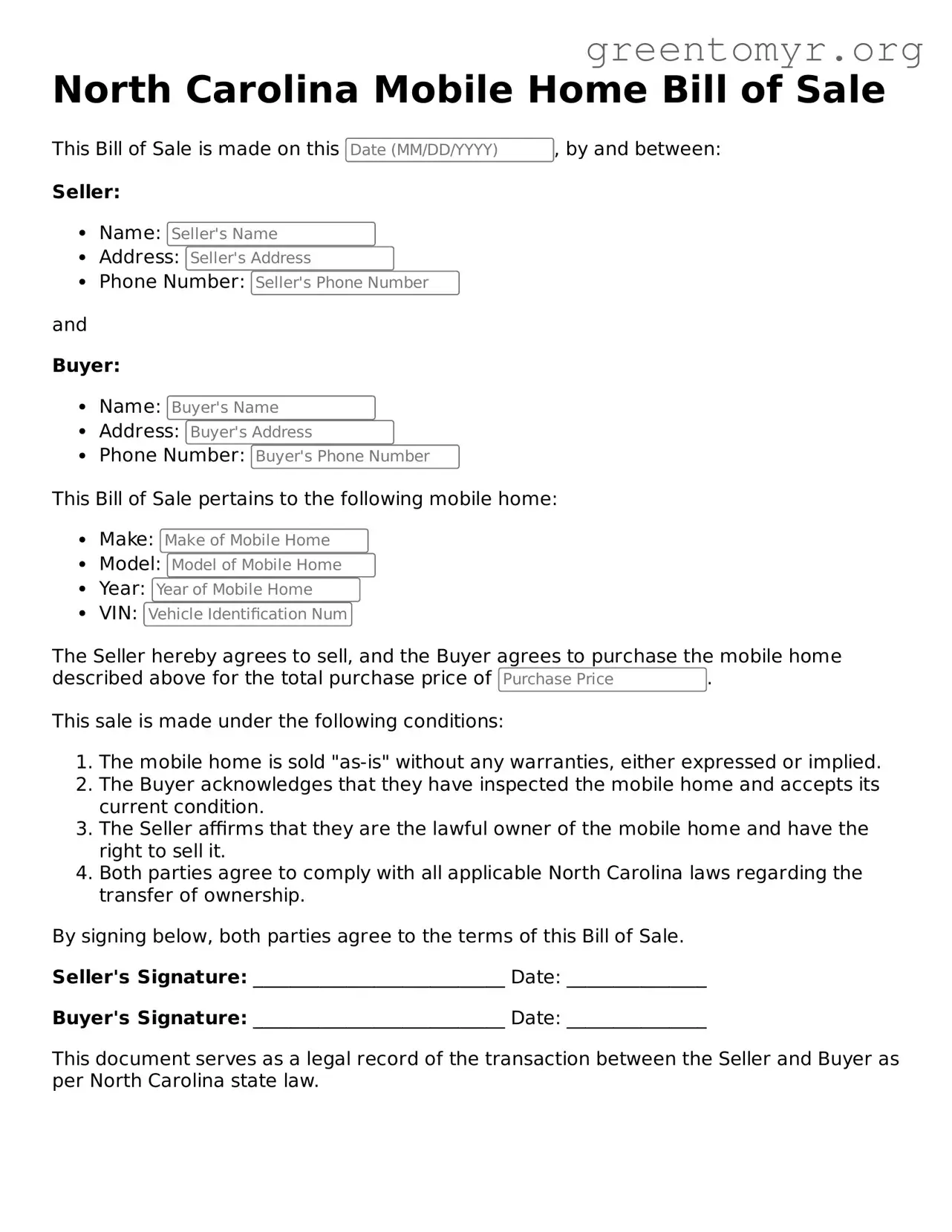
North Carolina Mobile Home Bill of Sale

This Bill of Sale is made on this , by and between:

Seller:

  • Name:
  • Address:
  • Phone Number:

and

Buyer:

  • Name:
  • Address:
  • Phone Number:

This Bill of Sale pertains to the following mobile home:

  • Make:
  • Model:
  • Year:
  • VIN:

The Seller hereby agrees to sell, and the Buyer agrees to purchase the mobile home described above for the total purchase price of .

This sale is made under the following conditions:

  1. The mobile home is sold "as-is" without any warranties, either expressed or implied.
  2. The Buyer acknowledges that they have inspected the mobile home and accepts its current condition.
  3. The Seller affirms that they are the lawful owner of the mobile home and have the right to sell it.
  4. Both parties agree to comply with all applicable North Carolina laws regarding the transfer of ownership.

By signing below, both parties agree to the terms of this Bill of Sale.

Seller's Signature: ___________________________ Date: _______________

Buyer's Signature: ___________________________ Date: _______________

This document serves as a legal record of the transaction between the Seller and Buyer as per North Carolina state law.

PDF Form Features

Fact Name Details
Purpose The North Carolina Mobile Home Bill of Sale form is used to document the sale of a mobile home, ensuring a clear transfer of ownership between the seller and buyer.
Governing Law This form is governed by North Carolina General Statutes, specifically under Chapter 105A, which pertains to mobile homes and personal property.
Required Information The form must include details such as the names and addresses of the seller and buyer, the mobile home’s description, and the sale price.
Notarization While notarization is not mandatory, it is highly recommended to add an extra layer of authenticity and protection for both parties involved.
Transfer of Title Completing this form is essential for transferring the title of the mobile home, which must be submitted to the North Carolina Department of Motor Vehicles.
Tax Implications Buyers should be aware that the sale may be subject to sales tax, and it is advisable to consult with a tax professional for guidance.
Record Keeping Both parties should retain a copy of the completed Bill of Sale for their records, as it serves as proof of the transaction and ownership transfer.

Guide to Using North Carolina Mobile Home Bill of Sale

After obtaining the North Carolina Mobile Home Bill of Sale form, you will need to fill it out carefully. This document is essential for transferring ownership of a mobile home. Once completed, the form should be signed by both the seller and the buyer to finalize the sale.

  1. Start by entering the date of the sale at the top of the form.
  2. Provide the full name and address of the seller. Make sure to include the city, state, and zip code.
  3. Next, enter the full name and address of the buyer, including city, state, and zip code.
  4. Fill in the mobile home details. This includes the make, model, year, and Vehicle Identification Number (VIN).
  5. Indicate the sale price of the mobile home clearly.
  6. Include any additional terms or conditions of the sale, if applicable.
  7. Both the seller and buyer should sign the form. Make sure to date the signatures.

Get Answers on North Carolina Mobile Home Bill of Sale

What is a Mobile Home Bill of Sale in North Carolina?

A Mobile Home Bill of Sale is a legal document that serves as proof of the sale and transfer of ownership of a mobile home in North Carolina. It outlines the details of the transaction, including the buyer and seller's information, the mobile home's description, and the sale price. This document is essential for both parties to ensure a clear record of the transfer.

Why is a Mobile Home Bill of Sale important?

This document is crucial for several reasons:

  • It provides legal protection for both the buyer and seller.
  • It helps in establishing ownership and can be used for registration purposes.
  • It may be required by lenders if the buyer is financing the purchase.
  • It serves as a record for tax purposes.

What information should be included in the Bill of Sale?

The Mobile Home Bill of Sale should include the following information:

  1. The names and addresses of both the buyer and seller.
  2. A detailed description of the mobile home, including make, model, year, and VIN (Vehicle Identification Number).
  3. The sale price and payment method.
  4. The date of the sale.
  5. Any warranties or disclosures related to the mobile home.

Do I need to have the Bill of Sale notarized?

While it is not legally required to have a Mobile Home Bill of Sale notarized in North Carolina, doing so can add an extra layer of security. A notarized document can help prevent disputes about the authenticity of the signatures and the agreement itself.

Can I create my own Mobile Home Bill of Sale?

Yes, you can create your own Mobile Home Bill of Sale. However, it is essential to ensure that all necessary information is included and that it complies with North Carolina laws. Many templates are available online that can assist you in drafting a comprehensive document.

What should I do after completing the Bill of Sale?

After completing the Mobile Home Bill of Sale, both the buyer and seller should keep a signed copy for their records. The buyer should also take the necessary steps to register the mobile home with the North Carolina DMV and obtain a title in their name.

Where can I find a Mobile Home Bill of Sale template?

Templates for a Mobile Home Bill of Sale can be found online through legal websites, real estate resources, or local government sites. It is advisable to choose a template that is specific to North Carolina to ensure compliance with state regulations.

Common mistakes

Filling out the North Carolina Mobile Home Bill of Sale form can be straightforward, but many people make common mistakes that can lead to complications down the line. One of the most frequent errors is not providing complete information about the mobile home. Buyers and sellers must ensure that all details, such as the make, model, year, and vehicle identification number (VIN), are accurately recorded. Missing or incorrect information can create confusion and may even affect ownership transfer.

Another common mistake involves the signatures on the form. Both the buyer and seller must sign the document for it to be legally binding. Sometimes, one party forgets to sign, or they may sign in the wrong place. This oversight can delay the transaction and cause issues with registration later on. It’s essential to double-check that all required signatures are present before submitting the form.

People often overlook the importance of including the sale price. While it may seem trivial, failing to list the agreed-upon price can lead to misunderstandings between the buyer and seller. Additionally, the absence of a sale price can complicate tax assessments and future transactions. Always ensure that the sale price is clearly stated on the form.

Lastly, many individuals neglect to keep a copy of the completed Bill of Sale for their records. This document serves as proof of the transaction and can be crucial if disputes arise in the future. Keeping a copy can provide peace of mind and help both parties in case they need to reference the agreement later. By avoiding these common mistakes, individuals can ensure a smoother transaction when buying or selling a mobile home in North Carolina.

Documents used along the form

The North Carolina Mobile Home Bill of Sale form is an essential document for transferring ownership of a mobile home. However, several other forms and documents are often used in conjunction with it to ensure a smooth transaction. Below is a list of these documents, each serving a specific purpose in the sale process.

  • Title Transfer Application: This form is required to officially transfer the title of the mobile home from the seller to the buyer. It includes details about the mobile home and both parties involved in the transaction.
  • Affidavit of Affixation: If the mobile home has been permanently affixed to a piece of land, this document certifies that it is no longer considered personal property. It helps clarify ownership and tax responsibilities.
  • Sales Tax Certification: This document confirms that the appropriate sales tax has been paid on the mobile home. It may be needed for registration purposes.
  • Purchase Agreement: This is a contract between the buyer and seller outlining the terms of the sale, including price, payment methods, and any contingencies. It protects both parties’ interests.
  • Inspection Report: An inspection report details the condition of the mobile home. It may be required by the buyer or lender to ensure that the home meets safety and quality standards.
  • Financing Agreement: If the buyer is financing the purchase, this document outlines the terms of the loan, including interest rates, repayment schedules, and any collateral involved.
  • Warranty Deed: If the mobile home is being sold along with the land it sits on, a warranty deed may be necessary. This document guarantees that the seller has the right to sell the property and that it is free from liens.
  • Release of Liens: This document is used to confirm that any existing liens on the mobile home have been cleared. It protects the buyer from any future claims against the property.

Using these documents alongside the North Carolina Mobile Home Bill of Sale can help ensure that the transaction is legally sound and protects the interests of both the buyer and seller. Proper documentation is crucial for a smooth transfer of ownership.

Similar forms

  • Vehicle Bill of Sale: Similar to the Mobile Home Bill of Sale, this document transfers ownership of a vehicle. It includes details like the buyer, seller, and vehicle identification number.
  • Real Estate Purchase Agreement: This agreement outlines the sale of real property. Like the Mobile Home Bill of Sale, it specifies the terms of the sale, including price and conditions.
  • Boat Bill of Sale: This document serves to transfer ownership of a boat. It includes similar information, such as the buyer, seller, and boat identification, mirroring the mobile home sale process.
  • Motorcycle Bill of Sale: Just as with mobile homes, this form transfers ownership of a motorcycle. It captures essential details about the transaction and the vehicle involved.
  • Aircraft Bill of Sale: This document facilitates the sale of an aircraft. It shares similarities in structure and purpose, detailing the buyer, seller, and aircraft information.
  • Personal Property Bill of Sale: This form transfers ownership of personal items, such as furniture or equipment. It serves a similar function as the Mobile Home Bill of Sale, documenting the transaction and the items involved.

Dos and Don'ts

When filling out the North Carolina Mobile Home Bill of Sale form, there are important steps to follow. Here’s a list of what to do and what to avoid.

  • Do provide accurate information about the mobile home, including its make, model, and VIN.
  • Do include the names and addresses of both the seller and the buyer.
  • Do sign and date the form to make it legally binding.
  • Do keep a copy of the completed form for your records.
  • Don't leave any sections blank; incomplete forms can lead to issues.
  • Don't use incorrect or outdated information; double-check all details.
  • Don't forget to check local regulations, as they may affect the sale.
  • Don't rush the process; take your time to ensure everything is correct.

Misconceptions

Understanding the North Carolina Mobile Home Bill of Sale form is crucial for anyone involved in the buying or selling of mobile homes. However, several misconceptions can lead to confusion. Here are nine common misunderstandings:

  1. The form is not legally required. Many believe that a bill of sale is optional. In reality, having this document protects both the buyer and seller by providing proof of the transaction.
  2. It is only necessary for new mobile homes. Some think the form is only needed for new purchases. However, it is equally important for used mobile homes to establish ownership transfer.
  3. Any written agreement suffices. While a written agreement is important, it must meet specific criteria to be valid. The Mobile Home Bill of Sale form is designed to meet these legal requirements.
  4. The seller must be the original owner. There is a misconception that only the original owner can sell a mobile home. In fact, anyone with legal ownership can sell their mobile home, provided they have the right documentation.
  5. It does not need to be notarized. Many people think that notarization is unnecessary. However, having the bill of sale notarized can add an extra layer of security and legitimacy to the transaction.
  6. It is only for private sales. Some believe that the bill of sale is only for transactions between individuals. In truth, it is also used in sales involving dealers or companies.
  7. It does not require a description of the mobile home. Some may think that a simple statement of sale is enough. However, a detailed description, including the make, model, and VIN, is essential for clarity and legal purposes.
  8. Once signed, it cannot be changed. There is a belief that the bill of sale is final and unchangeable. In reality, parties can amend the document if both agree, but this should be documented properly.
  9. It is not necessary for transferring titles. Many people are unaware that the bill of sale is often required to transfer the title of the mobile home. Without it, the title transfer may not be recognized by the DMV.

Being informed about these misconceptions can help ensure a smoother transaction process when buying or selling a mobile home in North Carolina.

Key takeaways

When filling out and using the North Carolina Mobile Home Bill of Sale form, keep the following key takeaways in mind:

  • Ensure all parties involved are identified clearly, including full names and addresses.
  • Provide accurate details about the mobile home, including the make, model, year, and Vehicle Identification Number (VIN).
  • Specify the sale price of the mobile home to avoid future disputes.
  • Include any warranties or guarantees regarding the condition of the mobile home.
  • Both the buyer and seller must sign the form to make it legally binding.
  • Consider having the document notarized to add an extra layer of authenticity.
  • Retain a copy of the completed Bill of Sale for your records.
  • Check local regulations to ensure compliance with any additional requirements for mobile home sales.

Taking these steps will help facilitate a smooth transaction and protect the interests of both parties involved.