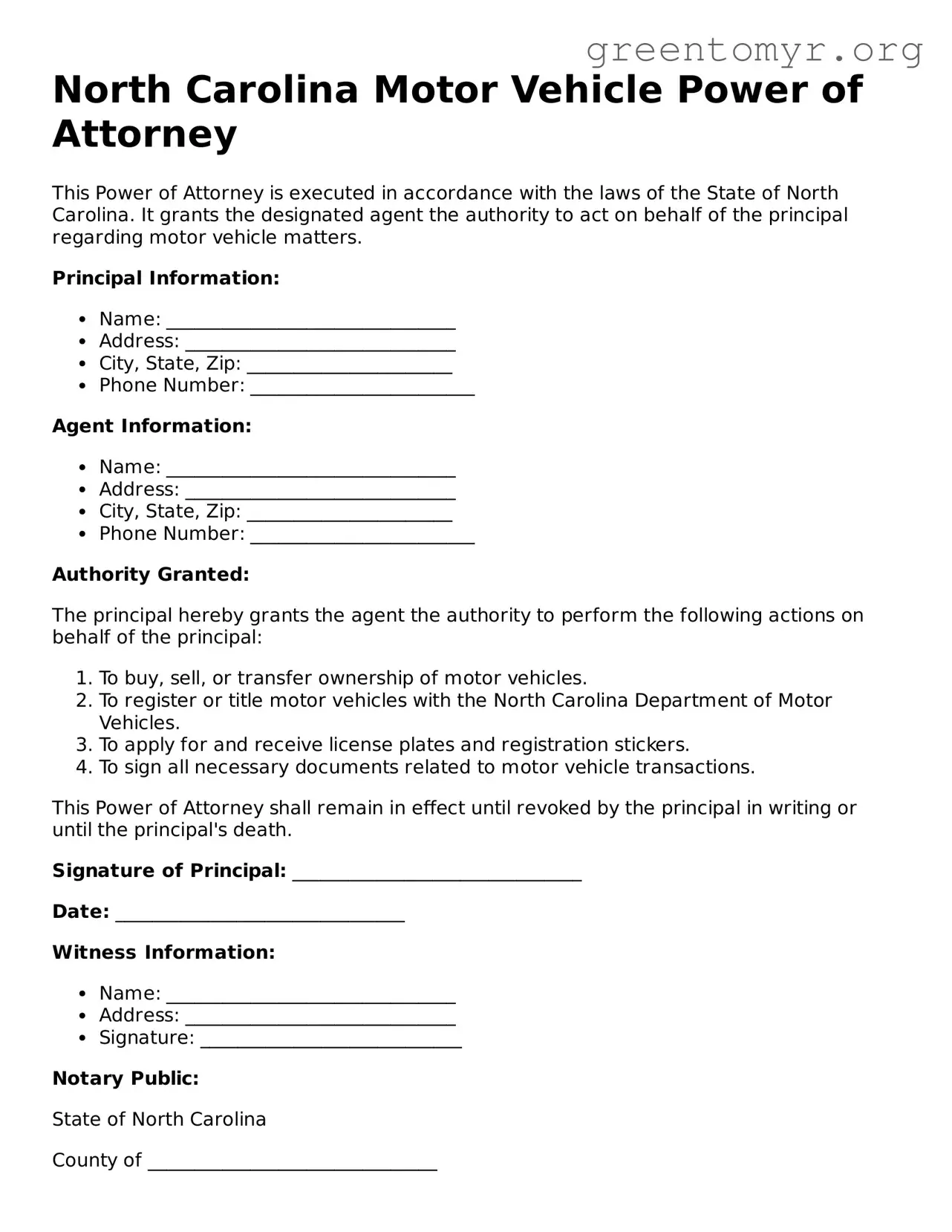
The North Carolina Motor Vehicle Power of Attorney form is a crucial document that empowers an individual to act on behalf of another person in matters related to motor vehicle transactions. This form is particularly important for those who may be unable to handle their vehicle-related affairs due to various reasons, such as illness, absence, or other constraints. It allows the designated agent to perform tasks such as registering a vehicle, transferring ownership, or obtaining a title. By completing this form, the principal grants specific authority to their agent, ensuring that all actions taken are legally binding. It is essential to understand the scope of authority granted and the responsibilities that come with it. Properly executed, this form can facilitate smooth transactions and prevent potential complications. Timeliness in completing and submitting the form is vital, especially when dealing with impending deadlines or necessary vehicle registrations. Overall, the North Carolina Motor Vehicle Power of Attorney form serves as a practical solution for managing motor vehicle affairs efficiently and effectively.
North Carolina Motor Vehicle Power of Attorney
This Power of Attorney is executed in accordance with the laws of the State of North Carolina. It grants the designated agent the authority to act on behalf of the principal regarding motor vehicle matters.
Principal Information:
Agent Information:
Authority Granted:
The principal hereby grants the agent the authority to perform the following actions on behalf of the principal:
This Power of Attorney shall remain in effect until revoked by the principal in writing or until the principal's death.
Signature of Principal: _______________________________
Date: _______________________________
Witness Information:
Notary Public:
State of North Carolina
County of _______________________________
Subscribed and sworn before me on this _____ day of __________, 20__.
Notary Signature: _______________________________
My Commission Expires: ________________________
| Fact Name | Details |
|---|---|
| Purpose | The North Carolina Motor Vehicle Power of Attorney form allows an individual to designate another person to handle motor vehicle transactions on their behalf. |
| Governing Law | This form is governed by North Carolina General Statutes, specifically Chapter 32A and Chapter 20. |
| Who Can Be an Agent | Any competent adult can be appointed as an agent to act on behalf of the principal in motor vehicle matters. |
| Revocation | The power of attorney can be revoked at any time by the principal, provided they notify the agent and any relevant parties. |
| Signature Requirement | The form must be signed by the principal in the presence of a notary public to be valid. |
| Specific Transactions | It can be used for various transactions, including title transfers, registrations, and obtaining duplicate titles. |
| Duration | The authority granted by this form remains in effect until revoked or until the principal's death. |
| Form Availability | The form is available through the North Carolina Department of Motor Vehicles and can often be found online. |
| Limitations | This power of attorney is limited to motor vehicle matters and does not extend to other types of property or legal issues. |
Filling out the North Carolina Motor Vehicle Power of Attorney form is a straightforward process that allows you to designate someone to handle specific motor vehicle-related tasks on your behalf. After completing the form, you will need to ensure it is signed and submitted according to the requirements set by the North Carolina Department of Motor Vehicles.
A Motor Vehicle Power of Attorney (POA) in North Carolina is a legal document that allows an individual (the principal) to appoint another person (the agent) to handle specific tasks related to motor vehicles on their behalf. This may include buying, selling, or transferring ownership of a vehicle, as well as signing necessary documents for these transactions.
Any competent adult can serve as an agent. This could be a family member, friend, or even a professional, such as an attorney or a car dealer. It is essential that the person you choose is trustworthy and understands the responsibilities involved in managing your vehicle-related matters.
To create a Motor Vehicle Power of Attorney in North Carolina, follow these steps:
Yes, the Motor Vehicle Power of Attorney must be notarized to be valid. Notarization adds a layer of authenticity and helps prevent fraud, ensuring that both parties are protected during the transaction.
Yes, you can revoke a Motor Vehicle Power of Attorney at any time, as long as you are mentally competent. To do so, you should create a written revocation document and notify your agent and any relevant parties, such as the Department of Motor Vehicles, to ensure that your previous agent is no longer authorized to act on your behalf.
You can grant your agent a range of powers, including:
The Motor Vehicle Power of Attorney does not have a set expiration date unless specified in the document itself. It remains valid until you revoke it or until the task for which it was created is completed. If you want to limit its duration, you should clearly state the time frame in the form.
If you suspect that your agent is misusing the Power of Attorney, it is crucial to act quickly. You can revoke the POA immediately and inform the relevant authorities, such as the Department of Motor Vehicles. If necessary, consult with a legal professional to discuss potential actions you can take to protect your interests.
The Motor Vehicle Power of Attorney form can be obtained from the North Carolina Department of Transportation's website or local DMV offices. Ensure that you are using the most current version of the form to avoid any issues during your transaction.
Filling out the North Carolina Motor Vehicle Power of Attorney form can seem straightforward, but many people make common mistakes that can lead to delays or complications. One frequent error is not providing accurate information. For instance, if the vehicle identification number (VIN) is incorrect, it can create confusion and invalidate the document.
Another mistake is failing to sign the form. A signature is crucial for the Power of Attorney to be valid. Without it, the document holds no legal weight. Additionally, people often overlook the need for a witness or notary. In North Carolina, having the form notarized can help ensure its acceptance by the DMV.
Some individuals forget to specify the exact powers being granted. It’s important to clearly outline what the agent can do on your behalf. Vague language can lead to misunderstandings or limit the agent's authority. In contrast, being too specific might unnecessarily restrict the agent's ability to act in your best interest.
Another common oversight is neglecting to date the form. A date is essential, as it indicates when the Power of Attorney takes effect. Without a date, the document may be questioned or rejected. Furthermore, people sometimes fail to provide their own contact information, which can hinder communication if any issues arise.
In addition, not keeping a copy of the completed form is a mistake that can lead to problems later on. Having a record of the document can be helpful for both the principal and the agent. It ensures that everyone is on the same page regarding the powers granted.
Lastly, individuals may not review the form for errors before submission. Simple typos or omissions can cause significant delays. Taking a moment to double-check the information can save time and prevent headaches down the road.
When dealing with the North Carolina Motor Vehicle Power of Attorney form, several other documents may be necessary to facilitate the transfer of vehicle ownership or management. Below is a list of commonly used forms that can complement the Power of Attorney.
These documents work together with the Motor Vehicle Power of Attorney form to ensure a smooth and legally compliant process for vehicle transactions in North Carolina.
When completing the North Carolina Motor Vehicle Power of Attorney form, it is essential to follow specific guidelines to ensure accuracy and compliance. Below is a list of things you should and shouldn't do during this process.
Understanding the North Carolina Motor Vehicle Power of Attorney form can be challenging. Here are seven common misconceptions that often arise regarding this important document:
Many people believe that this form is exclusively for selling a vehicle. In reality, it can also authorize someone to handle various tasks related to vehicle registration, title transfers, and more.
While the vehicle owner must sign the document, anyone can assist in completing it. This makes it easier for those who may need help understanding the requirements.
Some assume that notarization is a requirement for this form. However, it is not necessary unless specified by the party receiving the power of attorney.
People often think that once the form is signed, it cannot be revoked. In fact, the vehicle owner can revoke the power of attorney at any time, as long as they provide notice to the agent.
There is a misconception that a lawyer must draft the power of attorney. In North Carolina, individuals can complete the form themselves using a standard template.
While the form is specific to North Carolina, it may still be accepted in other states under certain conditions. Always check local regulations if you plan to use it outside of North Carolina.
Some believe that the power of attorney applies to all vehicles, but it specifically pertains to motor vehicles as defined by North Carolina law. This includes cars, trucks, and motorcycles, but not boats or trailers.
Clearing up these misconceptions can help ensure that individuals use the North Carolina Motor Vehicle Power of Attorney form effectively and understand its implications.
When dealing with the North Carolina Motor Vehicle Power of Attorney form, there are several important points to keep in mind. This document allows you to designate someone else to act on your behalf in matters related to your vehicle. Here are key takeaways to ensure you understand its use: