Content Navigation

In North Carolina, the Motorcycle Bill of Sale form serves as a crucial document for both buyers and sellers during the transfer of motorcycle ownership. This form not only provides a written record of the transaction but also protects the rights of both parties involved. Essential elements include the names and addresses of the buyer and seller, a detailed description of the motorcycle—including its make, model, year, and Vehicle Identification Number (VIN)—and the sale price. Additionally, the form may require the seller's signature, affirming that they have the legal right to sell the motorcycle. By documenting the sale, the Motorcycle Bill of Sale helps prevent disputes and serves as proof of ownership, which is particularly important for registering the motorcycle with the state. Understanding the importance of this form can facilitate a smoother transaction and ensure compliance with North Carolina's legal requirements regarding vehicle sales.

North Carolina Motorcycle Bill of Sale Example

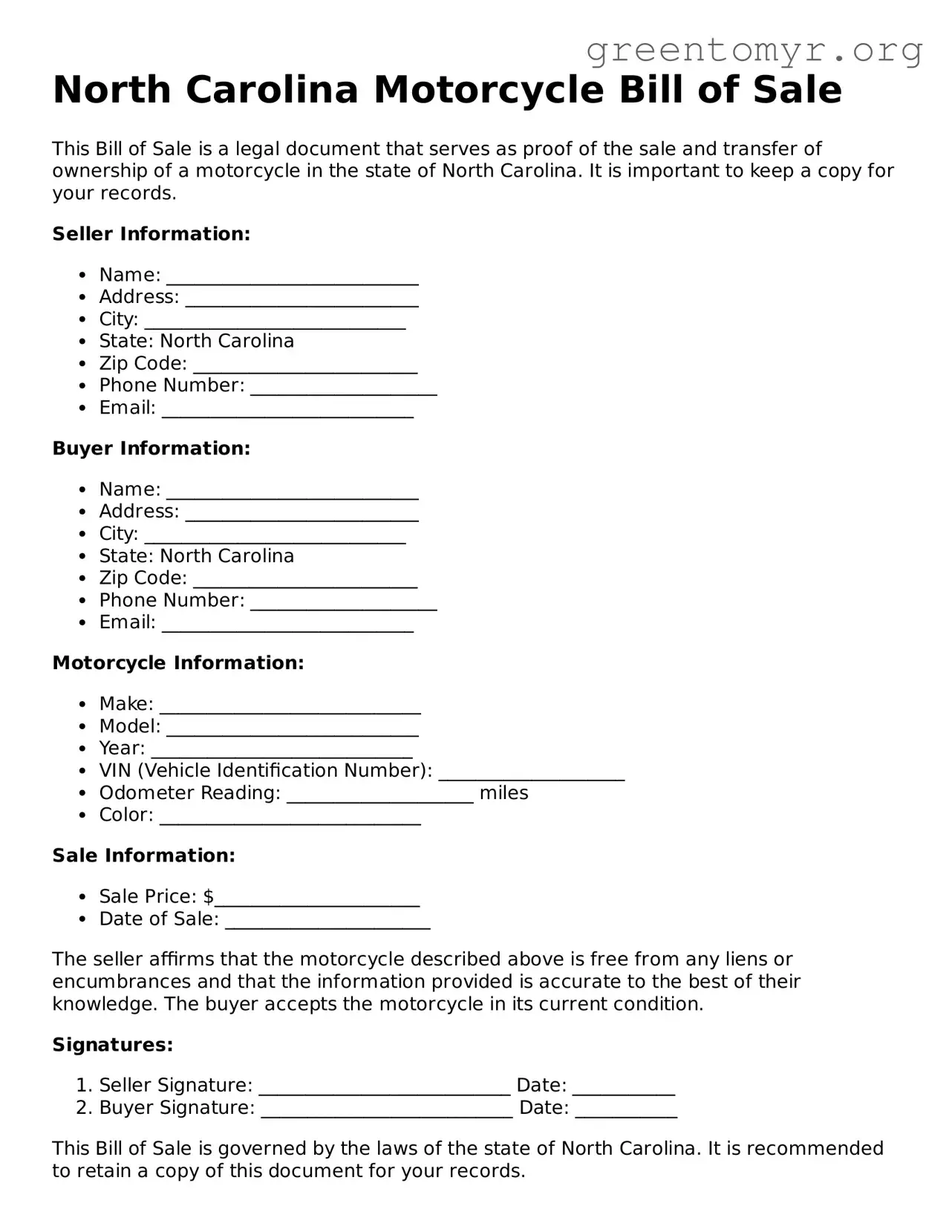
North Carolina Motorcycle Bill of Sale

This Bill of Sale is a legal document that serves as proof of the sale and transfer of ownership of a motorcycle in the state of North Carolina. It is important to keep a copy for your records.

Seller Information:

  • Name: ___________________________
  • Address: _________________________
  • City: ____________________________
  • State: North Carolina
  • Zip Code: ________________________
  • Phone Number: ____________________
  • Email: ___________________________

Buyer Information:

  • Name: ___________________________
  • Address: _________________________
  • City: ____________________________
  • State: North Carolina
  • Zip Code: ________________________
  • Phone Number: ____________________
  • Email: ___________________________

Motorcycle Information:

  • Make: ____________________________
  • Model: ___________________________
  • Year: ____________________________
  • VIN (Vehicle Identification Number): ____________________
  • Odometer Reading: ____________________ miles
  • Color: ____________________________

Sale Information:

  • Sale Price: $______________________
  • Date of Sale: ______________________

The seller affirms that the motorcycle described above is free from any liens or encumbrances and that the information provided is accurate to the best of their knowledge. The buyer accepts the motorcycle in its current condition.

Signatures:

  1. Seller Signature: ___________________________ Date: ___________
  2. Buyer Signature: ___________________________ Date: ___________

This Bill of Sale is governed by the laws of the state of North Carolina. It is recommended to retain a copy of this document for your records.

PDF Form Features

Fact Name Description
Purpose The North Carolina Motorcycle Bill of Sale form is used to document the sale of a motorcycle between a buyer and a seller.
Legal Requirement While not required by law, it is highly recommended to create a bill of sale for the transfer of ownership.
Information Included The form typically includes details such as the motorcycle's make, model, year, VIN, sale price, and the names and addresses of both parties.
Governing Laws This document is governed by North Carolina General Statutes, particularly § 20-72 regarding the transfer of motor vehicle ownership.
Signature Requirement Both the seller and buyer should sign the bill of sale to validate the transaction.
Record Keeping It is advisable for both parties to keep a copy of the bill of sale for their records.
Additional Uses The bill of sale can also be useful for tax purposes or to register the motorcycle in the buyer's name.

Guide to Using North Carolina Motorcycle Bill of Sale

Filling out the North Carolina Motorcycle Bill of Sale form is an important step in the process of transferring ownership of a motorcycle. This form serves as a record of the transaction between the buyer and the seller. Once completed, it can be used to register the motorcycle and ensure that all parties are clear on the details of the sale.

  1. Begin by entering the date of the sale at the top of the form. Make sure to use the format of month, day, and year.
  2. Next, provide the full name and address of the seller. This should include the street address, city, state, and zip code.
  3. Then, enter the full name and address of the buyer, using the same format as for the seller.
  4. In the designated section, write down the motorcycle's make, model, year, and Vehicle Identification Number (VIN). This information is crucial for identification purposes.
  5. Indicate the sale price of the motorcycle clearly. This is the amount the buyer agrees to pay the seller.
  6. Both the seller and buyer should sign and date the form. This step confirms that both parties agree to the terms outlined in the bill of sale.
  7. Finally, make copies of the completed form for both the seller and buyer. This provides each party with a record of the transaction.

Get Answers on North Carolina Motorcycle Bill of Sale

What is a Motorcycle Bill of Sale in North Carolina?

A Motorcycle Bill of Sale is a legal document that records the sale of a motorcycle between a buyer and a seller. It serves as proof of the transaction and includes important details about the motorcycle, the parties involved, and the terms of the sale. This document is essential for transferring ownership and can be used for registration purposes with the North Carolina Division of Motor Vehicles (DMV).

Why do I need a Motorcycle Bill of Sale?

The Motorcycle Bill of Sale is important for several reasons:

  • It provides legal proof of ownership for the buyer.
  • It protects the seller from future liabilities related to the motorcycle.
  • It is often required for registering the motorcycle with the DMV.
  • It can help resolve disputes regarding the sale.

What information should be included in the Motorcycle Bill of Sale?

A comprehensive Motorcycle Bill of Sale should include the following information:

  1. The names and addresses of both the buyer and seller.
  2. The motorcycle's make, model, year, and Vehicle Identification Number (VIN).
  3. The sale price of the motorcycle.
  4. The date of the sale.
  5. Any warranties or guarantees provided by the seller.
  6. Signatures of both parties.

Is a Motorcycle Bill of Sale required in North Carolina?

While a Motorcycle Bill of Sale is not legally required in North Carolina, it is highly recommended. Having this document can simplify the process of transferring ownership and registering the motorcycle. It provides both parties with a clear record of the transaction.

Can I create my own Motorcycle Bill of Sale?

Yes, you can create your own Motorcycle Bill of Sale. There are templates available online that you can customize. However, ensure that all necessary information is included and that it complies with state requirements. Alternatively, you can obtain a pre-made form from the DMV or legal document services.

How do I complete the Motorcycle Bill of Sale?

To complete the Motorcycle Bill of Sale:

  1. Fill in the names and addresses of both the buyer and seller.
  2. Provide detailed information about the motorcycle, including the VIN.
  3. State the sale price clearly.
  4. Include the date of the transaction.
  5. Both parties should sign the document.

What should I do after completing the Motorcycle Bill of Sale?

After completing the Motorcycle Bill of Sale, both the buyer and seller should keep a copy for their records. The buyer should take the document to the DMV to register the motorcycle in their name. It may also be beneficial to notify the DMV of the sale to protect against future liabilities.

What if the motorcycle has a lien?

If the motorcycle has a lien, it’s important to address this before completing the sale. The seller should provide documentation showing that the lien has been satisfied or arrange for the lien to be paid off at the time of sale. The Motorcycle Bill of Sale should note any existing liens to ensure transparency during the transaction.

Common mistakes

When filling out the North Carolina Motorcycle Bill of Sale form, many individuals make common mistakes that can lead to complications later. One frequent error is failing to provide complete information about the motorcycle. It's essential to include details such as the make, model, year, and Vehicle Identification Number (VIN). Omitting any of this information can create confusion and may even hinder the transfer of ownership.

Another mistake people often make is not signing the document. Both the seller and the buyer must sign the Bill of Sale for it to be valid. If either party forgets to sign, the document may not hold up if any disputes arise. Always double-check that all required signatures are present before submitting the form.

Additionally, many individuals overlook the importance of including the sale price. The Bill of Sale should clearly state the amount the buyer is paying for the motorcycle. This detail is not just a formality; it can affect taxes and registration fees. Leaving this section blank can lead to issues with the DMV or other authorities.

Finally, people sometimes fail to keep a copy of the completed Bill of Sale for their records. After the transaction, it’s crucial for both the buyer and seller to retain a copy of the document. This serves as proof of the sale and can be useful for future reference, especially if questions about ownership arise later.

Documents used along the form

When completing a motorcycle transaction in North Carolina, several important documents may accompany the Motorcycle Bill of Sale. Each document serves a specific purpose and helps ensure a smooth transfer of ownership. Below are some commonly used forms that you may need.

  • Title Transfer Form: This document is essential for officially transferring the ownership of the motorcycle from the seller to the buyer. It includes details about the motorcycle, such as the Vehicle Identification Number (VIN), and must be submitted to the DMV.
  • Application for Title: If the motorcycle is newly purchased or has never been titled, this form is required to obtain a title. It provides necessary information about the motorcycle and its new owner.
  • Odometer Disclosure Statement: This form is used to verify the motorcycle's mileage at the time of sale. It helps prevent fraud and ensures that the buyer is aware of the motorcycle's condition.
  • Affidavit of Ownership: In cases where the title is lost or unavailable, this affidavit can serve as proof of ownership. It may require the seller to provide additional information about the motorcycle and the circumstances surrounding the sale.

Having these documents ready can simplify the process and protect both parties involved in the transaction. Always ensure that all forms are completed accurately to avoid any complications down the line.

Similar forms

The Motorcycle Bill of Sale form serves as an important document in the transfer of ownership for motorcycles. It shares similarities with several other documents used in various transactions. Here are nine documents that are comparable to the Motorcycle Bill of Sale:

  • Vehicle Bill of Sale: Like the Motorcycle Bill of Sale, this document is used to transfer ownership of a motor vehicle. It includes details about the buyer, seller, and the vehicle itself.
  • Boat Bill of Sale: This form is similar in purpose, as it facilitates the transfer of ownership for boats. It contains relevant information about the boat and the parties involved.
  • Trailer Bill of Sale: Just as with motorcycles, a trailer bill of sale documents the sale of a trailer. It includes essential details to ensure a smooth transfer of ownership.
  • ATV Bill of Sale: This document is used for all-terrain vehicles. It serves the same function as the Motorcycle Bill of Sale, ensuring both parties agree on the sale terms.
  • Real Estate Purchase Agreement: While focused on property, this agreement outlines the terms of a sale, similar to how a Motorcycle Bill of Sale details the sale of a motorcycle.
  • Personal Property Bill of Sale: This form is used for the sale of various personal items. It provides proof of ownership transfer, akin to the motorcycle sale process.
  • Business Asset Bill of Sale: This document transfers ownership of business assets. It shares the same purpose of documenting the sale and protecting both parties involved.
  • Gun Bill of Sale: Similar to the Motorcycle Bill of Sale, this document is used to transfer ownership of firearms. It includes pertinent details about the buyer, seller, and the firearm.
  • Mobile Home Bill of Sale: This form is used for the sale of mobile homes. Like the Motorcycle Bill of Sale, it ensures that ownership is clearly transferred between parties.

Dos and Don'ts

When filling out the North Carolina Motorcycle Bill of Sale form, it's essential to be meticulous. This document serves as a legal record of the sale and can protect both the buyer and the seller. Here are some important dos and don'ts to keep in mind:

  • Do provide accurate information about the motorcycle, including make, model, year, and VIN.
  • Do include the purchase price clearly to avoid any misunderstandings.
  • Do have both the buyer and seller sign the form to validate the transaction.
  • Do keep a copy of the completed bill of sale for your records.
  • Do ensure that the date of the sale is clearly indicated on the form.
  • Don't leave any fields blank; incomplete forms can lead to complications.
  • Don't falsify information, such as the motorcycle's condition or ownership history.
  • Don't forget to check for any liens on the motorcycle before completing the sale.
  • Don't rush through the process; take your time to ensure everything is accurate.

By following these guidelines, you can help ensure a smooth transaction and avoid potential disputes in the future. The bill of sale is more than just a piece of paper; it’s a crucial part of your motorcycle’s history.

Misconceptions

Understanding the North Carolina Motorcycle Bill of Sale form is crucial for anyone involved in buying or selling a motorcycle. However, several misconceptions can lead to confusion. Here are eight common misunderstandings about this important document.

  • The Bill of Sale is not necessary for motorcycle transactions. Many people believe that a verbal agreement suffices. In reality, having a written Bill of Sale provides legal proof of the transaction.
  • Only the seller needs to sign the Bill of Sale. Some think that only the seller's signature is required. However, both the buyer and the seller should sign the document to validate the sale.
  • The Bill of Sale serves as a title. A common misconception is that the Bill of Sale can replace the motorcycle title. It cannot. The title is a separate document that proves ownership.
  • All states have the same Bill of Sale requirements. People often assume that motorcycle sale processes are uniform across the country. North Carolina has specific requirements that may differ from other states.
  • The Bill of Sale does not need to be notarized. Some individuals think notarization is optional. In North Carolina, notarizing the Bill of Sale is not mandatory, but it can add an extra layer of authenticity.
  • There is a specific form that must be used. Many believe that a state-issued form is the only option. While using a standard form can be helpful, any written document that includes the necessary information is acceptable.
  • The Bill of Sale is only for private sales. Some people think this document is only needed for sales between individuals. In fact, it is also useful for transactions involving dealerships or other businesses.
  • Once signed, the Bill of Sale cannot be changed. Many assume that the document is final and unchangeable. In reality, both parties can agree to amend the Bill of Sale as long as both consent to the changes.

By addressing these misconceptions, individuals can navigate the process of buying or selling a motorcycle in North Carolina with greater confidence and understanding.

Key takeaways

When dealing with the North Carolina Motorcycle Bill of Sale form, it’s essential to understand its significance and how to complete it correctly. Here are some key takeaways to keep in mind:

  • Purpose: The Motorcycle Bill of Sale serves as a legal document that records the transfer of ownership from the seller to the buyer.
  • Information Required: Complete details about the motorcycle, including the make, model, year, and Vehicle Identification Number (VIN), must be included.
  • Seller and Buyer Details: Both parties' names, addresses, and signatures are necessary for the form to be valid.
  • Purchase Price: Clearly state the purchase price to avoid any misunderstandings or disputes later on.
  • Date of Sale: The date on which the transaction occurs should be noted to establish a timeline for ownership transfer.
  • Notarization: While not always required, having the bill of sale notarized can add an extra layer of authenticity and protection.
  • Record Keeping: Both the buyer and seller should keep a copy of the completed bill of sale for their records. This can be useful for future reference or in case of disputes.
  • Registration: After the sale, the buyer must use the bill of sale to register the motorcycle with the North Carolina DMV to ensure legal ownership.

By following these guidelines, individuals can ensure a smooth transaction when buying or selling a motorcycle in North Carolina.