In the competitive landscape of North Carolina's job market, businesses often seek ways to protect their interests and maintain a strategic edge. One common tool they use is the Non-compete Agreement. This legal document serves to restrict employees from working for competitors or starting similar businesses within a specified timeframe and geographical area after leaving their current employer. By outlining the terms of employment and post-employment restrictions, the Non-compete Agreement aims to safeguard trade secrets, client relationships, and proprietary information. It is essential for both employers and employees to understand the implications of this agreement, as it can significantly impact career opportunities and business operations. Clarity in the language and stipulations of the agreement can help prevent misunderstandings and legal disputes down the line. As such, knowing how to properly draft, execute, and enforce this document is crucial for anyone navigating the employment landscape in North Carolina.
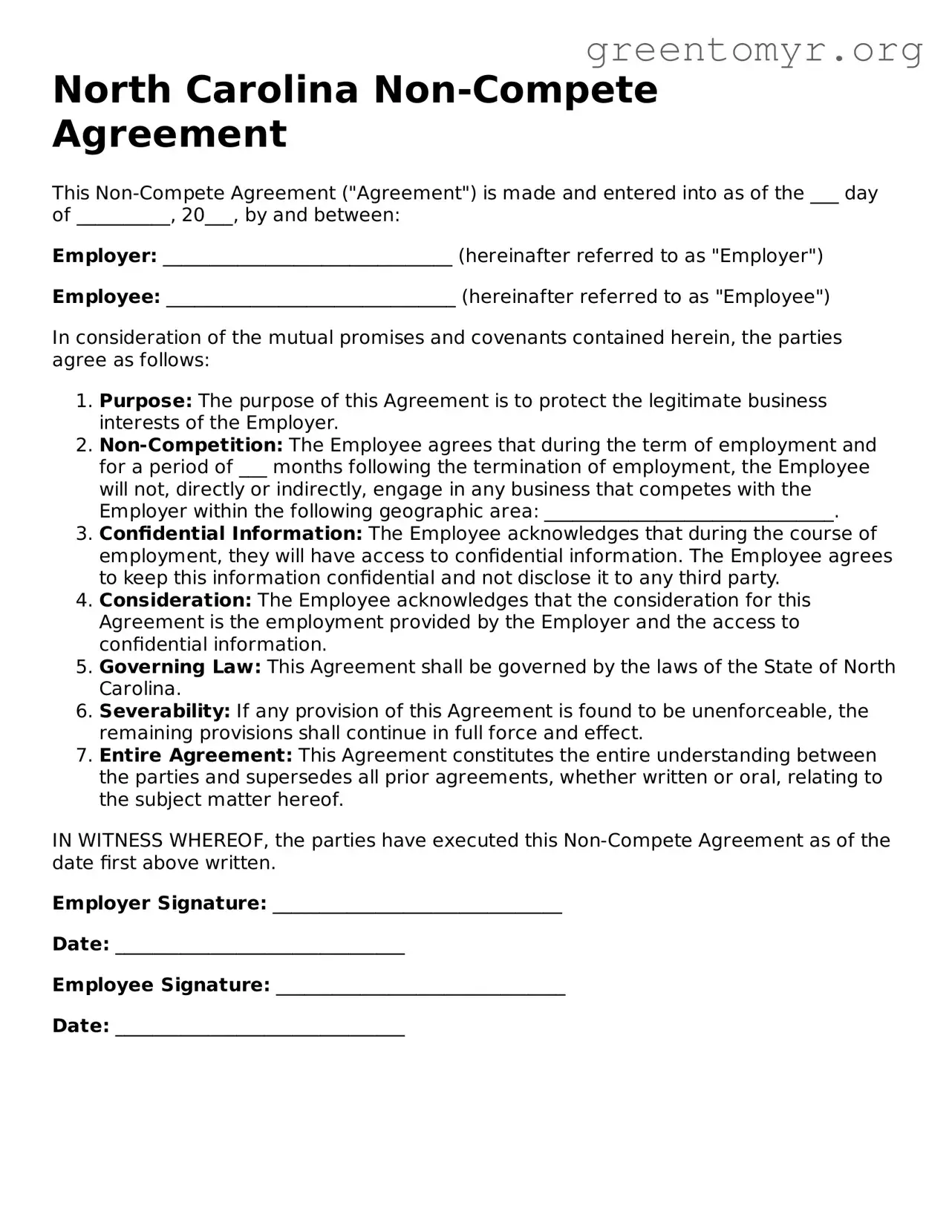
North Carolina Non-Compete Agreement
This Non-Compete Agreement ("Agreement") is made and entered into as of the ___ day of __________, 20___, by and between:
Employer: _______________________________ (hereinafter referred to as "Employer")
Employee: _______________________________ (hereinafter referred to as "Employee")
In consideration of the mutual promises and covenants contained herein, the parties agree as follows:
IN WITNESS WHEREOF, the parties have executed this Non-Compete Agreement as of the date first above written.
Employer Signature: _______________________________
Date: _______________________________
Employee Signature: _______________________________
Date: _______________________________
| Fact Name | Description |
|---|---|
| Governing Law | The North Carolina Non-compete Agreement is governed by North Carolina General Statutes, specifically Chapter 75-4.1. |
| Enforceability | Non-compete agreements in North Carolina are enforceable only if they are reasonable in time, geographic area, and scope of activity. |
| Time Limit | Typically, non-compete agreements should not exceed a duration of two years to be considered reasonable. |
| Geographic Scope | The geographic area covered by the agreement must be limited to the area where the employee worked or had a significant impact. |
| Consideration | For a non-compete agreement to be valid, there must be adequate consideration, such as a job offer or promotion. |
| Judicial Review | Courts in North Carolina have the authority to modify overly broad non-compete agreements to make them enforceable. |
To complete the North Carolina Non-compete Agreement form, gather the necessary information about the parties involved and the terms of the agreement. Ensure that all details are accurate and clearly stated. Following these steps will help ensure that the form is filled out correctly.
A Non-compete Agreement is a legal contract between an employer and an employee. It restricts the employee from working for competitors or starting a similar business for a specified period after leaving the employer. In North Carolina, these agreements are enforceable under certain conditions.
Yes, Non-compete Agreements can be enforceable in North Carolina, but they must meet specific criteria. The agreement should be reasonable in terms of time, geographic area, and the scope of activities restricted. Courts will often review these factors to determine enforceability.
For a Non-compete Agreement to be enforceable in North Carolina, consider the following factors:
The duration of a Non-compete Agreement in North Carolina varies. Generally, agreements lasting between six months to two years are considered reasonable. However, the specific circumstances of the employment relationship can influence this duration.
Yes, employees can negotiate the terms of a Non-compete Agreement. It’s advisable to discuss any concerns or desired changes with your employer before signing. Clear communication can lead to a more favorable agreement for both parties.
If you violate a Non-compete Agreement, your former employer may take legal action against you. This could include seeking an injunction to prevent you from working for a competitor or pursuing monetary damages. The outcome often depends on the enforceability of the agreement and the specifics of the violation.
Yes, there are exceptions. For example, in North Carolina, Non-compete Agreements may not be enforceable against certain professionals, such as employees in the medical field. Additionally, if the agreement is deemed overly restrictive or not in the public interest, it may be invalidated by a court.
To ensure your Non-compete Agreement is valid, consider the following steps:
Getting out of a Non-compete Agreement can be challenging but not impossible. If you believe the agreement is unreasonable or unenforceable, you may seek legal advice. A lawyer can help you understand your options, which may include negotiating with your former employer or challenging the agreement in court.
If you have more questions about your Non-compete Agreement, consider reaching out to a legal professional. They can provide personalized guidance based on your specific situation. Additionally, reviewing the terms of the agreement carefully and discussing any uncertainties with your employer can be beneficial.
When filling out the North Carolina Non-compete Agreement form, individuals often overlook critical details that can impact the enforceability of the agreement. One common mistake is failing to clearly define the scope of the agreement. The document should specify the type of activities that are restricted. Without a precise description, the agreement may be deemed too broad and therefore unenforceable.
Another frequent error is neglecting to include a reasonable duration for the non-compete clause. North Carolina courts typically look for a time frame that is justifiable based on the nature of the business and the role of the employee. An excessively long duration can lead to challenges in court, as it may be viewed as overly restrictive.
People also often forget to consider the geographic area covered by the agreement. The specified area should be relevant to the business interests at stake. If the geographic limitations are too expansive, the agreement risks being invalidated. A well-defined area helps protect legitimate business interests while allowing the employee some freedom to work.
Lastly, many individuals fail to seek legal advice before signing or drafting the agreement. Understanding the implications of a non-compete is crucial. Consulting with a legal professional can help ensure that the agreement is fair and enforceable, protecting both the employer's interests and the employee's right to work.
When engaging in a Non-compete Agreement in North Carolina, several other documents may be utilized to ensure clarity and legal compliance. These forms help outline the terms and conditions of the agreement, protecting both parties involved. Below is a list of commonly associated documents.
Utilizing these documents alongside the Non-compete Agreement can provide a comprehensive framework for both employers and employees. Each document serves a specific purpose and contributes to a clearer understanding of rights and responsibilities within the employment relationship.
Non-disclosure Agreement (NDA): Like a Non-compete Agreement, an NDA aims to protect sensitive information. While the Non-compete Agreement restricts a person's ability to work in certain industries or with specific competitors, the NDA focuses on preventing the sharing of confidential information. Both documents are designed to safeguard business interests.
Employment Agreement: An Employment Agreement outlines the terms of employment, including job responsibilities, salary, and duration of employment. Similar to a Non-compete Agreement, it may contain clauses that limit the employee's actions during and after their employment to protect the employer’s interests.
Confidentiality Agreement: A Confidentiality Agreement, often used interchangeably with an NDA, restricts the sharing of proprietary information. It serves a similar purpose to a Non-compete Agreement by protecting a company’s intellectual property and trade secrets from being disclosed or used by former employees.
Severance Agreement: A Severance Agreement provides terms for an employee's departure, including any compensation and benefits. It may also include a Non-compete clause, thereby restricting the employee's future employment opportunities in a manner similar to a standalone Non-compete Agreement.
When filling out the North Carolina Non-compete Agreement form, it is important to follow certain guidelines to ensure that the document is completed correctly and is enforceable. Below is a list of things you should and shouldn't do.
Non-compete agreements are often misunderstood. Here are nine common misconceptions about the North Carolina Non-compete Agreement form.
Understanding these misconceptions can help individuals navigate their rights and responsibilities regarding non-compete agreements in North Carolina.
When dealing with a Non-compete Agreement in North Carolina, it is important to understand several key points. Here are some takeaways to keep in mind:
By keeping these points in mind, individuals and businesses can better navigate the complexities of Non-compete Agreements in North Carolina.