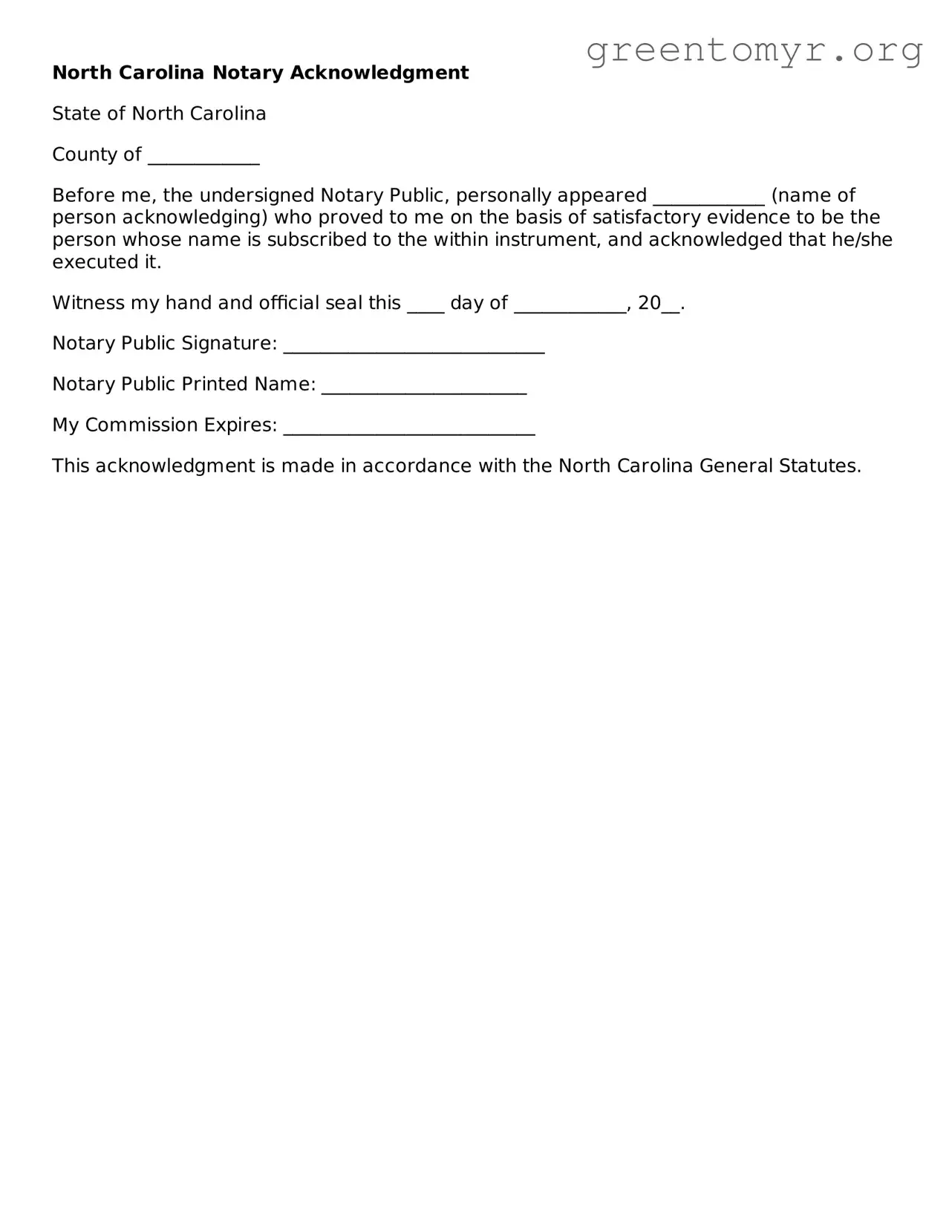
The North Carolina Notary Acknowledgment form serves a crucial role in the notarization process, providing a reliable method for verifying the identity of individuals signing important documents. This form ensures that the signer is doing so willingly and understands the contents of the document. It includes essential details such as the name of the signer, the date of the acknowledgment, and the notary's signature and seal. By capturing this information, the form enhances the integrity of legal transactions and helps prevent fraud. Additionally, the North Carolina Notary Acknowledgment form is often required for various legal documents, including deeds, contracts, and powers of attorney, making it an indispensable tool for both individuals and businesses. Understanding how to properly complete this form is vital for anyone involved in legal documentation in North Carolina.
North Carolina Notary Acknowledgment
State of North Carolina
County of ____________
Before me, the undersigned Notary Public, personally appeared ____________ (name of person acknowledging) who proved to me on the basis of satisfactory evidence to be the person whose name is subscribed to the within instrument, and acknowledged that he/she executed it.
Witness my hand and official seal this ____ day of ____________, 20__.
Notary Public Signature: ____________________________
Notary Public Printed Name: ______________________
My Commission Expires: ___________________________
This acknowledgment is made in accordance with the North Carolina General Statutes.
| Fact Name | Details |
|---|---|
| Governing Law | The North Carolina Notary Acknowledgment form is governed by N.C. Gen. Stat. § 10B-3. |
| Purpose | This form is used to verify the identity of the signer and confirm their willingness to sign a document. |
| Signer's Presence | The signer must be present in front of the notary at the time of the acknowledgment. |
| Identification | A notary must verify the signer's identity using a government-issued photo ID or other acceptable forms of identification. |
| Signature Requirement | The signer must provide their signature on the document in the presence of the notary. |
| Notary's Role | The notary public's role is to witness the signing and complete the acknowledgment section of the document. |
| Record Keeping | Notaries are required to keep a record of all acknowledgments in their notary journal. |
| Expiration | The acknowledgment does not expire, but the notary's commission must be current and valid. |
| Legal Effect | An acknowledgment serves as proof that the signer has willingly signed the document, which can be important in legal contexts. |
Once you have the North Carolina Notary Acknowledgement form in hand, you'll need to complete it accurately to ensure it meets legal requirements. Follow these steps carefully to fill out the form correctly.
After completing the form, ensure that all information is accurate and legible. The form is now ready for submission or filing as required.
A Notary Acknowledgment is a formal declaration made before a notary public. It verifies that the person signing a document has done so willingly and understands the contents of the document. This process helps prevent fraud and ensures that the signer's identity is confirmed. In North Carolina, this acknowledgment is often required for documents such as deeds, contracts, and powers of attorney.
Completing a Notary Acknowledgment form involves a few key steps:
It's important to ensure that all information is accurate and that you have proper identification when meeting with the notary.
In North Carolina, a notary public must meet certain criteria to serve. The individual must be at least 18 years old, a resident of North Carolina or have a place of employment in the state, and must have completed a notary training course. Additionally, they must pass an examination and submit an application to the Secretary of State. Once appointed, notaries are authorized to perform acknowledgments, administer oaths, and certify documents.
While the terms are often used interchangeably, they are not exactly the same. A Notary Acknowledgment specifically refers to the act of confirming that a signature is genuine and that the signer has willingly signed the document. Notarization, on the other hand, encompasses a broader range of services provided by a notary public, including witnessing signatures, administering oaths, and certifying copies of documents.
If a Notary Acknowledgment is not completed correctly, it may lead to complications. The document may not be accepted by courts, banks, or other entities that require notarization. Common issues include missing signatures, incorrect information, or lack of the notary's seal. To avoid these problems, it is crucial to ensure that the acknowledgment is filled out properly and that all parties involved understand the process.
Filling out the North Carolina Notary Acknowledgement form can seem straightforward, yet many individuals encounter pitfalls that can lead to complications. One common mistake is failing to include the correct date. The date is crucial because it indicates when the notarial act took place. If the date is omitted or incorrect, it may raise questions about the validity of the document.
Another frequent error involves the identification of the signer. The form requires that the notary accurately record the name of the individual whose signature is being acknowledged. Omitting a middle name or misspelling the name can create issues later, especially if the document is challenged. It’s essential to ensure that the name matches the identification presented at the time of signing.
In addition to name discrepancies, people often neglect to confirm that the signer is present at the time of the acknowledgment. The notary must witness the signing of the document. If the signer is not physically present, the acknowledgment is invalid. This requirement emphasizes the importance of the notary’s role in verifying the identity and intent of the signer.
Another mistake is failing to provide the notary’s signature and seal. A notary acknowledgment is not complete without these elements. The absence of a signature or seal can render the acknowledgment ineffective, potentially leading to legal challenges. Always double-check that both are present before submitting the document.
Some individuals overlook the importance of the notary’s commission details. The form requires the notary to include their commission expiration date. If this information is missing, it may create uncertainty about the authority of the notary at the time of the acknowledgment. Keeping this information accurate and up-to-date is crucial.
People also sometimes forget to use the correct format for the acknowledgment. The North Carolina Notary Acknowledgment form has specific language that must be adhered to. Deviating from this language can invalidate the acknowledgment. It’s advisable to follow the template closely to avoid any issues.
Another area of confusion can arise from the type of document being acknowledged. Not all documents require a notary acknowledgment. Understanding which documents necessitate this form is essential to avoid unnecessary steps. If a document does not require notarization, using the acknowledgment form can complicate the process.
Lastly, individuals may fail to keep copies of the completed acknowledgment. Retaining a copy is not just a good practice; it serves as a record of the transaction. If questions arise later, having a copy can provide clarity and protect all parties involved. Keeping organized records can save time and effort in the long run.
When engaging in various legal and official transactions in North Carolina, individuals often utilize the Notary Acknowledgment form. This form serves as a crucial document, verifying the identity of the signer and confirming their willingness to sign. However, it is commonly used alongside several other forms and documents to ensure that the entire process is smooth and legally sound. Below is a list of some of these documents.
Understanding these documents and their purposes can significantly aid individuals navigating legal processes in North Carolina. Each form plays a vital role in ensuring that agreements and transactions are clear, valid, and enforceable.
The Notary Acknowledgment form serves an important role in verifying the identity of individuals signing documents. Several other documents share similar functions, providing authentication and assurance in various legal contexts. Here’s a look at four documents that are similar to the Notary Acknowledgment form:
Each of these documents plays a vital role in legal proceedings and transactions, emphasizing the importance of authenticity and trust in the signing process.
When filling out the North Carolina Notary Acknowledgement form, it is important to follow certain guidelines to ensure accuracy and compliance. Here is a list of things you should and shouldn't do:
By following these guidelines, you can help ensure that the Notary Acknowledgement form is completed correctly and effectively. This will support the integrity of the notarization process.
Understanding the North Carolina Notary Acknowledgment form is essential for anyone involved in notarization processes. However, several misconceptions can lead to confusion. Here are five common misconceptions:
Being informed about these misconceptions can help ensure that the notarization process goes smoothly and that all parties understand their responsibilities. If you have further questions, consulting a legal professional may provide clarity.
When filling out and using the North Carolina Notary Acknowledgement form, it's important to keep the following key takeaways in mind:
By following these guidelines, you can ensure that the Notary Acknowledgement form is completed correctly and serves its intended purpose.