When starting a business in North Carolina, particularly a limited liability company (LLC), one of the most crucial documents you will encounter is the Operating Agreement form. This document serves as a foundational blueprint for how your LLC will operate, outlining the roles and responsibilities of members, management structure, and procedures for making important decisions. It addresses key aspects such as profit distribution, member voting rights, and procedures for adding or removing members. Importantly, while North Carolina does not legally require an Operating Agreement, having one in place can protect your business from potential disputes and provide clarity in operations. Furthermore, this agreement can enhance your LLC's credibility and establish a framework for resolving conflicts, should they arise. By detailing the internal workings of your business, the Operating Agreement not only safeguards your interests but also ensures that all members are on the same page regarding the direction and management of the company.
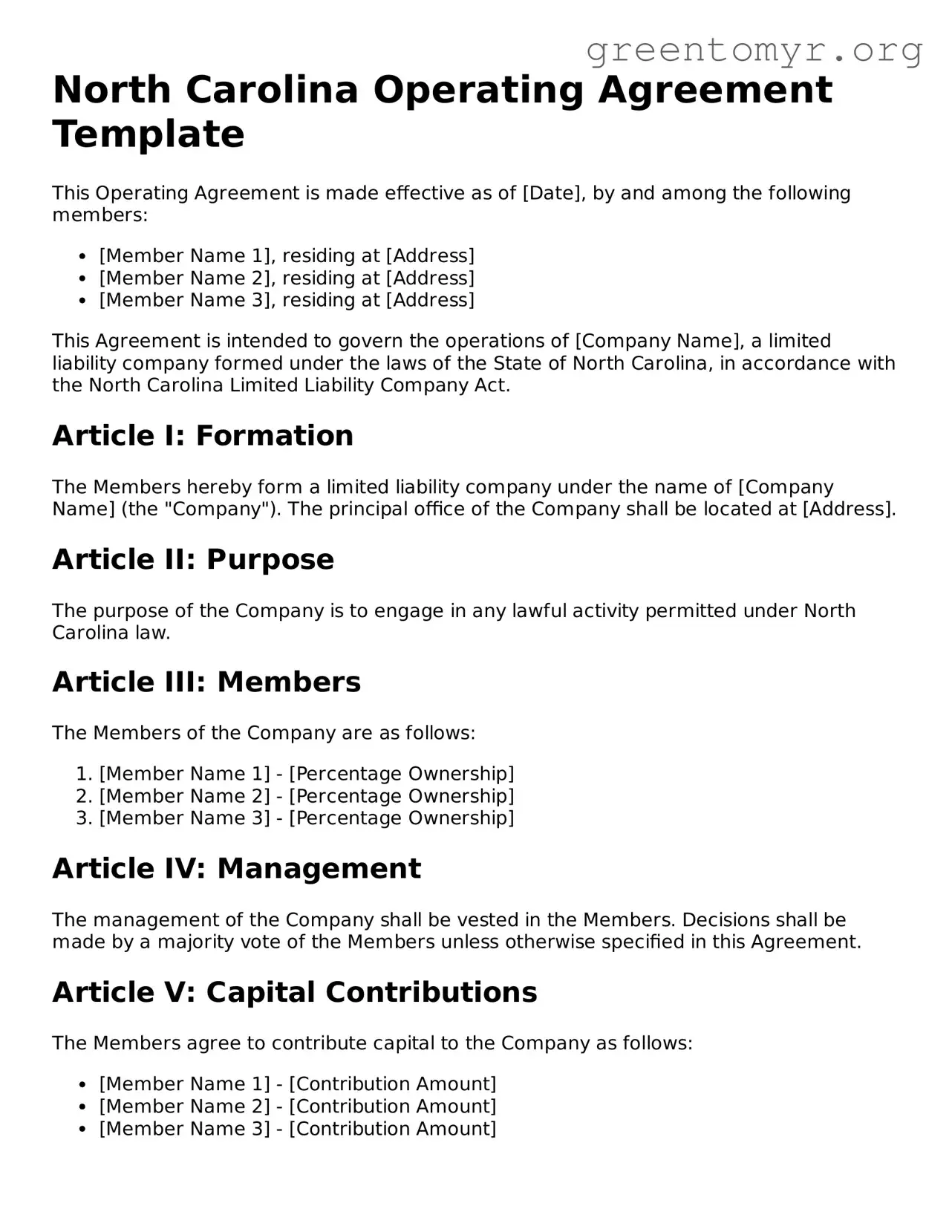
North Carolina Operating Agreement Template
This Operating Agreement is made effective as of [Date], by and among the following members:
This Agreement is intended to govern the operations of [Company Name], a limited liability company formed under the laws of the State of North Carolina, in accordance with the North Carolina Limited Liability Company Act.
Article I: Formation
The Members hereby form a limited liability company under the name of [Company Name] (the "Company"). The principal office of the Company shall be located at [Address].
Article II: Purpose
The purpose of the Company is to engage in any lawful activity permitted under North Carolina law.
Article III: Members
The Members of the Company are as follows:
Article IV: Management
The management of the Company shall be vested in the Members. Decisions shall be made by a majority vote of the Members unless otherwise specified in this Agreement.
Article V: Capital Contributions
The Members agree to contribute capital to the Company as follows:
Article VI: Distributions
Distributions of profits and losses shall be allocated to the Members in proportion to their ownership percentages.
Article VII: Indemnification
The Company shall indemnify the Members to the fullest extent permitted by North Carolina law against any losses or expenses incurred in connection with the Company.
Article VIII: Amendments
This Operating Agreement may be amended only by a written agreement signed by all Members.
Article IX: Governing Law
This Agreement shall be governed by and construed in accordance with the laws of the State of North Carolina.
IN WITNESS WHEREOF, the undersigned Members have executed this Operating Agreement as of the date first above written.
______________________________
[Member Name 1]
______________________________
[Member Name 2]
______________________________
[Member Name 3]
| Fact Name | Description |
|---|---|
| Purpose | The North Carolina Operating Agreement outlines the management structure and operational procedures of an LLC. |
| Governing Law | This agreement is governed by the North Carolina Limited Liability Company Act. |
| Members | All members of the LLC should sign the Operating Agreement to indicate their consent. |
| Flexibility | The agreement allows for customization based on the specific needs of the LLC and its members. |
| Dispute Resolution | It often includes provisions for resolving disputes among members, which can help avoid litigation. |
| Amendments | The Operating Agreement can be amended, allowing members to adapt to changing circumstances. |
| Tax Treatment | Members can choose how the LLC will be taxed, which can have significant financial implications. |
| Confidentiality | It may include clauses to protect sensitive information shared among members. |
| Compliance | Having an Operating Agreement helps ensure compliance with state regulations and enhances credibility. |
Filling out the North Carolina Operating Agreement form is an essential step in formalizing the structure and management of your business. This process will help clarify the roles and responsibilities of each member involved. Once you have completed the form, you can proceed with the necessary steps to ensure your business operates smoothly and in compliance with state regulations.
A North Carolina Operating Agreement is a legal document that outlines the management structure and operating procedures of a limited liability company (LLC) in North Carolina. It serves as an internal guideline for the members, detailing their rights, responsibilities, and the distribution of profits and losses. This agreement is not filed with the state but is essential for establishing clear expectations among members.
An Operating Agreement is crucial for several reasons:
Yes, even if you are the sole member of your LLC, having an Operating Agreement is advisable. It formalizes your business operations and can help protect your personal assets by demonstrating that your LLC is a separate entity. It also provides a clear outline for how you intend to manage your business, which can be beneficial for tax purposes and future growth.
A comprehensive Operating Agreement should include the following elements:
Creating an Operating Agreement can be straightforward. Here are the steps to follow:
Yes, you can change your Operating Agreement after it has been created. The process for making amendments should be outlined within the agreement itself. Typically, all members must agree to any changes, and it is advisable to document these changes in writing to maintain clarity and legal standing.
Filling out the North Carolina Operating Agreement form can be a straightforward process, but many people make common mistakes that can lead to complications down the line. One frequent error is failing to include all members' names. Every member of the LLC should be listed clearly. Omitting a member might create disputes later about ownership and decision-making.
Another common mistake is not specifying the management structure of the LLC. It’s essential to indicate whether the company will be member-managed or manager-managed. This distinction is crucial because it defines who has the authority to make decisions on behalf of the LLC. Without this clarity, misunderstandings can arise among members.
People often overlook the importance of detailing the distribution of profits and losses. An ambiguous or vague description can lead to disagreements among members. Clearly outlining how profits and losses will be shared helps ensure everyone is on the same page and can prevent conflicts in the future.
Additionally, many individuals forget to include provisions for the transfer of ownership interests. Life changes, such as a member wanting to sell their share or a member passing away, can lead to confusion without clear guidelines. Including these provisions in the Operating Agreement can provide a roadmap for these situations.
Another mistake is neglecting to update the Operating Agreement after changes occur. As the business evolves, members may change, or roles may shift. It’s vital to revisit and amend the agreement to reflect these changes accurately. Failing to do so can result in outdated information that may not serve the best interests of the LLC.
Some individuals also make the mistake of not having the Operating Agreement reviewed by a professional. While it may seem unnecessary, a legal expert can catch potential issues that may not be immediately obvious. This step can save time and money in the long run by preventing future disputes.
Finally, a lack of signatures from all members can render the Operating Agreement ineffective. Each member’s signature signifies their agreement to the terms laid out in the document. Without these signatures, the agreement may not hold up in legal situations, leading to further complications.
When forming a limited liability company (LLC) in North Carolina, the Operating Agreement is a crucial document. However, it is not the only one you may need. Below is a list of other forms and documents that are often used in conjunction with the North Carolina Operating Agreement.
Having these documents in order can help ensure that your LLC operates smoothly and complies with state regulations. It is advisable to consult with a professional to make sure you have everything you need for your specific situation.
The Operating Agreement is a crucial document for LLCs. It outlines the management structure and operational procedures. Several other documents share similarities with the Operating Agreement. Here are six of them:
When filling out the North Carolina Operating Agreement form, it is important to approach the task with care. Here are some guidelines to help ensure accuracy and compliance.
Things You Should Do:
Things You Shouldn't Do:
Operating agreements are essential for businesses in North Carolina, especially for limited liability companies (LLCs). However, there are several misconceptions surrounding the North Carolina Operating Agreement form. Here are seven common misunderstandings:
It’s not necessary if there’s only one member. Many people believe that a single-member LLC does not need an operating agreement. However, having one is still beneficial as it establishes the structure and rules for the business, even for just one owner.
It must be filed with the state. Some think that the operating agreement needs to be submitted to the state of North Carolina. In reality, it is an internal document and does not require filing. It should be kept with your business records instead.
It’s a one-size-fits-all document. There is a misconception that all operating agreements are the same. Each agreement should be tailored to the specific needs and circumstances of the business and its members.
Verbal agreements are sufficient. Some believe that a verbal agreement between members is enough. However, written agreements provide clarity and protection for all parties involved, reducing the risk of misunderstandings.
Changes can’t be made once it’s signed. Many think that once an operating agreement is signed, it cannot be altered. In fact, members can amend the agreement as needed, provided that all members agree to the changes.
It only covers financial matters. While financial aspects are important, an operating agreement also addresses management structure, member roles, and procedures for decision-making. It serves as a comprehensive guide for the operation of the business.
It’s only for larger businesses. Some assume that only larger LLCs require an operating agreement. In truth, every LLC, regardless of size, benefits from having a clear operating agreement to define its operations and member relationships.
Understanding these misconceptions can help ensure that business owners in North Carolina create a solid foundation for their LLCs. A well-crafted operating agreement is an important step in protecting both the business and its members.
Filling out and using the North Carolina Operating Agreement form is an essential step for members of a limited liability company (LLC) in the state. Here are some key takeaways to consider: