Content Navigation

In North Carolina, the Power of Attorney (POA) form serves as a vital legal document that empowers an individual, known as the agent or attorney-in-fact, to make decisions on behalf of another person, referred to as the principal. This arrangement can be crucial in situations where the principal is unable to manage their affairs due to illness, absence, or incapacity. The form outlines the specific powers granted to the agent, which may include handling financial transactions, managing real estate, or making healthcare decisions. Importantly, North Carolina recognizes both general and limited powers of attorney, allowing the principal to tailor the authority given to their agent according to their needs. Additionally, the POA can be durable, meaning it remains effective even if the principal becomes incapacitated, or it can be non-durable, ending if the principal loses the ability to make decisions. Understanding the nuances of this form is essential for anyone considering designating an agent, ensuring that their wishes are respected and that their affairs are handled appropriately in times of need.

North Carolina Power of Attorney Example

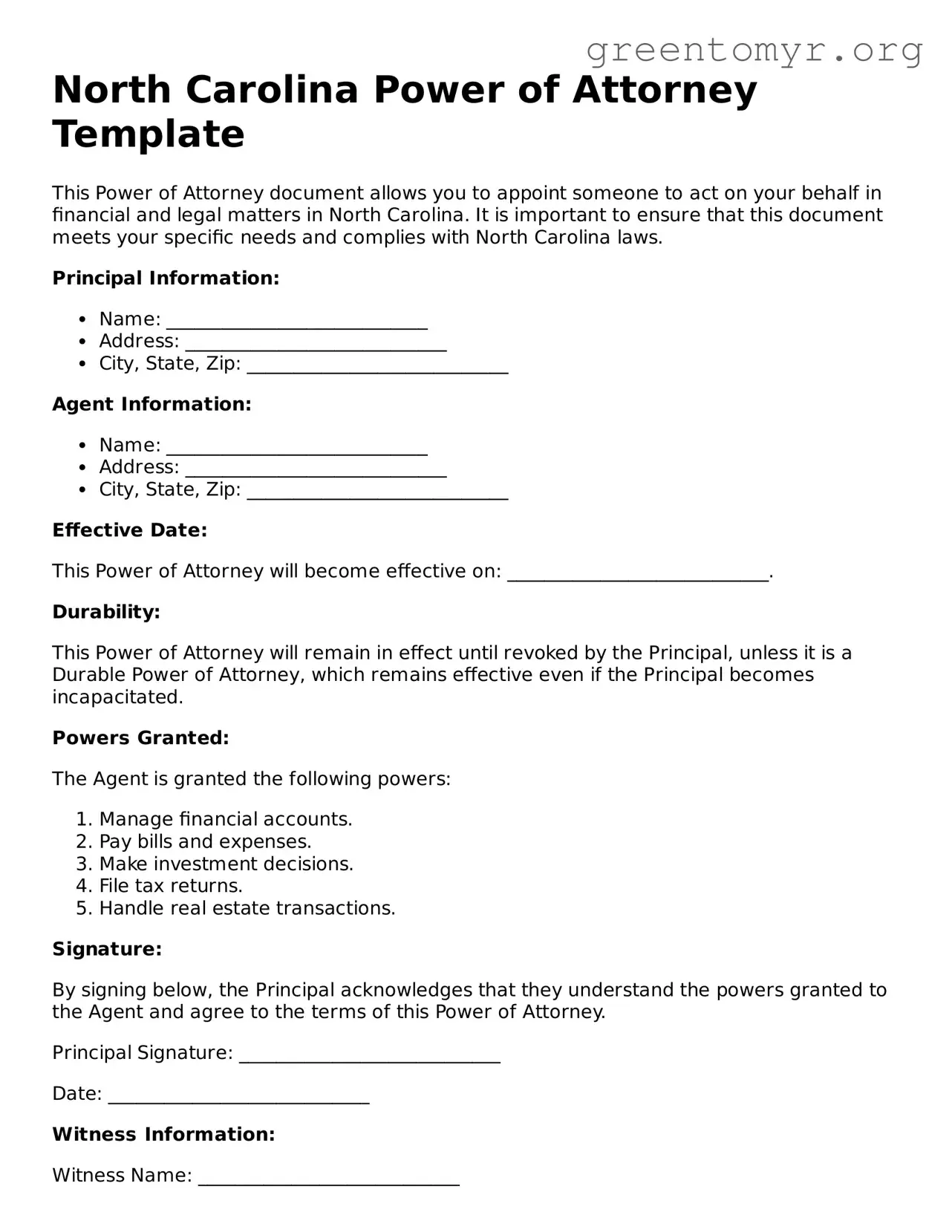
North Carolina Power of Attorney Template

This Power of Attorney document allows you to appoint someone to act on your behalf in financial and legal matters in North Carolina. It is important to ensure that this document meets your specific needs and complies with North Carolina laws.

Principal Information:

  • Name: ____________________________
  • Address: ____________________________
  • City, State, Zip: ____________________________

Agent Information:

  • Name: ____________________________
  • Address: ____________________________
  • City, State, Zip: ____________________________

Effective Date:

This Power of Attorney will become effective on: ____________________________.

Durability:

This Power of Attorney will remain in effect until revoked by the Principal, unless it is a Durable Power of Attorney, which remains effective even if the Principal becomes incapacitated.

Powers Granted:

The Agent is granted the following powers:

  1. Manage financial accounts.
  2. Pay bills and expenses.
  3. Make investment decisions.
  4. File tax returns.
  5. Handle real estate transactions.

Signature:

By signing below, the Principal acknowledges that they understand the powers granted to the Agent and agree to the terms of this Power of Attorney.

Principal Signature: ____________________________

Date: ____________________________

Witness Information:

Witness Name: ____________________________

Witness Signature: ____________________________

Date: ____________________________

Notary Acknowledgment:

State of North Carolina

County of ____________________________

Subscribed and sworn to before me on this _____ day of __________, 20__.

Notary Public Signature: ____________________________

My Commission Expires: ____________________________

PDF Form Features

Fact Name Description
Definition A Power of Attorney (POA) in North Carolina is a legal document that allows one person to act on behalf of another in legal and financial matters.
Types of POA North Carolina recognizes several types of POA, including General, Durable, and Limited Power of Attorney, each serving different purposes.
Governing Laws The North Carolina General Statutes, specifically Chapter 32A, govern the use and execution of Power of Attorney forms in the state.
Durability A Durable Power of Attorney remains effective even if the principal becomes incapacitated, ensuring continued management of affairs.
Execution Requirements To be valid, a Power of Attorney in North Carolina must be signed by the principal and notarized, and may require witnesses depending on the type.

Guide to Using North Carolina Power of Attorney

Filling out the North Carolina Power of Attorney form is a straightforward process. Follow these steps carefully to ensure that the form is completed correctly.

  1. Begin by downloading the North Carolina Power of Attorney form from a reliable source.
  2. Read the form thoroughly to understand the sections and requirements.
  3. In the first section, fill in the name and address of the principal, the person granting the power.
  4. Next, provide the name and address of the agent, the person who will act on behalf of the principal.
  5. Specify the powers you wish to grant to the agent. This may include financial, legal, or medical decisions.
  6. Indicate the duration of the power of attorney. You can choose for it to be effective immediately or upon a specific event.
  7. Sign and date the form in the designated area. Make sure to use your legal name.
  8. Have the form witnessed by at least one individual who is not related to you and is over 18 years old.
  9. If required, have the document notarized. This adds an extra layer of validity.
  10. Distribute copies of the completed form to your agent and any relevant institutions.

Get Answers on North Carolina Power of Attorney

What is a Power of Attorney in North Carolina?

A Power of Attorney (POA) is a legal document that allows you to appoint someone to make decisions on your behalf. This can include financial matters, healthcare decisions, or other personal affairs. In North Carolina, the person you appoint is called an agent or attorney-in-fact. This document can be tailored to fit your specific needs, whether you want to grant broad powers or limit them to specific tasks.

Why would I need a Power of Attorney?

Having a Power of Attorney in place can provide peace of mind. Here are a few reasons why you might consider it:

  • You want someone to handle your financial matters if you become unable to do so.
  • You wish to ensure that your healthcare decisions are made according to your wishes if you cannot communicate them.
  • It can help avoid potential family disputes about who should make decisions on your behalf.

How do I create a Power of Attorney in North Carolina?

Creating a Power of Attorney in North Carolina involves a few straightforward steps:

  1. Choose your agent carefully. This should be someone you trust completely.
  2. Decide what powers you want to grant. You can choose to give broad authority or limit it to specific actions.
  3. Complete the Power of Attorney form. You can find templates online or consult with a legal professional for assistance.
  4. Sign the document in front of a notary public. This step is crucial for the document to be legally binding.

Can I revoke a Power of Attorney?

Yes, you can revoke a Power of Attorney at any time, as long as you are mentally competent. To do this, you should create a written revocation document and notify your agent. It’s also a good idea to inform any institutions or individuals who might have relied on the original Power of Attorney.

What happens if I don’t have a Power of Attorney?

If you don’t have a Power of Attorney and become incapacitated, your loved ones may need to go through a legal process to gain authority to make decisions on your behalf. This can be time-consuming, stressful, and costly. Having a Power of Attorney in place can help avoid these complications and ensure your wishes are respected.

Common mistakes

Filling out a Power of Attorney (POA) form in North Carolina can be straightforward, but many people make common mistakes that can lead to significant issues. One frequent error is failing to clearly identify the principal and the agent. The principal is the person granting authority, while the agent is the person receiving it. If either party's name is misspelled or incomplete, it can create confusion and invalidate the document.

Another mistake involves not specifying the powers granted to the agent. The form should clearly outline what the agent can and cannot do on behalf of the principal. Vague language can lead to misunderstandings and potential misuse of authority. It's crucial to be specific about financial, medical, or legal powers to avoid complications down the line.

People also often overlook the need for witnesses or notarization. In North Carolina, a Power of Attorney must be signed in the presence of a notary public or two witnesses to be valid. Failing to include these necessary signatures can render the document ineffective. It's important to follow all legal requirements to ensure the POA is enforceable.

Lastly, many individuals neglect to review the document after completion. Once the form is filled out, it should be carefully checked for any errors or omissions. Even minor mistakes can lead to significant problems when the time comes to use the Power of Attorney. Taking the time to review the document can save a lot of hassle later on.

Documents used along the form

When creating a Power of Attorney in North Carolina, there are several other documents that may complement or enhance its effectiveness. Each of these documents serves a specific purpose and can help ensure that your wishes are respected and your affairs are managed according to your preferences. Below is a list of commonly used forms and documents that often accompany a Power of Attorney.

  • Durable Power of Attorney: This document remains effective even if you become incapacitated. It allows your agent to make decisions on your behalf without interruption.
  • Health Care Power of Attorney: This form specifically grants authority to your agent to make medical decisions for you if you are unable to do so. It focuses on health-related matters.
  • Living Will: A Living Will outlines your preferences regarding medical treatment in situations where you are unable to communicate your wishes. It complements the Health Care Power of Attorney.
  • Advance Directive: This document combines both a Health Care Power of Attorney and a Living Will, providing comprehensive guidance on your healthcare preferences.
  • Financial Power of Attorney: This form allows your agent to handle financial matters, such as managing bank accounts, paying bills, and making investments on your behalf.
  • Will: A Will specifies how your assets should be distributed after your death. It is an essential document for estate planning and works alongside a Power of Attorney.
  • Trust Agreement: A Trust can manage your assets during your lifetime and after your death. It can provide additional control over how your assets are distributed.
  • Authorization for Release of Medical Records: This document allows your agent to access your medical records, which is crucial for making informed healthcare decisions.
  • Property Deed: If real estate is involved, a property deed may be necessary to transfer ownership or manage property on your behalf.

Understanding these documents can help you make informed decisions about your legal and financial affairs. Each serves a unique role in ensuring that your wishes are honored and that your interests are protected. Consider consulting with a professional to determine which documents are best suited for your specific needs.

Similar forms

The Power of Attorney (POA) form is a significant legal document that allows one person to act on behalf of another in various matters. Several other documents share similarities with a Power of Attorney, each serving a unique purpose while allowing for delegation of authority. Here are eight documents that are similar to a Power of Attorney:

  • Living Will: This document outlines an individual's preferences regarding medical treatment in situations where they cannot communicate their wishes. Like a POA, it involves decision-making on behalf of another, but it specifically focuses on healthcare choices.
  • Healthcare Proxy: A healthcare proxy allows someone to make medical decisions for another person if they are unable to do so. It is similar to a POA in that it grants authority, but it is limited to healthcare matters.
  • Durable Power of Attorney: This is a specific type of POA that remains effective even if the principal becomes incapacitated. It ensures that the designated agent can continue to make decisions when the principal cannot, similar to a standard POA but with added durability.
  • Financial Power of Attorney: A financial POA specifically grants authority to manage financial affairs. This document is akin to a general POA but is focused solely on financial matters, such as managing bank accounts and paying bills.
  • Trust Agreement: A trust agreement allows a person to transfer assets to a trustee who manages them for the benefit of another. While it involves delegating authority over assets, it differs in that it establishes a fiduciary relationship rather than simply granting decision-making power.
  • Guardian Appointment: This document appoints someone to care for a minor or an incapacitated adult. Similar to a POA, it involves making decisions on behalf of another person, but it also includes responsibilities for their care and well-being.
  • Advance Directive: An advance directive is a broader term that encompasses both living wills and healthcare proxies. It allows individuals to express their healthcare preferences and designate decision-makers, much like a POA focused on health-related matters.
  • Bill of Sale: While primarily a document for transferring ownership of personal property, a bill of sale can also delegate authority to act on behalf of the seller in specific transactions. This is similar to a POA in that it allows another person to handle particular tasks related to property transfer.

Each of these documents serves to empower individuals to make decisions on behalf of others, addressing various needs such as healthcare, financial matters, and personal care. Understanding their similarities and differences can help individuals choose the right document for their specific circumstances.

Dos and Don'ts

When filling out the North Carolina Power of Attorney form, it’s important to follow some guidelines to ensure the document is valid and meets your needs. Here’s a list of things you should and shouldn’t do:

  • Do clearly identify the principal and the agent in the form.
  • Do specify the powers you are granting to the agent.
  • Do sign the document in front of a notary public.
  • Do keep a copy of the signed document for your records.
  • Don't leave any blank spaces in the form; this could lead to misunderstandings.
  • Don't use vague language when describing the powers granted.

Following these guidelines will help ensure that your Power of Attorney is effective and legally binding.

Misconceptions

Understanding the North Carolina Power of Attorney form is crucial for effective estate planning and financial management. However, several misconceptions can lead to confusion. Here are six common misconceptions explained:

  • All Power of Attorney forms are the same. Many people believe that a Power of Attorney form is universal. In reality, each state has its own specific requirements and forms, including North Carolina. It is important to use the correct form for your state to ensure it is legally valid.
  • A Power of Attorney is only for financial matters. While many associate Power of Attorney with financial decisions, it can also encompass medical decisions. In North Carolina, you can designate someone to make healthcare decisions on your behalf, which is often referred to as a Health Care Power of Attorney.
  • Once a Power of Attorney is signed, it cannot be changed. This is not true. You can revoke or change your Power of Attorney at any time, as long as you are mentally competent. It is advisable to notify the agent and any institutions that may have relied on the previous document.
  • The agent must be a lawyer. Many assume that only attorneys can serve as agents under a Power of Attorney. In North Carolina, any competent adult can act as your agent. This could be a family member, friend, or trusted individual.
  • A Power of Attorney is only necessary for older adults. This misconception overlooks the fact that anyone can face situations where they cannot make decisions for themselves, regardless of age. Accidents or sudden illnesses can happen at any time, making a Power of Attorney a prudent choice for adults of all ages.
  • A Power of Attorney automatically expires upon the principal's death. While it is true that a Power of Attorney ceases to be effective when the principal dies, many people mistakenly believe it continues to apply to the estate. After death, estate matters are handled through a will or probate process, not through a Power of Attorney.

Clarifying these misconceptions can help individuals make informed decisions regarding their legal and financial planning. Understanding the specifics of the North Carolina Power of Attorney form is essential for ensuring your wishes are honored.

Key takeaways

When it comes to filling out and using the North Carolina Power of Attorney form, there are several important points to keep in mind. Here are five key takeaways:

  1. Choose the Right Agent: Select someone you trust to act on your behalf. This person will have significant authority over your financial and legal matters.
  2. Specify Powers Clearly: Clearly outline the powers you are granting. Whether it’s managing bank accounts, selling property, or making healthcare decisions, clarity is crucial.
  3. Consider a Durable Power of Attorney: If you want your agent to continue acting on your behalf even if you become incapacitated, make sure to specify that it is a durable power of attorney.
  4. Sign in Front of Witnesses: In North Carolina, you need to sign the document in front of a notary public and at least one witness to ensure its validity.
  5. Review Regularly: Life changes, and so do your needs. Regularly review your Power of Attorney to ensure it still reflects your wishes.

Understanding these key points can help you navigate the process more smoothly and ensure that your Power of Attorney meets your needs and protects your interests.