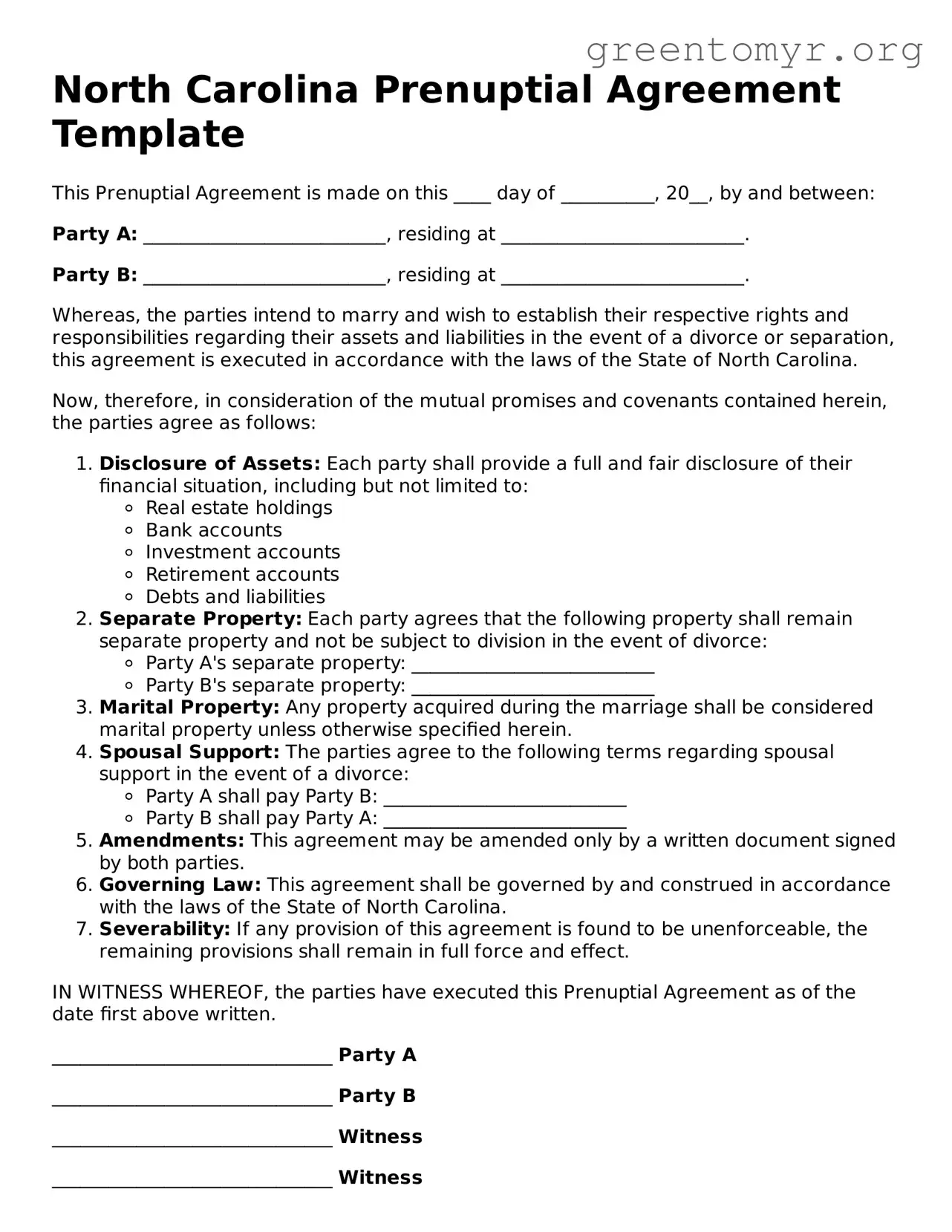
In North Carolina, couples considering marriage often explore the benefits of a prenuptial agreement, commonly referred to as a prenup. This legal document serves to outline the financial rights and responsibilities of each partner in the event of a divorce or separation. A well-structured prenuptial agreement can address various aspects, such as the division of property, spousal support, and the management of debts. By clearly defining these terms before marriage, both parties can protect their individual assets and reduce potential conflicts in the future. The North Carolina Prenuptial Agreement form requires specific information, including the full names of both parties, a detailed list of assets and liabilities, and any additional provisions the couple wishes to include. Ensuring that the agreement is fair and voluntarily entered into by both partners is crucial for its enforceability. Understanding the importance of this document can help couples navigate their financial futures with confidence.
North Carolina Prenuptial Agreement Template
This Prenuptial Agreement is made on this ____ day of __________, 20__, by and between:
Party A: __________________________, residing at __________________________.
Party B: __________________________, residing at __________________________.
Whereas, the parties intend to marry and wish to establish their respective rights and responsibilities regarding their assets and liabilities in the event of a divorce or separation, this agreement is executed in accordance with the laws of the State of North Carolina.
Now, therefore, in consideration of the mutual promises and covenants contained herein, the parties agree as follows:
IN WITNESS WHEREOF, the parties have executed this Prenuptial Agreement as of the date first above written.
______________________________ Party A
______________________________ Party B
______________________________ Witness
______________________________ Witness
| Fact Name | Details |
|---|---|
| Governing Law | The North Carolina Prenuptial Agreement is governed by North Carolina General Statutes Chapter 52B. |
| Purpose | This agreement outlines the division of assets and financial responsibilities in the event of divorce or separation. |
| Voluntary Agreement | Both parties must enter into the agreement voluntarily without any duress or undue influence. |
| Full Disclosure | Each party must fully disclose their financial situation, including assets and debts, for the agreement to be valid. |
| Written Form | The agreement must be in writing and signed by both parties to be enforceable. |
| Legal Representation | It is advisable for both parties to seek independent legal counsel before signing the agreement. |
| Enforceability | Courts in North Carolina will enforce prenuptial agreements unless they are found to be unconscionable or obtained through fraud. |
Filling out a prenuptial agreement form in North Carolina is an important step for couples considering marriage. This document lays out the financial rights and responsibilities of each partner in the event of a divorce or separation. To ensure that both parties are protected and that the agreement is legally binding, it’s essential to complete the form accurately and thoroughly.
Once the form is completed, it is advisable to consult with a legal professional to ensure that the agreement meets all legal requirements and adequately protects both parties’ interests.
A prenuptial agreement, often referred to as a prenup, is a legal document created by two individuals before they marry. This agreement outlines the division of assets and financial responsibilities in the event of a divorce or separation. In North Carolina, prenuptial agreements can also address issues such as spousal support and the management of debts. By having this agreement in place, couples can establish clear expectations and protect their individual interests.
To ensure a prenuptial agreement is valid in North Carolina, the following requirements must be met:
Yes, a prenuptial agreement can be modified or revoked after marriage. Both parties must agree to any changes, and these modifications should also be in writing and signed by both individuals. It is advisable to consult with a legal professional to ensure that any changes comply with North Carolina laws and are enforceable in court.
If a prenuptial agreement is challenged in court, a judge will review the circumstances surrounding its creation and the fairness of its terms. Common reasons for challenges include:
The court will assess these factors and determine whether to uphold or invalidate the agreement based on the evidence presented.
Filling out a prenuptial agreement in North Carolina can be a crucial step for couples looking to protect their assets. However, there are common mistakes that people often make when completing this form. Understanding these pitfalls can help ensure the agreement is valid and enforceable.
One frequent error is failing to fully disclose all assets and debts. Both parties must provide a complete and honest accounting of their financial situation. If one party hides assets, the agreement could be challenged later in court. Transparency is key to a valid prenuptial agreement.
Another mistake involves using vague language. Specificity is essential in legal documents. Terms like “reasonable” or “fair” can lead to confusion and disputes later on. Clearly defining what is meant by each term helps avoid misunderstandings.
People often overlook the importance of having the agreement reviewed by separate legal counsel. Each party should have their own attorney to ensure they understand their rights and obligations. This step can prevent claims of coercion or unfairness down the line.
Timing can also be an issue. Waiting until the last minute to present the prenuptial agreement can create pressure and lead to accusations of duress. It’s advisable to discuss and finalize the agreement well in advance of the wedding date.
Another common mistake is failing to update the agreement after significant life changes. Events such as the birth of a child, changes in income, or the acquisition of new assets can necessitate a review and possible revision of the agreement. Keeping it current ensures it remains relevant.
Some individuals neglect to include provisions for the future. A well-drafted prenuptial agreement should address not only the current financial situation but also potential future scenarios, such as what happens in the event of divorce or death.
Relying on a template without customization can lead to problems. While templates can provide a good starting point, each couple’s situation is unique. Tailoring the agreement to fit specific needs and circumstances is crucial for its effectiveness.
Finally, couples sometimes forget to sign and date the agreement properly. Both parties must sign the document, and having witnesses or notarization can add an extra layer of validity. Ensuring all formalities are observed is vital for the agreement to hold up in court.
When preparing a North Carolina Prenuptial Agreement, several other forms and documents may be useful to ensure clarity and protection for both parties. Below is a list of commonly associated documents.
Utilizing these forms and documents alongside a North Carolina Prenuptial Agreement can provide a comprehensive framework for managing financial and legal matters in a marriage. Clarity and communication are key to ensuring both parties feel secure and understood.
When filling out the North Carolina Prenuptial Agreement form, it is crucial to approach the process with care. Here are four essential dos and don'ts to consider:
Many people have misunderstandings about prenuptial agreements, especially in North Carolina. Here are five common misconceptions:
This is not true. While high-net-worth individuals often use them, anyone can benefit from a prenuptial agreement. It helps clarify financial responsibilities and expectations, regardless of income level.
Prenuptial agreements are not solely about divorce. They can also address financial matters during marriage, including debt management and asset protection. They promote open communication about finances.
Many believe that prenuptial agreements hold no legal weight. In North Carolina, however, if properly drafted and executed, they are enforceable. Courts will uphold agreements that meet legal requirements.
This misconception can create tension. In reality, a prenuptial agreement can strengthen trust by encouraging honest discussions about finances and expectations. It fosters transparency in the relationship.
Many think that these agreements are a sign of impending separation. However, they serve as a proactive measure to protect both parties. They can help prevent misunderstandings and conflicts in the future.
When considering a Prenuptial Agreement in North Carolina, it's essential to understand the key aspects of the process. Here are important takeaways to keep in mind:
Taking these steps can help ensure that your prenuptial agreement is effective and meets your needs. Act promptly to secure your financial future.