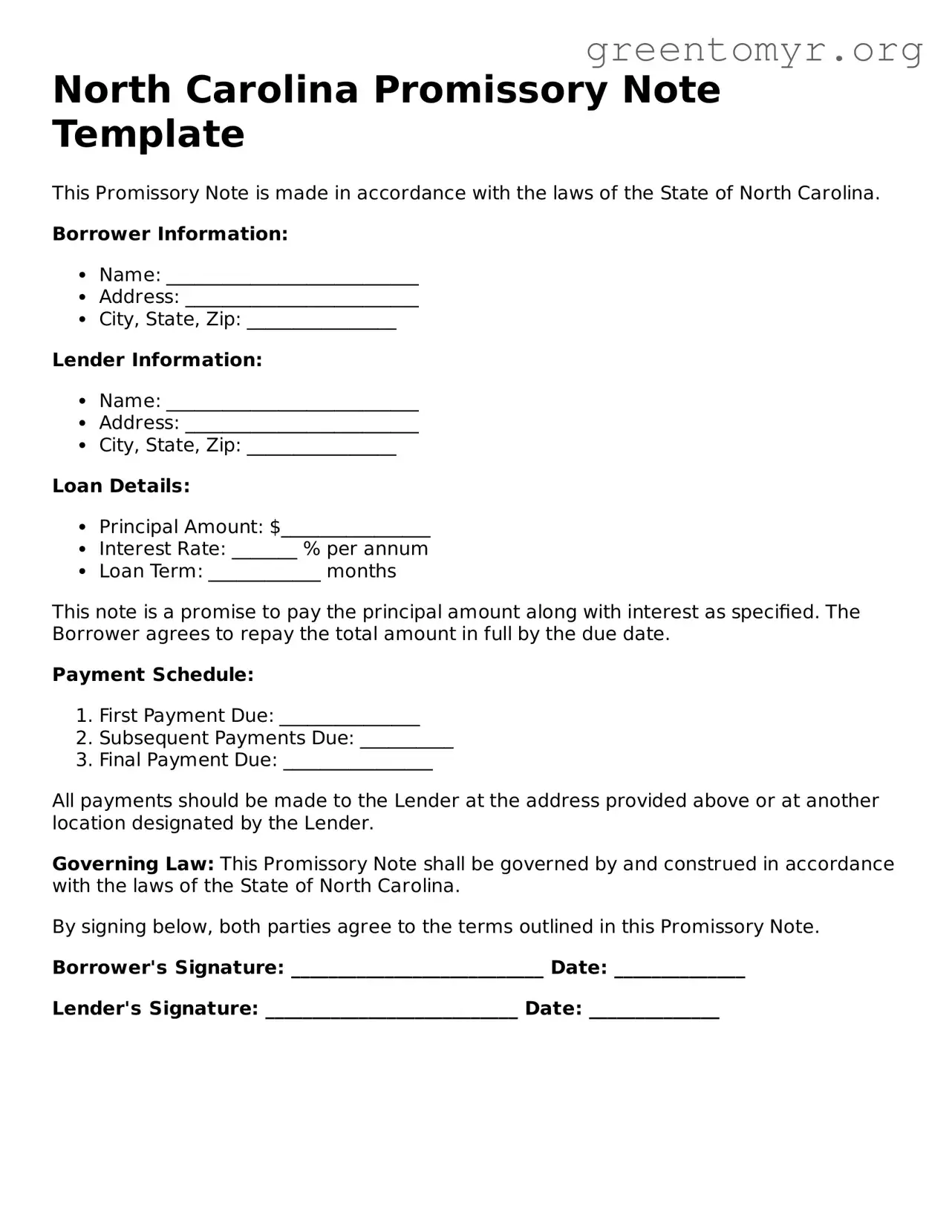
In North Carolina, the Promissory Note serves as a crucial financial instrument that outlines the terms of a loan between a borrower and a lender. This document specifies the amount borrowed, the interest rate, and the repayment schedule, ensuring both parties have a clear understanding of their obligations. It typically includes essential details such as the maturity date, which indicates when the loan must be fully repaid, and any provisions for late payments or default. Additionally, the form may address the rights of the lender in the event of non-payment, providing a layer of security for the lender. By having a well-structured Promissory Note, both borrowers and lenders can protect their interests and foster trust in their financial transactions. Understanding the nuances of this form can help individuals navigate the lending landscape in North Carolina with confidence.
North Carolina Promissory Note Template
This Promissory Note is made in accordance with the laws of the State of North Carolina.
Borrower Information:
Lender Information:
Loan Details:
This note is a promise to pay the principal amount along with interest as specified. The Borrower agrees to repay the total amount in full by the due date.
Payment Schedule:
All payments should be made to the Lender at the address provided above or at another location designated by the Lender.
Governing Law: This Promissory Note shall be governed by and construed in accordance with the laws of the State of North Carolina.
By signing below, both parties agree to the terms outlined in this Promissory Note.
Borrower's Signature: ___________________________ Date: ______________
Lender's Signature: ___________________________ Date: ______________
| Fact Name | Details |
|---|---|
| Definition | A promissory note is a written promise to pay a specified amount of money to a designated person or entity at a future date. |
| Governing Law | The North Carolina Promissory Note is governed by the North Carolina General Statutes, specifically Chapter 25. |
| Parties Involved | The form involves two main parties: the maker (borrower) and the payee (lender). |
| Interest Rates | Interest rates can be fixed or variable, but must comply with state usury laws. |
| Payment Terms | Payment terms should clearly outline the due date, payment frequency, and method of payment. |
| Default Clauses | Default clauses specify the consequences if the borrower fails to make payments on time. |
| Signatures Required | Both the maker and the payee must sign the note for it to be legally binding. |
| Notarization | Notarization is not required but can provide additional legal protection for the parties involved. |
| Amendments | Any changes to the promissory note must be documented in writing and signed by both parties. |
After obtaining the North Carolina Promissory Note form, you will need to provide specific information to complete it accurately. Ensure you have all necessary details on hand before starting the process. Follow these steps to fill out the form properly.
Once the form is filled out, review all information for accuracy. Ensure both parties retain a copy for their records. The completed form serves as a formal agreement outlining the terms of the loan.
A promissory note is a written promise to pay a specific amount of money to a designated person or entity at a future date or on demand. In North Carolina, this document serves as a legally binding agreement between the borrower and the lender, outlining the terms of the loan.
Common elements found in a promissory note include:
While it is not legally required to have a lawyer draft a promissory note, consulting with a legal professional can help ensure that the document meets all legal requirements and protects your interests. A lawyer can also provide guidance on specific terms that should be included based on the circumstances of the loan.
Yes, a properly executed promissory note is generally enforceable in a court of law in North Carolina. If the borrower fails to repay the loan as agreed, the lender can take legal action to recover the owed amount. It is important that the note is clear and unambiguous to be enforceable.
Yes, a promissory note can be modified if both the borrower and lender agree to the changes. It is advisable to document any modifications in writing and have both parties sign the amended note to avoid any misunderstandings in the future.
If a borrower defaults, the lender may pursue several options, including:
Each situation is unique, and the lender may choose the best course of action based on the circumstances.
North Carolina has specific laws that govern promissory notes, including provisions related to interest rates, repayment terms, and enforcement. It is important to be aware of these laws to ensure compliance and protect your rights as either a borrower or a lender.
Yes, a promissory note can be used for personal loans between individuals. It is a common practice for friends or family members who lend money to document the loan terms to avoid potential disputes later on.
Notarization is not required for a promissory note to be valid in North Carolina. However, having the document notarized can provide additional legal protection and help verify the identities of the parties involved, which may be beneficial if disputes arise.
Templates for North Carolina promissory notes can be found online through various legal websites, or you may consider consulting with a legal professional who can provide a customized document tailored to your specific needs.
Filling out a North Carolina Promissory Note form can be a straightforward process, but several common mistakes can lead to complications. One frequent error is neglecting to include the correct names of the parties involved. It is crucial to ensure that both the borrower and the lender are clearly identified. Inaccuracies in names can create confusion and may affect the enforceability of the note.
Another common mistake is failing to specify the loan amount clearly. The amount should be written both in numerical form and in words. Omitting this step can lead to disputes about the actual amount owed. Additionally, rounding errors can occur if the figures are not accurately represented.
People often overlook the importance of stating the interest rate. If the interest rate is not included, the note may be considered invalid. Even if the parties agree on the terms verbally, documenting the interest rate is essential for clarity and legal protection.
Many individuals forget to define the repayment terms. It is vital to outline when payments are due, how often they should be made, and the method of payment. Ambiguities in these terms can lead to misunderstandings between the borrower and lender.
Another mistake involves neglecting to include a default clause. This clause outlines the consequences if the borrower fails to make payments as agreed. Without this provision, the lender may have limited options for recourse in the event of a default.
People sometimes fail to have the document properly signed and dated. A Promissory Note must be signed by both parties to be legally binding. Without signatures, the document lacks authenticity, which can render it unenforceable.
It is also important to consider witnesses or notarization. While not always required, having a witness or a notary public can add an extra layer of legitimacy to the document. This step can be particularly beneficial if disputes arise later.
Another mistake involves not keeping copies of the signed Promissory Note. Both the borrower and lender should retain a copy for their records. This ensures that both parties have access to the terms of the agreement, which can be crucial for future reference.
Finally, individuals may rush through the process without fully understanding the terms they are agreeing to. Taking the time to read and comprehend each section of the Promissory Note is essential. Understanding the implications of the agreement can prevent future legal issues and foster a positive relationship between the borrower and lender.
When dealing with a North Carolina Promissory Note, several other documents may be necessary to ensure clarity and legal compliance. Each of these documents serves a specific purpose in the lending process, protecting both the lender and the borrower.
Understanding these documents can help borrowers and lenders navigate the lending process more effectively. Proper documentation ensures that all parties are aware of their rights and responsibilities, fostering a smoother transaction.
When filling out the North Carolina Promissory Note form, attention to detail is crucial. Here are some guidelines to help ensure accuracy and compliance.
Understanding the North Carolina Promissory Note form is essential for both lenders and borrowers. However, several misconceptions can lead to confusion. Here are five common misconceptions:
This is not true. While the basic concept of a promissory note is consistent, the specific terms and conditions can vary significantly. Each note can be tailored to the needs of the parties involved, including interest rates, repayment schedules, and consequences of default.
Although verbal agreements can be legally binding, having a written promissory note is crucial. A written document provides clear evidence of the agreement, which can help prevent disputes and misunderstandings in the future.
This misconception overlooks the fact that individuals and businesses can also create promissory notes. Any party can issue a promissory note as long as they have the legal capacity to enter into a contract.
While it is true that changes to a signed note can be complicated, they are not impossible. Parties can agree to modify the terms of the note through a written amendment, provided both parties consent to the changes.
This is a common misunderstanding. A promissory note represents a promise to pay, but it does not guarantee that the borrower will fulfill that promise. Lenders should always assess the creditworthiness of the borrower before entering into an agreement.
Filling out and using the North Carolina Promissory Note form is a straightforward process, but there are important points to keep in mind. Here are some key takeaways: