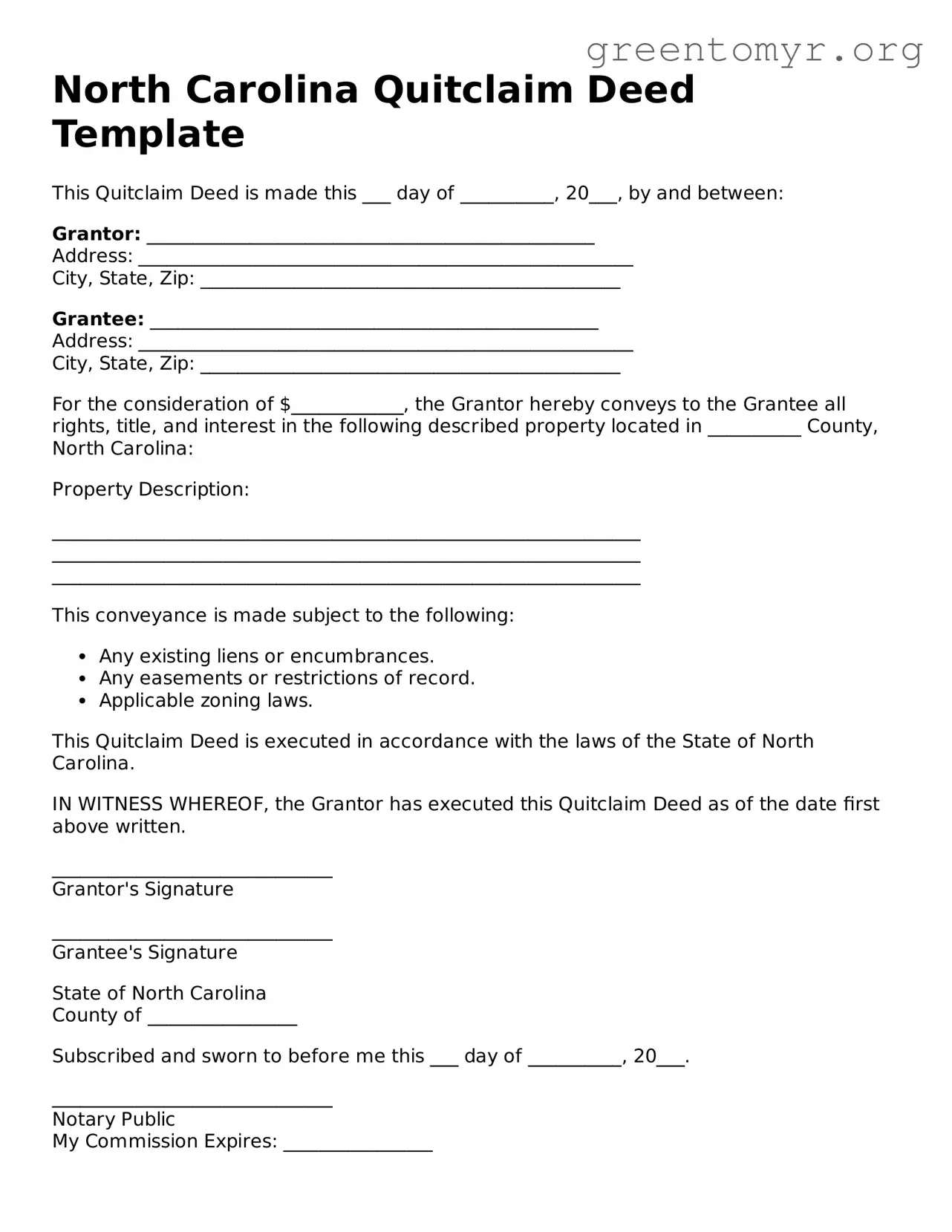
In North Carolina, the Quitclaim Deed serves as a valuable tool for property owners looking to transfer their interest in real estate without the complexities often associated with traditional property transfers. This straightforward document allows one party, known as the grantor, to convey their rights to another party, called the grantee, effectively simplifying the transfer process. Unlike warranty deeds, which guarantee that the property title is clear and free of liens, a quitclaim deed offers no such assurances. Instead, it simply transfers whatever interest the grantor holds, making it particularly useful in situations like family transfers, divorce settlements, or clearing up title issues. Understanding the nuances of this form is crucial for anyone involved in real estate transactions in North Carolina, as it can help avoid potential disputes and ensure a smoother transfer of ownership.
North Carolina Quitclaim Deed Template
This Quitclaim Deed is made this ___ day of __________, 20___, by and between:
Grantor: ________________________________________________
Address: _____________________________________________________
City, State, Zip: _____________________________________________
Grantee: ________________________________________________
Address: _____________________________________________________
City, State, Zip: _____________________________________________
For the consideration of $____________, the Grantor hereby conveys to the Grantee all rights, title, and interest in the following described property located in __________ County, North Carolina:
Property Description:
_______________________________________________________________
_______________________________________________________________
_______________________________________________________________
This conveyance is made subject to the following:
This Quitclaim Deed is executed in accordance with the laws of the State of North Carolina.
IN WITNESS WHEREOF, the Grantor has executed this Quitclaim Deed as of the date first above written.
______________________________
Grantor's Signature
______________________________
Grantee's Signature
State of North Carolina
County of ________________
Subscribed and sworn to before me this ___ day of __________, 20___.
______________________________
Notary Public
My Commission Expires: ________________
| Fact Name | Description |
|---|---|
| Definition | A Quitclaim Deed allows a property owner to transfer their interest in a property to another party without making any guarantees about the title. |
| Governing Law | The Quitclaim Deed in North Carolina is governed by the North Carolina General Statutes, specifically Chapter 47. |
| Use Cases | This form is commonly used among family members, in divorce settlements, or to clear up title issues. |
| Filing Requirements | The completed Quitclaim Deed must be filed with the county Register of Deeds where the property is located. |
After obtaining the North Carolina Quitclaim Deed form, you will need to complete it carefully. This form allows you to transfer property ownership without warranty. Once filled out, the next step will be to have it signed and notarized before recording it with the appropriate county office.
A Quitclaim Deed is a legal document used to transfer ownership of real estate from one party to another. Unlike other types of deeds, a Quitclaim Deed does not guarantee that the person transferring the property has clear title. Instead, it simply conveys whatever interest the grantor has in the property, if any.
People often use Quitclaim Deeds in situations such as transferring property between family members, adding or removing a spouse from the title after marriage or divorce, or clearing up title issues. It's a straightforward way to transfer interest without the complexities of a warranty deed.
While it's not legally required to have an attorney prepare a Quitclaim Deed, consulting one can be beneficial. An attorney can ensure that the deed is filled out correctly and that it meets all legal requirements, which can help avoid potential disputes in the future.
A Quitclaim Deed typically requires the following information:
To record a Quitclaim Deed in North Carolina, you must take the completed deed to the Register of Deeds in the county where the property is located. There may be a small fee for recording the deed. Once recorded, the deed becomes part of the public record, providing official notice of the transfer.
Generally, transferring property through a Quitclaim Deed does not trigger a taxable event. However, it’s important to consult a tax professional to understand any potential implications, especially if the property is sold or if there are significant changes in ownership.
Yes, a Quitclaim Deed can be contested in court. If someone believes the deed was signed under duress, fraud, or if the grantor did not have the legal capacity to sign, they may challenge the validity of the deed. Documentation and evidence will be crucial in such cases.
If the grantor has no ownership interest in the property, the Quitclaim Deed still transfers whatever interest they may have, which could be nothing. This situation may not affect the grantee's rights, but it could lead to complications if the grantee was expecting a clear title.
No, a Quitclaim Deed and a Warranty Deed are not the same. A Warranty Deed provides a guarantee that the grantor holds clear title to the property and has the right to sell it. In contrast, a Quitclaim Deed offers no such assurances, making it a riskier option for the grantee.
Yes, you can use a Quitclaim Deed to transfer property into a trust. This is often done as part of estate planning. However, it’s advisable to consult with an estate planning attorney to ensure that the transfer is done correctly and in accordance with your overall estate plan.
Filling out a Quitclaim Deed form in North Carolina can be straightforward, but many individuals make common mistakes that can lead to complications. One frequent error is not including the correct names of the grantor and grantee. It’s essential to ensure that the names are spelled accurately and match the names on the property title. This mistake can create issues with the transfer of ownership.
Another common mistake is failing to provide a complete legal description of the property. The legal description must be precise and detailed, as it identifies the property being transferred. Omitting this information can lead to confusion or disputes in the future.
Many people forget to include the date of the transfer. This date is crucial for establishing when the ownership change takes effect. Without it, the deed may be considered incomplete or invalid.
Additionally, some individuals neglect to sign the deed. Both the grantor and the grantee must sign the document for it to be legally binding. Failing to obtain the necessary signatures can result in the deed being rejected.
Another mistake involves not having the deed notarized. In North Carolina, notarization is typically required for the Quitclaim Deed to be valid. Without a notary’s acknowledgment, the deed may not be accepted by the county register of deeds.
People often overlook the requirement to pay the appropriate transfer tax. This tax must be calculated based on the property's value and included with the deed when it is filed. Failure to pay this tax can delay the recording process.
In some cases, individuals may use outdated or incorrect forms. It’s important to ensure that the Quitclaim Deed form being used is the most current version. Using an outdated form can lead to legal issues or rejections during processing.
Another mistake is not providing contact information for both parties. Including addresses and phone numbers can facilitate communication if any issues arise during the transfer process.
Moreover, individuals sometimes forget to check for any liens or encumbrances on the property before completing the deed. It’s crucial to be aware of any existing claims against the property, as these can affect the transfer of ownership.
Lastly, not keeping a copy of the completed deed can be problematic. It is advisable to retain a copy for personal records. This documentation can be essential for future reference or in case any disputes arise regarding ownership.
A Quitclaim Deed is a legal document used to transfer ownership of real estate from one party to another. When utilizing this form in North Carolina, several other documents may be required or beneficial for the transaction. Below is a list of forms and documents commonly associated with the Quitclaim Deed.
These documents play a crucial role in ensuring a smooth transfer of property ownership. It is advisable to consult with a real estate professional or legal expert to determine the specific requirements for your transaction.
A Quitclaim Deed is a legal document used to transfer ownership of real estate. It has similarities with several other documents. Here’s a list of five documents that share characteristics with a Quitclaim Deed:
When filling out the North Carolina Quitclaim Deed form, it is important to follow specific guidelines to ensure the document is completed correctly. Below is a list of things to do and avoid during this process.
By adhering to these guidelines, you can help ensure that the Quitclaim Deed is valid and enforceable in North Carolina.
Understanding the Quitclaim Deed form in North Carolina can be challenging. Below are ten common misconceptions that people often have about this legal document, along with clarifications to help you navigate the process more effectively.
By understanding these misconceptions, individuals can make more informed decisions regarding property transfers in North Carolina. Always consider consulting a legal professional for personalized advice tailored to your specific situation.
When filling out and using the North Carolina Quitclaim Deed form, it's important to understand the following key points:
By keeping these points in mind, individuals can navigate the process of using a Quitclaim Deed with confidence and clarity.