Content Navigation

In North Carolina, the Small Estate Affidavit serves as a streamlined process for settling the estates of deceased individuals whose assets fall below a specified threshold. Designed to simplify the probate process, this form allows eligible heirs to claim the decedent’s property without the need for a formal probate proceeding. Typically, this option is available when the total value of the estate does not exceed $34,000, excluding certain exempt property. The affidavit must be completed by an eligible heir, who is responsible for providing essential information about the deceased, including their name, date of death, and a description of the assets involved. Furthermore, the form requires the affiant to affirm that no pending debts or claims against the estate exist, thereby ensuring a clear transfer of ownership. Once properly executed, the Small Estate Affidavit can be presented to financial institutions, title companies, and other entities holding the decedent’s assets, facilitating a more efficient transition of property to rightful heirs.

North Carolina Small Estate Affidavit Example

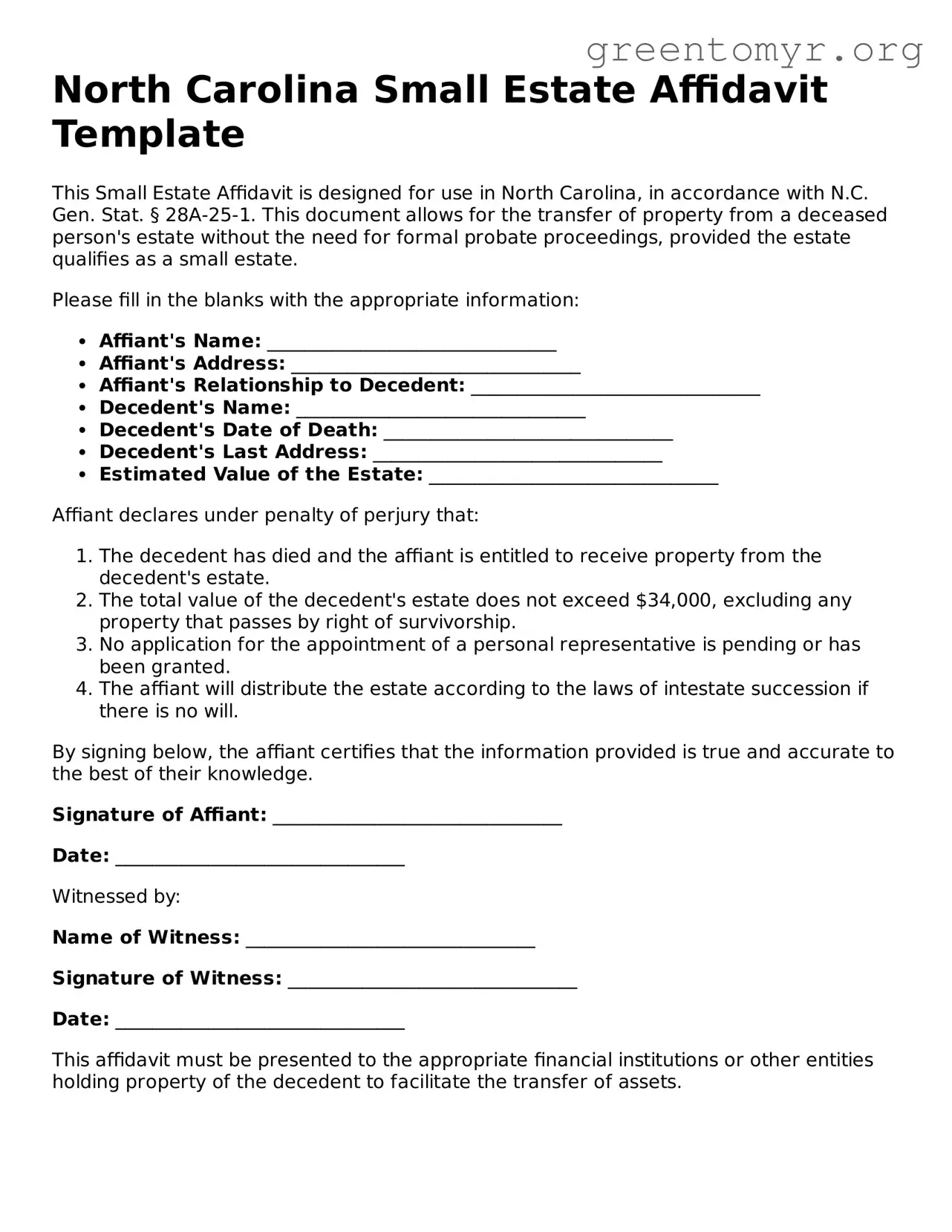
North Carolina Small Estate Affidavit Template

This Small Estate Affidavit is designed for use in North Carolina, in accordance with N.C. Gen. Stat. § 28A-25-1. This document allows for the transfer of property from a deceased person's estate without the need for formal probate proceedings, provided the estate qualifies as a small estate.

Please fill in the blanks with the appropriate information:

  • Affiant's Name: _______________________________
  • Affiant's Address: _______________________________
  • Affiant's Relationship to Decedent: _______________________________
  • Decedent's Name: _______________________________
  • Decedent's Date of Death: _______________________________
  • Decedent's Last Address: _______________________________
  • Estimated Value of the Estate: _______________________________

Affiant declares under penalty of perjury that:

  1. The decedent has died and the affiant is entitled to receive property from the decedent's estate.
  2. The total value of the decedent's estate does not exceed $34,000, excluding any property that passes by right of survivorship.
  3. No application for the appointment of a personal representative is pending or has been granted.
  4. The affiant will distribute the estate according to the laws of intestate succession if there is no will.

By signing below, the affiant certifies that the information provided is true and accurate to the best of their knowledge.

Signature of Affiant: _______________________________

Date: _______________________________

Witnessed by:

Name of Witness: _______________________________

Signature of Witness: _______________________________

Date: _______________________________

This affidavit must be presented to the appropriate financial institutions or other entities holding property of the decedent to facilitate the transfer of assets.

PDF Form Features

Fact Name Description
Purpose The North Carolina Small Estate Affidavit allows heirs to claim assets of a deceased person without going through formal probate, provided the estate meets certain criteria.
Eligibility To use this form, the total value of the estate must be less than $34,000, excluding certain exempt property.
Governing Law This affidavit is governed by North Carolina General Statutes, specifically N.C. Gen. Stat. § 28A-25-1.
Required Information The form requires information about the deceased, including their name, date of death, and a list of assets to be claimed.
Filing Process After completing the affidavit, heirs must present it to the institutions or individuals holding the deceased's assets to transfer ownership.

Guide to Using North Carolina Small Estate Affidavit

After gathering the necessary information, you can begin filling out the North Carolina Small Estate Affidavit form. Ensure that you have all relevant details about the deceased, their estate, and the heirs before you start. This will help streamline the process and reduce errors.

  1. Obtain the Small Estate Affidavit form. You can find it online or at your local courthouse.
  2. Fill in the name of the deceased in the designated space.
  3. Provide the date of death of the deceased.
  4. Enter the last known address of the deceased.
  5. List the names and addresses of all heirs or beneficiaries. Include their relationship to the deceased.
  6. State the value of the estate. Include all assets and property owned by the deceased.
  7. Indicate if there are any outstanding debts or liabilities of the deceased.
  8. Sign and date the affidavit. Ensure your signature is in the appropriate section.
  9. Have the affidavit notarized. A notary public must witness your signature.
  10. Make copies of the completed affidavit for your records and for the heirs.

Get Answers on North Carolina Small Estate Affidavit

What is a Small Estate Affidavit in North Carolina?

A Small Estate Affidavit is a legal document that allows individuals to settle the estate of a deceased person without going through the lengthy and often expensive process of probate. In North Carolina, this option is available when the total value of the estate is below a certain threshold, which is currently set at $34,000. This affidavit enables heirs or beneficiaries to collect assets, such as bank accounts or personal property, directly from institutions or individuals holding those assets.

Who is eligible to use the Small Estate Affidavit?

To use the Small Estate Affidavit, you must meet specific criteria:

  • The deceased must have been a resident of North Carolina.
  • The total value of the estate must not exceed $34,000, excluding certain types of property like real estate.
  • You must be an heir or beneficiary of the deceased, meaning you have a legal right to inherit from them.
  • At least 30 days must have passed since the deceased's passing.

How do I complete a Small Estate Affidavit?

Completing a Small Estate Affidavit involves several steps:

  1. Gather necessary information about the deceased, including their name, date of death, and details about their assets.
  2. Identify the heirs or beneficiaries entitled to the estate.
  3. Fill out the Small Estate Affidavit form accurately. This form will require details about the deceased's assets and debts.
  4. Have the affidavit signed in front of a notary public to ensure its validity.

Once completed, you can present the affidavit to banks, financial institutions, or other entities holding the deceased's assets to claim them on behalf of the estate.

What happens after I submit the Small Estate Affidavit?

After submitting the Small Estate Affidavit, the institutions or individuals holding the deceased's assets will review the document. If everything is in order, they will release the assets to you as the affiant. It’s important to note that some institutions may have their own requirements, so it’s wise to check with them beforehand. If any disputes arise or if there are debts that exceed the estate's value, further legal action may be necessary.

Can I use the Small Estate Affidavit for real estate?

No, the Small Estate Affidavit cannot be used to transfer real estate in North Carolina. The affidavit is specifically designed for personal property and financial accounts. If the deceased owned real estate, a different legal process, such as probate, will be required to transfer ownership of that property. It’s essential to consult with a legal professional if real estate is involved to understand the best course of action.

Common mistakes

Filling out the North Carolina Small Estate Affidavit form can be straightforward, but many people make critical mistakes that can delay the process or even invalidate their claims. One common error is failing to provide accurate information about the deceased. It is essential to ensure that the name, date of birth, and date of death are correct. Any discrepancies can lead to complications.

Another mistake is not including all the required assets. The affidavit must list all the assets owned by the deceased at the time of death. Omitting any property, bank accounts, or personal belongings could result in legal issues later. Be thorough in your assessment of what constitutes the estate.

Many individuals also overlook the requirement for signatures. The affidavit must be signed by the appropriate parties, including the heirs or beneficiaries. Failing to secure the necessary signatures can render the document ineffective. Double-check that all required signatures are present before submission.

Inaccurate valuations of assets is another frequent mistake. When estimating the value of the estate's assets, be realistic and precise. Underestimating or overestimating can lead to problems during the probate process. If necessary, obtain professional appraisals to support your claims.

Some people neglect to include the necessary supporting documentation. The affidavit should be accompanied by relevant documents, such as the death certificate and any applicable wills. Without these documents, the affidavit may be rejected or delayed.

Another common error is misunderstanding the eligibility requirements. Not everyone qualifies to use the Small Estate Affidavit. Ensure that the estate's total value meets the threshold set by North Carolina law. If it exceeds this limit, a different probate process may be necessary.

People often fail to keep copies of the completed affidavit. It is crucial to maintain a copy for your records. This can be invaluable if any disputes arise or if further documentation is needed later.

Not consulting with a legal professional can be a significant oversight. While the form may seem simple, having guidance can help avoid pitfalls. A legal expert can provide insights tailored to your specific situation, ensuring that you comply with all requirements.

Some individuals submit the affidavit without fully understanding its implications. The Small Estate Affidavit is a legal document, and signing it carries responsibilities. Be aware of what you are attesting to and the potential consequences of inaccuracies.

Lastly, procrastination can lead to missed deadlines. Timely submission of the affidavit is essential to avoid complications. Stay organized and set a timeline to complete and submit the form as soon as possible.

Documents used along the form

When navigating the process of settling a small estate in North Carolina, several documents may accompany the Small Estate Affidavit form. Each of these documents plays a critical role in ensuring that the estate is administered properly and that the rightful heirs receive their due inheritance. Here’s a brief overview of some commonly used forms and documents in this context.

  • Death Certificate: This official document confirms the death of the individual whose estate is being settled. It serves as proof of death for legal purposes.
  • Will: If the deceased left a will, this document outlines their wishes regarding the distribution of their assets. It can provide clarity on the intent of the deceased.
  • List of Assets: This document details all the assets owned by the deceased, including real estate, bank accounts, and personal property. It helps in assessing the estate's value.
  • Affidavit of Heirship: This sworn statement identifies the heirs of the deceased. It is particularly useful when there is no will or when the heirs are not immediately clear.
  • Notice to Creditors: This document informs creditors of the deceased's passing and provides them with an opportunity to make claims against the estate for any debts owed.
  • Tax Returns: Copies of the deceased's final tax returns may be necessary to settle any outstanding tax obligations and ensure compliance with tax laws.
  • Inventory of Estate: This form lists all property and assets of the estate, often required by the court to assess the total value of the estate being settled.

Each of these documents helps clarify the estate's status and facilitates a smoother process for the heirs and administrators. Understanding their purpose can make navigating the legal landscape of small estates much more manageable.

Similar forms

The Small Estate Affidavit is a useful legal document that allows individuals to settle the estate of a deceased person without going through the lengthy probate process, provided the estate meets certain criteria. Here are ten other documents that share similarities with the Small Estate Affidavit:

  • Last Will and Testament: This document outlines how a person's assets should be distributed after their death. Like the Small Estate Affidavit, it provides a clear plan for asset distribution, though it typically requires probate to be validated.
  • Probate Petition: A formal request to the court to initiate the probate process. While the Small Estate Affidavit bypasses this process, both documents aim to settle the affairs of a deceased individual.
  • Letters Testamentary: Issued by a court, these letters authorize an executor to manage the deceased's estate. Similar to the Small Estate Affidavit, they are essential for asset distribution but require probate.
  • Affidavit of Heirship: This document identifies the rightful heirs of a deceased person. It can serve as a supplement to the Small Estate Affidavit by clarifying who is entitled to inherit.
  • Deed of Distribution: This document transfers property from an estate to the heirs. Both documents facilitate the transfer of assets, but the Deed of Distribution often follows the probate process.
  • Trust Agreement: A legal arrangement where one party holds property for the benefit of another. Like the Small Estate Affidavit, it can simplify the transfer of assets, but it operates outside of probate.
  • Power of Attorney: This document grants someone authority to act on another's behalf. While it is typically used during a person's lifetime, it can be relevant in managing an estate, similar to the Small Estate Affidavit.
  • Release of Estate Claim: A document in which a beneficiary relinquishes their claim to an estate. This can streamline the distribution process, much like the Small Estate Affidavit does.
  • Consent to Transfer: This document is used when all heirs agree to transfer assets without going through probate. Similar to the Small Estate Affidavit, it emphasizes cooperation among heirs.
  • Certificate of Trust: This document verifies the existence of a trust and outlines its terms. It can be used to transfer assets without probate, similar to the Small Estate Affidavit's intent.

Understanding these documents can provide clarity on the estate settlement process and help individuals navigate their options effectively.

Dos and Don'ts

When filling out the North Carolina Small Estate Affidavit form, it's important to follow certain guidelines to ensure the process goes smoothly. Here are some dos and don'ts to keep in mind:

  • Do provide accurate information about the deceased, including their full name and date of death.
  • Do list all assets clearly, making sure to include their estimated values.
  • Do sign the affidavit in the presence of a notary public to validate the document.
  • Do check for any specific requirements set by the county where you are filing the affidavit.
  • Do keep a copy of the completed affidavit for your records.
  • Don't omit any debts or liabilities that the deceased may have had.
  • Don't use the form for estates that exceed the small estate limit set by North Carolina law.
  • Don't forget to include your contact information as the affiant.
  • Don't submit the affidavit without ensuring all required signatures are present.
  • Don't rush through the process; take your time to review all details carefully.

Misconceptions

The North Carolina Small Estate Affidavit form is a useful tool for settling the estates of individuals who have passed away. However, there are several misconceptions surrounding this form that can lead to confusion. Here are eight common misconceptions:

  • Only wealthy individuals can use the Small Estate Affidavit. Many people believe this form is reserved for estates with significant assets. In reality, it is designed for estates with a total value of $34,000 or less, making it accessible to a wide range of individuals.
  • The Small Estate Affidavit can be used for any type of asset. Some assume that all assets can be transferred using this affidavit. However, certain assets, like real estate or those held in a trust, may not qualify.
  • All heirs must agree to use the Small Estate Affidavit. While it is beneficial to have consensus, it is not a requirement. The affidavit can still be filed even if not all heirs are in agreement, provided the necessary conditions are met.
  • The process is the same as probate. Many people think that using the Small Estate Affidavit is identical to going through probate. In fact, it is a simplified process designed to expedite the transfer of assets without the lengthy probate procedures.
  • You need an attorney to file the Small Estate Affidavit. Some believe that legal representation is mandatory. While having an attorney can be helpful, individuals can complete and file the affidavit on their own if they feel comfortable doing so.
  • The Small Estate Affidavit can be filed anytime after the death. There is a misconception that timing is flexible. In North Carolina, the affidavit must be filed within a certain timeframe after the death to ensure proper handling of the estate.
  • The Small Estate Affidavit eliminates all debts. Some people think that using this form automatically clears all debts of the deceased. This is not true; debts must still be settled according to state laws before assets can be distributed.
  • Once filed, the Small Estate Affidavit cannot be revoked. Many believe that the affidavit is final and cannot be changed. However, if errors are found or circumstances change, it is possible to amend or revoke the affidavit under certain conditions.

Understanding these misconceptions can help individuals navigate the process more effectively. Being informed allows for smoother transitions during what is often a challenging time.

Key takeaways

When dealing with the North Carolina Small Estate Affidavit form, it is essential to understand its purpose and the process involved. Here are key takeaways to guide you:

  • The Small Estate Affidavit is designed for estates with a total value of less than $34,000, excluding certain types of property.
  • It allows heirs to claim property without going through the lengthy probate process.
  • The form must be completed accurately and truthfully to avoid legal complications.
  • All heirs must agree on the distribution of the deceased's assets before submitting the affidavit.
  • Supporting documents, such as a death certificate and proof of the deceased's assets, may be required.
  • The affidavit should be filed in the county where the deceased lived at the time of death.
  • Once filed, the affidavit serves as a legal document that allows heirs to access and distribute the assets.
  • Consulting with a legal professional can provide clarity and ensure compliance with all requirements.

Understanding these points can simplify the process and help ensure that the estate is settled in a respectful and efficient manner.