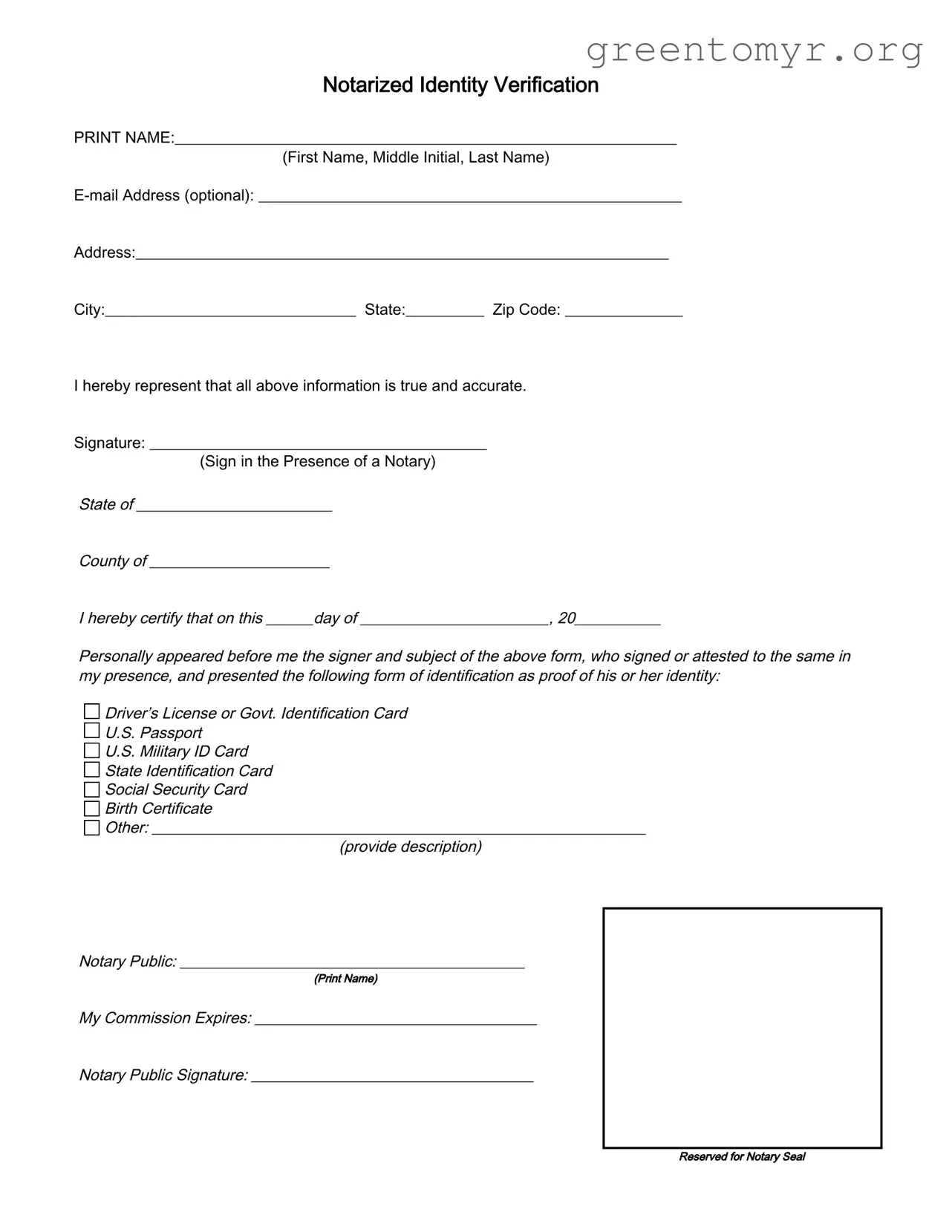
The Notarized Identity Verification form serves as a crucial tool for confirming an individual's identity in various legal and official contexts. This form requires the individual to provide their full name, optional email address, and residential address, ensuring that all information is accurate and verifiable. The signer must affirm the truthfulness of their provided details by signing the document in the presence of a notary public. The notary plays an essential role in this process, certifying the identity of the signer on a specified date and confirming that proper identification has been presented. Acceptable forms of ID include a driver's license, government identification card, U.S. passport, military ID, state identification card, social security card, or even a birth certificate. The notary public will also complete their section by printing their name, signing, and noting their commission expiration date, alongside a reserved space for the notary seal. This form not only safeguards against identity fraud but also helps streamline various transactions that require verified identity, offering peace of mind to all parties involved.

Notarized Identity Verification
PRINT NAME:________________________________________________________________
(First Name, Middle Initial, Last Name)
Address:____________________________________________________________________
City:________________________________ State:__________ Zip Code: _______________
I hereby represent that all above information is true and accurate.
Signature: ___________________________________________
(Sign in the Presence of a Notary)
State of _________________________
County of _______________________
I hereby certify that on this ______day of ________________________, 20___________
Personally appeared before me the signer and subject of the above form, who signed or attested to the same in my presence, and presented the following form of identification as proof of his or her identity:
Driver’s License or Govt. Identification Card
U.S. Passport
U.S. Military ID Card
State Identification Card
Social Security Card
Birth Certificate
Other: _______________________________________________________________
(provide description)
Notary Public: ____________________________________________
(Print Name)
My Commission Expires: ____________________________________
Notary Public Signature: ____________________________________
Reserved for Notary Seal
| Fact Name | Details |
|---|---|
| Purpose | The Notarized Identity Verification form is used to confirm an individual's identity through notarization. |
| Required Information | The form requires the individual's full name, optional email address, and residential address, including city, state, and zip code. |
| Signature Requirement | The individual must sign the form in the presence of a notary public. |
| Identification Options | Acceptable forms of identification include a driver's license, passport, military ID, state ID, social security card, birth certificate, or other specified identification. |
| Notary Certification | The notary public certifies the identity of the signer and records the date of notarization on the form. |
| State-Specific Forms | Each state may have specific requirements for notarization, governed by local laws, such as the Notary Public Act. |
| Commission Expiration | The notary public must indicate the expiration date of their commission on the form. |
| Notary Seal | A space is reserved for the notary seal, which is required for the form to be valid. |
Completing the Notarized Identity Verification form is a straightforward process, but it’s essential to ensure accuracy. Once you’ve filled out the form, you’ll need to have it notarized, which means a notary public will verify your identity and witness your signature. Follow these steps carefully to avoid any delays.
The Notarized Identity Verification form is a document that confirms a person's identity. It requires the individual to provide personal information, such as their name, address, and a signature, in the presence of a notary public. The notary then verifies the person's identity by checking an accepted form of identification.
This form is often required for various legal and financial transactions. It helps organizations ensure that they are dealing with the correct individual. You might need it for things like opening a bank account, applying for a loan, or verifying your identity for legal purposes.
You will need to provide your full name, email address (optional), and your address, including city, state, and zip code. Additionally, you must sign the form in front of a notary public. The notary will also need to note the identification you presented.
The form allows for several types of identification. You can use any of the following:
To complete the notarization, you must sign the form in the presence of a notary public. The notary will then verify your identity using your identification. After confirming your identity, the notary will sign and stamp the form, making it an official document.
Yes, most notaries charge a fee for their services. The cost can vary depending on the notary and your location. It’s a good idea to ask about the fee before you meet with the notary.
The validity of the notarized identity verification can depend on the specific requirements of the organization requesting it. Generally, it remains valid as long as the information provided is accurate and hasn’t changed. However, some institutions may have their own time limits, so it’s best to check with them.
No, the Notarized Identity Verification form must be completed in person. The notary needs to witness your signature and verify your identity, which cannot be done online.
If you make a mistake, do not try to erase or cross out the information. Instead, it’s best to fill out a new form. Ensure all information is correct before signing in front of the notary to avoid complications.
Completing the Notarized Identity Verification form accurately is essential for ensuring that your identity is confirmed without complications. One common mistake is leaving out the full name. It is crucial to provide your first name, middle initial, and last name in the designated space. Omitting any part of your name can lead to issues during verification.
Another frequent error involves the signature. It must be done in the presence of a notary. Some individuals mistakenly sign the form before meeting with the notary, which can invalidate the document. Ensure that you sign only when the notary is present to witness your signature.
Providing an incorrect or incomplete address is also a common oversight. Make sure to include your full street address, city, state, and zip code. Incomplete or incorrect information can delay the verification process and may require you to resubmit the form.
Individuals sometimes forget to include their email address, even though it is optional. While this may not be mandatory, providing an email can facilitate communication regarding the verification process. It is a simple addition that can be beneficial.
Another mistake involves the identification section. Some people fail to present an acceptable form of identification when meeting with the notary. It is important to bring a valid ID, such as a driver’s license or passport, as specified on the form. Without proper identification, the notarization cannot be completed.
Lastly, individuals may neglect to check the notary section for completion. After the notary has witnessed your signature, they must fill out their portion of the form, including their name, signature, and commission expiration date. Ensure that this section is completed to avoid any issues with the notarization.
The Notarized Identity Verification form is often used in conjunction with several other documents to ensure a thorough verification process. Each of these forms serves a specific purpose and helps to establish the identity of an individual in various contexts. Below is a list of commonly associated documents.
Using these documents together with the Notarized Identity Verification form helps to create a robust framework for confirming an individual's identity. This thorough approach is essential in many legal and financial contexts, ensuring that all parties involved can trust the verification process.
The Notarized Identity Verification form serves an important purpose in confirming a person's identity. Several other documents share similar functions or characteristics. Here’s a list of seven documents that are comparable:
When completing the Notarized Identity Verification form, attention to detail is essential. Here are ten important dos and don'ts to consider:
Following these guidelines will help ensure that your Notarized Identity Verification form is completed correctly and efficiently.
Misconceptions about the Notarized Identity Verification form can lead to confusion and mistakes. Understanding these misconceptions is crucial for ensuring accurate and effective use of the form.
This is not true. While often used in legal contexts, the form can also be required for various administrative processes, such as banking or applying for government services.
The form allows for multiple types of identification, including a driver's license, passport, or even a birth certificate. As long as the identification is valid, it can be used.
This is incorrect. A notary public is trained to verify identity through acceptable forms of identification, and prior personal acquaintance is not a requirement.
While the form serves to confirm that a person has presented valid identification, it does not guarantee the authenticity of the information provided. The signer is responsible for the accuracy of their details.
When filling out and using the Notarized Identity Verification form, keep these key takeaways in mind:
Following these steps will help ensure that your Notarized Identity Verification form is completed correctly and accepted without issues.