Content Navigation

The Notarized Odometer Statement form plays a crucial role in the vehicle transfer process, ensuring transparency and accuracy regarding a vehicle's mileage. This document is designed to protect both buyers and sellers by providing a legally recognized declaration of the odometer reading at the time of sale. It includes essential details such as the vehicle's make, model, year, and Vehicle Identification Number (VIN), along with the mileage recorded. A notary public verifies the information, confirming the identity of the vehicle owner and the authenticity of the statement. This verification adds an extra layer of security, helping to prevent odometer fraud, which can have significant financial implications. The form requires the signature of the registered owner and the notary, along with the date of the transaction, making it a vital component of any vehicle sale or transfer in the United States.

Notarized Odometer Statement Example

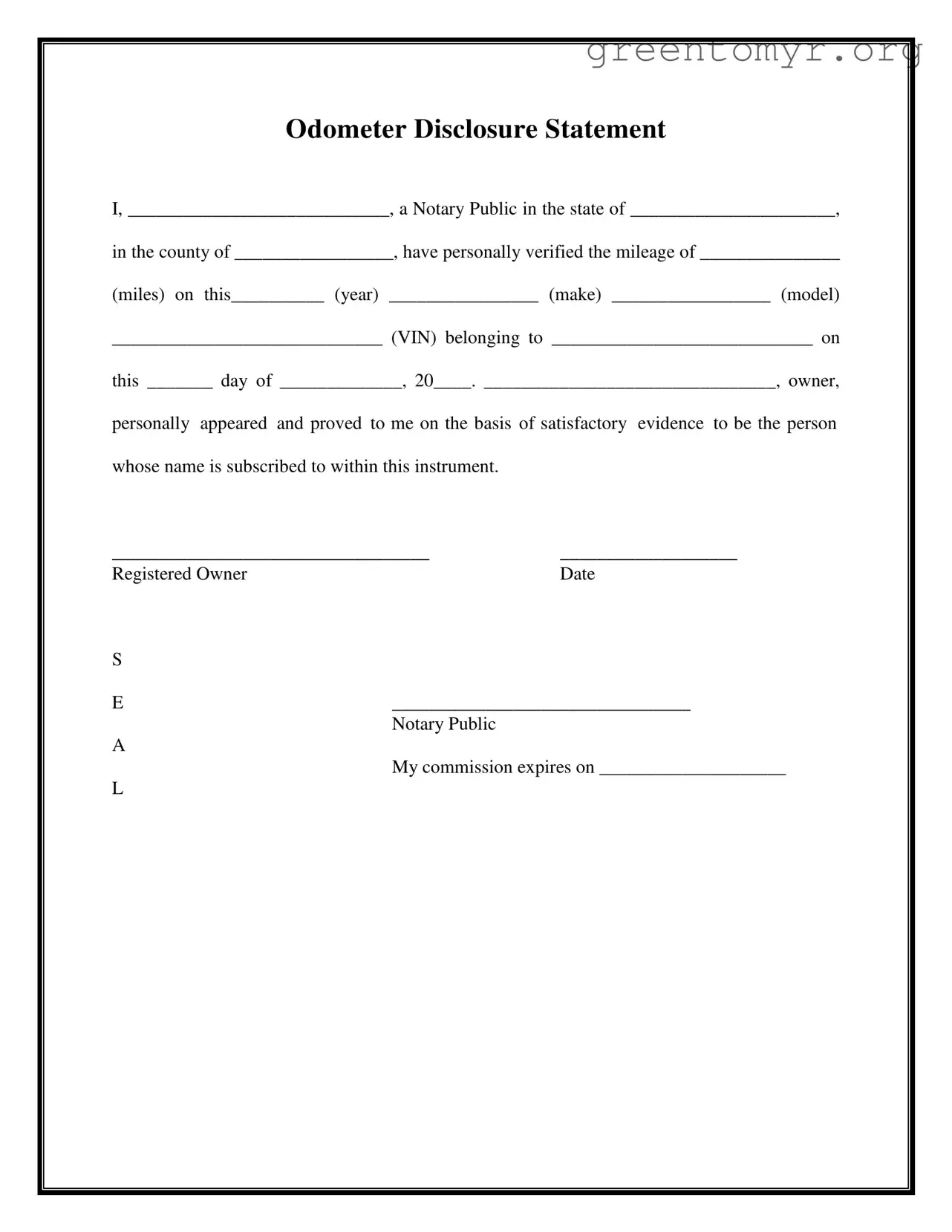
ODOMETER DISCLOSURE STATEMENT

I, ____________________________, a Notary Public in the state of ______________________,

in the county of _________________, have personally verified the mileage of _______________

(miles) on this__________ (year) ________________ (make) _________________ (model)

_____________________________ (VIN) belonging to ____________________________ on

this _______ day of _____________, 20____. _______________________________, owner,

personally appeared and proved to me on the basis of satisfactory evidence to be the person whose name is subscribed to within this instrument.

__________________________________

___________________

Registered Owner

Date

S


E

________________________________


Notary Public

A


My commission expires on ____________________

L


File Breakdown

Fact Name Description
Purpose The Notarized Odometer Statement form is used to document the mileage of a vehicle at the time of sale or transfer.
Notary Requirement A Notary Public must verify the mileage and the identity of the vehicle owner for the statement to be valid.
State-Specific Forms Each state may have its own version of the Odometer Disclosure Statement, governed by state laws.
Federal Law The federal law requires that sellers disclose the odometer reading when transferring ownership of a vehicle.
VIN Requirement The form must include the Vehicle Identification Number (VIN) for accurate identification of the vehicle.
Owner's Signature The registered owner must sign the form to confirm the accuracy of the odometer reading.
Date of Statement The form must indicate the date it was completed, which is essential for legal purposes.
Evidence of Identity The Notary must confirm the identity of the owner based on satisfactory evidence, such as a driver's license.
Expiration of Notary Commission The Notary Public must include the expiration date of their commission on the form.
Record Keeping Both the buyer and seller should keep a copy of the notarized form for their records, as it may be needed for future reference.

Guide to Using Notarized Odometer Statement

After completing the Notarized Odometer Statement form, you will need to ensure that it is signed in the presence of a notary public. The notary will verify the information and witness the signatures. Once notarized, keep a copy for your records and provide the original to the necessary parties.

  1. Begin by writing your name in the first blank line where it says "I, ____________________________."
  2. In the next blank, fill in the state where the notarization is taking place.
  3. Next, write the county where the notarization occurs in the following blank.
  4. Enter the mileage in the blank that states "have personally verified the mileage of _______________ (miles)."
  5. Fill in the year of the vehicle in the space provided for "this__________ (year)."
  6. Next, write the make of the vehicle in the blank for "________________ (make)."
  7. In the next blank, enter the model of the vehicle for "________________ (model)."
  8. Fill in the Vehicle Identification Number (VIN) in the space labeled "_____________________________ (VIN)."
  9. Write the name of the registered owner in the blank for "belonging to ____________________________."
  10. Enter the day and month in the blanks labeled "on this _______ day of _____________, 2015."
  11. Have the registered owner sign their name in the space labeled "_____________________________, owner."
  12. Next, the owner should print their name below their signature.
  13. The notary public will then sign and stamp the form in the designated area.
  14. Finally, the notary will fill in the expiration date of their commission in the last blank.

Get Answers on Notarized Odometer Statement

What is a Notarized Odometer Statement?

A Notarized Odometer Statement is a legal document that confirms the mileage of a vehicle at the time of sale. It is signed by the vehicle owner and notarized by a public notary. This statement helps to prevent fraud related to odometer readings during vehicle transfers.

Why do I need a Notarized Odometer Statement?

This document is essential for several reasons:

  • It provides proof of the vehicle's mileage at the time of sale.
  • It protects both the buyer and seller from potential disputes regarding the vehicle's condition.
  • Many states require this statement for vehicle registration and title transfer.

How do I complete a Notarized Odometer Statement?

To complete the statement, follow these steps:

  1. Fill in your name, the state, and county where the notarization will take place.
  2. Enter the vehicle's mileage, year, make, model, and VIN (Vehicle Identification Number).
  3. Sign the document in the presence of a notary public.
  4. Have the notary public complete their section, including their signature and commission expiration date.

Where can I get a Notarized Odometer Statement form?

You can obtain a Notarized Odometer Statement form from various sources:

  • Your local Department of Motor Vehicles (DMV) office.
  • Online legal form websites.
  • Some auto dealerships may also provide this form.

How much does it cost to get a Notarized Odometer Statement?

The cost can vary based on several factors. Typically, notary fees range from $5 to $15 per signature. Additionally, some locations may charge for the form itself. Always check with your local notary for specific pricing.

Is a Notarized Odometer Statement required in all states?

No, the requirement for a Notarized Odometer Statement varies by state. Some states mandate it for all vehicle sales, while others may not require it at all. Check your state’s DMV regulations to determine if it is necessary for your transaction.

What should I do if the odometer reading is incorrect?

If you discover that the odometer reading is incorrect, you should not complete the Notarized Odometer Statement. Instead, resolve the discrepancy before proceeding with the sale. Contact a professional mechanic or your local DMV for guidance on how to correct the odometer reading.

Common mistakes

Filling out the Notarized Odometer Statement form can seem straightforward, but many people overlook critical details that can lead to complications. One common mistake is failing to provide accurate mileage. The mileage must be filled in correctly to avoid any legal issues later. If the number is incorrect, it can raise suspicions about the vehicle's condition and history.

Another frequent error involves not having the proper notarization. Many individuals assume that signing the document is enough. However, a Notary Public must verify the identity of the signer and witness the signing. Without this step, the document may not hold up legally, potentially causing problems during the sale or transfer of the vehicle.

People often neglect to complete all required fields. Each section of the form is essential for its validity. Missing information, such as the vehicle's year, make, model, or VIN, can invalidate the document. It's crucial to double-check that all areas are filled out completely before submission.

Additionally, some individuals forget to include the date of the notarization. This date is vital as it indicates when the statement was executed. Without it, the document may be considered incomplete, leading to delays or disputes in the transaction process.

Lastly, many overlook the expiration date of the Notary's commission. If the Notary Public's commission has expired, the notarization may not be legally recognized. Always ensure that the Notary's credentials are current to avoid any issues with the form's legitimacy.

Documents used along the form

The Notarized Odometer Statement form is an essential document in the process of transferring vehicle ownership. It serves to verify the mileage of a vehicle at the time of sale, ensuring transparency and preventing fraud. Several other forms and documents are commonly used alongside this statement to facilitate a smooth transaction.

  • Vehicle Title: This document proves ownership of the vehicle. It includes details such as the vehicle identification number (VIN), make, model, and the name of the current owner. The title must be signed over to the new owner during the sale.
  • Bill of Sale: A bill of sale is a legal document that records the sale of a vehicle. It outlines the terms of the sale, including the sale price, date of transaction, and the names of both the buyer and seller. This document serves as proof of the transaction.
  • Application for Title: This form is submitted to the state’s Department of Motor Vehicles (DMV) to apply for a new title in the buyer's name. It typically requires information from the vehicle title and bill of sale.
  • Emissions Test Certificate: In some states, a vehicle must pass an emissions test before it can be sold. This certificate confirms that the vehicle meets state emissions standards, ensuring it is environmentally compliant.
  • Vehicle Registration: This document is required to legally operate the vehicle on public roads. It includes information about the vehicle and its owner and must be updated whenever ownership changes.
  • Release of Liability: This form protects the seller from any future claims related to the vehicle after the sale. It informs the DMV that the seller is no longer responsible for the vehicle once it is sold.
  • Power of Attorney: In some cases, a seller may authorize another person to complete the sale on their behalf. This document grants that individual the legal authority to act in the seller's stead during the transaction.

Each of these documents plays a crucial role in ensuring a transparent and legally compliant vehicle sale. Proper completion and submission of these forms can help prevent disputes and protect the interests of both the buyer and the seller.

Similar forms

The Notarized Odometer Statement form serves a specific purpose in documenting the mileage of a vehicle during a sale or transfer. Several other documents share similarities in function and intent, often requiring verification of information or personal identification. Below are eight documents that are comparable to the Notarized Odometer Statement:

  • Bill of Sale: This document records the transaction between a buyer and seller, detailing the vehicle's sale price, identification, and the date of the transaction.
  • Title Transfer Document: Similar to the Odometer Statement, this form is used to officially transfer ownership of a vehicle from one party to another, often requiring signatures and notarization.
  • Vehicle Registration Application: This application is necessary for registering a vehicle with the state, requiring identification and proof of ownership, similar to the verification process in the Odometer Statement.
  • Power of Attorney for Vehicle Transactions: This document allows one person to act on behalf of another in vehicle-related matters, often needing notarization to confirm identity and authority.
  • Affidavit of Identity: This sworn statement verifies an individual's identity and is often used in conjunction with other documents, much like the personal verification in the Odometer Statement.
  • Vehicle History Report: While not always notarized, this report provides a detailed history of a vehicle's ownership, accidents, and mileage, serving a similar purpose in ensuring transparency in transactions.
  • Sales Contract: This legally binding agreement outlines the terms of the sale of a vehicle, requiring signatures and sometimes notarization, ensuring both parties are informed and agree to the terms.
  • Insurance Declaration Page: This document outlines the coverage of a vehicle and often requires verification of the vehicle’s details, similar to the information required in the Odometer Statement.

Dos and Don'ts

When filling out the Notarized Odometer Statement form, it's essential to follow specific guidelines to ensure accuracy and compliance. Here’s a helpful list of dos and don'ts:

  • Do fill in all required fields completely.
  • Do verify the mileage before signing the document.
  • Do ensure the vehicle's year, make, model, and VIN are correct.
  • Do have the form notarized by a licensed Notary Public.
  • Don't leave any fields blank; incomplete forms may be rejected.
  • Don't use white-out or any correction fluid on the form.
  • Don't sign the document until you are in the presence of the Notary Public.
  • Don't forget to check the expiration date of the Notary's commission.

Misconceptions

Understanding the Notarized Odometer Statement form is essential for vehicle transactions. However, several misconceptions can lead to confusion. Here are six common misunderstandings:

  • Notarization guarantees accuracy of mileage. Many people believe that a notary public verifies the accuracy of the odometer reading. In reality, the notary only confirms the identity of the person signing the document and does not check the vehicle's mileage.
  • All states require a notarized odometer statement. Some individuals think that every state mandates a notarized odometer statement for vehicle sales. In fact, requirements vary by state, and not all states require notarization.
  • The form is only needed for used vehicles. It is a common belief that notarized odometer statements apply only to used cars. However, they can also be required for certain transactions involving new vehicles, depending on state regulations.
  • Only the seller needs to sign the form. Some assume that only the seller's signature is necessary on the notarized odometer statement. In many cases, both the seller and buyer may need to sign the document, depending on state laws.
  • Once notarized, the form cannot be changed. A misconception exists that a notarized form is immutable. While the notarization indicates that the document was signed in the presence of a notary, it can still be amended or corrected if necessary, following proper procedures.
  • Notarized odometer statements are only for private sales. Many believe that notarized odometer statements are exclusively for private sales between individuals. In reality, dealerships and other entities may also require this form as part of their sales process.

Being informed about these misconceptions can help individuals navigate the vehicle buying and selling process more effectively.

Key takeaways

When filling out and using the Notarized Odometer Statement form, keep the following key points in mind:

  • Ensure that all sections of the form are completed accurately. This includes the owner's name, vehicle details, and mileage.
  • The form must be signed in the presence of a Notary Public. This step is crucial for the document to be valid.
  • Provide the correct date when the statement is signed. This helps establish the timeline of the vehicle's ownership.
  • Verify that the Notary Public has filled in their information correctly, including their commission expiration date.
  • Retain a copy of the completed form for your records. This serves as proof of the odometer disclosure.