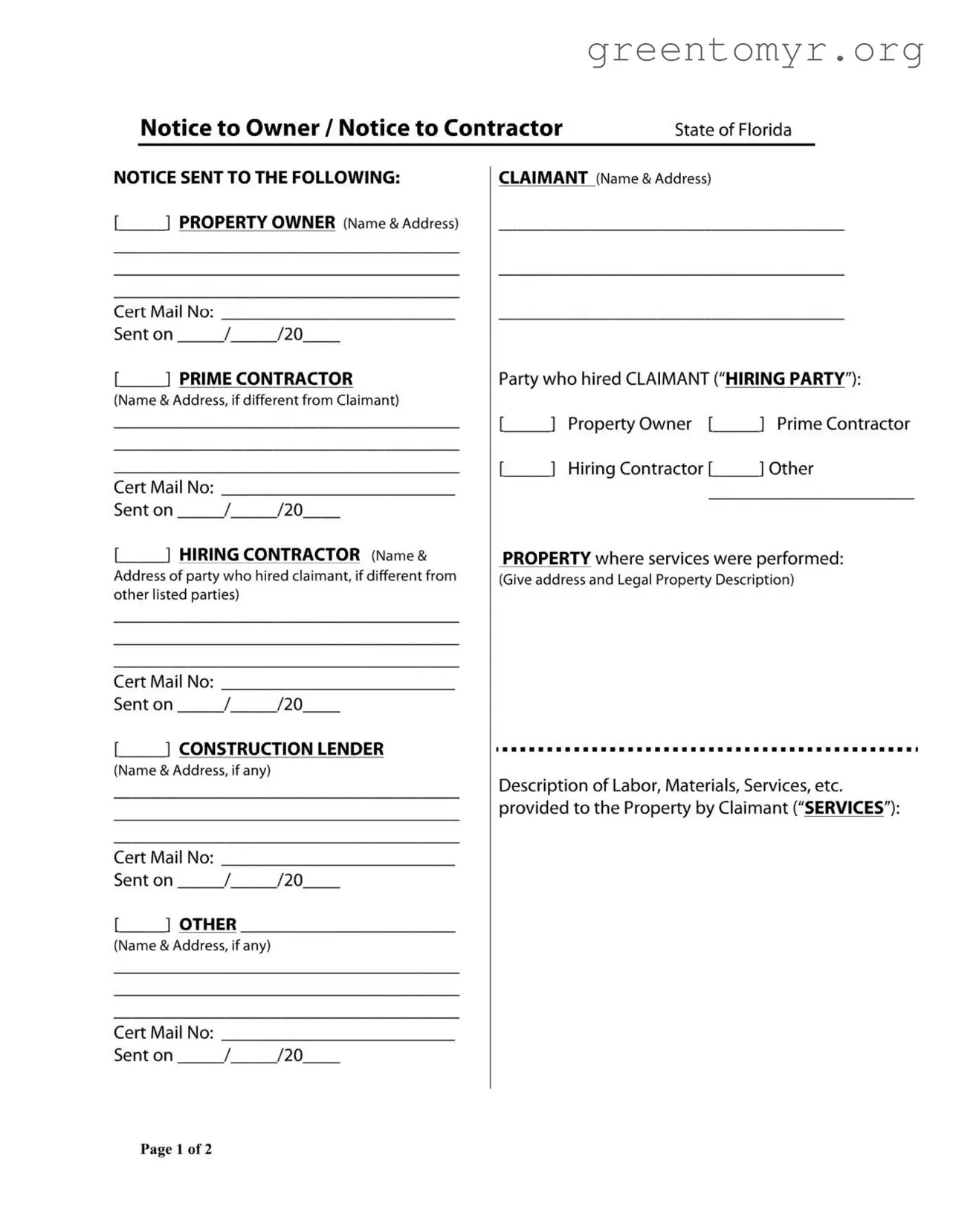
The Notice Owner Florida form serves as a critical communication tool within the construction industry, aimed at protecting the rights of contractors, subcontractors, and material suppliers. This form is primarily issued by a claimant—typically a contractor or supplier—who has provided services or materials for a specific property. It notifies various parties involved in the construction project, including the property owner, prime contractor, hiring contractor, and construction lender, of the services rendered. By sending this notice, the claimant establishes a formal record of their involvement and intent to seek payment for their work. The form includes essential details such as the names and addresses of the parties involved, a description of the services provided, and legal property descriptions. Importantly, it also warns property owners about the potential for construction liens, which can arise even if payments have been made in full to the contractor. Understanding the implications of this form is crucial for property owners, as failure to adhere to the stipulations outlined may result in financial liabilities, including the risk of paying twice for the same services. Therefore, familiarity with the Notice Owner Florida form and its requirements is vital for all parties engaged in construction projects in the state.
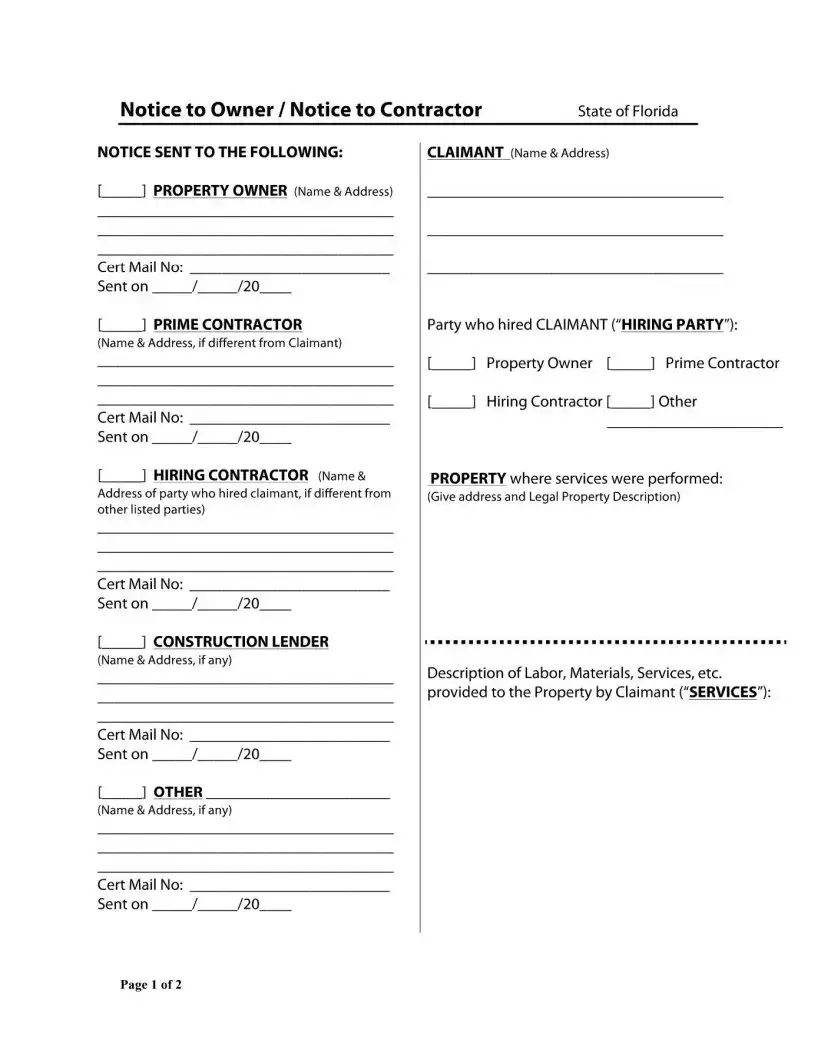
Notice to Owner/ Notice to Contractor |
State of Florida |
NOTICE SENT TO THE FOLLOWING:
~_ _,) PROPERTY OWNER (Name & Address)
Cert Mail No: ___________
Sent on __!__!20
..__..) PRIME CONTRACTOR
(Name & Address, if different from Claimant)
Cert Mail No: ___________
Senton __/__/20__
..__..) HIRING CONTRACTOR (Name &
Address of party who hired claimant, if different from other listed parties)
Cert Mail No:
Senton __/ __/20__
..__..) CONSTRUCTION LENDER
(Name & Address, if any)
Cert Mail No:
Sent on __/__/20__
~_ _,] OTHER __________
(Name & Address, if any)
CLAIMANT (Name & Address)
Party who hired CLAIMANT ("HIRING PARTY"):
Property Owner .__[_ __,) Prime Contractor
Hiring Contractor.__[_ __,) Other
PROPERTY where services were performed:
(Give address and Legal Property Description)
..........•.•.... |
• |
• |
• |
• |
Description of Labor, Materials, Services, et c. provided to t he Property by Claimant ("SERVICES"):
Cert Mail No:
Sent on __/__/20__
Page 1 of2
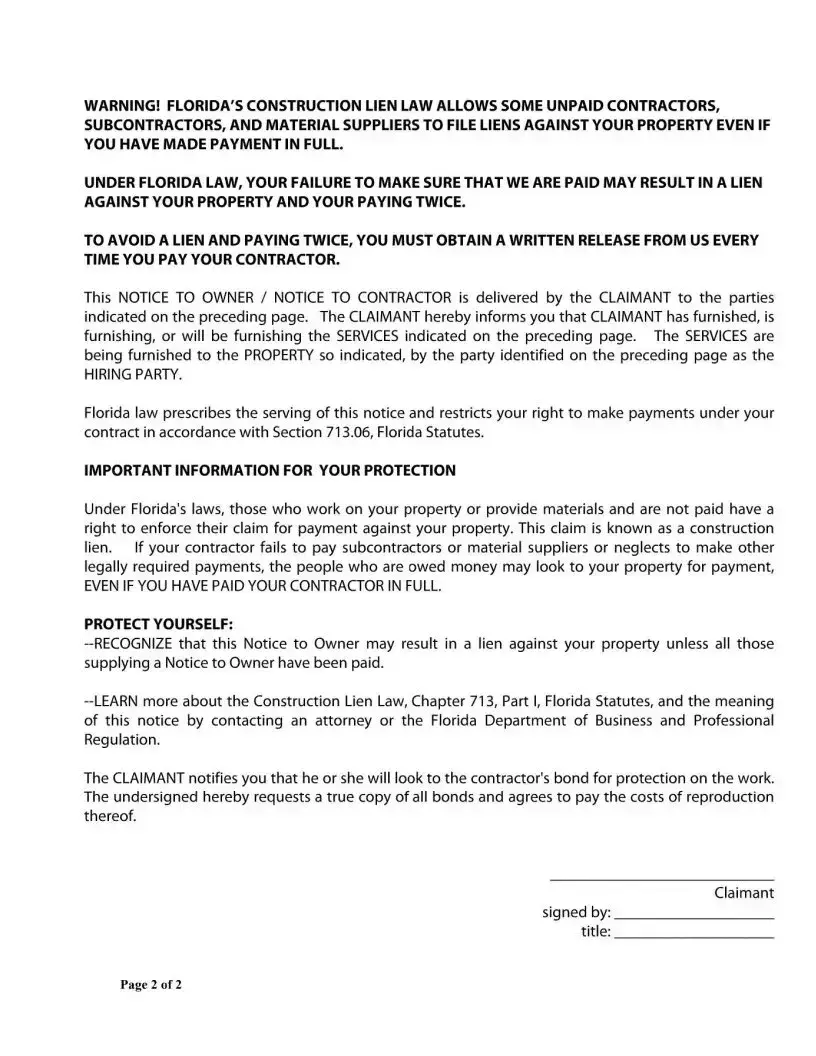
WARNING! FLORIDA'SCONSTRUCTION LIEN LAW ALLOWS SOME UNPAID CONTRACTORS, SUBCONTRACTORS, AND MATERIAL SUPPLIERS TO FILE LIENS AGAINST YOUR PROPERTY EVEN IF YOU HAVE MADE PAYMENT IN FULL.
UNDER FLORIDA LAW, YOUR FAILURE TO MAKE SURE THAT WE ARE PAID MAY RESULT IN A LIEN AGAINST YOUR PROPERTY AND YOUR PAYING TWICE.
TO AVOID A LIEN AND PAYING TWICE, YOU MUST OBTAIN A WRITTEN RELEASE FROM US EVERY TIME YOU PAY YOUR CONTRACTOR.
This NOTICE TO OWNER / NOTICE TO CONTRACTOR is delivered by the CLAIMANT to the parties indicated on the preceding page. The CLAIMANT hereby informs you that CLAIMANT has furnished, is furnishing, or will be furnishing the SERVICES indicated on the preceding page. The SERVICES are being furnished to the PROPERTY so indicated, by the party identified on the preceding page as the
HIRING PARTY.
Florida law prescribes the serving of this notice and restricts your right to make payments under your contract in accordance with Section 713.06, Florida Statutes.
IMPORTANT INFORMATION FOR YOUR PROTECTION
Under Florida'slaws, those who work on your property or provide materials and are not paid have a right to enforce their claim for payment against your property. This claim is known as a construction lien. If your contractor fails to pay subcontractors or material suppliers or neglects to make other legally required payments, the people who are owed money may look to your property for payment,
EVEN IF YOU HAVE PAID YOUR CONTRACTOR IN FULL.
PROTECT YOURSELF:
The CLAIMANT notifies you that he or she will look to the contractor'sbond for protection on the work. The undersigned hereby requests a true copy of all bonds and agrees to pay the costs of reproduction thereof.
Claimant
signed by: ________
title:
Page 2 of2
| Fact Name | Description |
|---|---|
| Purpose | The Notice to Owner form is used to inform property owners and other parties that services or materials have been provided, ensuring awareness of potential liens. |
| Governing Law | This form is governed by Florida's Construction Lien Law, specifically Section 713.06 of the Florida Statutes. |
| Recipients | The notice must be sent to various parties, including the property owner, prime contractor, hiring contractor, construction lender, and any other relevant parties. |
| Liability Warning | The form includes a warning that unpaid contractors, subcontractors, and material suppliers may file liens against the property, even if the owner has paid in full. |
| Payment Protection | Property owners are advised to obtain a written release from contractors for every payment made to avoid potential double payment due to liens. |
Filling out the Notice Owner Florida form is a straightforward process that requires attention to detail. This form serves as an important communication tool in the construction industry, ensuring that all parties involved are informed about the services provided and their rights regarding payment. Follow the steps below to complete the form accurately.
After completing the form, ensure all information is accurate before sending it to the relevant parties. This will help protect your rights and interests in the construction process. Keep a copy for your records as well.
The Notice to Owner form is a document used in Florida's construction industry. It informs property owners, contractors, and other parties that a contractor, subcontractor, or material supplier is providing services or materials to a property. This notice is essential for protecting the rights of those who work on the property and helps prevent unpaid claims from becoming liens against the property.
The Notice to Owner must be sent to several parties, including:
Each party listed on the notice should receive a copy to ensure they are informed about the services being provided.
This notice is crucial because it helps protect the rights of contractors and suppliers. If they are not paid for their work, they can file a lien against the property. This means that even if the property owner has paid their contractor in full, they could still be responsible for paying again if the subcontractors or suppliers are not compensated.
If you do not receive a Notice to Owner, it may put you at risk. Without this notice, you might not be aware of potential claims against your property. This could lead to a situation where you are liable for payments that you thought were settled. It's best to ensure that all parties involved in the construction are properly notified.
To protect yourself from liens, consider the following steps:
If you receive a Notice to Owner, take it seriously. Review the information and ensure that you understand who is providing services to your property. You may want to reach out to your contractor for clarification. Additionally, consider consulting with a legal professional to understand your rights and obligations.
Yes, you can dispute a Notice to Owner if you believe it is incorrect or unjustified. It's essential to gather any supporting documents and evidence to back your claim. Consulting with an attorney can help you navigate the dispute process effectively.
For more information about the Notice to Owner and construction lien laws in Florida, you can contact an attorney or visit the Florida Department of Business and Professional Regulation's website. They provide resources and guidance to help you understand your rights and responsibilities in construction matters.
When filling out the Notice Owner Florida form, individuals often make several common mistakes that can lead to complications down the line. Awareness of these pitfalls can help ensure that the form is completed correctly and that all parties are adequately protected under Florida law.
One frequent mistake is providing incomplete or inaccurate information about the property owner. The form requires the name and address of the property owner, and any errors in this section can lead to issues with notification. If the property owner's name is misspelled or the address is incorrect, it may invalidate the notice and prevent the claimant from enforcing their rights effectively.
Another common error involves the failure to include all necessary parties. The form asks for information about the prime contractor, hiring contractor, and construction lender. Omitting any of these parties can create confusion and may lead to disputes regarding payment. Each party plays a crucial role in the transaction, and their inclusion is essential for a clear understanding of responsibilities.
Additionally, individuals sometimes neglect to provide a complete legal property description. The form requests a detailed description of the property where services were performed. Without this information, it may be difficult to establish a connection between the work done and the property in question. This can hinder the ability to file a lien if necessary.
Moreover, many people overlook the importance of sending the notice via certified mail. The form includes a section for certifying mail numbers and dates sent. Failing to send the notice through certified mail can result in a lack of proof that the notice was delivered, which is critical if disputes arise later. Documentation of delivery is essential for protecting one’s interests.
Lastly, individuals often forget to request a written release from the contractor upon payment. The Notice Owner form serves as a reminder of the need for such a release to avoid potential liens. By not obtaining this document, property owners risk paying for services twice, which can lead to significant financial strain.
By being aware of these common mistakes—providing accurate information, including all necessary parties, detailing the property description, using certified mail, and securing written releases—individuals can navigate the complexities of the Notice Owner Florida form more effectively. Taking these steps can help protect property owners and ensure compliance with Florida's construction lien laws.
When dealing with construction projects in Florida, it is essential to understand the various forms and documents that accompany the Notice to Owner form. These documents help protect the rights of all parties involved and ensure compliance with state laws. Below is a list of commonly used forms that are often associated with the Notice to Owner in Florida.
Understanding these documents and their purposes can help mitigate risks associated with construction projects. Properly managing these forms ensures that all parties are aware of their rights and obligations, fostering a smoother construction process.
The Notice to Owner Florida form serves a crucial role in the construction industry, particularly in protecting the rights of those who provide labor and materials. Several other documents share similarities with this form, each serving specific purposes within the realm of construction and property law. Below is a list of six such documents, highlighting their similarities with the Notice to Owner Florida form.
Each of these documents plays a vital role in the construction process, ensuring transparency and protecting the rights of those involved. Understanding their similarities can help property owners navigate the complexities of construction law more effectively.
When filling out the Notice Owner Florida form, it's important to be thorough and accurate. Here are some key dos and don'ts to keep in mind:
By following these guidelines, you can help ensure that the Notice Owner Florida form is filled out correctly and serves its intended purpose.
This is not true. The Notice to Owner form is required for any construction project where services or materials are provided. Whether the project is small or large, filing this notice helps protect the rights of contractors and subcontractors.
Many property owners believe that a good contractor does not need this notice. However, it is crucial to send the Notice to Owner regardless of the contractor's reputation. This form serves as a legal safeguard against potential liens.
This is a dangerous assumption. Even if you have paid your contractor, subcontractors or suppliers may still file a lien if they have not been compensated. It is essential to ensure that all parties involved have been paid to avoid financial repercussions.
While the Notice to Owner helps protect against liens, it does not eliminate the risk entirely. If payments are not made to all parties involved, there is still a possibility of a lien being placed on your property.
Procrastination can lead to significant problems. Addressing lien issues promptly is vital. Ignoring the Notice to Owner or delaying action can result in legal complications and financial loss.
When dealing with the Notice Owner Florida form, it’s essential to understand its purpose and implications. Here are some key takeaways to keep in mind:
Being informed about these aspects can help property owners navigate potential issues related to construction liens effectively.