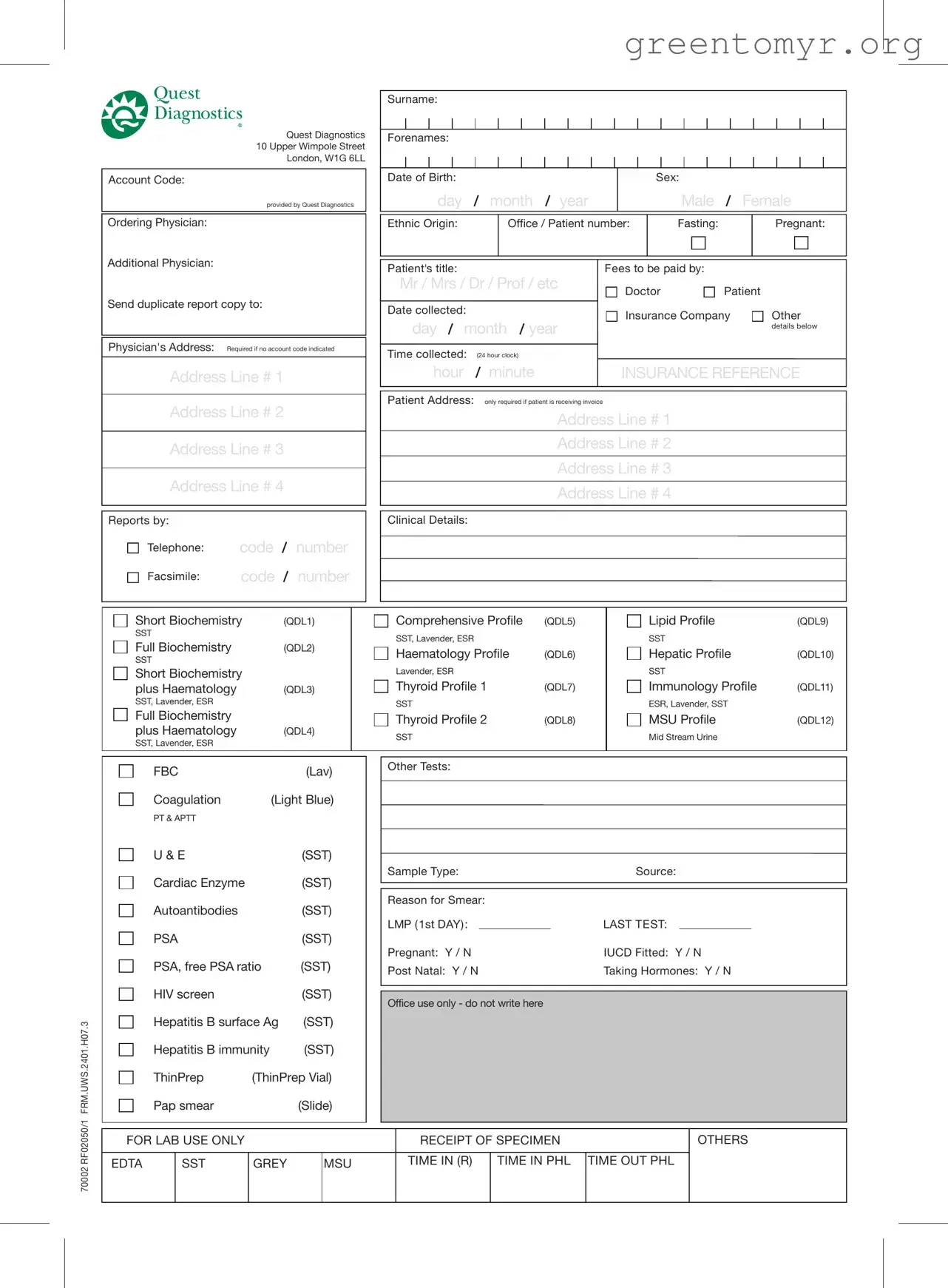
The Order Quest Diagnostics form is a crucial document used in the medical field for a variety of testing and diagnostic purposes. It captures essential patient information, including the patient's surname, date of birth, and sex, which helps ensure accurate identification and record-keeping. The form also requires details about the ordering physician, such as their name and contact information, making communication seamless between healthcare providers. Patients must indicate their fasting status and whether they are pregnant, as these factors can influence test results. Additionally, the form allows for the inclusion of an insurance reference, helping to streamline billing processes. Clinical details are vital, as they specify the type of tests requested, ranging from biochemical profiles to specific screenings like HIV and hepatitis. Other important sections include patient and physician addresses, as well as options for sending duplicate reports. Ultimately, this form serves as a comprehensive tool that facilitates effective patient care and ensures that all necessary information is gathered for accurate testing and reporting.
Surname:
Quest Diagnostics
10 Upper Wimpole Street
London, W1G 6LL
Account Code:
provided by Quest Diagnostics
Ordering Physician:
Forenames:
|
|
|
|
|
|
|
|
|
|
|
|
|
|
|
|
|
|
|
|
|
|
Date of Birth: |
|
|
|
|
|
|
|
|
|
Sex: |
|
|
|
|
|
||||||
|
|
day |
month |
year |
|
|
|
Male |
Female |
||||||||||||
Ethnic Origin: |
|
Office / Patient number: |
|
Fasting: |
|
Pregnant: |
|||||||||||||||
|
|
|
|||||||||||||||||||
|
|
|
|
|
|
|
|
|
|
|
|
|
|
|
|
|
|
|
|
|
|
Additional Physician:
Send duplicate report copy to:
Physician's Address: Required if no account code indicated
Address Line # 1
Patient's title:
Mr / Mrs / Dr / Prof / etc
Date collected:
day month year
Time collected: (24 hour clock)
hour minute
Fees to be paid by: |
|
|
Doctor |
Patient |
|
Insurance Company |
Other |
|
|
|
details below |
INSURANCE REFERENCE
Address Line # 2
Address Line # 3
Address Line # 4
Reports by:
Telephone: code number
Facsimile: code number
Patient Address: only required if patient is receiving invoice
Address Line # 1
Address Line # 2
Address Line # 3
Address Line # 4
Clinical Details:
Short Biochemistry |
(QDL1) |
Comprehensive Profile |
(QDL5) |
Lipid Profile |
(QDL9) |
SST |
|
SST, Lavender, ESR |
|
SST |
|
Full Biochemistry |
|
|
|
||
(QDL2) |
Haematology Profile |
(QDL6) |
Hepatic Profile |
(QDL10) |
|
SST |
|
||||
|
|
|
|
|
|
Short Biochemistry |
|
Lavender, ESR |
|
SST |
|
|
|
|
|
|
|
plus Haematology |
(QDL3) |
Thyroid Profile 1 |
(QDL7) |
Immunology Profile |
(QDL11) |
SST, Lavender, ESR |
|
SST |
|
ESR, Lavender, SST |
|
|
|
|
|
||
Full Biochemistry |
|
Thyroid Profile 2 |
(QDL8) |
MSU Profile |
(QDL12) |
plus Haematology |
|
||||
(QDL4) |
SST |
|
Mid Stream Urine |
|
|
SST, Lavender, ESR |
|
|
|
||
|
|
|
|
|
|
|
|
|
|
|
|
FRM.UWS.2401.H07.3
FBC |
|
|
(Lav) |
Coagulation |
|
(Light Blue) |
|
PT & APTT |
|
|
|
ertert |
|
|
|
U & E |
|
|
(SST) |
Cardiac Enzyme |
|
|
(SST) |
Autoantibodies |
|
|
(SST) |
PSA |
|
|
(SST) |
PSA, free PSA ratio |
|
(SST) |
|
HIV screen |
|
|
(SST) |
Hepatitis B surface Ag |
(SST) |
||
Hepatitis B immunity |
|
(SST) |
|
ThinPrep |
(ThinPrep Vial) |
||
Pap smear |
|
|
(Slide) |
|
|
|
|
Other Tests:
Sample Type: |
Source: |
|||
|
|
|
|
|
|
|
|
|
|
Reason for Smear: |
|
|
|
|
LMP (1st DAY): |
|
LAST TEST: |
|
|
Pregnant: Y / N |
IUCD Fitted: Y / N |
|||
Post Natal: Y / N |
Taking Hormones: Y / N |
|||
|
|
|
|
|
|
|
|
|
|
Office use only - do not write here |
|
|
|
|
|
|
|
|
|
70002 RF02050/1
FOR LAB USE ONLY |
|
|
RECEIPT OF SPECIMEN |
|
OTHERS |
||
|
|
|
|
|
|
|
|
EDTA |
SST |
GREY |
MSU |
TIME IN (R) |
TIME IN PHL |
TIME OUT PHL |
|
|
|
|
|
||||
|
|
|
|
|
|
|
|
| Fact Name | Description |
|---|---|
| Ordering Physician | The form requires the name of the ordering physician, including their forenames and surname. |
| Patient Information | Essential details such as date of birth, sex, and ethnic origin must be provided for the patient. |
| Insurance Details | Insurance information is necessary if fees are to be billed to an insurance company. Include an insurance reference number. |
| Sample Collection | The form asks for the date and time the sample was collected. This is crucial for accurate testing. |
| State-Specific Governing Laws | Each state may have different regulations governing the use of medical forms. Check local laws for compliance. |
Filling out the Order Quest Diagnostics form is a straightforward process that requires specific information about the patient and the tests being ordered. Once the form is completed, it can be submitted to Quest Diagnostics for processing. Below are the steps to accurately fill out the form.
The Order Quest Diagnostics form is utilized by healthcare providers to request various laboratory tests for patients. It captures essential information about the patient, the ordering physician, and the specific tests required. This ensures that the laboratory can process the request accurately and efficiently.
You will need to provide several key details, including:
Additionally, you may need to specify if the patient is fasting or pregnant, and provide the date and time the specimen was collected.
The form includes a section where you can select the specific tests needed. Options range from basic biochemistry panels to more specialized tests like thyroid profiles or immunology profiles. Be sure to check the appropriate boxes to ensure clarity.
If you do not have an account code provided by Quest Diagnostics, you must fill out the physician's address section on the form. This ensures that the laboratory can send the results to the correct location. Without this information, processing may be delayed.
Yes, the form allows you to specify an additional physician to receive a duplicate report. Simply fill out the "Send duplicate report copy to" section with the required details, including the physician's address.
If the patient is responsible for payment and will receive an invoice, you must provide their address on the form. This ensures that billing is accurate and reaches the right person.
Yes, if the patient is pregnant, you should indicate this on the form. Additionally, you may need to provide information regarding the last menstrual period (LMP) and whether the patient is taking hormones. This information can be crucial for certain tests.
It's important to fill out the form carefully. If you notice an error after submitting, contact Quest Diagnostics as soon as possible to correct the information. They can guide you on the best course of action to ensure the test results are accurate.
The Order Quest Diagnostics form can typically be obtained directly from Quest Diagnostics' website or through your healthcare provider's office. Ensure you have the most current version to avoid any issues during the ordering process.
Filling out the Order Quest Diagnostics form can seem straightforward, but many individuals encounter common pitfalls that can lead to delays or complications in processing. One frequent mistake is neglecting to include the account code. This code is essential for billing and must be provided unless specified otherwise. Omitting it can result in confusion and delays in receiving test results.
Another common error is not providing accurate patient information. This includes the patient's surname, date of birth, and sex. Errors in these details can complicate the identification process, potentially leading to misdiagnosis or miscommunication regarding test results.
Individuals often forget to specify the ordering physician. This information is crucial as it links the patient to their healthcare provider. Without it, there may be challenges in ensuring that the results reach the appropriate physician.
Fasting status is another area where mistakes occur. Patients frequently either fail to indicate whether they have fasted or misunderstand the requirements. This can impact the accuracy of certain tests and may necessitate retesting.
Many people also overlook the section regarding insurance information. Failing to provide accurate insurance details can lead to unexpected out-of-pocket costs. It is vital to include the insurance reference and ensure that the insurance company is correctly identified.
Inaccurate contact details, such as the telephone number and facsimile number, can hinder communication. If the laboratory needs to reach out for clarification or additional information, incorrect contact details can delay the process.
Another mistake is not specifying the patient's address when an invoice is to be sent. This can lead to billing issues and confusion regarding where to send important documents.
People often misunderstand the clinical details section. Selecting the wrong tests or not providing enough information can result in receiving the wrong tests or delays in processing. It is important to double-check the selected profiles and tests to ensure they align with the patient's needs.
Additionally, many individuals neglect to indicate whether the patient is pregnant or taking hormones. This information is critical for interpreting certain test results accurately and ensuring patient safety.
Finally, individuals sometimes forget to sign or date the form. This oversight can lead to the form being considered incomplete and may cause delays in processing. Ensuring that all required fields are filled out and verified is essential for a smooth experience.
The Order Quest Diagnostics form is a critical document used to facilitate laboratory testing for patients. It collects essential information about the patient, the ordering physician, and the specific tests required. Alongside this form, several other documents may be utilized to ensure a comprehensive understanding of the patient's medical needs and insurance coverage. Below is a list of related forms that are commonly used in conjunction with the Order Quest Diagnostics form.
These documents collectively enhance the efficiency and accuracy of the testing process while ensuring that patients receive appropriate care and support. Utilizing the Order Quest Diagnostics form alongside these related documents can streamline interactions between patients, healthcare providers, and insurance companies.
When filling out the Order Quest Diagnostics form, attention to detail is crucial. Here are five important do's and don'ts to consider:
Completing the form accurately and thoroughly will help ensure timely and effective testing. Take a moment to review your entries before submission. Your health matters, and so does the accuracy of this form.
Understanding the Order Quest Diagnostics form is crucial for both patients and healthcare providers. However, several misconceptions can lead to confusion. Here’s a breakdown of eight common misunderstandings:
While healthcare providers typically complete the form, patients may also need to provide specific information, such as personal details and insurance information.
Fasting is only necessary for certain tests. The form specifies whether fasting is required, so it’s important to check the details for each test.
If no account code is provided, the form may not be processed. It’s essential to include this code or follow up with the ordering physician.
Patients must request a duplicate report copy on the form. If this section is left blank, the report may only be sent to the ordering physician.
Providing insurance details is crucial for billing purposes. Omitting this information can delay processing and result in unexpected charges.
Accurate documentation of the date and time is essential for the integrity of the test results. This information must be filled out on the form.
Pregnancy status can affect test results. Therefore, patients should indicate if they are pregnant on the form to ensure accurate interpretation of results.
Different tests may require specific sample types or handling procedures. The form outlines these requirements, which must be followed for accurate results.
By clarifying these misconceptions, patients and healthcare providers can work together more effectively, ensuring that the necessary information is accurately conveyed and that testing proceeds smoothly.
When filling out and utilizing the Order Quest Diagnostics form, there are several important aspects to consider. Understanding these key takeaways can ensure a smooth process for both patients and healthcare providers.
By paying close attention to these elements, the process of ordering tests through Quest Diagnostics can be made more efficient and effective. Proper completion of the form not only facilitates accurate testing but also enhances communication between patients and healthcare providers.