Content Navigation

The Personal Accident Report SR-13 GA form is a crucial document for anyone involved in a motor vehicle accident in the state of Georgia. This form must be completed and submitted within ten days of the accident if it results in injury, death, or property damage exceeding $250. It is the responsibility of the vehicle operator to file the report, but if they are incapacitated and do not own the vehicle, the owner must step in to fulfill this requirement. Additionally, if a parked vehicle is involved, the owner is also obligated to report the incident. Failing to submit this report can lead to fines and potential suspension of driving privileges. The form requires detailed information, including the exact time and location of the accident, as well as the names, addresses, and insurance details of all parties involved. It is important to fill out all sections accurately to avoid any complications. The form emphasizes confidentiality, ensuring that the information provided cannot be used as evidence in legal proceedings related to damages. Completing the SR-13 GA form accurately and promptly is essential for compliance with Georgia law and for the protection of all parties involved in the accident.
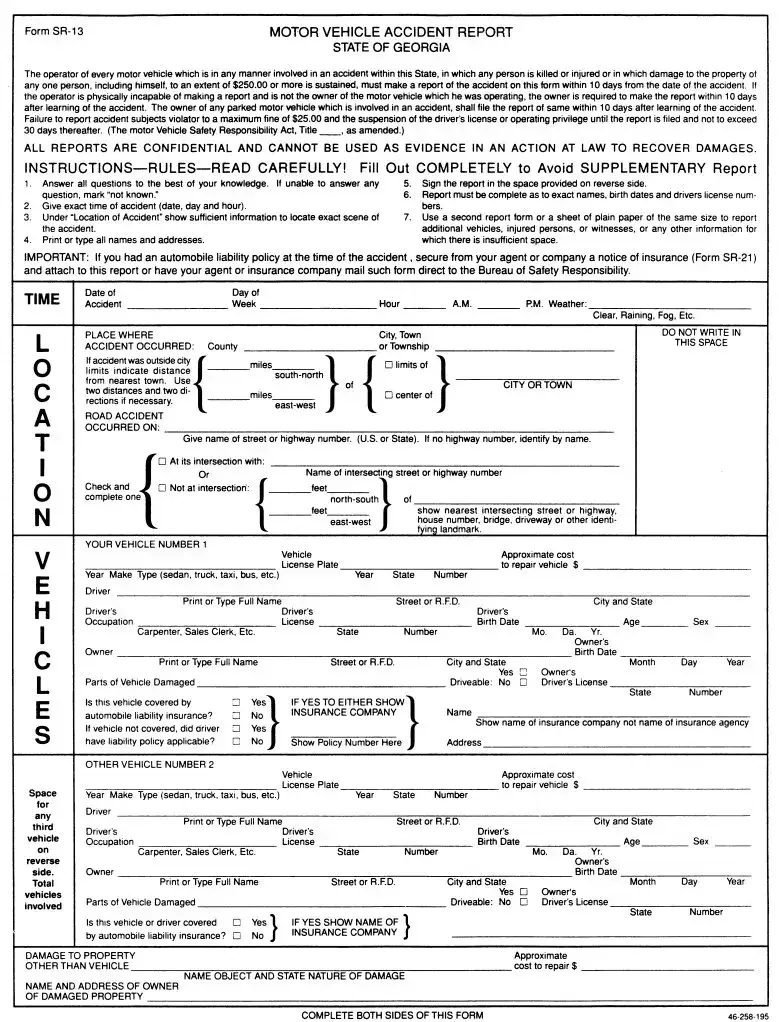
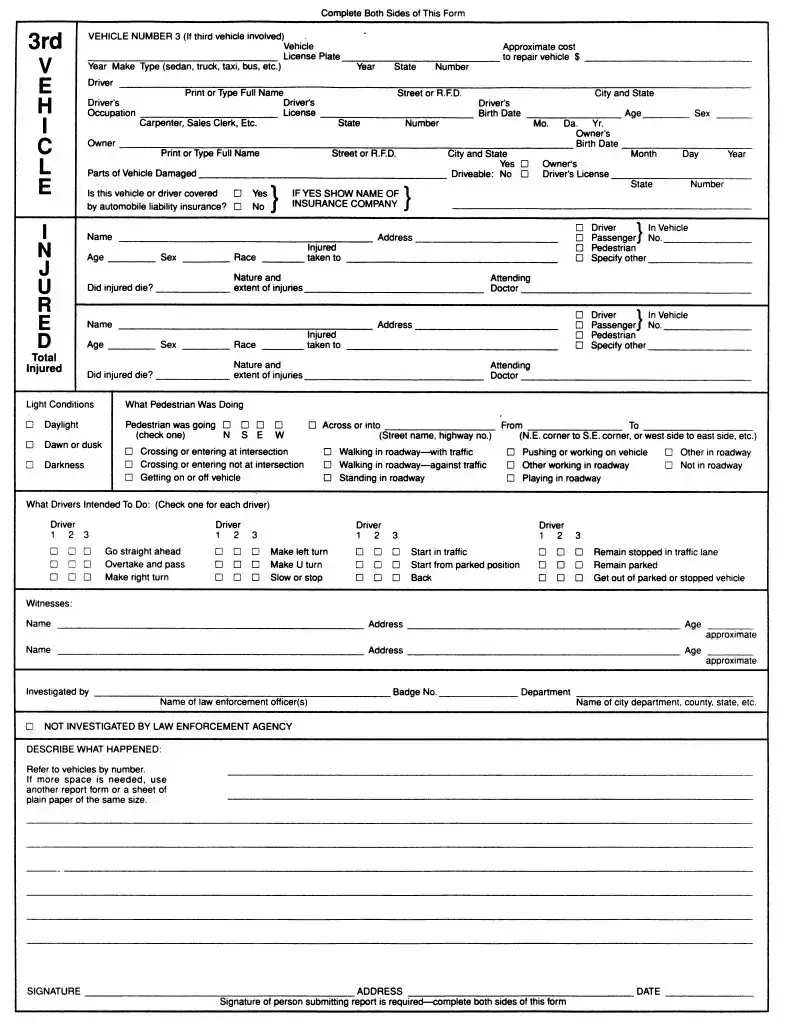
Personal Accident Report Sr 13 Ga Example

File Breakdown

Fact Name Description
Reporting Requirement Drivers involved in an accident must report it using the SR-13 form within 10 days if there is injury, death, or property damage exceeding $250.
Owner's Responsibility If the driver is unable to report the accident, the vehicle owner must file the report within 10 days after learning about the accident.
Confidentiality All reports submitted are confidential and cannot be used as evidence in legal actions to recover damages.
Governing Law This form is governed by the Motor Vehicle Safety Responsibility Act in Georgia, Title 40, as amended.

Guide to Using Personal Accident Report Sr 13 Ga

Completing the Personal Accident Report SR-13 GA form is essential for documenting an accident involving a motor vehicle in Georgia. This report must be filed within 10 days of the accident. It is crucial to ensure that all information is accurate and complete to avoid any complications or penalties.

  1. Fill in your full name and address at the top of the form.
  2. Provide the exact date, day, and time of the accident.
  3. Describe the location of the accident in detail, including the nearest intersecting street or landmark.
  4. Indicate the weather conditions at the time of the accident.
  5. Complete the section regarding your vehicle, including the year, make, type, and license plate number.
  6. Print or type the driver's full name, birth date, and driver's license number.
  7. List the owner’s information if different from the driver, including their birth date and driver's license number.
  8. Answer whether the vehicle is covered by automobile liability insurance and provide the insurance company's name and policy number if applicable.
  9. If there are additional vehicles involved, use a second report form or plain paper to provide their details.
  10. Document any damage to property other than vehicles, including the nature of the damage and the owner's information.
  11. Record details about any injured parties, including names, ages, and the extent of their injuries.
  12. Complete both sides of the form and sign where indicated.

After filling out the form, make sure to keep a copy for your records. Submit the completed report to the appropriate authorities as required. This ensures that you comply with state regulations and helps facilitate any necessary follow-up actions.

Get Answers on Personal Accident Report Sr 13 Ga

  1. Who is required to file a Personal Accident Report SR 13 Ga?

    The operator of any motor vehicle involved in an accident in Georgia must file this report if there are injuries, fatalities, or property damage exceeding $250. If the operator is unable to file the report, the vehicle owner must do so within 10 days of learning about the accident. This requirement also applies to the owner of any parked vehicle involved in an accident.

  2. What happens if the report is not filed on time?

    Failure to submit the Personal Accident Report SR 13 Ga within the required 10-day period may result in a fine of up to $25. Additionally, the driver's license or operating privilege may be suspended until the report is filed, with a maximum suspension period of 30 days.

  3. What information is needed to complete the form?

    When filling out the form, it is crucial to provide accurate and complete information. This includes:

    • The exact date, time, and location of the accident.
    • Names, addresses, and driver's license numbers of all parties involved.
    • Details about the vehicles, including make, model, and license plate numbers.
    • Information about any injuries and property damage.

    If there is insufficient space on the form, use a separate sheet of paper to provide additional details.

  4. Are the reports confidential?

    Yes, all reports submitted using the Personal Accident Report SR 13 Ga are confidential. They cannot be used as evidence in legal actions to recover damages. This confidentiality is important to protect the privacy of those involved in the accident.

Common mistakes

Completing the Personal Accident Report SR-13 GA form can be a straightforward process, but many individuals make common mistakes that can lead to complications. One significant error is failing to provide complete information. When filling out the form, it is crucial to answer all questions accurately. Omitting details or leaving sections blank can result in delays or even penalties. If there is a question that cannot be answered, it is better to mark it as “not known” rather than leaving it empty.

Another frequent mistake involves the time and location of the accident. Many people do not provide the exact time of the incident or sufficient details about where it occurred. This information is vital for the authorities to understand the context of the accident. The form asks for the date, day, and hour, as well as specific location details. Providing vague or incomplete information can hinder the investigation and complicate the resolution process.

Additionally, individuals often neglect to sign the report in the designated space. A signature is a necessary part of validating the report. Without it, the form may be considered incomplete, which could lead to further complications, including fines. It’s essential to double-check that all required signatures are present before submitting the form.

Many people also overlook the importance of including additional information about other vehicles or witnesses involved in the accident. The form allows for supplementary information, but failing to use a second report form or plain paper can result in critical details being missed. This oversight may affect the accuracy of the report and the subsequent handling of the case.

Finally, a common mistake is not attaching the notice of insurance (Form SR-21) if applicable. If an individual had an automobile liability policy at the time of the accident, they must secure this notice and attach it to the report. Not doing so can lead to complications with insurance claims and may affect liability determinations. Ensuring that all necessary documents are included is a vital step in the process.

Documents used along the form

The Personal Accident Report SR-13 GA form is essential for documenting motor vehicle accidents in Georgia. However, several other forms and documents often accompany this report to ensure all necessary information is collected and processed. Below is a list of these documents, each playing a crucial role in the aftermath of an accident.

  • Form SR-21: This is a notice of insurance that must be obtained from your insurance agent or company. It confirms that you had an automobile liability policy at the time of the accident and should be attached to the SR-13 report.
  • Claim Form: This form is submitted to your insurance company to initiate a claim for damages or injuries resulting from the accident. It provides detailed information about the incident and the parties involved.
  • Witness Statements: These are written accounts from individuals who witnessed the accident. They can provide valuable insights and corroborate the events as reported in the SR-13 form.
  • Police Report: If law enforcement responded to the scene, they would create a report detailing their findings. This document can be crucial for insurance claims and legal proceedings.
  • Medical Records: If injuries occurred, medical records documenting the treatment and diagnosis of those injuries will be essential for any personal injury claims.
  • Property Damage Estimates: These estimates detail the cost of repairs for any damaged vehicles or property. They are often required by insurance companies to process claims.
  • Photos of the Scene: Photographs taken at the accident scene can serve as evidence of the circumstances surrounding the incident, including vehicle positions and road conditions.
  • Vehicle Registration: This document proves ownership of the vehicle involved in the accident and may be required for insurance claims or legal matters.
  • Driver’s License Copies: A copy of the driver’s license for all involved parties may be necessary to verify identities and insurance coverage.
  • Accident Reconstruction Report: In complex cases, experts may conduct a reconstruction of the accident to provide a detailed analysis of how it occurred. This report can be critical in legal disputes.

Understanding these documents and their purposes can greatly aid in navigating the aftermath of a motor vehicle accident. Collecting and submitting the appropriate forms ensures that all parties involved can effectively address the consequences of the incident.

Similar forms

The Personal Accident Report SR-13 GA form serves as a critical document in the context of motor vehicle accidents in Georgia. Several other documents share similarities with this form, primarily in their purpose of documenting incidents and facilitating the reporting process. Below is a list of five such documents, each accompanied by a brief explanation of how they relate to the SR-13 GA form.

  • Form SR-21 (Notice of Insurance): This form is often required to accompany the SR-13 GA form. It serves to confirm that the driver had an automobile liability insurance policy at the time of the accident, thereby providing essential information for insurance claims and legal responsibilities.
  • Police Accident Report: When law enforcement is called to the scene of an accident, they typically file a police accident report. This document includes details about the incident, witness statements, and the officer’s observations, much like the SR-13 GA form, which also requires detailed information about the accident.
  • Claim Form for Insurance: After an accident, drivers often need to file a claim with their insurance company. This claim form requests information about the accident, damages, and injuries, paralleling the SR-13 GA form’s focus on documenting the specifics of the incident.
  • Medical Report: In cases where injuries occur, a medical report detailing the nature and extent of injuries is often generated. This document complements the SR-13 GA form by providing medical evidence that can be crucial for insurance claims and potential legal actions.
  • Witness Statement Form: Witnesses to an accident may be asked to fill out a statement form that captures their account of the event. Similar to the SR-13 GA form, which includes a section for witness information, this document aids in creating a comprehensive understanding of the accident from multiple perspectives.

Dos and Don'ts

When filling out the Personal Accident Report SR-13 GA form, it’s important to follow certain guidelines. Here are five things you should and shouldn’t do:

  • Do: Answer all questions honestly and to the best of your knowledge.
  • Do: Provide the exact time and date of the accident.
  • Do: Clearly indicate the location of the accident, including street names and landmarks.
  • Do: Print or type all names and addresses clearly.
  • Do: Sign the report in the designated area on the reverse side.
  • Don't: Leave any questions blank; if you don't know, write “not known.”
  • Don't: Forget to include the details of all vehicles and individuals involved.
  • Don't: Use a different form or paper for additional information; stick to the provided format.
  • Don't: Write in the designated spaces meant for official use only.
  • Don't: Delay in submitting the report; it must be done within 10 days of the accident.

Misconceptions

Misconceptions about the Personal Accident Report SR-13 GA form can lead to confusion among drivers involved in accidents. Here are six common misconceptions and clarifications regarding the form:

  • All accidents must be reported regardless of damage. Many believe that any accident, no matter how minor, requires a report. However, the law specifies that a report is only necessary if there is injury, death, or property damage exceeding $250.
  • Only the driver must file the report. Some think that only the operator of the vehicle is responsible for reporting the accident. In reality, if the driver is unable to report, the vehicle owner must file the report within the specified time frame.
  • Reports can be filed anytime after the accident. There is a misconception that there is flexibility in the reporting timeline. In fact, the report must be submitted within 10 days of the accident to avoid penalties.
  • Reports can be used as evidence in court. It is a common belief that the information in the SR-13 form can be used in legal proceedings. However, all reports are confidential and cannot be utilized as evidence in lawsuits for damages.
  • Only serious accidents require a report. Some individuals think that only accidents resulting in severe injuries necessitate a report. Yet, any accident with property damage over $250 must be reported, regardless of the severity of injuries.
  • Completing the form is optional. There is a misconception that filling out the form is voluntary. In truth, failure to report an accident as required can result in fines and potential suspension of driving privileges.

Understanding these misconceptions can help ensure compliance with Georgia's accident reporting requirements and promote safer driving practices.

Key takeaways

  • Timely Reporting: The form must be submitted within 10 days of the accident. This applies to all involved parties, including vehicle owners and operators.
  • Confidentiality: All reports are confidential and cannot be used as evidence in court for damage recovery.
  • Accurate Information: Fill out the form to the best of your ability. If unsure about any detail, indicate “not known” rather than leaving it blank.
  • Location Details: Provide precise information about the accident location to help authorities identify the scene accurately.
  • Completeness: Ensure all names, addresses, and other required information are printed or typed clearly to avoid confusion.
  • Supplementary Information: If there is insufficient space for additional vehicles, witnesses, or details, use a second report form or a plain sheet of paper.
  • Insurance Notification: If applicable, secure a notice of insurance (Form SR-21) from your insurance agent and attach it to the report.
  • Sign the Report: Don’t forget to sign the report in the designated space on the reverse side to validate it.
  • Consequences of Non-Compliance: Failing to file the report can lead to a fine of up to $25 and possible suspension of driving privileges.