Content Navigation

The Progress Notes form is an essential tool used in medical record keeping, ensuring that patient information is accurately documented and easily accessible. It includes crucial details such as the patient's identification, which encompasses their name, grade, rank, rate, and the specific hospital or medical facility where they are receiving care. The form is designed to provide a structured format for healthcare providers to record observations, treatments, and any changes in a patient's condition over time. This documentation not only supports continuity of care but also enhances communication among medical staff. The standard form, identified as Standard Form 509, was last revised in July 1991 and is prescribed by various governmental regulations, ensuring compliance and consistency across medical facilities. By utilizing this form, healthcare professionals can maintain a comprehensive medical record that is vital for effective patient management.

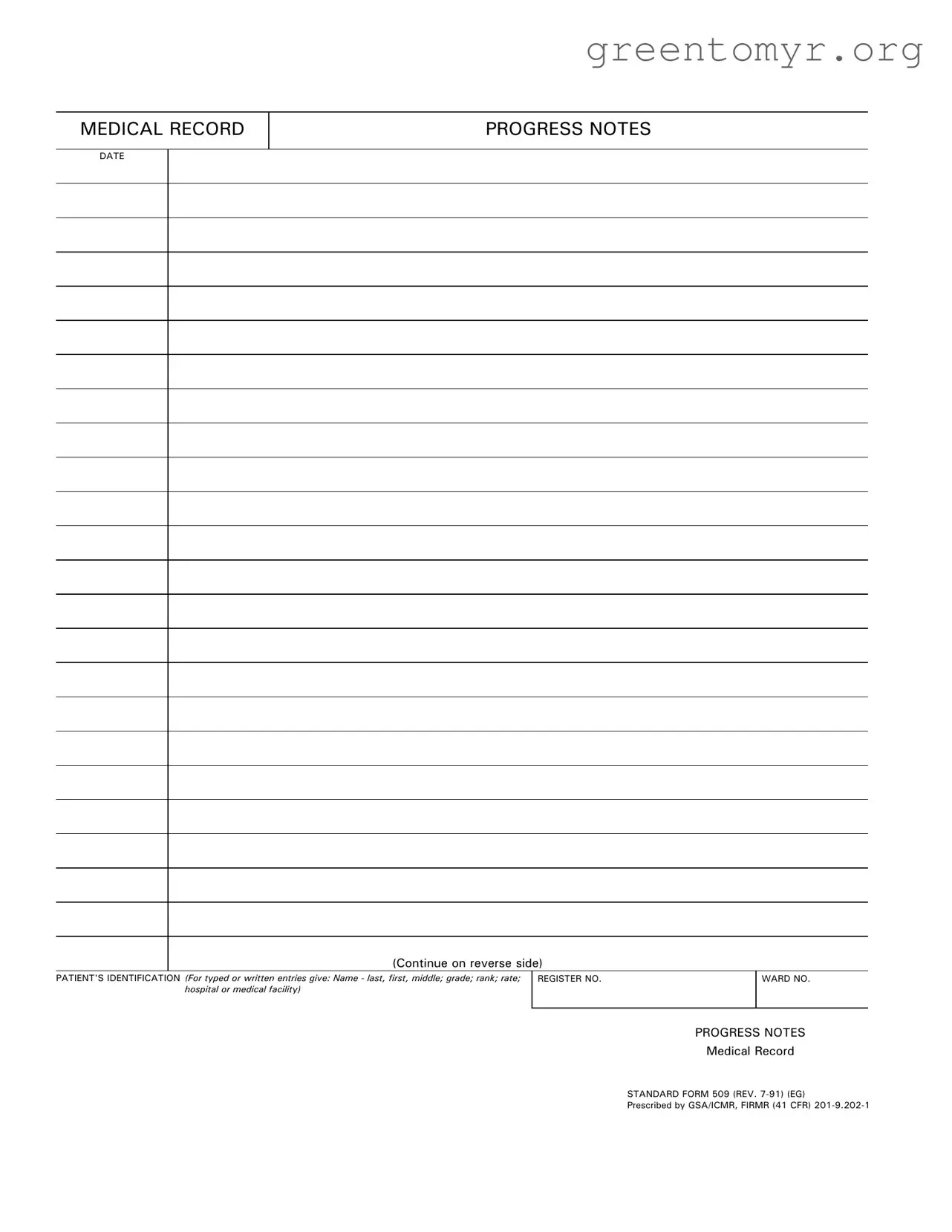
Progress Notes Example

MEDICAL RECORD

PROGRESS NOTES

DATE

(Continue on reverse side)

PATIENT'S IDENTIFICATION (For typed or written entries give: Name - last, first, middle; grade; rank; rate; hospital or medical facility)

REGISTER NO.

WARD NO.


PROGRESS NOTES

Medical Record

STANDARD FORM 509 (REV. 7-91) (EG)

Prescribed by GSA/ICMR, FIRMR (41 CFR) 201-9.202-1

PROGRESS NOTES

DATE

STANDARD FORM 509 (REV. 7-91) BACK

File Breakdown

Fact Name Details
Form Title The form is titled "Medical Record Progress Notes."
Date Requirement Each entry on the form must include the date of the progress note.
Patient Identification It requires the patient's name (last, first, middle), grade, rank, rate, and the medical facility.
Standard Form Number This is identified as Standard Form 509, revised in July 1991.
Governing Law The form is prescribed by GSA/ICMR, FIRMR (41 CFR) 201-9.202-1.
Usage Context It is primarily used in medical settings to document patient progress and treatment.
Reverse Side The form allows for additional notes to be recorded on the reverse side.
Ward and Register Numbers It includes fields for the ward number and register number, essential for record-keeping.

Guide to Using Progress Notes

After you have gathered all necessary information, you can begin filling out the Progress Notes form. Make sure to provide accurate details to ensure proper documentation.

  1. Write the date at the top of the form.
  2. Fill in the patient's identification details. Include the patient's name (last, first, middle), grade, rank, rate, and the name of the hospital or medical facility.
  3. Enter the registration number in the designated space.
  4. Provide the ward number where the patient is located.
  5. Complete the progress notes section with relevant information regarding the patient's condition and treatment.

Once you have filled out the form, review it for accuracy before submitting it. This will help ensure that all information is correct and complete.

Get Answers on Progress Notes

What is the purpose of the Progress Notes form?

The Progress Notes form is used to document a patient's medical history and ongoing treatment. It provides a structured way for healthcare professionals to record observations, treatments, and any changes in a patient's condition. This ensures continuity of care and helps other providers understand the patient's progress over time.

What information is required on the Progress Notes form?

The form requires the following information:

  • Patient's name (last, first, middle)
  • Patient's grade, rank, or rate
  • Hospital or medical facility name
  • Patient's registration number
  • Ward number
  • Date of the entry

This information helps to identify the patient and organize their medical records effectively.

Who should fill out the Progress Notes form?

The form should be filled out by healthcare professionals involved in the patient's care. This includes doctors, nurses, and therapists. Each entry should reflect the observations and actions taken by the individual who is directly responsible for the patient's treatment.

How often should Progress Notes be updated?

Progress Notes should be updated regularly, typically after each patient encounter. This could be daily, weekly, or as needed based on the patient's condition and treatment plan. Timely updates ensure that all team members are informed about the patient's status.

What should be included in the Progress Notes?

Entries should include:

  1. Subjective observations (what the patient reports about their condition)
  2. Objective findings (what the healthcare provider observes during the examination)
  3. Assessment of the patient's condition
  4. Plan for future treatment or interventions

Including this information provides a comprehensive view of the patient's progress.

Is the Progress Notes form standardized?

Yes, the Progress Notes form is a standardized document, specifically the Medical Record Standard Form 509. This standardization ensures consistency in documentation across different healthcare settings, making it easier to share and understand patient information.

Can the Progress Notes form be modified?

While the standard format should generally be followed, specific healthcare facilities may have their own guidelines for additional information or modifications. Always check with your facility's policies before making any changes to the form.

What should I do if I make a mistake on the Progress Notes form?

If you make a mistake, do not erase or use correction fluid. Instead, draw a single line through the error, initial it, and write the correct information next to it. This maintains the integrity of the medical record while ensuring that accurate information is recorded.

Common mistakes

Filling out the Progress Notes form can seem straightforward, but several common mistakes can lead to complications. One frequent error is neglecting to include the patient's identification details accurately. This includes the patient's name, grade, rank, and hospital or medical facility. Omitting or misspelling this information can create confusion and hinder patient care.

Another mistake involves failing to date the entries correctly. Each progress note should have a clear date indicating when the entry was made. If this crucial detail is missing, it can lead to misunderstandings about the timeline of patient care. Accurate dating is essential for maintaining a reliable medical record.

In addition, many individuals overlook the importance of providing detailed notes. Progress notes should include relevant observations, treatments, and responses. Vague or incomplete entries fail to convey the necessary information to other healthcare providers. This lack of clarity can impact patient outcomes and continuity of care.

Moreover, using the wrong format can also be a significant issue. The Progress Notes form has a specific structure that must be followed. Deviating from this format may result in lost information or misinterpretation of the notes. Adhering to the prescribed format ensures that all necessary information is captured effectively.

Finally, some may forget to continue notes on the reverse side of the form when needed. If the space provided on the front is insufficient, vital information may be left out. Always check for enough room to include comprehensive notes, or utilize the reverse side as necessary to maintain thorough documentation.

Documents used along the form

When managing patient care, several documents complement the Progress Notes form. Each of these documents plays a crucial role in maintaining accurate and comprehensive medical records. Below is a list of commonly used forms that healthcare providers often utilize alongside Progress Notes.

  • Patient History Form: This form collects detailed information about the patient's medical history, including past illnesses, surgeries, and family health issues. It helps healthcare providers understand the patient's background.
  • Treatment Plan: A document outlining the goals and strategies for a patient's care. It includes the proposed interventions and timelines, ensuring all team members are on the same page.
  • Medication Administration Record (MAR): This record tracks all medications administered to the patient, including dosages and times. It helps prevent medication errors and ensures compliance with treatment protocols.
  • Referral Form: Used when a healthcare provider refers a patient to a specialist. This form contains relevant patient information and the reason for the referral, facilitating continuity of care.
  • Consent Forms: These documents ensure that patients understand and agree to the proposed treatments or procedures. They protect both the patient’s rights and the provider’s liability.
  • Discharge Summary: A summary provided when a patient is discharged from care. It includes the patient's condition at discharge, follow-up instructions, and any referrals to other healthcare providers.
  • Assessment and Evaluation Forms: These forms document the healthcare provider's observations and assessments of the patient's condition. They are essential for tracking progress and making necessary adjustments to the treatment plan.
  • Insurance Verification Form: This form confirms a patient's insurance coverage and benefits. It ensures that the services provided are covered, streamlining the billing process.

Utilizing these documents alongside the Progress Notes form helps ensure that patient care is thorough and well-documented. Each form serves a specific purpose, contributing to a holistic approach to healthcare management.

Similar forms

The Progress Notes form is a crucial component of medical documentation. It shares similarities with several other documents used in healthcare settings. Understanding these similarities can enhance clarity and continuity in patient care. Below are six documents that are comparable to the Progress Notes form:

  • Patient Chart: Like Progress Notes, a patient chart contains detailed information about a patient's medical history, treatment plans, and ongoing care. Both documents serve as vital records that healthcare providers reference to make informed decisions.
  • SOAP Notes: SOAP stands for Subjective, Objective, Assessment, and Plan. This format, similar to Progress Notes, organizes patient information in a clear and concise manner, aiding in effective communication among healthcare professionals.
  • Discharge Summary: A discharge summary provides a comprehensive overview of a patient's hospitalization, including treatment received and follow-up care. This document, like Progress Notes, ensures continuity of care post-discharge.
  • Clinical Pathways: Clinical pathways outline the expected course of treatment for specific conditions. Similar to Progress Notes, they help in tracking patient progress and ensuring adherence to best practices in care.
  • Medication Administration Record (MAR): The MAR documents the administration of medications to patients. Like Progress Notes, it is essential for maintaining accurate records of patient treatment and medication history.
  • Referral Notes: Referral notes are used when a healthcare provider refers a patient to another specialist. They contain pertinent information about the patient’s condition, similar to Progress Notes, facilitating informed decisions by the receiving provider.

Dos and Don'ts

When filling out the Progress Notes form, it is essential to approach the task with care and attention to detail. Here are some important do's and don'ts to keep in mind:

  • Do include the patient's full name, including last, first, and middle names.
  • Do provide accurate identification details such as grade, rank, and rate.
  • Do ensure the date is clearly marked on the form.
  • Do use legible handwriting or typed entries to avoid any confusion.
  • Do keep the information concise and relevant to the patient's care.
  • Don't leave any sections blank; if something does not apply, indicate that clearly.
  • Don't use abbreviations that may not be understood by others reviewing the notes.
  • Don't include personal opinions or irrelevant information in the notes.
  • Don't forget to check for any errors before submitting the form.

By following these guidelines, you can help ensure that the Progress Notes are accurate and useful for ongoing patient care.

Misconceptions

Understanding the Progress Notes form is essential for effective medical documentation. However, several misconceptions can lead to confusion. Here are nine common misconceptions about the Progress Notes form, along with clarifications to help clear up any misunderstandings.

  1. Progress Notes are only for doctors. Many believe that only physicians can fill out Progress Notes. In reality, any qualified healthcare professional involved in a patient's care can document their observations and treatments.
  2. Progress Notes are optional. Some think that filling out Progress Notes is not mandatory. However, these notes are crucial for maintaining accurate medical records and ensuring continuity of care.
  3. All Progress Notes must be handwritten. While handwritten notes are acceptable, electronic documentation is increasingly common and often preferred for efficiency and legibility.
  4. Progress Notes can be vague. There is a misconception that Progress Notes can be general or non-specific. In fact, detailed and precise documentation is necessary to provide a clear picture of the patient's condition and treatment.
  5. Progress Notes are only for tracking physical health. Many people assume these notes only pertain to physical health. However, they also encompass mental health, emotional well-being, and social factors affecting the patient.
  6. Progress Notes are only for the current visit. Some think that Progress Notes only reflect the most recent visit. In reality, they should provide a comprehensive view of the patient's ongoing treatment and progress over time.
  7. Only negative observations need to be documented. There is a belief that only adverse findings should be recorded. However, positive progress and improvements are equally important to note.
  8. Progress Notes are confidential and cannot be shared. While these notes are indeed confidential, they can be shared with other healthcare providers involved in the patient's care, with the patient's consent.
  9. Progress Notes do not require a signature. Some may think that a signature is unnecessary. However, signing Progress Notes is essential for validating the entries and ensuring accountability.

By addressing these misconceptions, individuals can better appreciate the importance of Progress Notes in the medical field. Clear documentation plays a vital role in patient care and safety.

Key takeaways

Filling out and using the Progress Notes form is essential for maintaining accurate medical records. Here are key takeaways to consider:

  • Accurate Identification: Always include the patient's full name, including last, first, and middle names, along with their grade, rank, and rate.
  • Registration Information: Ensure the patient's registration number and ward number are correctly filled out.
  • Date Entry: Clearly indicate the date of the progress notes to maintain a chronological record.
  • Standard Format: Use the prescribed Standard Form 509 to ensure compliance with regulatory requirements.
  • Medical Facility Details: Specify the hospital or medical facility where the patient is receiving care.
  • Legibility: Write clearly, whether typing or handwriting, to prevent misinterpretation of the information.
  • Confidentiality: Protect patient information by following HIPAA guidelines when handling and sharing progress notes.
  • Continuity of Care: Use the notes to document ongoing treatment and observations to enhance patient care.
  • Review and Update: Regularly review progress notes to ensure they reflect the most current patient status and treatment plans.
  • Compliance: Follow institutional policies regarding the completion and storage of progress notes to maintain legal and ethical standards.