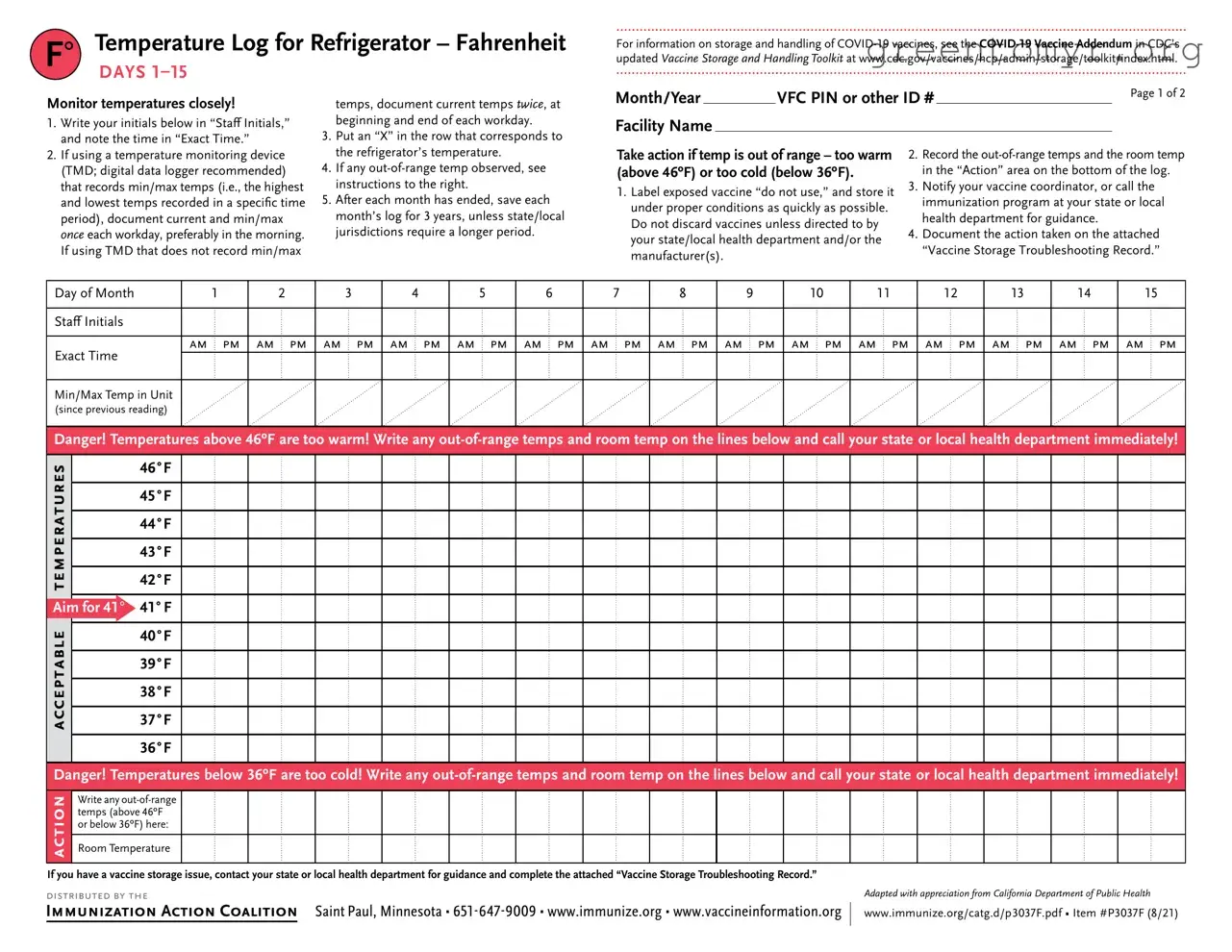
The Refrigerator Temperature Log form is a crucial tool for ensuring the safe storage of vaccines, particularly in light of the ongoing need for proper vaccine management. This form helps healthcare facilities monitor and document the temperature of their refrigerators over a specified period, typically 31 days. Users are instructed to record the current temperature twice daily, along with their initials and the exact time of each reading. A digital data logger is recommended for those who wish to track minimum and maximum temperatures, providing a comprehensive view of the refrigerator's performance. If temperatures fall outside the acceptable range—above 46°F or below 36°F—immediate action is required. This includes labeling any exposed vaccines as “do not use” and notifying the appropriate health department for guidance. Additionally, facilities must retain these logs for a minimum of three years, ensuring compliance with state and local regulations. By adhering to these guidelines, healthcare providers can safeguard the integrity of vaccines, ultimately protecting public health.
F° |
Temperature Log for Refrigerator – Fahrenheit |
DAYS |
For information on storage and handling of
Monitor temperatures closely!
temps, document current temps twice, at
Month/Year |
|
VFC PIN or other ID # |
|
Page 1 of 2 |
|
|
|
1.Write your initials below in “Staff Initials,” and note the time in “Exact Time.”
2.If using a temperature monitoring device
(TMD; digital data logger recommended) that records min/max temps (i.e., the highest and lowest temps recorded in a specific time period), document current and min/max once each workday, preferably in the morning. If using TMD that does not record min/max
beginning and end of each workday.
3.Put an “X” in the row that corresponds to the refrigerator’s temperature.
4.If any
5.After each month has ended, save each month’s log for 3 years, unless state/local jurisdictions require a longer period.
Facility Name
Take action if temp is out of range – too warm (above 46ºF) or too cold (below 36ºF).
1.Label exposed vaccine “do not use,” and store it under proper conditions as quickly as possible. Do not discard vaccines unless directed to by your state/local health department and/or the manufacturer(s).
2.Record the
3.Notify your vaccine coordinator, or call the immunization program at your state or local health department for guidance.
4.Document the action taken on the attached
“Vaccine Storage Troubleshooting Record.”
Day of Month |
1 |
|
2 |
|
3 |
|
4 |
|
5 |
|
6 |
|
7 |
|
8 |
|
9 |
|
10 |
|
11 |
|
12 |
|
13 |
|
14 |
|
15 |
Staff Initials |
|
|
|
|
|
|
|
|
|
|
|
|
|
|
|
|
|
|
|
|
|
|
|
|
|
|
|
|
|
am |
pm |
am |
pm |
am |
pm |
am |
pm |
am |
pm |
am |
pm |
am |
pm |
am |
pm |
am |
pm |
am |
pm |
am |
pm |
am |
pm |
am |
pm |
am |
pm |
am |
pm |
Exact Time |
|
|
|
|
|
|
|
|
|
|
|
|
|
|
|
|
|
|
|
|
|
|
|
|
|
|
|
|
|
Min/Max Temp in Unit |
|
|
|
|
|
|
|
|
|
|
|
|
|
|
|
|
|
|
|
|
|
|
|
|
|
|
|
|
|
(since previous reading) |
|
|
|
|
|
|
|
|
|
|
|
|
|
|
|
|
|
|
|
|
|
|
|
|
|
|
|
|
|
Danger! Temperatures above 46ºF are too warm! Write any
temperatures
Aim for 41º
acceptable
46˚F
45˚F
44˚F
43˚F
42˚F
41˚F
40˚F
39˚F
38˚F
37˚F
36˚F
Danger! Temperatures below 36ºF are too cold! Write any
action
Write any
Room Temperature
If you have a vaccine storage issue, contact your state or local health department for guidance and complete the attached “Vaccine Storage Troubleshooting Record.”
DISTRIBUTED BY THE
IMMUNIZATION ACTION COALITION Saint Paul, Minnesota •
Adapted with appreciation from California Department of Public Health
www.immunize.org/catg.d/p3037F.pdf • Item #P3037F (8/21)
F° |
Temperature Log for Refrigerator – Fahrenheit |
DAYS 16 |
For information on storage and handling of
Monitor temperatures closely!
temps, document current temps twice, at
Month/Year |
|
VFC PIN or other ID # |
|
Page 2 of 2 |
1.Write your initials below in “Staff Initials,” and note the time in “Exact Time.”
2.If using a temperature monitoring device
(TMD; digital data logger recommended) that records min/max temps (i.e., the highest and lowest temps recorded in a specific time period), document current and min/max once each workday, preferably in the morning. If using TMD that does not record min/max
beginning and end of each workday.
3.Put an “X” in the row that corresponds to the refrigerator’s temperature.
4.If any
5.After each month has ended, save each month’s log for 3 years, unless state/local jurisdictions require a longer period.
Facility Name
Take action if temp is out of range – too warm (above 46ºF) or too cold (below 36ºF).
1.Label exposed vaccine “do not use,” and store it under proper conditions as quickly as possible. Do not discard vaccines unless directed to by your state/local health department and/or the manufacturer(s).
2.Record the
3.Notify your vaccine coordinator, or call the immunization program at your state or local health department for guidance.
4.Document the action taken on the attached
“Vaccine Storage Troubleshooting Record.”
Day of Month |
16 |
|
17 |
|
18 |
|
19 |
|
20 |
|
21 |
|
22 |
|
23 |
|
24 |
|
25 |
|
26 |
|
27 |
|
28 |
|
29 |
|
30 |
|
31 |
Staff Initials |
|
|
|
|
|
|
|
|
|
|
|
|
|
|
|
|
|
|
|
|
|
|
|
|
|
|
|
|
|
|
|
am |
pm |
am |
pm |
am |
pm |
am |
pm |
am |
pm |
am |
pm |
am |
pm |
am |
pm |
am |
pm |
am |
pm |
am |
pm |
am |
pm |
am |
pm |
am |
pm |
am |
pm |
am |
pm |
Exact Time |
|
|
|
|
|
|
|
|
|
|
|
|
|
|
|
|
|
|
|
|
|
|
|
|
|
|
|
|
|
|
|
Min/Max Temp in Unit |
|
|
|
|
|
|
|
|
|
|
|
|
|
|
|
|
|
|
|
|
|
|
|
|
|
|
|
|
|
|
|
(since previous reading) |
|
|
|
|
|
|
|
|
|
|
|
|
|
|
|
|
|
|
|
|
|
|
|
|
|
|
|
|
|
|
|
Danger! Temperatures above 46ºF are too warm! Write any
temperatures
Aim for 41º
acceptable
46˚F
45˚F
44˚F
43˚F
42˚F
41˚F
40˚F
39˚F
38˚F
37˚F
36˚F
Danger! Temperatures below 36ºF are too cold! Write any
action
Write any
Room Temperature
If you have a vaccine storage issue, contact your state or local health department for guidance and complete the attached “Vaccine Storage Troubleshooting Record.”
DISTRIBUTED BY THE
IMMUNIZATION ACTION COALITION Saint Paul, Minnesota •
Adapted with appreciation from California Department of Public Health
www.immunize.org/catg.d/p3037F.pdf • Item #P3037F (8/21)
Vaccine Storage Troubleshooting Record
(check one) □Refrigerator □Freezer
Use this form to document any unacceptable vaccine storage event, such as exposure of refrigerated vaccines to temperatures that are outside the manufacturers’ recommended storage ranges.
A fillable pdf of this form is available at www.immunize. org/catg.d/p3041.pdf
Date & Time of Event |
Storage Unit Temperature |
Room Temperature |
Person Completing Report |
|
|
If multiple, related events occurred, |
at the time the problem was discovered |
at the time the problem was discovered |
|
|
|
see Description of Event below. |
|
|
|
|
|
|
|
|
|
|
|
Date: |
Temp when discovered: |
|
Temp when discovered: |
Name: |
|
|
|
|
|
|
|
Time: |
Minimum temp: |
Maximum temp: |
Comment (optional): |
Title: |
Date: |
|
|
|
|
|
|
Description of Event (If multiple, related events occurred, list each date, time, and length of time out of storage.)
•General description (i.e., what happened?)
•Estimated length of time between event and last documented reading of storage temperature in acceptable range (2o to 8oC [36o to 46oF] for refrigerator;
• Inventory of affected vaccines, including (1) lot #s and (2) whether purchased with public (for example, VFC) or private funds (Use separate sheet if needed, but maintain the inventory with this troubleshooting record.)
•At the time of the event, what else was in the storage unit? For example, were there water bottles in the refrigerator and/or frozen coolant packs in the freezer?
•Prior to this event, have there been any storage problems with this unit and/or with the affected vaccine?
•Include any other information you feel might be relevant to understanding the event.
Action Taken (Document thoroughly. This information is critical to determining whether the vaccine might still be viable!)
•When were the affected vaccines placed in proper storage conditions? (Note: Do not discard the vaccine. Store exposed vaccine in proper conditions and label it “do not use” until after you can discuss with your state/ local health department and/or the manufacturer[s].)
•Who was contacted regarding the incident? (For example, supervisor, state/local health department,
•IMPORTANT: What did you do to prevent a similar problem from occurring in the future?
Results
• What happened to the vaccine? Was it able to be used? If not, was it returned to the distributor? (Note: For
DISTRIBUTED BY THE
IMMUNIZATION ACTION COALITION Saint Paul, Minnesota •
www.immunize.org/catg.d/p3041.pdf • Item #P3041 (8/21)
Vaccine Storage Troubleshooting Record (check one) |
◯ |
◯ |
◯ |
Refrigerator |
Freezer |
Use this form to document any unacceptable vaccine storage event, such as exposure of refrigerated vaccines to temperatures that are outside the manufacturers' recommended storage ranges.
Date & Time of Event |
Storage Unit Temperature |
Room Temperature |
Person Completing Report |
|
|
If multiple, related events occurred, |
at the time the problem was discovered |
at the time the problem was discovered |
|
|
|
see Description of Event below. |
|
|
|
|
|
|
|
|
|
|
|
Date: (see below) |
Temp when discovered: |
45º F |
Temp when discovered: 77º F |
Name: Natalie Nurse |
|
|
|
|
|
|
|
Time: (see below) |
Minimum temp: 38º F |
Maximum temp: 53º F |
Comment (optional):temp is approx. |
Title: VFC Coordinator |
Date: 6/29/21 |
Description of Event (If multiple, related events occurred, list each date, time, and length of time out of storage.)
•General description (i.e., what happened?)
•Estimated length of time between event and last documented reading of storage temperature in acceptable range (2o to 8oC [36o to 46oF] for refrigerator;
• Inventory of affected vaccines, including (1) lot #s and (2) whether purchased with public (for example, VFC) or private funds (Use separate sheet if needed, but maintain the inventory with this troubleshooting record.)
•At the time of the event, what else was in the storage unit? For example, were there water bottles in the refrigerator and/or frozen coolant packs in the freezer?
•Prior to this event, have there been any storage problems with this unit and/or with the affected vaccine?
•Include any other information you feel might be relevant to understanding the event.
At 8 am on Tuesday (6/29/21) morning when clinic opened, identified 4 temperature excursions over the weekend in refrigerator with readings as high as 54°, 50°, 49° & 53°F in primary vaccine storage unit #1. Recordings taken every 15 min on calibrated digital data logger overnight. Data logger probe in glycol located in middle of refrigerator with vaccines.
Total time out of range: approximately 3 hrs — maximum temp 53°F (see attached document of continuous temp readings)
Inventory of vaccines: see attached
Water bottles in refrigerator door. No vaccine stored in freezer. No problems with storage unit prior to Saturday night. Thunderstorms in area over weekend may have affected power.
Action Taken (Document thoroughly. This information is critical to determining whether the vaccine might still be viable!)
•When were the affected vaccines placed in proper storage conditions? (Note: Do not discard the vaccine. Store exposed vaccine in proper conditions and label it “do not use” until after you can discuss with your state/ local health department and/or the manufacturer[s].)
•Who was contacted regarding the incident? (For example, supervisor, state/local health department,
•IMPORTANT: What did you do to prevent a similar problem from occurring in the future?
Vaccines currently stored appropriately at 41ºF. Refrigerator and vaccines labeled "Do Not Use."
My State Immunization Program contacted at 8:30 am. Spoke with Victor Vaccine. Provided Victor with details of event and list of vaccines. Vaccine to remain quarantined until we hear back from Victor.
Called electric company and confirmed 2 short power outages during weekend. Checked refrigerator seals called refrigerator maintenance company to replace seals.
Checked plug on unit placed tape over plug to prevent inadvertent dislodging. Plan to purchase plug guard.
Plan to follow up with Immunization Program on data loggers with alarms that could be sent to coordinator and
Results
• What happened to the vaccine? Was it able to be used? If not, was it returned to the distributor? (Note: For
Late on Monday, I talked with Victor regarding continued use of vaccine. Victor had checked with manufacturers which confirmed that vaccine is acceptable for use. He told me that vaccine could therefore be removed from quarantine. I discussed the entire situation with Susie Supervisor and Dr. Director (clinic medical director) who agreed that we could put vaccine back in use.
DISTRIBUTED BY THE
IMMUNIZATION ACTION COALITION Saint Paul, Minnesota •
www.immunize.org/catg.d/p3041.pdf • Item #P3041 (8/21)
Vaccine Storage Troubleshooting Record (check one) |
◯ |
◯ |
◯ |
Refrigerator |
Freezer |
Use this form to document any unacceptable vaccine storage event, such as exposure of refrigerated vaccines to temperatures that are outside the manufacturers' recommended storage ranges.
Date & Time of Event |
Storage Unit Temperature |
Room Temperature |
Person Completing Report |
|
|
If multiple, related events occurred, |
at the time the problem was discovered |
at the time the problem was discovered |
|
|
|
see Description of Event below. |
|
|
|
|
|
|
|
|
|
|
|
Date:7/13/2021 |
Temp when discovered: |
28º F |
Temp when discovered: 77º F |
Name: Natalie Nurse |
|
|
|
|
|
|
|
Time: 8:00 am |
Minimum temp: 28º F |
Maximum temp: 42º F |
Comment (optional):temp is approx. |
Title: VFC Coordinator |
Date: 7/13/21 |
Description of Event (If multiple, related events occurred, list each date, time, and length of time out of storage.)
•General description (i.e., what happened?)
•Estimated length of time between event and last documented reading of storage temperature in acceptable range (2o to 8oC [36o to 46oF] for refrigerator;
• Inventory of affected vaccines, including (1) lot #s and (2) whether purchased with public (for example, VFC) or private funds (Use separate sheet if needed, but maintain the inventory with this troubleshooting record.)
•At the time of the event, what else was in the storage unit? For example, were there water bottles in the refrigerator and/or frozen coolant packs in the freezer?
•Prior to this event, have there been any storage problems with this unit and/or with the affected vaccine?
•Include any other information you feel might be relevant to understanding the event.
When checked main clinic fridge (in lab) at 8:00 am on Tuesday, 7/13/2021, digital readout on data logger read 28ºF. Data logger located in center of fridge with probe in glycol . Review of computer readings (taken every 15 minutes) showed steady drop in temps from 42ºF at 8:15 pm (7/12/2021) to 28ºF reading discovered when arrived at clinic on Tuesday morning (7/13/2021). Readings hit 34ºF at 11 pm (7/12) and 32ºF at 2 am (7/13). Total time out of recommended storage temps = 9 hours, with 6 hours at freezing or below (see attached document of continuous temp readings). Inventory of vaccines attached.
Water bottles in refrigerator door and crisper area. No vaccines stored in freezer. No recent adjustments to temp controls and no previous temp excursions noted with this refrigerator before 7/13.
Action Taken (Document thoroughly. This information is critical to determining whether the vaccine might still be viable!)
•When were the affected vaccines placed in proper storage conditions? (Note: Do not discard the vaccine. Store exposed vaccine in proper conditions and label it “do not use” until after you can discuss with your state/ local health department and/or the manufacturer[s].)
•Who was contacted regarding the incident? (For example, supervisor, state/local health department,
•IMPORTANT: What did you do to prevent a similar problem from occurring in the future?
Upon discovery, vaccines marked “Do Not Use” and stored in 2nd clinic fridge (in exam room #3 at 41ºF). Also placed “Do Not Use” note on main fridge in lab. Notified Susie Supervisor about the issue. Contacted Victor Vaccine at My State Immunization Program at 8:30 am. Provided Victor with details of event and list of vaccines in fridge. Victor said to maintain vaccines in 2nd fridge and that he would check with manufacturers to determine next steps.
Called Jim’s Appliance Repair to examine fridge. Repairman found and replaced faulty thermostat in unit. Reset data logger on center shelf in fridge with probe in glycol .
Results
• What happened to the vaccine? Was it able to be used? If not, was it returned to the distributor? (Note: For
After fridge thermostat repaired, monitored temps in empty fridge for 1 week, per state requirements. Fridge maintained
DISTRIBUTED BY THE
IMMUNIZATION ACTION COALITION Saint Paul, Minnesota •
www.immunize.org/catg.d/p3041.pdf • Item #P3041 (8/21)
| Fact Name | Fact Description |
|---|---|
| Purpose | The Refrigerator Temperature Log form is used to monitor and document the temperature of refrigerators storing vaccines. |
| Temperature Range | The acceptable temperature range for vaccine storage in refrigerators is between 36°F and 46°F. |
| Monitoring Frequency | Temperatures should be documented twice daily, ideally in the morning and at the end of the workday. |
| Action for Out-of-Range Temps | If temperatures exceed 46°F or drop below 36°F, vaccines must be labeled "do not use" and stored properly until further instructions are received. |
| Documentation Duration | Logs must be retained for a minimum of three years, unless state or local laws specify a longer retention period. |
| State Regulations | Specific state regulations may apply, such as those from the California Department of Public Health, which oversees vaccine storage practices. |
| Temperature Monitoring Device | A digital data logger is recommended for accurate temperature monitoring, capturing both minimum and maximum readings. |
| Initials Requirement | Staff members must initial the log each time they record temperatures to ensure accountability and traceability. |
| Immediate Notification | In the event of out-of-range temperatures, notify the vaccine coordinator and the local health department immediately for guidance. |
| Resources for Guidance | The CDC provides a Vaccine Storage and Handling Toolkit, which includes additional information on proper vaccine storage practices. |
Filling out the Refrigerator Temperature Log form is a crucial task that ensures the safety and efficacy of vaccines stored within. By accurately recording temperature readings and taking prompt action when necessary, you help maintain the integrity of these vital medical supplies. Below are the steps to effectively complete the form.
Following these steps will help ensure that you maintain accurate records and take necessary actions when temperatures are not within the acceptable range. Remember, keeping vaccines at the right temperature is essential for their effectiveness.
The Refrigerator Temperature Log form is designed to help facilities monitor the temperature of their refrigerators where vaccines are stored. Maintaining the correct temperature is crucial for ensuring the efficacy and safety of vaccines. This log assists in documenting daily temperature readings and any out-of-range temperatures that may occur.
Temperatures should be recorded twice each workday, preferably in the morning. If you are using a temperature monitoring device that records minimum and maximum temperatures, you should document the current temperature along with the min/max readings once each workday. If your device does not record these, you will need to take manual readings at the beginning and end of each workday.
If you observe a temperature above 46ºF or below 36ºF, take immediate action. Label any exposed vaccines as “do not use” and store them under proper conditions as quickly as possible. Record the out-of-range temperatures and the room temperature in the designated area of the log. Notify your vaccine coordinator or contact your local health department for guidance.
Each month’s log should be saved for a minimum of three years. However, you should check with your state or local health department, as they may have specific requirements for longer retention periods.
In the log, you need to include the following information:
Do not discard any vaccines unless instructed by your state or local health department or the manufacturer. Store the exposed vaccines under proper conditions and label them as “do not use.” You must document the action taken on the attached Vaccine Storage Troubleshooting Record.
A digital data logger is recommended for monitoring temperatures. These devices can provide accurate readings and record minimum and maximum temperatures over specific time periods, making it easier to track any fluctuations that may occur.
Regular maintenance is key to ensuring your refrigerator operates correctly. Check the seals, monitor the temperature consistently, and address any issues promptly. If you notice recurring problems, consider contacting a maintenance professional to inspect the unit.
In the event of a power outage, monitor the refrigerator’s temperature closely. Once power is restored, document the temperature readings. If the temperature falls outside the acceptable range, follow the same procedures for handling out-of-range temperatures, including notifying the appropriate authorities.
For more information on the storage and handling of COVID-19 vaccines, refer to the CDC’s Vaccine Storage and Handling Toolkit. You can access it at www.cdc.gov/vaccines/hcp/admin/storage/toolkit/index.html .
Filling out the Refrigerator Temperature Log form is a critical task that ensures the safe storage of vaccines. However, several common mistakes can undermine its effectiveness. One significant error occurs when individuals forget to document the exact time of temperature readings. The form clearly requires the entry of the time under "Exact Time." Neglecting to fill this in can lead to confusion regarding when specific temperatures were recorded, making it difficult to trace any potential issues.
Another frequent mistake is failing to record both the current temperature and the minimum/maximum temperatures. The instructions specify that users should document these readings at least once each workday, preferably in the morning. If individuals only enter the current temperature without noting the min/max, they miss valuable data that can indicate temperature fluctuations over time. This oversight can hinder the ability to identify patterns that may lead to vaccine spoilage.
Some users also mistakenly place an "X" in the wrong row when indicating the refrigerator's temperature. This can lead to inaccurate records, which could result in improper actions being taken in response to temperature excursions. The form is designed to be clear, yet errors in marking can create significant misunderstandings about the storage conditions of the vaccines.
Moreover, individuals often overlook the importance of documenting out-of-range temperatures in the designated "Action" area. When temperatures fall outside the acceptable range—above 46°F or below 36°F—immediate action is necessary. Failing to record these out-of-range temperatures can delay critical responses, potentially jeopardizing the integrity of the vaccines stored within the refrigerator.
Additionally, some people neglect to save the completed logs for the required duration. The instructions state that logs should be retained for three years unless local jurisdictions mandate a longer retention period. Discarding these records prematurely can lead to compliance issues and may hinder investigations if temperature-related problems arise in the future.
Lastly, a lack of communication is a common mistake when dealing with out-of-range temperatures. The form advises users to notify their vaccine coordinator or contact the local health department for guidance. Failing to communicate these incidents can leave facilities unprepared to handle potential vaccine spoilage and may lead to unnecessary losses.
The Refrigerator Temperature Log form is a crucial document for monitoring the storage conditions of vaccines. However, it is often used in conjunction with several other important forms and documents that help ensure proper vaccine handling and storage. Below is a list of related documents that are commonly utilized alongside the Refrigerator Temperature Log.
Using these forms together with the Refrigerator Temperature Log helps facilities maintain proper vaccine storage and handling, ensuring that vaccines remain effective and safe for use. By keeping thorough records and following established procedures, healthcare providers can better protect public health.
When filling out the Refrigerator Temperature Log form, it’s essential to follow specific guidelines to ensure accuracy and compliance. Here’s a list of what you should and shouldn’t do:
This form is essential for monitoring vaccine storage temperatures. Proper documentation ensures vaccines are stored within acceptable ranges, which is crucial for maintaining their efficacy.
It is important to document temperatures twice a day, preferably in the morning and evening. This practice helps catch any fluctuations that could compromise vaccine integrity.
While temperatures between 36ºF and 46ºF are generally acceptable, anything outside this range requires immediate action. This includes labeling affected vaccines and notifying the appropriate health authorities.
Vaccines should not be discarded without consulting your state or local health department. Proper procedures must be followed to determine their viability.
Logs must be retained for a minimum of three years, unless state or local regulations require a longer retention period. This documentation is crucial for audits and compliance checks.
All staff involved in vaccine handling should be informed of any temperature excursions. This ensures everyone is aware of the situation and can take necessary precautions.
While temperature monitoring devices are helpful, manual logging is still necessary. It provides a record of actions taken and helps identify patterns that could indicate problems.
Initials and Time: Write your initials in the “Staff Initials” section and note the time in the “Exact Time” field for each entry. This ensures accountability and accurate record-keeping.
Temperature Monitoring: Use a temperature monitoring device (TMD) to record current and min/max temperatures daily. Aim to document these readings in the morning for consistency.
Action for Out-of-Range Temperatures: If temperatures exceed 46ºF or drop below 36ºF, label affected vaccines as “do not use” and notify your vaccine coordinator immediately. Proper action is crucial to vaccine safety.
Record Keeping: Save each month’s log for at least three years. This period may extend based on state or local regulations, so check those requirements to ensure compliance.
Follow-Up Actions: After any temperature excursion, document the incident in the “Vaccine Storage Troubleshooting Record” and take necessary steps to prevent future occurrences. Communication with health department officials is key.