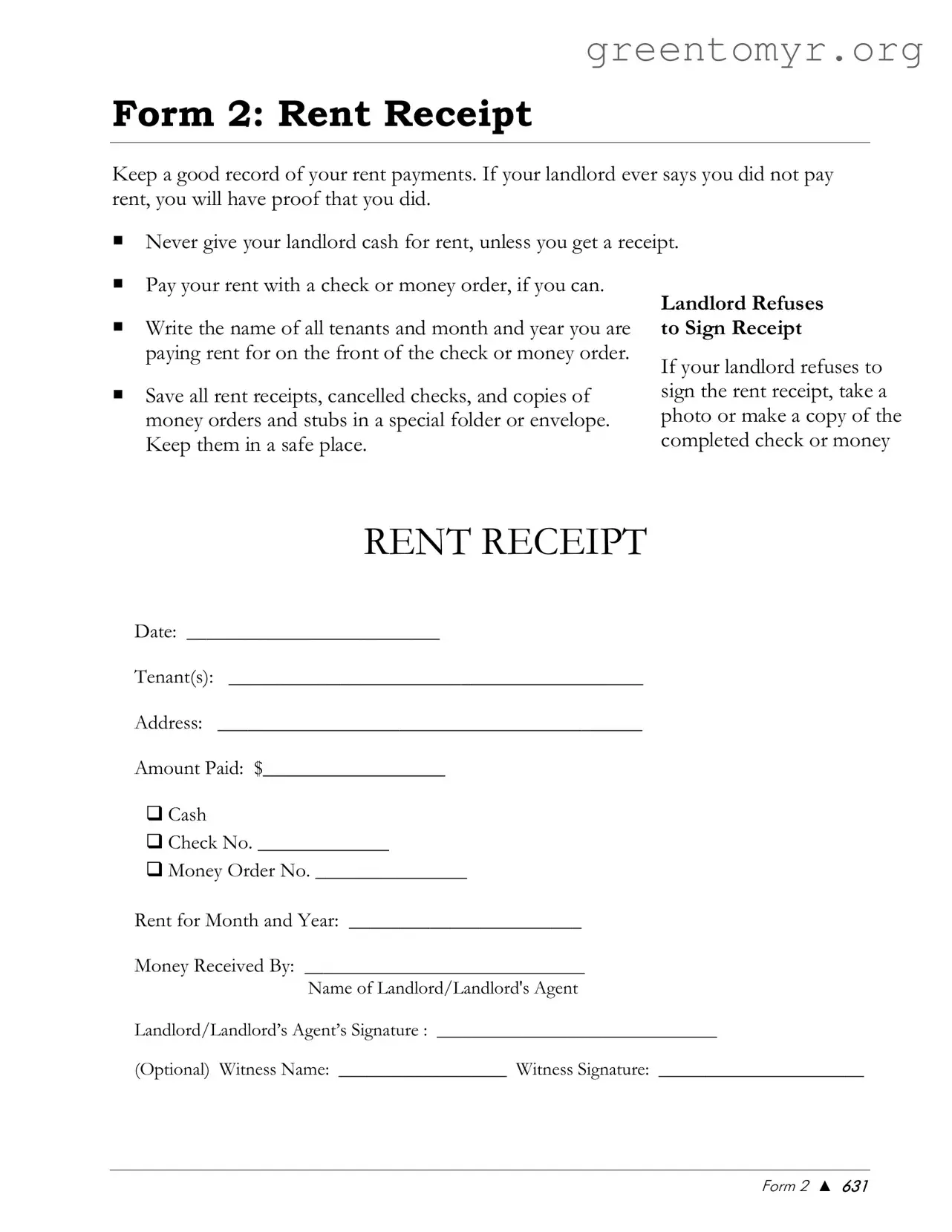
When renting a property, clear communication and documentation are essential for both landlords and tenants. One important document that plays a vital role in this process is the Rental Receipt form. This form serves as proof of payment, detailing crucial information such as the date of the transaction, the names of the tenant(s), and the address of the rental property. It also specifies the amount paid, which can be made through various methods, including cash, check, or money order. Additionally, the form includes a section for the landlord or their agent to sign, confirming receipt of the payment. Witness signatures can also be included, adding an extra layer of validity to the transaction. By utilizing this form, both parties can maintain accurate records and avoid potential disputes regarding rental payments.
RENT RECEIPT
Date: _________________________
Tenant(s): _________________________________________
Address: __________________________________________
Amount Paid: $__________________
Cash
Check No. _____________
Money Order No. _______________
Rent for Month and Year: _______________________
Money Received By: ______________________________
Name of Landlord/Landlord's Agent Landlord/Landlord’s Agent’s Signature : ______________________________
(Optional) Witness Name: __________________ Witness Signature: ______________________
| Fact Name | Description |
|---|---|
| Purpose | The Rental Receipt form serves as proof of payment for rent made by a tenant to a landlord. |
| Payment Methods | Tenants can pay rent via cash, check, or money order, as indicated on the form. |
| Tenant Information | The form requires the tenant's name and address to ensure accurate record-keeping. |
| Landlord's Signature | The signature of the landlord or their agent is optional but adds authenticity to the receipt. |
| State-Specific Laws | Rental receipt requirements may vary by state; for example, California Civil Code Section 1947.3 governs rental receipts in California. |
| Record Keeping | Both tenants and landlords should keep copies of the receipt for their records, ensuring clarity in future transactions. |
Filling out the Rental Receipt form is straightforward. This document serves as proof of payment for rent, providing essential information for both the tenant and the landlord. Follow the steps below to ensure that all necessary details are accurately recorded.
A Rental Receipt form is a document that serves as proof of payment made by a tenant to a landlord. This form typically includes essential details such as the date of payment, the tenant's name, the property address, the amount paid, and the method of payment. It is important for both parties, as it provides a record of transactions that can be referenced in the future.
Keeping a Rental Receipt is crucial for several reasons:
The Rental Receipt form should include the following information:
The Rental Receipt form provides checkboxes to indicate the payment method. Tenants can mark the appropriate box next to the method used—either cash, check, or money order. If a check or money order is used, the tenant should also fill in the respective number for reference. This clarity helps in tracking the transaction and provides transparency for both parties.
While it is not a legal requirement for landlords to provide a Rental Receipt, it is highly recommended. Offering a receipt not only builds trust between the landlord and tenant but also establishes a professional relationship. Tenants have the right to request a receipt, and landlords should be prepared to provide one to ensure clear communication and record-keeping.
If a tenant does not receive a Rental Receipt after making a payment, they should take the following steps:
Maintaining clear communication is key in these situations, as it can help prevent misunderstandings in the future.
When filling out the Rental Receipt form, one common mistake is neglecting to include the date. This detail is crucial as it indicates when the payment was made. Without a date, there could be confusion regarding payment timelines, which may lead to disputes between the landlord and tenant. Always ensure that the date is clearly written at the top of the form.
Another frequent error involves leaving out the tenant's name or providing incomplete information. The tenant(s) should be clearly identified to avoid any ambiguity about who made the payment. If the name is not filled out correctly, it can complicate record-keeping and create challenges if questions arise later about the payment.
Many people also forget to specify the amount paid and the method of payment. This section is vital for both parties to understand the transaction fully. Whether the payment was made in cash, by check, or via money order, it should be clearly marked. Failing to do so can lead to misunderstandings, especially if there are discrepancies in payment records.
Lastly, a common oversight is not obtaining the landlord's signature or failing to have a witness sign the receipt. While the landlord's signature is optional, it adds a layer of credibility to the document. A witness signature can also serve as an additional verification of the transaction. Without these signatures, the receipt may lack the necessary validation that both parties need for their records.
When engaging in a rental agreement, several important documents accompany the Rental Receipt form. Each document plays a crucial role in ensuring that both landlords and tenants are protected and that their rights and responsibilities are clearly defined. Below is a list of commonly used forms that complement the Rental Receipt.
Understanding these documents is essential for both landlords and tenants. Each form contributes to a smoother rental experience and helps clarify expectations, responsibilities, and rights throughout the rental period.
The Rental Receipt form serves a specific purpose in documenting the payment of rent between a landlord and a tenant. However, there are several other documents that share similarities with this form, primarily in their function of recording transactions or agreements. Here are eight such documents:
When filling out a Rental Receipt form, attention to detail is crucial. Here are ten guidelines to ensure the process goes smoothly:
Here are four common misconceptions about the Rental Receipt form:
Many tenants believe that receipts are optional. In reality, providing a receipt is crucial for both parties. It serves as proof of payment and can help resolve disputes in the future.
While landlords should retain a copy for their records, tenants also need to keep their receipts. This documentation is essential for verifying payments made and can be useful for tax purposes or if disputes arise.
Some think that a signature from both the landlord and tenant is required for the receipt to be valid. However, the landlord's signature is optional. The receipt remains valid as long as it includes the necessary information.
People often assume that different payment methods necessitate unique receipt formats. In fact, the Rental Receipt form accommodates various payment methods, including cash, checks, and money orders, all within the same template.
When filling out and using the Rental Receipt form, there are several important points to keep in mind. Here are some key takeaways:
Using this form properly can help maintain clear communication and documentation between landlords and tenants.