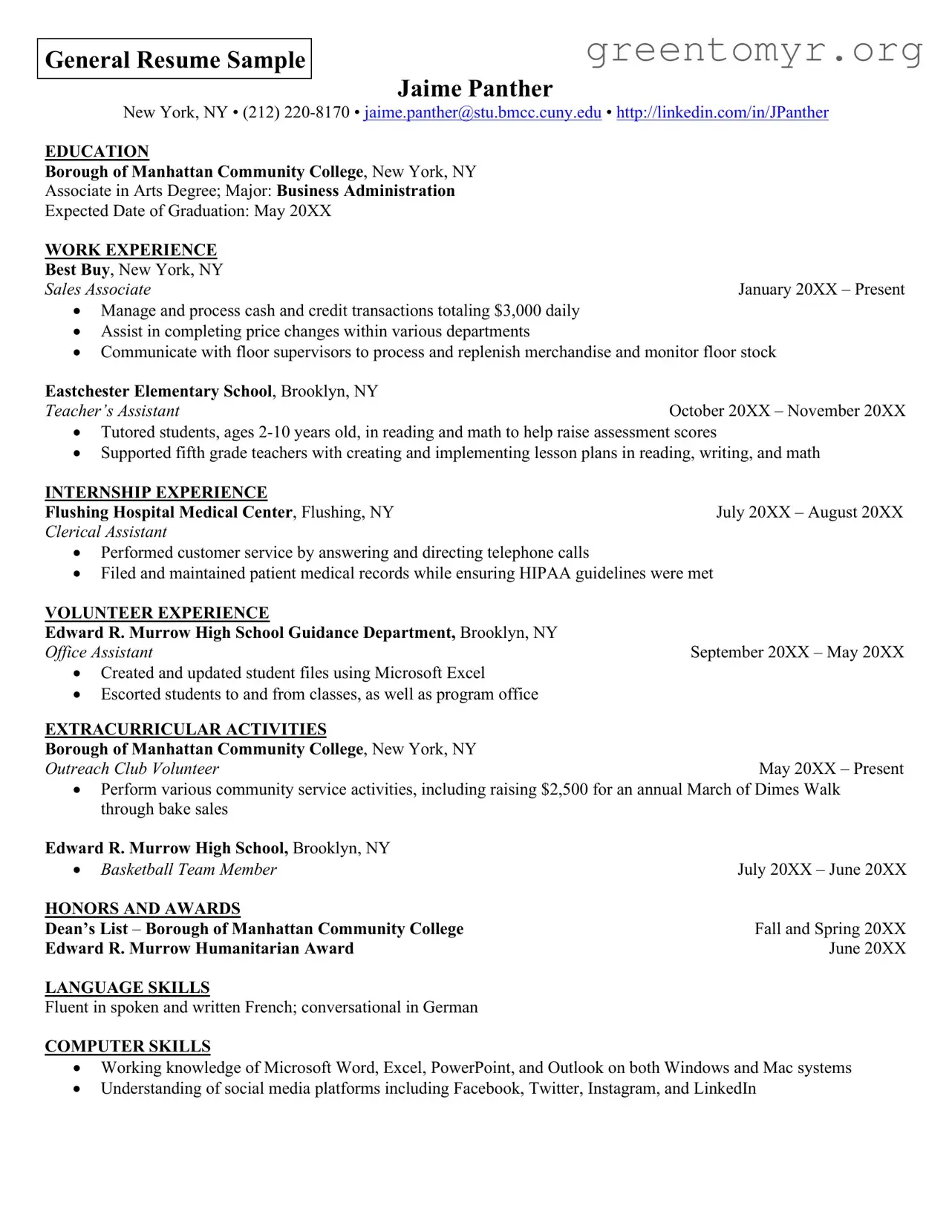
The Resume form serves as a critical tool for job seekers, encapsulating their professional journey and qualifications in a concise format. This form typically includes sections for personal information, educational background, work experience, skills, and references, each designed to present the candidate's credentials in the most favorable light. The layout can vary significantly, with some opting for a chronological approach while others may choose a functional or combination format to highlight specific skills or achievements. Additionally, the Resume form often requires careful attention to detail, as it not only reflects a candidate’s qualifications but also their ability to communicate effectively and present themselves professionally. Tailoring the content to align with the job description can enhance its impact, making it essential for applicants to understand the nuances of what employers are seeking. Ultimately, the Resume form is more than just a document; it is a strategic tool that can open doors to new opportunities and career advancements.

General Resume Sample
Jaime Panther
New York, NY • (212)
EDUCATION
Borough of Manhattan Community College, New York, NY
Associate in Arts Degree; Major: Business Administration
Expected Date of Graduation: May 20XX
WORK EXPERIENCE |
|
Best Buy, New York, NY |
January 20XX – Present |
Sales Associate |
•Manage and process cash and credit transactions totaling $3,000 daily
•Assist in completing price changes within various departments
•Communicate with floor supervisors to process and replenish merchandise and monitor floor stock
Eastchester Elementary School, Brooklyn, NY |
October 20XX – November 20XX |
Teacher’s Assistant |
•Tutored students, ages
•Supported fifth grade teachers with creating and implementing lesson plans in reading, writing, and math
INTERNSHIP EXPERIENCE
Flushing Hospital Medical Center, Flushing, NYJuly 20XX – August 20XX Clerical Assistant
•Performed customer service by answering and directing telephone calls
•Filed and maintained patient medical records while ensuring HIPAA guidelines were met
VOLUNTEER EXPERIENCE |
|
Edward R. Murrow High School Guidance Department, Brooklyn, NY |
September 20XX – May 20XX |
Office Assistant |
|
• Created and updated student files using Microsoft Excel |
|
• Escorted students to and from classes, as well as program office |
|
EXTRACURRICULAR ACTIVITIES |
|
Borough of Manhattan Community College, New York, NY |
May 20XX – Present |
Outreach Club Volunteer |
•Perform various community service activities, including raising $2,500 for an annual March of Dimes Walk through bake sales
Edward R. Murrow High School, Brooklyn, NY |
July 20XX – June 20XX |
• Basketball Team Member |
|
HONORS AND AWARDS |
|
Dean’s List – Borough of Manhattan Community College |
Fall and Spring 20XX |
Edward R. Murrow Humanitarian Award |
June 20XX |
LANGUAGE SKILLS |
|
Fluent in spoken and written French; conversational in German |
|
COMPUTER SKILLS
•Working knowledge of Microsoft Word, Excel, PowerPoint, and Outlook on both Windows and Mac systems
•Understanding of social media platforms including Facebook, Twitter, Instagram, and LinkedIn
BLANK RESUME TEMPLATE |
|
|
|
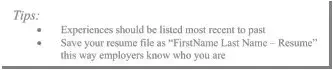
Tips: |
|
|
|
• Experiences should be listed most recent to past |
|
|
|
HEADING (Do not put the word HEADING in your resume) |
• Save your resume file as “FirstName Last Name – Resume” |
|
this way employers know who you are |
||
Name _______________________________________________ |
|
|
|
||
Address ____________________________________________________________________________________________
Phone ______________________________________________________________________________________________
Professional Email (student email is okay too) ______________________________________________________________
EDUCATION
Current or most recent College/University, City, State_________________________________________________________
Degree, Major, Month and Year of Completion or Anticipated Graduation Date_____________________________________
RELATED COURSEWORK (Optional) Coursework relevant to targeted position
• |
________________________________________ |
• |
________________________________________ |
• |
________________________________________ |
• |
________________________________________ |
RESEARCH PROJECTS (Optional)
Class or personal projects completed relevant to targeted position
•______________________________________________________________________________________________
•______________________________________________________________________________________________
LICENSES/CERTIFICATIONS (Be sure to include expiration dates) (Optional)
•______________________________________________________________________________________________
WORK EXPERIENCE (“Related Experience” or “Internships”, “Clinical Rotations,” from the most recent to the oldest)
Name of Company/Organization, City, State ______________________________________________________________
Job Title_________________________________________________________Dates of Employment __________________
Brief overview of role and responsibilities, using impact action verbs, accomplishments, and achievements:
•______________________________________________________________________________________________
•______________________________________________________________________________________________
•______________________________________________________________________________________________
Name of Company/Organization, City, State ______________________________________________________________
Job Title__________________________________________________________Dates of Employment__________________
Brief overview of role and responsibilities, using impact action verbs, accomplishments, and achievements:
•______________________________________________________________________________________________
•______________________________________________________________________________________________
•______________________________________________________________________________________________
*ADDITIONAL EXPERIENCE: Use the same format as your work experience to list additional experience such as Internship, and Volunteer categories
EXTRACURRICULAR ACTIVITIES
•______________________________________________________________________________________________
•______________________________________________________________________________________________
HONORS AND AWARDS (From college, or work/internship/volunteer experience)
•______________________________________________________________________________________________
LANGUAGE SKILLS (indicate written and/or spoken proficiency, English not necessary even if it is your 2nd language)
•______________________________________________________________________________________________
COMPUTER SKILLS (indicate proficiency level [familiar with, knowledge of, proficient in, intermediate in, or beginner in])
•______________________________________________________________________________________________
•______________________________________________________________________________________________
•____________________________________________________________________________________________
| Fact Name | Description |
|---|---|
| Purpose | The Resume form is used to provide a summary of an individual's qualifications, experience, and skills for job applications. |
| Format | The Resume form typically follows a structured format that includes sections for contact information, objective, education, work experience, and skills. |
| Length | Most resumes should be one page long, especially for those with less than 10 years of experience, while more experienced professionals may extend to two pages. |
| Customization | Each resume should be tailored to the specific job being applied for, highlighting the most relevant experiences and skills. |
| Governing Laws | There are no specific state laws governing resumes, but anti-discrimination laws apply to hiring practices in all states. |
| Submission | Resumes can be submitted in various formats, including PDF, Word document, or even as part of an online application form. |
| Updates | It is essential to regularly update your resume to reflect new skills, experiences, and accomplishments, especially before job searches. |
Filling out the Resume form is an important step in showcasing your skills and experiences. Once completed, this form will serve as a key document in your job application process.
The Resume form is designed to collect essential information about an individual’s professional background, skills, and qualifications. It serves as a tool for potential employers to assess candidates for job opportunities. By filling out this form, applicants can effectively showcase their experience and make a strong first impression.
When completing the Resume form, you should include the following information:
Formatting your Resume form is crucial for readability and professionalism. Use clear headings and bullet points to organize information. Keep your font consistent and choose a professional style. Avoid excessive colors or graphics that may distract from the content. Aim for a clean, straightforward layout that allows potential employers to quickly grasp your qualifications.
While there is no strict rule regarding length, a one-page resume is generally recommended for those with less than 10 years of experience. For individuals with more extensive backgrounds, a two-page resume may be appropriate. Focus on including only the most relevant information to ensure clarity and conciseness.
Absolutely! Volunteer work and internships can be valuable additions to your Resume form. They demonstrate your commitment, skills, and ability to work in various environments. Be sure to list these experiences in the same manner as your professional work history, highlighting your responsibilities and accomplishments.
Yes, tailoring your Resume form for each job application is highly recommended. This practice allows you to emphasize the skills and experiences that are most relevant to the specific position. By customizing your resume, you can better align your qualifications with the job requirements, making you a more attractive candidate.
Gaps in employment history are not uncommon and can be addressed effectively. Be honest about the gaps, and if possible, briefly explain them in your cover letter or during an interview. Focus on what you did during that time, such as pursuing education, volunteering, or developing new skills. Highlighting any productive activities can help mitigate concerns.
To make your Resume form stand out, consider the following tips:
By following these guidelines, you can create a compelling Resume form that captures the attention of potential employers.
Filling out a resume form can feel daunting, and many individuals make common mistakes that can hinder their chances of landing a job. One of the most frequent errors is failing to tailor the resume to the specific job being applied for. Each position has unique requirements and expectations, so a generic resume may not effectively showcase the relevant skills and experiences.
Another mistake is neglecting to proofread the document. Spelling and grammatical errors can create a negative impression. A simple typo can suggest a lack of attention to detail, which is crucial in most professional settings. It’s always wise to take the time to review the resume carefully or have someone else look it over.
Many applicants also overlook the importance of formatting. A cluttered or overly complicated layout can make it difficult for hiring managers to read the resume. Clear headings, consistent font sizes, and adequate spacing can enhance readability and make a positive impact.
In addition, including irrelevant information is a common pitfall. While it may be tempting to list every job held, focusing on experiences that directly relate to the position is far more effective. This helps to keep the resume concise and impactful.
Another frequent mistake is using vague language. Phrases like “responsible for” do not convey the actual impact of your work. Instead, using action verbs and specific accomplishments can provide a clearer picture of your contributions and achievements.
People often forget to include measurable results. For example, stating that you “increased sales” is less powerful than saying you “increased sales by 20% in six months.” Quantifying achievements gives potential employers a better sense of your capabilities.
Some individuals fail to include keywords from the job description. Many companies use applicant tracking systems to filter resumes before they reach human eyes. Incorporating relevant keywords can help ensure that your resume passes these initial screenings.
Additionally, listing job titles without context can be misleading. Providing a brief description of responsibilities and achievements for each role can help clarify your experience and demonstrate your qualifications more effectively.
Lastly, many applicants neglect to update their resumes regularly. Keeping your resume current is essential, especially if you are actively seeking new opportunities. Regular updates ensure that all your recent accomplishments and experiences are accurately reflected.
Avoiding these common mistakes can significantly improve your chances of making a great impression. A well-crafted resume is a vital tool in the job search process, and taking the time to refine it can lead to exciting opportunities.
When applying for a job, a resume is just one of the many documents that can enhance your application. Each additional document provides a different perspective on your qualifications and experiences. Here are some commonly used forms and documents that often accompany a resume:
Each of these documents serves a unique purpose and can provide valuable insights into your qualifications. Together, they create a more comprehensive picture of who you are as a candidate, increasing your chances of making a positive impression on potential employers.
When filling out a resume form, it's important to present yourself in the best light possible. Here are five key things to do and avoid:
Following these guidelines can significantly improve your chances of making a positive impression on potential employers.
When it comes to resumes, many people have misconceptions that can lead to mistakes in their job applications. Here are seven common misunderstandings about resumes:
Many believe that a longer resume will impress employers. In reality, a concise resume that highlights relevant skills and experiences is often more effective.
Some think they can use the same resume for every job application. Tailoring your resume to fit each specific job increases your chances of standing out.
While work experience is important, skills, education, and volunteer work can also showcase your qualifications. Employers look for a well-rounded candidate.
Many underestimate the importance of a clean and professional format. A well-organized resume makes it easier for employers to read and find key information.
Some think a resume is merely a list of past jobs. Instead, it should tell a story about your career journey, emphasizing achievements and skills.
Many believe they should include personal details like age or marital status. However, this information is generally unnecessary and can lead to bias.
Some people include references directly on their resume. It’s better to state that references are available upon request, saving space for more relevant information.
Understanding these misconceptions can help you create a more effective resume that truly represents your qualifications and makes a positive impression on potential employers.
Filling out a resume form can be a straightforward process if you keep a few key points in mind. Here are some essential takeaways to consider:
By keeping these points in mind, individuals can create an effective resume that showcases their qualifications and helps them stand out in a competitive job market.