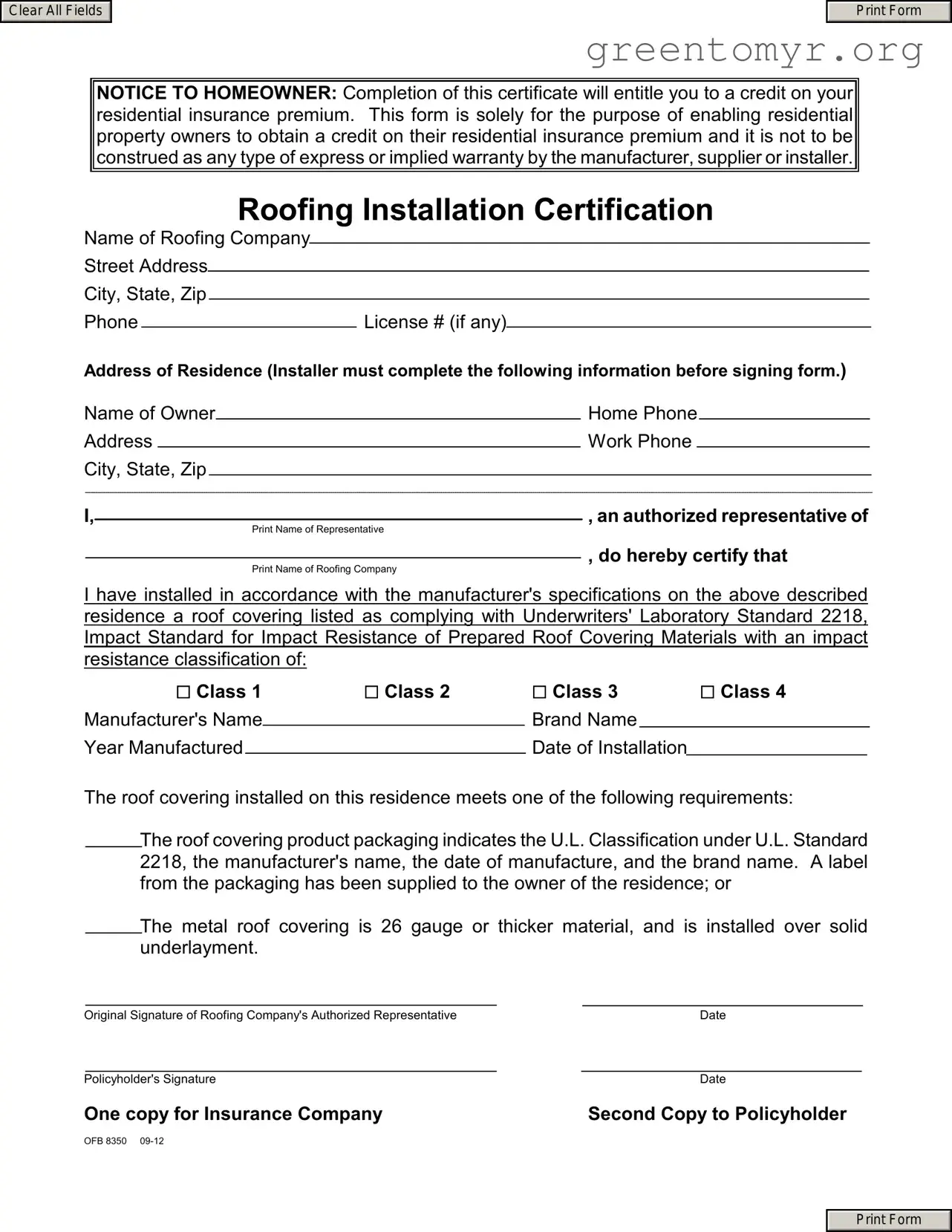
The Roofing Certificate form plays a crucial role in the realm of residential insurance, particularly for homeowners seeking to reduce their insurance premiums. This form, issued by the Texas Department of Insurance, provides essential details regarding the installation of roofing materials that meet specific impact resistance standards. Homeowners must complete this certificate to qualify for a premium reduction, which can lead to significant savings over time. The form requires information about the roofing company, including its name, address, and license number, as well as the homeowner’s details. Importantly, it certifies that the roofing installation adheres to the manufacturer's specifications and complies with Underwriters’ Laboratory Standard 2218. This standard ensures that the roofing material has the necessary impact resistance classification, ranging from Class 1 to Class 4. The roofing company’s authorized representative must sign the form, attesting to the accuracy of the information provided. Homeowners should retain a copy of the completed form, while a second copy is sent to the insurance company. It is vital to note that any intentional misrepresentation on this form is considered fraud, underscoring the importance of accuracy and honesty in the certification process.
Clear All Fields
Print Form
NOTICE TO HOMEOWNER: Completion of this certificate will entitle you to a credit on your residential insurance premium. This form is solely for the purpose of enabling residential property owners to obtain a credit on their residential insurance premium and it is not to be construed as any type of express or implied warranty by the manufacturer, supplier or installer.
Roofing Installation Certification
Name of Roofing Company
Street Address
City, State, Zip
PhoneLicense # (if any)
Address of Residence (Installer must complete the following information before signing form.)
Name of Owner |
|
Home Phone |
|
|
|||||
Address |
|
|
|
Work Phone |
|
|
|||
City, State, Zip |
|
|
|
|
|
|
|||
I, |
|
|
, an authorized representative of |
||||||
|
|
||||||||
|
|
|
|
|
Print Name of Representative |
||||
|
|
|
|
|
|
, do hereby certify that |
|||
|
|
|
|
|
|
||||
|
|
|
|
|
Print Name of Roofing Company |
||||
I have installed in accordance with the manufacturer's specifications on the above described residence a roof covering listed as complying with Underwriters' Laboratory Standard 2218, Impact Standard for Impact Resistance of Prepared Roof Covering Materials with an impact resistance classification of:
Class 1 |
Class 2 |
|
Class 3 |
Class 4 |
||||
Manufacturer's Name |
|
|
Brand Name |
|
|
|
||
Year Manufactured |
|
|
|
Date of Installation |
|
|
||
|
|
|
|
|
|
|
|
|
The roof covering installed on this residence meets one of the following requirements:
The roof covering product packaging indicates the U.L. Classification under U.L. Standard 2218, the manufacturer's name, the date of manufacture, and the brand name. A label from the packaging has been supplied to the owner of the residence; or
The metal roof covering is 26 gauge or thicker material, and is installed over solid underlayment.
|
|
|
|
|
Original Signature of Roofing Company's Authorized Representative |
|
Date |
||
|
|
|
|
|
|
Policyholder's Signature |
|
Date |
|
One copy for Insurance Company |
|
Second Copy to Policyholder |
||
OFB 8350 |
|
|
|
|
Print Form
| Fact Name | Description |
|---|---|
| Purpose of the Form | This certificate allows homeowners to obtain a reduction in their residential insurance premiums by certifying the installation of compliant roofing materials. |
| Governing Law | The form is governed by Texas law, specifically the regulations set forth by the Texas Department of Insurance. |
| Impact Resistance Standards | The roofing materials must comply with Underwriters’ Laboratory Standard 2218, which classifies impact resistance into four classes: Class 1, Class 2, Class 3, and Class 4. |
| Fraud Warning | Any intentional misrepresentation on this form is considered fraud, highlighting the importance of accurate and honest information. |
After completing the Roofing Certificate form, you will be able to submit it to your insurance company for a potential reduction in your residential insurance premium. It’s important to ensure that all information is accurate and complete to avoid any delays or issues with your submission.
Make sure to keep one copy of the completed form for your records and send the second copy to your insurance company. This will ensure that your request for a premium reduction is processed efficiently.
The Roofing Certificate form is a document provided by the Texas Department of Insurance. It allows homeowners to certify that their roofing has been installed according to specific standards. By completing this form, homeowners can qualify for a reduction in their residential insurance premiums.
This form must be completed by an authorized representative of the roofing company that installed the roof. Homeowners should ensure that the roofing company provides accurate information about the installation, including the type of materials used and the installation date.
The form requires several key pieces of information, including:
All this information helps verify that the roofing meets the necessary standards for insurance premium reduction.
By completing the Roofing Certificate form, homeowners may receive a reduction in their residential insurance premiums. This can lead to significant savings over time. It is important to keep a copy of the form for personal records and to provide another copy to the insurance company.
Providing incorrect information on the Roofing Certificate form can lead to serious consequences. If misrepresentation is discovered, it may be considered fraud. This could result in penalties, including loss of insurance coverage. Homeowners should ensure that all information is accurate and truthful.
Once completed, the Roofing Certificate form should be distributed in the following manner:
This ensures that both parties have the necessary documentation to support the insurance premium reduction.
Completing the Roofing Certificate form can be a straightforward process, yet many homeowners encounter pitfalls that can lead to complications. One common mistake is neglecting to provide complete contact information for the roofing company. This includes the company's name, street address, city, county, zip code, and phone number. Omitting any of these details may delay the processing of the certificate and could result in a loss of the intended insurance premium reduction.
Another frequent error involves the failure to include the license number of the roofing company, if applicable. This information is crucial for verifying the legitimacy of the contractor and ensuring compliance with state regulations. Without this number, the certificate may be deemed incomplete, which can hinder the homeowner's ability to secure the promised benefits.
Homeowners often overlook the importance of accurately filling out the address of the residence where the roofing work was performed. Inaccuracies in this section can lead to confusion and may complicate claims or disputes in the future. It is essential to double-check that the address matches official records to avoid any discrepancies.
Misrepresentation of the roofing materials used is another serious mistake. The form requires specific details about the roof covering, including the manufacturer’s name, brand name, and the year manufactured. Failing to provide this information accurately can not only invalidate the certificate but may also lead to potential legal issues if discrepancies arise later.
Homeowners should also be cautious when selecting the impact resistance classification of the roof covering. Each classification—Class 1, Class 2, Class 3, or Class 4—has distinct implications for insurance premiums. Incorrectly marking this section could result in an unintended increase in costs or a denial of the premium reduction.
Additionally, many individuals forget to check the appropriate labeling options on the form. The certificate requires that either the product packaging indicates compliance with U.L. Standard 2218 or that each individual roofing component is labeled accordingly. Missing this step can lead to further complications during the insurance review process.
Finally, the signature of the authorized representative from the roofing company must be included. Failing to sign the form renders it invalid. This signature serves as a certification of compliance with the stated requirements and is critical for the form's acceptance by the insurance company. Homeowners should ensure that this step is not overlooked to avoid unnecessary delays in receiving their premium reduction.
When seeking a reduction in residential insurance premiums, homeowners often need to submit various forms and documents alongside the Roofing Certificate. Each document serves a specific purpose in verifying compliance with industry standards and ensuring that homeowners receive the benefits they deserve. Below is a list of commonly used forms and documents that complement the Roofing Certificate.
By gathering these documents, homeowners can ensure a smoother process when applying for insurance premium reductions. Each document plays a vital role in confirming the quality of the roofing work and the homeowner's compliance with insurance requirements.
When filling out the Roofing Certificate form, it is essential to follow specific guidelines to ensure accuracy and compliance. Here are four things you should and shouldn't do:
Following these guidelines will help avoid delays in processing and ensure you receive the intended reduction in your residential insurance premium.
Misconceptions about the Roofing Certificate form can lead to confusion for homeowners seeking insurance premium reductions. Below are seven common misunderstandings, along with clarifications for each.
While completing the Roofing Certificate form may entitle homeowners to a premium reduction, it does not guarantee that the insurance company will approve the reduction. Each insurer has its own policies and criteria for granting discounts.
The form is not a warranty for the roofing materials or installation. It simply certifies that the roof was installed according to the manufacturer's specifications and meets certain impact resistance standards.
While a licensed roofing company may provide additional assurance, the form can be completed by any authorized representative of the roofing company, regardless of licensing status.
There is no strict deadline for submitting the Roofing Certificate form. However, homeowners should do so promptly to ensure they receive the premium reduction in a timely manner.
Not all roofing materials qualify for premium reductions. Only those that comply with Underwriters’ Laboratory Standard 2218 and meet specific impact resistance classifications are eligible.
The Roofing Certificate form is designed specifically for residential properties. It does not apply to commercial properties or other types of buildings.
Homeowners are required to retain a copy of the form, but they do not need to keep the original. A duplicate will suffice for their records.
Understanding these misconceptions can help homeowners navigate the process of obtaining a reduction in their residential insurance premiums more effectively.
Here are key takeaways regarding the Roofing Certificate form:
Make sure to keep a copy for your records and send another to your insurance company. Misrepresentations on this form can lead to serious consequences.