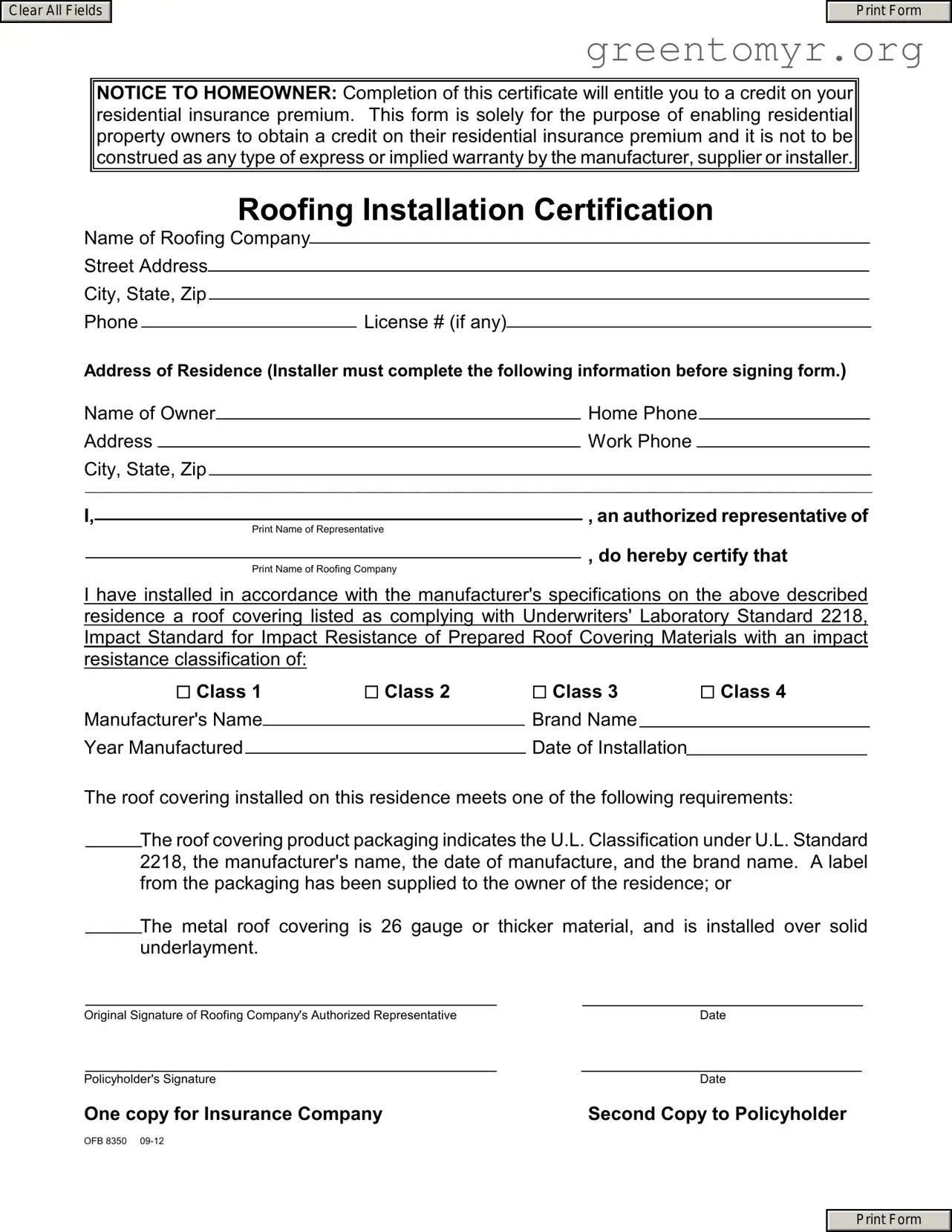
The Roofing Installation Certification form serves a crucial role for homeowners seeking to secure financial benefits on their residential insurance premiums. By completing this form, homeowners can potentially receive a credit that reduces their overall insurance costs. It is important to note that this certification is not a warranty from the manufacturer, supplier, or installer, but rather a means to validate that the roofing work has been performed according to specific standards. The form requires detailed information about the roofing company, including its name, address, and license number, as well as information about the homeowner and the property in question. Additionally, an authorized representative from the roofing company must certify that the installation adheres to the manufacturer's specifications and meets the impact resistance standards set by Underwriters' Laboratory. This includes providing the classification of the roof covering, which ranges from Class 1 to Class 4, and verifying the manufacturer's name and the date of installation. The form also stipulates that documentation, such as product packaging or labels, must be supplied to the homeowner, ensuring transparency and accountability in the roofing process. Ultimately, this certification not only benefits homeowners financially but also promotes quality and compliance in roofing installations.
Clear All Fields
Print Form
NOTICE TO HOMEOWNER: Completion of this certificate will entitle you to a credit on your residential insurance premium. This form is solely for the purpose of enabling residential property owners to obtain a credit on their residential insurance premium and it is not to be construed as any type of express or implied warranty by the manufacturer, supplier or installer.
Roofing Installation Certification
Name of Roofing Company
Street Address
City, State, Zip
PhoneLicense # (if any)
Address of Residence (Installer must complete the following information before signing form.)
Name of Owner |
|
Home Phone |
|
|
|||||
Address |
|
|
|
Work Phone |
|
|
|||
City, State, Zip |
|
|
|
|
|
|
|||
I, |
|
|
, an authorized representative of |
||||||
|
|
||||||||
|
|
|
|
|
Print Name of Representative |
||||
|
|
|
|
|
|
, do hereby certify that |
|||
|
|
|
|
|
|
||||
|
|
|
|
|
Print Name of Roofing Company |
||||
I have installed in accordance with the manufacturer's specifications on the above described residence a roof covering listed as complying with Underwriters' Laboratory Standard 2218, Impact Standard for Impact Resistance of Prepared Roof Covering Materials with an impact resistance classification of:
Class 1 |
Class 2 |
|
Class 3 |
Class 4 |
||||
Manufacturer's Name |
|
|
Brand Name |
|
|
|
||
Year Manufactured |
|
|
|
Date of Installation |
|
|
||
|
|
|
|
|
|
|
|
|
The roof covering installed on this residence meets one of the following requirements:
The roof covering product packaging indicates the U.L. Classification under U.L. Standard 2218, the manufacturer's name, the date of manufacture, and the brand name. A label from the packaging has been supplied to the owner of the residence; or
The metal roof covering is 26 gauge or thicker material, and is installed over solid underlayment.
|
|
|
|
|
Original Signature of Roofing Company's Authorized Representative |
|
Date |
||
|
|
|
|
|
|
Policyholder's Signature |
|
Date |
|
One copy for Insurance Company |
|
Second Copy to Policyholder |
||
OFB 8350 |
|
|
|
|
Print Form
| Fact Name | Details |
|---|---|
| Purpose of the Form | This form allows homeowners to obtain a credit on their residential insurance premium. |
| No Warranty Implied | Completion of this certificate does not imply any warranty from the manufacturer, supplier, or installer. |
| Certification Requirement | The roofing company must certify that the installation complies with the manufacturer's specifications. |
| U.L. Classification | The roof covering must comply with Underwriters' Laboratory Standard 2218 for impact resistance. |
| Impact Resistance Classes | The form allows for classifications from Class 1 to Class 4 based on impact resistance. |
| State-Specific Forms | Some states may have specific laws governing roofing installation certifications, such as the Florida Building Code. |
| Signature Requirement | Both the roofing company's authorized representative and the policyholder must sign the form. |
After filling out the Roofing Installation Certification form, you will be able to submit it to your insurance provider. This may qualify you for a credit on your residential insurance premium. Ensure all information is accurate and complete to avoid any delays in processing your request.
The Roofing Installation Certification form is designed to help homeowners obtain a credit on their residential insurance premium. By completing this form, homeowners can provide proof that their roof has been installed according to the manufacturer's specifications and meets certain safety standards. It is important to note that this form does not serve as a warranty from the manufacturer, supplier, or installer.
To properly complete the Roofing Installation Certification form, several pieces of information must be provided. This includes:
Both the authorized representative of the roofing company and the policyholder must sign the form to validate it.
The impact resistance classification of your roof covering can play a significant role in determining your insurance premium. Roofs that meet higher impact resistance classifications (Class 3 or Class 4) are generally considered more durable and less likely to sustain damage from severe weather events, such as hail. As a result, insurance companies may offer lower premiums for homes with roofs that have a higher classification, providing a financial incentive for homeowners to invest in quality roofing materials.
If your roofing company does not complete the Roofing Installation Certification form, it is important to address the issue promptly. You can take the following steps:
Having a properly completed form is essential for you to receive the insurance benefits associated with your new roof.
Once the Roofing Installation Certification form is completed and signed by both the authorized representative of the roofing company and the policyholder, it is important to distribute the copies correctly. The form typically requires:
Make sure to keep a copy for yourself, as it may be needed for future reference or in case of any disputes regarding your insurance premium.
Filling out the Roofing Installation Certification form is a crucial step for homeowners seeking to secure a credit on their residential insurance premiums. However, many individuals make common mistakes that can lead to delays or even denials of their claims. Understanding these pitfalls can help ensure a smoother process.
One frequent error occurs when homeowners neglect to provide accurate contact information for the roofing company. This includes not just the name of the company but also the complete street address, city, state, and zip code. If the insurance company cannot easily reach the roofing contractor for verification, it could jeopardize the certification's validity.
Another mistake involves incomplete or incorrect information regarding the roofing installation itself. Homeowners must ensure that the name of the roofing representative and the license number (if applicable) are filled out correctly. Omitting this information or making typographical errors can raise red flags during the review process.
Additionally, the classification of impact resistance is a critical component that homeowners often overlook. The form requires the installer to select one of the four classes of impact resistance. Failing to make a selection or misclassifying the roof covering can lead to complications, as insurance companies rely on this classification to determine eligibility for premium credits.
Homeowners should also be cautious about the documentation they provide. The form stipulates that either the product packaging must indicate the U.L. Classification or that a label from the packaging should be supplied to the homeowner. Many forget to include this essential proof, which can result in the form being rejected.
Lastly, signatures play a vital role in the certification process. Both the roofing company’s authorized representative and the policyholder must sign and date the form. Missing signatures or dates can render the certification incomplete, causing unnecessary delays in processing the insurance credit.
By being mindful of these common mistakes, homeowners can navigate the Roofing Installation Certification form more effectively, ensuring they receive the credits they deserve on their insurance premiums.
When dealing with roofing installations, several documents often accompany the Roofing Installation Certification form. Each serves a specific purpose, ensuring that homeowners, contractors, and insurance companies have all necessary information for a smooth process.
Having these documents on hand can streamline the roofing process and provide necessary protections for everyone involved. Each plays a crucial role in ensuring that the installation is completed correctly and that all parties are satisfied.
When filling out the Roofing Installation Certification form, there are important dos and don'ts to keep in mind. Following these guidelines can help ensure that the process goes smoothly.
Misconceptions about the Roofing Installation Certification form can lead to confusion for homeowners and roofing professionals alike. Here are nine common misunderstandings:
Understanding these misconceptions can empower homeowners to make informed decisions regarding their roofing projects and insurance savings.
Here are some key takeaways about filling out and using the Roofing Installation Certification form: