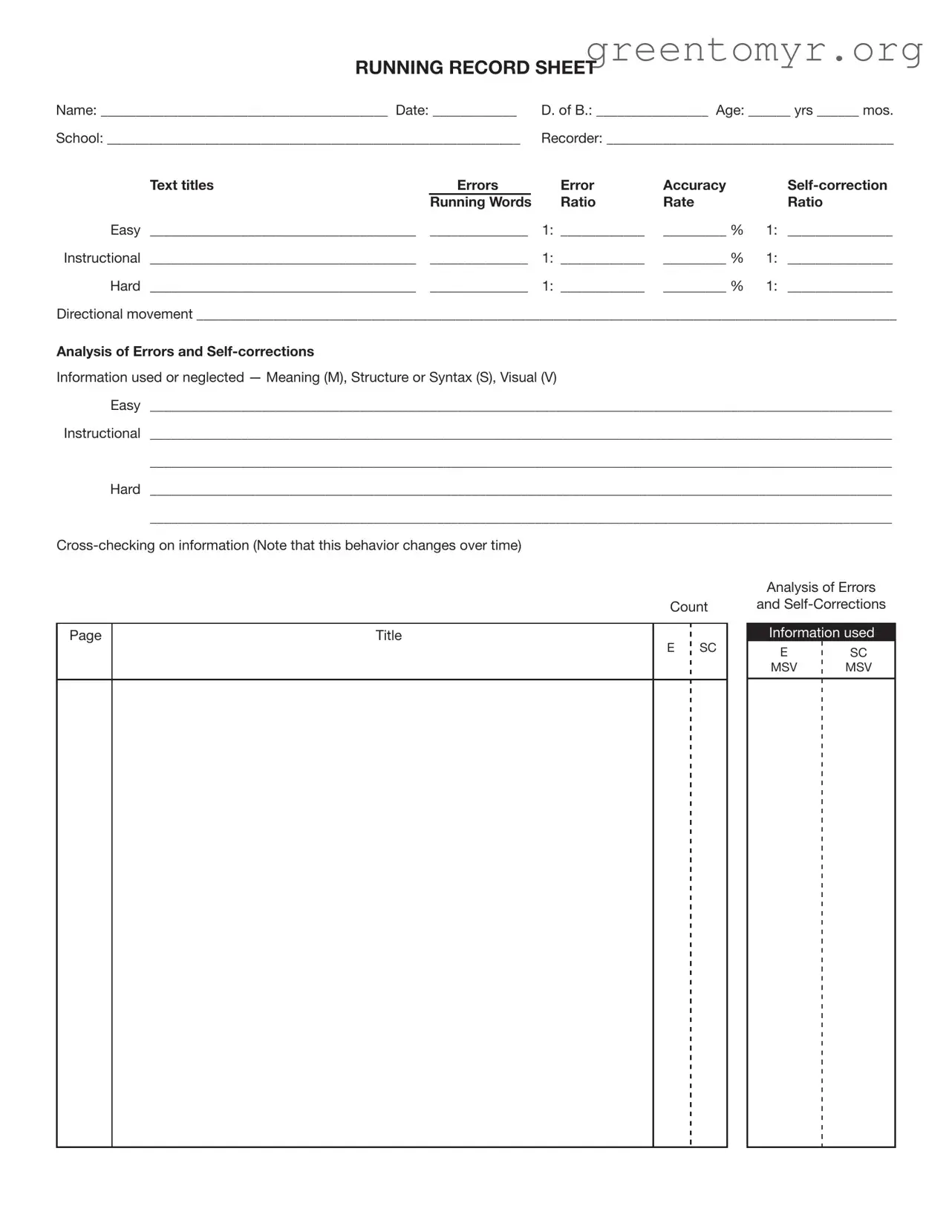
The Running Record Sheet is an essential tool for educators aiming to assess a student's reading abilities effectively. This form captures vital information about a reader's performance, including their name, date of assessment, date of birth, age, school, and the recorder's name. It provides a structured way to document the text titles read, the number of errors made, and the overall accuracy percentage. Additionally, it includes metrics such as self-correction rates and running words ratio, which help in evaluating a student's fluency and comprehension. The form categorizes texts into three levels—easy, instructional, and hard—allowing educators to tailor their teaching strategies to meet individual student needs. The Running Record Sheet also features sections for analyzing errors and self-corrections, providing insight into the types of mistakes students make and whether they rely on meaning, structure, or visual cues. This comprehensive approach enables teachers to track progress over time and adjust their instructional methods accordingly, ensuring that each student receives the support necessary to enhance their reading skills.

RUNNING RECORD SHEET
Name: _________________________________________ Date: ____________ |
D. of B.: ________________ Age: ______ yrs ______ mos. |
|||||
School: ___________________________________________________________ |
Recorder: _________________________________________ |
|||||
|
Text titles |
Errors |
|
Error |
Accuracy |
|
|
|
Running Words |
Ratio |
Rate |
Ratio |
|
Easy |
______________________________________ |
______________ |
|
1: ____________ |
_________ % |
1: _______________ |
Instructional |
______________________________________ |
______________ |
|
1: ____________ |
_________ % |
1: _______________ |
Hard |
______________________________________ |
______________ |
|
1: ____________ |
_________ % |
1: _______________ |
Directional movement ____________________________________________________________________________________________________
Analysis of Errors and
Information used or neglected — Meaning (M), Structure or Syntax (S), Visual (V)
Easy __________________________________________________________________________________________________________
Instructional __________________________________________________________________________________________________________
__________________________________________________________________________________________________________
Hard __________________________________________________________________________________________________________
__________________________________________________________________________________________________________
Page
Title
Count
ESC
Analysis of Errors
and
Information used
ESC
MSV MSV

Page
Title
Count
ESC
Analysis of Errors
and
Information used
ESC
MSV MSV
| Fact Name | Description |
|---|---|
| Name | The Running Record Sheet includes a section for the individual's name, ensuring accurate identification of the student being assessed. |
| Date | It requires the date of the assessment, which helps track progress over time. |
| Date of Birth | The form captures the student's date of birth to provide context for their age and developmental stage. |
| Age | Age is recorded in years and months, allowing for precise evaluation against developmental benchmarks. |
| Text Titles | Different text titles are categorized as Easy, Instructional, or Hard, guiding educators in selecting appropriate reading materials. |
| Error Analysis | The form includes sections for analyzing errors and self-corrections, which are critical for understanding a student's reading strategies. |
| State-Specific Laws | In states like California, the use of Running Record Sheets aligns with the California Education Code, which emphasizes individualized assessment. |
Once you have gathered all the necessary information, you can begin filling out the Running Record Sheet form. This form is designed to capture specific details about a reading session, including the reader's performance and the text used. Follow the steps below to complete the form accurately.
A Running Record Sheet is a tool used to assess a reader's fluency and comprehension while they read a text aloud. It captures information such as errors, self-corrections, and overall reading accuracy. This information is vital for educators to tailor instruction to meet each student's needs.
To fill out the Running Record Sheet, start by entering the student's name, date, date of birth, age, and school at the top of the form. Next, record the text title and note any errors made during reading. Calculate the accuracy percentage and self-correction ratio for each text level (easy, instructional, and hard) as you go along.
For each error made during reading, document the nature of the mistake. You can categorize errors based on the type of information used or neglected, such as meaning (M), structure or syntax (S), and visual (V). This analysis helps in understanding the student's reading strategies.
The accuracy percentage reflects how well a student reads a text without making errors. A higher percentage indicates better reading proficiency. Generally, an accuracy rate of 95% or higher is considered easy, while 90-94% is instructional, and below 90% is hard.
The self-correction ratio shows how often a student corrects their own mistakes while reading. A higher ratio suggests that the student is actively engaged in monitoring their reading and is able to self-correct, which is a positive sign of comprehension and fluency.
To analyze the errors, categorize them based on the information used or neglected. For each text level, note whether the errors relate to meaning, structure, or visual cues. This analysis can guide future instruction and help target specific areas for improvement.
Cross-checking refers to the strategy where readers verify their understanding by checking multiple sources of information. It is important because it shows how well students can integrate different cues while reading, enhancing their overall comprehension skills.
Yes, the Running Record Sheet can be adapted for various grade levels. While the text complexity may change, the fundamental principles of assessing reading fluency and comprehension remain relevant across all ages. Adjust the texts and expectations according to the student's reading level.
It is recommended to use the Running Record Sheet regularly, such as once every few weeks or at the end of each unit. Frequent assessments help track progress over time and allow for timely adjustments in teaching strategies based on the student's needs.
Many educational websites and teaching resources provide guidelines and examples for using Running Record Sheets effectively. Additionally, professional development workshops often cover assessment tools, including the Running Record Sheet, to help educators enhance their skills.
Filling out the Running Record Sheet form accurately is crucial for effective assessment. However, many individuals make common mistakes that can lead to incorrect data collection. Understanding these pitfalls can enhance the reliability of the results.
One frequent error is failing to complete all required fields. Essential information such as the name, date, and age is often overlooked. Incomplete data can hinder the ability to analyze the student’s reading progress accurately. Each section of the form serves a purpose, and missing details can lead to misinterpretations.
Another mistake involves miscalculating the error rate and accuracy percentage. These figures are essential for determining a student’s reading level. If errors are not counted correctly, or if the total words read are miscalculated, the resulting accuracy percentage will be flawed. This can mislead educators about a student’s reading abilities.
People often neglect the analysis of errors and self-corrections. This section is vital for understanding the types of mistakes a student makes and their ability to self-correct. Skipping this analysis can result in missed opportunities for targeted instruction. It is important to provide specific examples and insights into the student’s reading behavior.
Additionally, some users fail to utilize the directional movement section effectively. This part of the form tracks the student's ability to follow text visually. Not recording this information can overlook critical aspects of a student's reading process, such as their engagement with the text or their ability to track words.
Lastly, there is often confusion regarding the different text categories: easy, instructional, and hard. Misclassifying a text can lead to inappropriate reading level assessments. Ensuring that each text is categorized correctly is essential for providing the right support to the student. Accurate categorization allows for more effective instructional strategies tailored to individual needs.
The Running Record Sheet is a valuable tool for educators, providing insights into a student's reading abilities and challenges. However, it often works in conjunction with several other documents that enhance the assessment process. Below is a list of forms and documents that are commonly used alongside the Running Record Sheet.
Utilizing these documents alongside the Running Record Sheet creates a holistic view of a student's reading abilities. This comprehensive approach enables educators to provide targeted support, ultimately fostering a more effective learning environment.
When filling out the Running Record Sheet form, there are important guidelines to follow. Here’s a list of what you should and shouldn’t do:
Misconceptions about the Running Record Sheet form can lead to confusion and misinterpretation of its purpose. Here are six common misunderstandings:
Filling out and using the Running Record Sheet form is essential for accurately assessing reading abilities. Here are six key takeaways to consider: