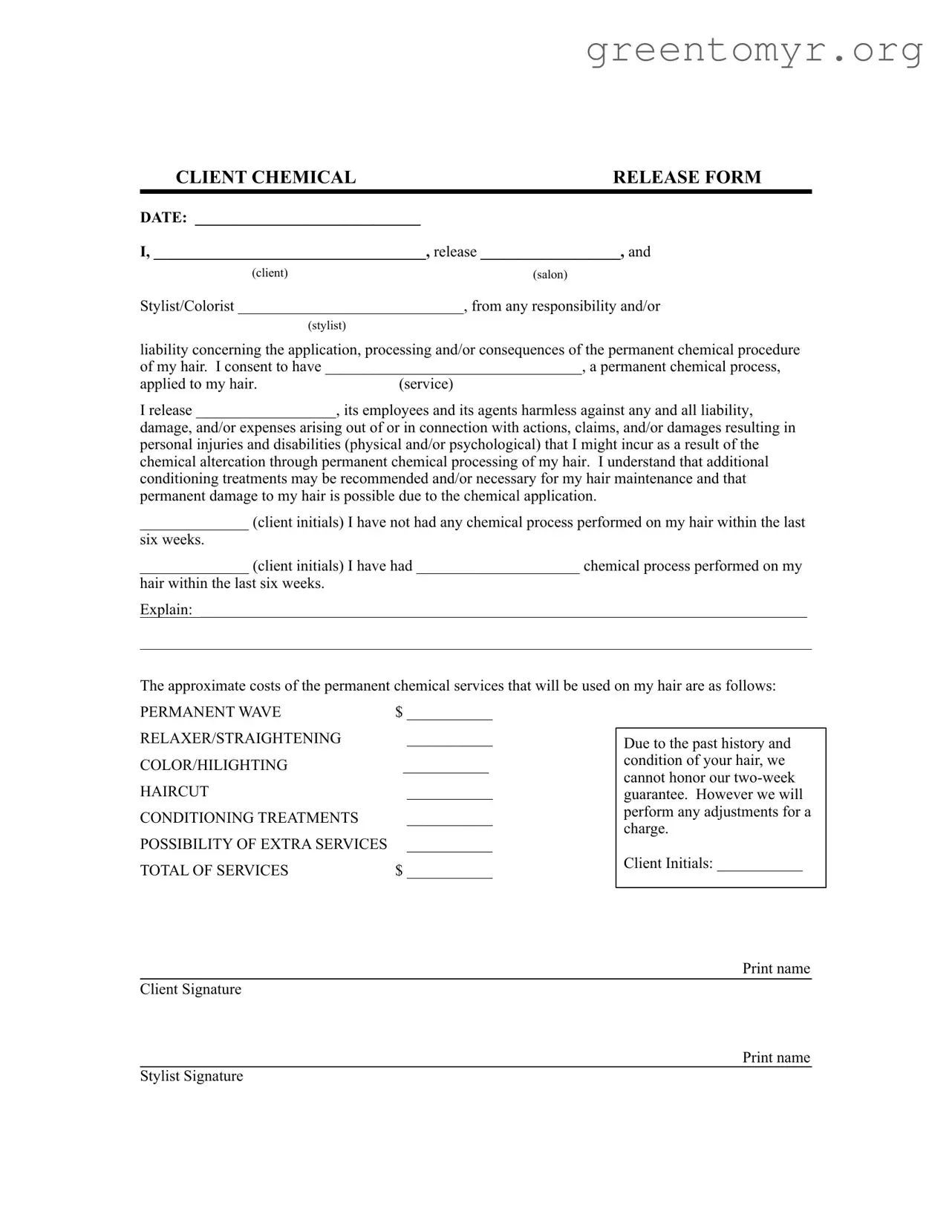
The Salon Chemical Waiver form is an essential document for clients undergoing permanent chemical treatments at a salon. It serves to protect both the client and the salon by outlining the responsibilities and potential risks associated with chemical hair processes. Clients must acknowledge that they are voluntarily consenting to these procedures, which may include services like permanent waves, relaxers, or color treatments. The form requires clients to confirm their hair's recent treatment history, ensuring that stylists have the necessary information to provide safe and effective services. Additionally, the waiver includes a release of liability clause, which safeguards the salon and its staff from any claims arising from the chemical application. Clients are also informed about the possibility of permanent damage to their hair and may be advised to undergo additional conditioning treatments for optimal maintenance. The form concludes with a breakdown of service costs, highlighting the financial aspects of the treatments. Overall, the Salon Chemical Waiver form is a critical component in the salon experience, fostering transparency and informed consent between clients and stylists.

CLIENT CHEMICALRELEASE FORM
DATE: _____________________________
I, ___________________________________, release __________________, and
(client)(salon)
Stylist/Colorist _____________________________, from any responsibility and/or
(stylist)
liability concerning the application, processing and/or consequences of the permanent chemical procedure of my hair. I consent to have _________________________________, a permanent chemical process,
applied to my hair.(service)
I release __________________, its employees and its agents harmless against any and all liability,
damage, and/or expenses arising out of or in connection with actions, claims, and/or damages resulting in personal injuries and disabilities (physical and/or psychological) that I might incur as a result of the chemical altercation through permanent chemical processing of my hair. I understand that additional conditioning treatments may be recommended and/or necessary for my hair maintenance and that permanent damage to my hair is possible due to the chemical application.
______________ (client initials) I have not had any chemical process performed on my hair within the last
six weeks.
______________ (client initials) I have had _____________________ chemical process performed on my
hair within the last six weeks.
Explain: ______________________________________________________________________________
The approximate costs of the permanent chemical services that will be used on my hair are as follows:
PERMANENT WAVE |
$ ___________ |
|
|
RELAXER/STRAIGHTENING |
___________ |
|
|
Due to the past history and |
|||
COLOR/HILIGHTING |
___________ |
condition of your hair, we |
|
HAIRCUT |
___________ |
cannot honor our |
|
guarantee. However we will |
|||
CONDITIONING TREATMENTS |
___________ |
perform any adjustments for a |
|
charge. |
|||
POSSIBILITY OF EXTRA SERVICES |
___________ |
||
Client Initials: ___________ |
|||
TOTAL OF SERVICES |
$ ___________ |
||
|
|||
|
|
|
Print name
Client Signature
Print name
Stylist Signature
| Fact Name | Description |
|---|---|
| Date of Agreement | The form requires the client to enter the date when they are signing the waiver. |
| Release of Liability | Clients release the salon and stylist from any responsibility for injuries or damages resulting from the chemical procedure. |
| Consent for Chemical Process | Clients must consent to the specific permanent chemical process being applied to their hair. |
| History of Chemical Processes | Clients must disclose if they have had any chemical processes on their hair within the last six weeks. |
| Cost Estimates | The form includes a section for clients to see approximate costs for various permanent chemical services. |
| Governing Laws | Each state may have specific laws governing the use of chemical waivers, such as California's Business and Professions Code. |
Completing the Salon Chemical Waiver form is a straightforward process that requires careful attention to detail. Ensure that all necessary information is provided accurately to avoid any misunderstandings regarding your consent for the chemical procedure.
The Salon Chemical Waiver form is designed to protect both the client and the salon. By signing this document, clients acknowledge the potential risks associated with chemical hair treatments. It releases the salon and its staff from liability for any adverse effects that may arise during or after the procedure. This ensures that clients are fully informed and consent to the services being provided.
Before signing the waiver, it’s crucial to review your hair's history and current condition. The form requires you to disclose any chemical processes you have undergone in the past six weeks. This information helps the stylist assess the health of your hair and determine the best approach for your treatment. Additionally, be aware that permanent damage is a possibility, and you may need extra conditioning treatments afterward to maintain your hair's health.
Yes, the waiver outlines the approximate costs for various permanent chemical services. These may include:
Clients should expect to see a total amount for services listed at the end of the form. It’s important to discuss any additional costs for adjustments or conditioning treatments that may be necessary after the initial service.
If you have concerns about your hair's condition, it’s best to discuss them with your stylist before signing the waiver. The stylist can provide insight into how your hair may react to chemical treatments based on its current state. If your hair has been previously processed, the stylist may recommend alternative services or additional treatments to ensure the best outcome. Open communication is key to achieving your desired results while maintaining the health of your hair.
Filling out the Salon Chemical Waiver form is an important step for clients seeking chemical treatments for their hair. However, mistakes can lead to misunderstandings or issues later on. Here are four common mistakes people make when completing this form.
One frequent error is failing to provide complete information about previous chemical treatments. Clients must indicate whether they have had any chemical process performed on their hair within the last six weeks. Omitting this detail can result in complications during the new treatment. If a client has had a recent chemical service, it may affect the outcome of the new treatment. Therefore, it is crucial to be honest and thorough in this section.
Another mistake involves neglecting to initial the sections that require client initials. The form includes specific areas where clients must acknowledge their understanding of potential risks and recommendations. By skipping these initials, clients may unintentionally forfeit their rights to claim any issues that arise later. It is essential to read each statement carefully and provide initials where indicated.
Clients also often overlook the importance of discussing the costs associated with the services. The form includes sections for various services, and clients should ensure that they understand and agree to the estimated costs. Not clarifying these charges beforehand can lead to surprises at checkout, which can create frustration for both the client and the salon staff. Being proactive about understanding the financial aspects can help avoid misunderstandings.
Lastly, clients may forget to sign the form. A signature is not just a formality; it signifies that the client agrees to the terms and conditions outlined in the waiver. Without a signature, the salon may not proceed with the chemical treatment, leaving clients disappointed. Always double-check to ensure that all required signatures are in place before submitting the form.
When preparing for a salon appointment that involves chemical treatments, several documents may be necessary to ensure a smooth process. These forms help clarify responsibilities, consent, and other important details. Below is a list of common documents used alongside the Salon Chemical Waiver form.
Having these documents prepared and signed can enhance the client experience and ensure that everyone is on the same page regarding services and expectations. It is important for clients to read and understand each form before signing.
The Salon Chemical Waiver form serves a specific purpose in the context of hair treatments, particularly those involving chemical processes. Several other documents share similarities with this waiver, each designed to protect service providers and inform clients about the potential risks associated with their services. Here are four such documents:
When filling out the Salon Chemical Waiver form, it is important to approach the process thoughtfully. Below is a list of things you should and shouldn't do.
Completing the form correctly helps ensure a smooth experience and protects both you and the salon. Your safety and satisfaction are important.
This is not entirely accurate. While the waiver does release the salon from certain liabilities, it does not protect against negligence or misconduct. If the salon fails to follow proper procedures, they may still be held accountable.
This is misleading. Although the waiver limits liability, it does not eliminate the possibility of legal action. Clients can still pursue claims if they believe their rights have been violated or if there is evidence of negligence.
The waiver covers various services, including haircuts and conditioning treatments. Clients should be aware that it encompasses all procedures performed during their visit.
No guarantee is implied. The waiver states that due to individual hair conditions, results may vary. Clients should understand that outcomes depend on many factors, including hair type and prior treatments.
This is not advisable. Clients should read and understand the waiver fully before signing. Ignorance of its contents does not exempt one from its terms.
This is incorrect. The waiver is a legal document that outlines the client's consent and understanding of the risks involved. It serves an important purpose in protecting both the client and the salon.
Clients are encouraged to ask questions. The waiver does not prevent individuals from seeking clarification about the services or the potential risks involved.
Clients have the right to refuse to sign the waiver. However, refusal may result in the salon declining to provide the requested services, as the waiver is part of their policy for chemical treatments.
This is not true. The waiver is specific to the services rendered on the date it is signed. Clients may need to sign a new waiver for subsequent visits, especially if different services are being requested.
When filling out and using the Salon Chemical Waiver form, consider the following key takeaways: