Content Navigation

The Sample Roof Certification form is an important document for homeowners and buyers who want assurance about the condition of a roof. This certification must be issued on the letterhead or invoice of a licensed roofing contractor, ensuring that it carries the necessary credibility. Key details included in the form are the contractor’s name, address, telephone number, and license number, all of which help verify the contractor's qualifications. The form states that the roof is certified, warranted, or guaranteed to be moisture-proof for a minimum of two years. It also references a thorough inspection conducted by a qualified roofer, who assesses the roof's condition by observing visible elements. The inspector's findings conclude that the roof is satisfactory and shows no signs of leaks. However, it is essential to note that this certification does not cover damages from severe weather or other unforeseen issues like foot traffic or natural disasters. Additionally, it specifically pertains to the livable area of the home and does not apply to patio covers or porches. Understanding these aspects can help homeowners make informed decisions regarding their roofing needs.
Sample Roof Certification Example

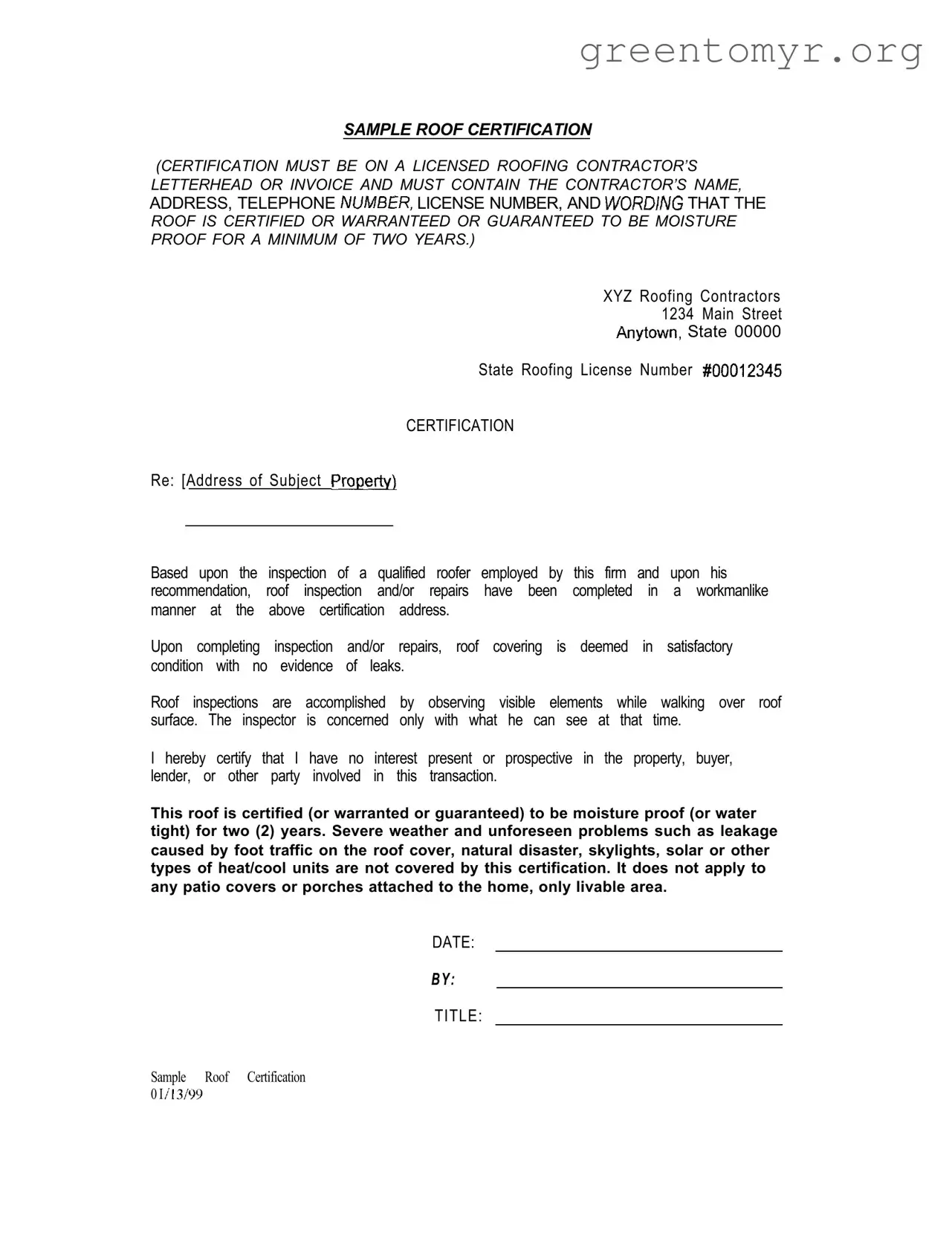
SAMPLE ROOF CERTIFICATION

(CERTIFICATION MUST BE ON A LICENSED ROOFING CONTRACTOR’S LETTERHEAD OR INVOICE AND MUST CONTAIN THE CONTRACTOR’S NAME,

ADDRESS, TELEPHONE NUMSER, LICENSE NUMBER, AND WORDlNG THAT THE

ROOF IS CERTIFIED OR WARRANTEED OR GUARANTEED TO BE MOISTURE PROOF FOR A MINIMUM OF TWO YEARS.)

XYZ Roofing Contractors

1234 Main Street

Anytown, State 00000

State Roofing License Number #00012345

CERTIFICATION

Re: [Address of Subject Property)

Based upon the inspection of a qualified roofer employed by this firm and upon his recommendation, roof inspection and/or repairs have been completed in a workmanlike manner at the above certification address.

Upon completing inspection and/or repairs, roof covering is deemed in satisfactory condition with no evidence of leaks.

Roof inspections are accomplished by observing visible elements while walking over roof surface. The inspector is concerned only with what he can see at that time.

I hereby certify that I have no interest present or prospective in the property, buyer, lender, or other party involved in this transaction.

This roof is certified (or warranted or guaranteed) to be moisture proof (or water tight) for two (2) years. Severe weather and unforeseen problems such as leakage caused by foot traffic on the roof cover, natural disaster, skylights, solar or other types of heat/cool units are not covered by this certification. It does not apply to any patio covers or porches attached to the home, only livable area.

DATE:

BY:

TITLE:

Sample Roof Certification 0I/13/w

File Breakdown

Fact Name Description
Certification Requirements The certification must be on the letterhead or invoice of a licensed roofing contractor and include the contractor's name, address, telephone number, and license number.
Moisture Proof Guarantee The roof is certified to be moisture proof for a minimum of two years, covering only the livable area of the property.
Inspection Process Inspections are conducted by a qualified roofer who assesses visible elements of the roof while walking over its surface.
Exclusions This certification does not cover damage caused by severe weather, foot traffic, natural disasters, or issues related to skylights and HVAC units.

Guide to Using Sample Roof Certification

Completing the Sample Roof Certification form is an important step in ensuring that the roof of a property meets certain standards. This form must be filled out accurately to provide assurance to buyers, lenders, and other parties involved in the transaction. Follow these steps carefully to ensure that all necessary information is included.

  1. Obtain the Form: Make sure you have the Sample Roof Certification form ready. It should be printed on the letterhead or invoice of a licensed roofing contractor.
  2. Contractor Information: Fill in the contractor’s name, address, telephone number, and license number at the top of the form. This information must be clearly visible.
  3. Property Address: In the section labeled "Re:", write the address of the property for which the roof certification is being issued.
  4. Inspection Statement: Include a statement confirming that a qualified roofer inspected the roof. Specify that the inspection and/or repairs were completed in a workmanlike manner.
  5. Condition of Roof: State that the roof covering is in satisfactory condition and note that there is no evidence of leaks at the time of inspection.
  6. Inspector's Limitations: Mention that the inspection was based on visible elements and that the inspector could only assess what was observable at that time.
  7. Conflict of Interest: Certify that the inspector has no present or prospective interest in the property or any parties involved in the transaction.
  8. Certification Statement: Clearly state that the roof is certified (or warranted or guaranteed) to be moisture proof (or watertight) for a minimum of two years.
  9. Limitations of Certification: Note that the certification does not cover severe weather issues, foot traffic, natural disasters, or any skylights and solar units. Clarify that it applies only to the livable area of the home.
  10. Date and Signature: Finally, write the date on which the certification is being issued. The contractor should sign the form and include their title beneath their signature.

Get Answers on Sample Roof Certification

What is a Sample Roof Certification form?

The Sample Roof Certification form is a document provided by a licensed roofing contractor. It certifies that a roof has been inspected and is in satisfactory condition, free from leaks. The certification is typically issued on the contractor's letterhead or invoice and must include essential details such as the contractor's name, address, telephone number, license number, and a clear statement that the roof is certified to be moisture-proof for a minimum of two years.

What information is required on the form?

To be valid, the Sample Roof Certification form must contain the following information:

  • The contractor's name
  • The contractor's address
  • The contractor's telephone number
  • The contractor's state roofing license number
  • A statement certifying that the roof is moisture-proof for at least two years
  • The address of the property being certified
  • The date of certification
  • The signature and title of the certifying contractor

What does the certification cover?

The certification covers the roof's condition based on a visual inspection conducted by a qualified roofer. It ensures that the roof is free from leaks and in satisfactory condition at the time of inspection. However, it is important to note that the certification does not cover damages caused by severe weather, natural disasters, or issues arising from foot traffic on the roof. Additionally, it does not apply to patio covers or porches, only to livable areas of the property.

How long is the certification valid?

The Sample Roof Certification is valid for a period of two years from the date of issuance. During this time, the roof is guaranteed to be moisture-proof or watertight. After this period, homeowners should consider having another inspection conducted to ensure the roof remains in good condition. Regular maintenance and inspections can help extend the life of the roof and prevent potential issues.

Common mistakes

Filling out the Sample Roof Certification form requires attention to detail. One common mistake is failing to use the appropriate letterhead. The certification must be on the letterhead of a licensed roofing contractor. Without this, the form may not be considered valid.

Another frequent error involves omitting essential contact information. The contractor's name, address, telephone number, and license number must be clearly stated. Missing any of these details can lead to confusion or delays in processing the certification.

People often overlook the specific wording required in the certification. It must explicitly state that the roof is "certified," "warranted," or "guaranteed" to be moisture-proof for a minimum of two years. If this language is not included, the certification may lack the necessary legal weight.

Additionally, there is a tendency to provide vague descriptions of the property being certified. The address of the subject property should be clearly indicated. Ambiguity in this section can create complications for all parties involved.

Another mistake is failing to document the inspection process adequately. The form should reflect that the inspection was conducted by a qualified roofer and that it was done in a workmanlike manner. If this information is missing or unclear, it can undermine the credibility of the certification.

Some individuals neglect to mention the limitations of the certification. The form explicitly states that it does not cover issues caused by severe weather, foot traffic, or natural disasters. Failing to acknowledge these limitations can lead to misunderstandings about what the certification actually covers.

Lastly, the date and signature are crucial components that should not be overlooked. The form must be dated and signed by the authorized individual. Incomplete forms lacking these elements may be deemed invalid, causing unnecessary complications in the certification process.

Documents used along the form

When obtaining a Sample Roof Certification, several other forms and documents may also be necessary to ensure a comprehensive understanding of the property's roofing condition and related obligations. Each of these documents serves a specific purpose and contributes to the overall assessment and transaction process. Below is a list of common forms that are often used alongside the Sample Roof Certification.

  • Roof Inspection Report: This document provides detailed findings from a thorough inspection of the roof. It outlines any issues found, recommendations for repairs, and the overall condition of the roofing materials. This report is crucial for understanding the roof's current state.
  • Roof Repair Estimate: This estimate outlines the costs associated with any necessary repairs identified during the inspection. It helps property owners budget for maintenance and ensures transparency regarding potential expenses.
  • Warranty Documentation: This document details the terms of any warranties provided by the roofing contractor. It specifies what is covered, the duration of the warranty, and any exclusions. Understanding warranty terms is essential for property owners in case issues arise.
  • Contractor License Verification: This form confirms that the roofing contractor holds a valid license to perform roofing work in the relevant state. It is important for ensuring that the contractor is qualified and meets local regulations.
  • Insurance Certificate: This certificate proves that the roofing contractor carries liability insurance. It protects the property owner from potential claims arising from accidents or damages that occur during the roofing work.
  • Property Disclosure Statement: This statement is typically provided by the seller of the property and includes information about the condition of the roof and any known issues. It is essential for buyers to have full disclosure of the property's history and maintenance.

These documents collectively enhance the understanding of the roofing situation and protect the interests of all parties involved in a real estate transaction. Being informed about each of these forms can lead to more confident decision-making regarding roofing matters.

Similar forms

The Sample Roof Certification form is similar to several other documents used in the roofing and construction industry. Here’s a list of those documents and how they relate:

  • Roof Inspection Report: This document provides a detailed analysis of a roof's condition, similar to the Sample Roof Certification. Both documents confirm that an inspection has taken place and outline the findings regarding the roof's integrity.
  • Roof Warranty: Like the Sample Roof Certification, a roof warranty guarantees that the roof will remain leak-free for a specified time. Both documents aim to protect the homeowner against future issues.
  • Contractor Invoice: This document includes details about the services rendered and often includes a certification of work. Both the invoice and the Sample Roof Certification must be on the contractor's letterhead and provide essential contact information.
  • Building Permit: A building permit indicates that work has been approved by local authorities. It is similar to the Sample Roof Certification in that both documents signify that the work meets certain standards and regulations.
  • Completion Certificate: This certificate confirms that a construction project has been completed satisfactorily. Like the Sample Roof Certification, it assures the property owner that the work meets required standards.
  • Maintenance Agreement: A maintenance agreement outlines the services a contractor will provide over time, ensuring the roof remains in good condition. This is similar to the Sample Roof Certification, which guarantees a specific condition for a set period.
  • Insurance Certificate: This document proves that a contractor has insurance coverage. It is similar to the Sample Roof Certification in that both provide assurance to the homeowner regarding the contractor's reliability and professionalism.
  • Service Agreement: This outlines the terms of service between a contractor and a client. Like the Sample Roof Certification, it helps define responsibilities and expectations regarding the roof's condition.
  • Home Inspection Report: A home inspection report assesses the overall condition of a property, including the roof. Both documents provide insights into the state of the roof and potential issues that may arise.

Dos and Don'ts

When filling out the Sample Roof Certification form, it's important to follow specific guidelines to ensure accuracy and compliance. Here are some do's and don'ts to keep in mind:

  • Do use a licensed roofing contractor’s letterhead or invoice.
  • Do include the contractor’s name, address, and telephone number.
  • Do provide the contractor’s license number.
  • Do clearly state that the roof is certified, warranted, or guaranteed to be moisture proof for at least two years.
  • Do ensure the certification includes the address of the subject property.
  • Don't forget to mention that the roof inspection was completed in a workmanlike manner.
  • Don't include any personal interests in the property or transaction.
  • Don't certify coverage for severe weather or unforeseen problems like foot traffic damage.
  • Don't apply the certification to patio covers or porches attached to the home.

Following these guidelines will help ensure that the certification is valid and meets all necessary requirements.

Misconceptions

Understanding the Sample Roof Certification form can be challenging, and several misconceptions often arise. Here are nine common misunderstandings related to this important document:

  • It guarantees a roof will never leak. The certification only states that the roof is moisture-proof for a specified period, typically two years, but does not cover leaks from unforeseen circumstances.
  • All types of roofs are included. The certification applies only to livable areas and does not extend to patio covers or porches attached to the home.
  • Any contractor can issue a certification. The form must be completed on the letterhead or invoice of a licensed roofing contractor, ensuring that the certification comes from a qualified professional.
  • The inspection is exhaustive. The inspection is based on visible elements only. Inspectors do not have the ability to see underlying issues that may not be apparent at the time of inspection.
  • Severe weather is covered. The certification explicitly states that it does not cover damage caused by severe weather or natural disasters, which can lead to leaks.
  • It can be transferred to new owners. The certification is tied to the property and the specific transaction; it does not automatically transfer to new owners without additional considerations.
  • It provides a long-term warranty. The certification is valid for a minimum of two years, and after that, it does not guarantee the roof's condition.
  • Foot traffic is covered. Any damage resulting from foot traffic on the roof is not covered by the certification, which can lead to misunderstandings about maintenance responsibilities.
  • All repairs must be visible to be certified. The certification is based on the visible condition of the roof at the time of inspection, meaning that hidden issues may exist even if the roof appears satisfactory.

By clarifying these misconceptions, property owners can better understand the limitations and scope of the Sample Roof Certification form, helping them make informed decisions regarding their roofing needs.

Key takeaways

Here are key takeaways about filling out and using the Sample Roof Certification form:

  1. The certification must be on the letterhead or invoice of a licensed roofing contractor.
  2. Include the contractor’s name, address, telephone number, and license number on the form.
  3. Clearly state that the roof is certified, warranted, or guaranteed to be moisture proof for at least two years.
  4. Provide the address of the property being certified in the designated area.
  5. The inspection must be performed by a qualified roofer employed by the contractor.
  6. Document that the roof inspection and/or repairs were completed in a workmanlike manner.
  7. The inspector's assessment is based on visible elements observed while walking on the roof.
  8. State that the inspector has no interest in the property or parties involved in the transaction.
  9. Note that the certification does not cover damage from severe weather or unforeseen issues.
  10. This certification applies only to the livable area of the home, excluding patio covers or porches.

Ensure all information is accurate and complete to avoid any issues in the future.