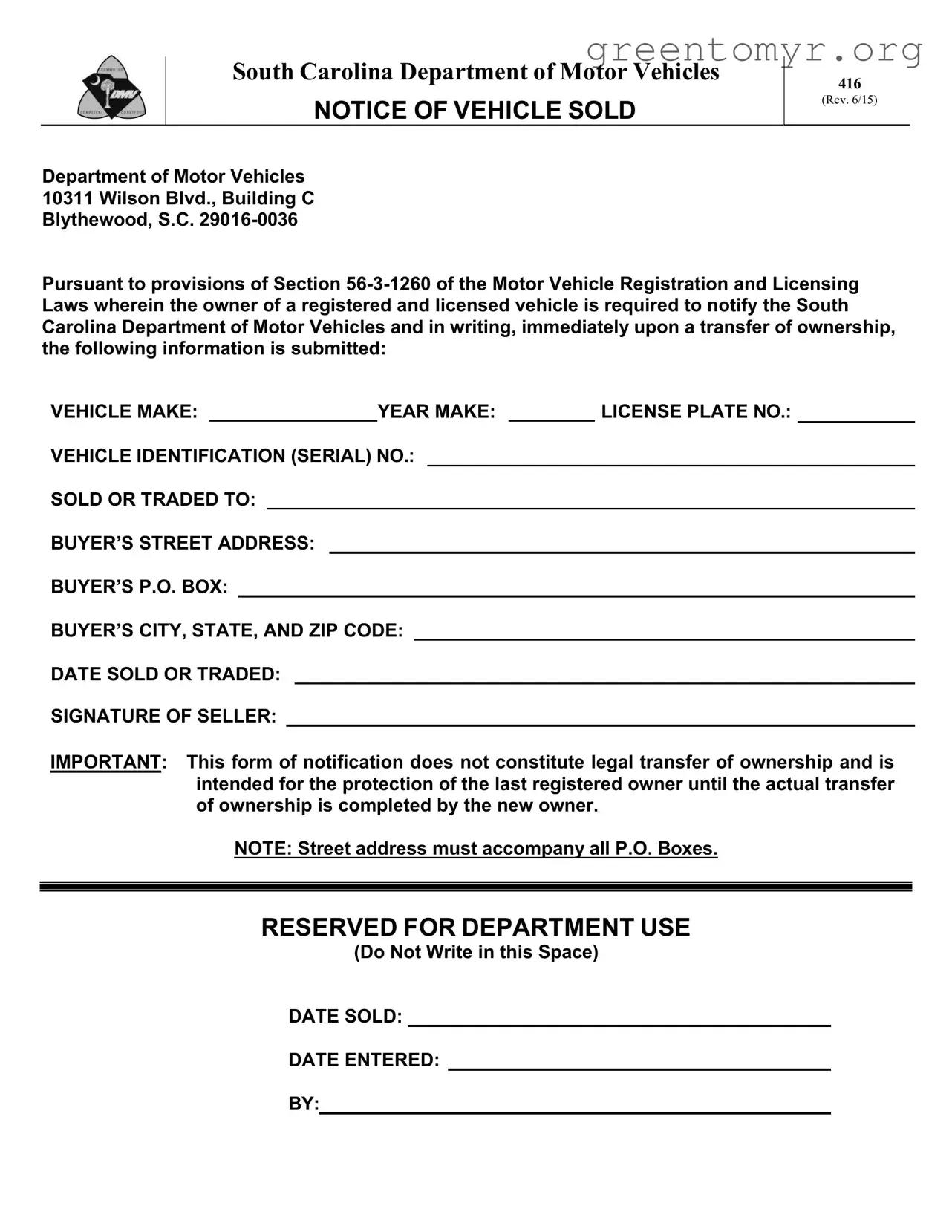
The SC DMV 416 form serves a crucial role in the vehicle ownership transfer process in South Carolina. When a registered vehicle is sold or traded, the last registered owner must notify the South Carolina Department of Motor Vehicles (DMV) immediately. This notification is not just a formality; it helps protect the seller from potential liabilities associated with the vehicle after the transfer. The form requires essential details, including the vehicle's make, year, license number, and vehicle identification number (VIN). Additionally, the seller must provide information about the buyer, such as their street address and city, state, and zip code. The date of the sale or trade is also necessary for record-keeping purposes. It is important to note that submitting the SC DMV 416 form does not legally transfer ownership; it merely serves as a notification until the new owner completes the official transfer process. This distinction underscores the importance of following through with the appropriate legal steps to ensure that ownership is correctly documented and that the seller remains protected.

South Carolina Department of Motor Vehicles |
416 |
NOTICE OF VEHICLE SOLD |
(Rev. 6/15) |
|
Department of Motor Vehicles
10311 Wilson Blvd., Building C
Blythewood, S.C.
Pursuant to provisions of Section
VEHICLE MAKE: |
|
YEAR MAKE: |
|
LICENSE PLATE NO.: |
VEHICLE IDENTIFICATION (SERIAL) NO.:
SOLD OR TRADED TO:
BUYER’S STREET ADDRESS:
BUYER’S P.O. BOX:
BUYER’S CITY, STATE, AND ZIP CODE:
DATE SOLD OR TRADED:
SIGNATURE OF SELLER:
IMPORTANT: This form of notification does not constitute legal transfer of ownership and is intended for the protection of the last registered owner until the actual transfer of ownership is completed by the new owner.
NOTE: Street address must accompany all P.O. Boxes.
RESERVED FOR DEPARTMENT USE
(Do Not Write in this Space)
DATE SOLD:
DATE ENTERED:
BY:
| Fact Name | Description |
|---|---|
| Form Title | South Carolina Department of Motor Vehicles Notice of Vehicle Sold (Form 416) |
| Governing Law | Section 56-3-1260 of the Motor Vehicle Registration and Licensing Laws |
| Purpose | This form notifies the DMV of a vehicle's ownership transfer. |
| Submission Requirement | The seller must submit this form immediately upon transfer of ownership. |
| Legal Disclaimer | Filing this form does not legally transfer ownership of the vehicle. |
| Address Requirement | A street address must accompany all P.O. Box submissions. |
After completing the SC DMV 416 form, the next steps involve submitting the form to the South Carolina Department of Motor Vehicles. This notification is essential for protecting the last registered owner until the new owner finalizes the transfer of ownership.
The SC DMV 416 form, also known as the Notice of Vehicle Sold, is a document that notifies the South Carolina Department of Motor Vehicles about the sale or trade of a registered vehicle. It is essential for the previous owner to submit this form to ensure that their record is updated and to protect them from any future liabilities associated with the vehicle.
The previous owner of a registered vehicle in South Carolina must complete this form when they sell or trade the vehicle. This includes individuals and businesses that have ownership of the vehicle. It is crucial to notify the DMV promptly to avoid any potential issues.
When filling out the SC DMV 416 form, you will need to provide the following information:
Make sure to include a street address along with any P.O. Box information.
No, the SC DMV 416 form does not legally transfer ownership of the vehicle. It serves as a notification to the DMV for record-keeping purposes. The actual transfer of ownership must be completed by the new owner through the appropriate registration process.
After submitting the form, keep a copy for your records. This will help protect you in case any issues arise with the vehicle after the sale. It is also advisable to follow up with the DMV to confirm that the form has been processed and that your records have been updated.
The completed SC DMV 416 form should be mailed to the following address:
South Carolina Department of Motor Vehicles
P.O. Box 1498
Blythewood, S.C. 29016-0036
Currently, the SC DMV 416 form must be submitted by mail. There is no online submission option available. Ensure that you send the form promptly after the sale or trade to keep your records accurate and up to date.
Filling out the South Carolina DMV 416 form can be straightforward, but many people make common mistakes that can lead to complications. One frequent error is leaving out the vehicle identification number (VIN). This number is crucial for identifying the specific vehicle being sold or traded. Without it, the DMV cannot process the notification effectively.
Another mistake occurs when individuals fail to provide a complete address for the buyer. The form requires both a street address and a P.O. Box. Omitting either part can result in delays or the rejection of the form. It is essential to ensure that the address is accurate and complete.
People often forget to include the date of sale. This date is important for record-keeping and can affect the liability of the seller. Without a clear date, it may be challenging to establish when the ownership transfer occurred.
In addition, some individuals neglect to sign the form. The seller's signature is a critical component of the notification process. Without it, the DMV may not recognize the form as valid, leading to further issues.
Another common oversight is not keeping a copy of the completed form. This can create problems if there are disputes or questions about the sale in the future. Retaining a copy serves as proof that the notification was submitted.
Some people also misinterpret the purpose of the form. It is important to remember that this notification does not legally transfer ownership. Many assume that submitting the form is sufficient for transferring title, which is not the case.
Errors in the vehicle make or year can also occur. It is vital to double-check these details for accuracy. Incorrect information can lead to confusion and may delay the processing of the notification.
Lastly, individuals may rush through the form without reviewing it thoroughly. Taking the time to carefully read each section can help prevent mistakes. A complete and accurate submission will ensure that the process goes smoothly.
By being mindful of these common mistakes, you can ensure that your submission of the DMV 416 form is correct and complete. This will help protect your interests and facilitate a smoother transition of vehicle ownership.
The South Carolina DMV 416 form is essential for notifying the DMV about the sale or trade of a vehicle. However, several other forms and documents may be required or beneficial during this process. Below is a list of these forms, each serving a specific purpose in vehicle ownership transfer and registration.
Completing these documents accurately is crucial for a smooth vehicle ownership transfer process. Ensure that all required forms are filled out correctly to avoid delays or complications with the DMV.
The SC DMV 416 form serves as a notification of vehicle sale or trade. Several other documents share similar purposes in vehicle ownership transfer and registration. Here are ten documents that are comparable to the SC DMV 416 form:
Filling out the South Carolina DMV 416 form correctly is crucial for ensuring a smooth transfer of vehicle ownership. Here are four important dos and don’ts to keep in mind while completing this form:
By following these guidelines, you can help protect yourself and ensure that the transfer of ownership is handled properly.
When it comes to the SC DMV 416 form, there are several misconceptions that can lead to confusion. Here are six common misunderstandings:
Understanding these misconceptions can help ensure that you handle the sale of your vehicle properly and avoid potential issues down the road.
When filling out and using the South Carolina DMV 416 form, consider the following key takeaways: