Content Navigation

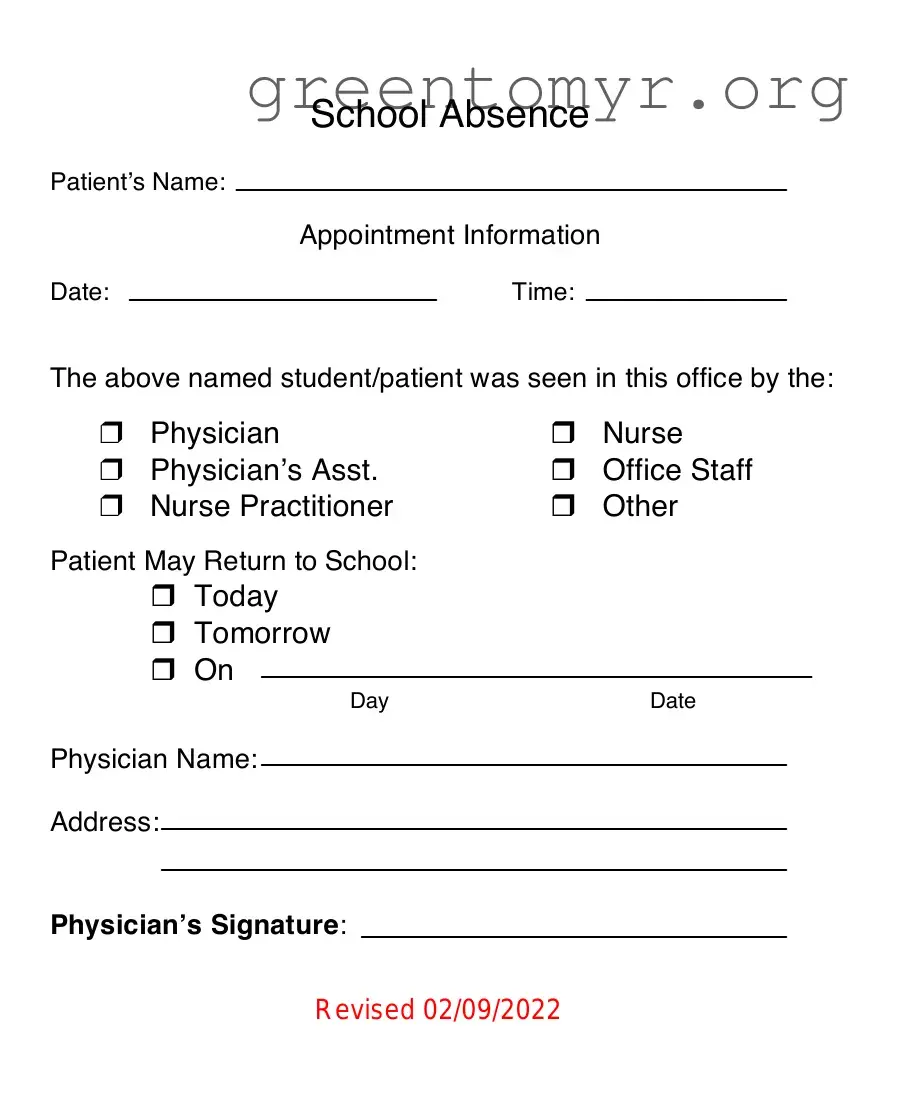
The School Absence form serves as an important document for students who miss school due to medical appointments or health-related issues. It includes essential information such as the patient's name and the date and time of the appointment. The form also identifies the healthcare professional who saw the student, which could be a physician, nurse, nurse practitioner, or other office staff. This helps schools verify the legitimacy of the absence. Additionally, the form specifies when the student may return to school, whether it be the same day, the following day, or on a specified date. To ensure proper documentation, the physician's name, address, and signature are required. This form is crucial for maintaining accurate attendance records and supporting students' health needs, and it was last revised on February 9, 2022.

School Absence Example

School Absence

Patientʼs Name:

Appointment Information

Date:Time:

The above named student/patient was seen in this office by the:

Physician

 Nurse

Physicianʼs Asst.

 Office Staff

Nurse Practitioner

 Other

Patient May Return to School:

Today

Tomorrow

On

DayDate

Physician Name:

Address:

Physicianʼs Signature:

Revised 02/09/2022

File Breakdown

Fact Name Description
Patient's Name This section requires the full name of the student or patient who is absent from school due to an appointment.
Appointment Information Details about the appointment, including the date and time, must be filled out to provide context for the absence.
Return to School The form indicates whether the student can return to school today, tomorrow, or on a specified date.
Physician's Information Includes the physician's name, address, and signature, ensuring that the absence is officially documented by a medical professional.

Guide to Using School Absence

Completing the School Absence form is an essential step to ensure that your child's absence is properly documented. This process will help communicate the necessary information to the school, allowing for a smooth transition back to class.

  1. Begin by entering the Patient’s Name at the top of the form.
  2. Fill in the Appointment Information section by providing the Date and Time of the appointment.
  3. Indicate who saw the patient by checking the appropriate box: Physician, Nurse, Physician’s Assistant, Office Staff, Nurse Practitioner, or Other.
  4. In the section labeled Patient May Return to School, select the option that applies: Today, Tomorrow, or On Day/Date.
  5. Provide the Physician Name and their Address in the designated fields.
  6. Finally, the form must be signed by the physician in the Physician’s Signature area.

Get Answers on School Absence

What is the purpose of the School Absence form?

The School Absence form serves as official documentation for a student's absence from school due to a medical appointment. It provides necessary information to the school regarding the student's visit to a healthcare provider and indicates when the student is expected to return to school.

Who needs to fill out the School Absence form?

The form should be completed by the healthcare provider who attended to the student. This could include a physician, nurse, nurse practitioner, or other office staff. The information must be accurate and signed by the healthcare provider to ensure its validity.

What information is required on the form?

The form requires the following information:

  • Patient's name
  • Date and time of the appointment
  • Type of healthcare provider who attended to the patient
  • Expected return date to school
  • Physician's name and address
  • Physician's signature

When should the School Absence form be submitted?

The form should be submitted to the school as soon as possible after the medical appointment. Timely submission helps ensure that the school is aware of the student's absence and can update their records accordingly.

Can the form be used for multiple absences?

Generally, the School Absence form is intended for a single absence related to one medical appointment. If a student has multiple appointments, a separate form should be filled out for each absence to provide accurate documentation for the school.

What happens if the form is not submitted?

If the School Absence form is not submitted, the school may not recognize the absence as excused. This could lead to potential consequences for the student, such as unexcused absence records, which may affect their academic standing or attendance policy compliance.

Is there a deadline for submitting the form?

What if the student needs to return to school on a different date?

If the student needs to return on a different date than indicated on the form, it is important to communicate this to the school. The healthcare provider can issue an updated form or a note specifying the new return date to ensure that the school's records are accurate.

Common mistakes

Completing a School Absence form can seem straightforward, but many people make common mistakes that can lead to confusion or delays. One frequent error is leaving the patient's name section incomplete. It is essential to ensure that the full name is provided, as this helps the school accurately identify the student. Without this information, the form may not be processed correctly.

Another mistake often seen is neglecting to fill in the appointment information. The date and time of the appointment are critical details that schools need to understand the reason for the absence. Omitting this information can lead to misunderstandings about the legitimacy of the absence.

Many people also forget to indicate who saw the patient. The options include physician, nurse, physician's assistant, office staff, nurse practitioner, or other. Selecting the appropriate option is crucial because it provides context for the absence and informs the school about the level of care received.

Additionally, some individuals overlook the section regarding when the patient may return to school. It is important to clearly mark whether the student can return today, tomorrow, or on a specific date. This information helps schools manage attendance records and ensures that students do not return prematurely.

Furthermore, not providing the physician's name and address can create issues. This information is necessary for verification purposes. Schools may need to contact the healthcare provider for further details, and missing this information can delay the process.

Another common oversight is forgetting to obtain the physician's signature. This signature serves as an official acknowledgment of the appointment and the recommendation for the student's return to school. Without it, the form may be considered incomplete.

Lastly, failing to check for any revisions or updates to the form can lead to using outdated information. Always ensure that the most current version of the form is being filled out to avoid any complications. By taking the time to review each section carefully, you can help ensure a smooth process for the student's return to school.

Documents used along the form

The School Absence form is often accompanied by several other documents that help provide context and support for a student's absence. These documents can assist in ensuring clear communication between parents, schools, and healthcare providers.

  • Doctor's Note: This document confirms the medical appointment or illness of the student. It typically includes the doctor's name, contact information, and a brief description of the student's condition.
  • Appointment Confirmation: This form serves as proof of the scheduled appointment. It may include the date, time, and location of the visit, along with the name of the healthcare provider.
  • Health History Form: This document provides background on the student's medical history. It may include past illnesses, allergies, and any ongoing treatments that the school should be aware of.
  • Medication Authorization Form: If a student requires medication during school hours, this form allows parents to give permission for school staff to administer it. It typically includes details about the medication, dosage, and administration schedule.
  • Emergency Contact Form: This document lists individuals who can be contacted in case of an emergency. It is crucial for ensuring that the school can reach someone if the student needs immediate assistance.
  • Attendance Policy Acknowledgment: This form confirms that parents understand the school's attendance policies. It may outline the procedures for reporting absences and the consequences of excessive absences.

These documents work together to create a comprehensive record of a student's absence and ensure that all parties involved are informed and prepared to support the student's return to school.

Similar forms

  • Medical Appointment Form: Similar to the School Absence form, this document provides details about a patient's visit to a healthcare provider, including the patient's name, appointment date, and the provider's signature. It also indicates when the patient can return to school or work.
  • Excuse Letter: An excuse letter serves to inform a school about a student's absence due to illness or other valid reasons. It typically includes the student's name, the reason for absence, and the duration, similar to the School Absence form.
  • Attendance Record: This document tracks a student’s attendance over a specified period. It shares similarities with the School Absence form by documenting when a student was absent and often includes notes from parents or guardians.
  • Health Clearance Form: A health clearance form is used to confirm that a student is fit to return to school after an illness. It includes the healthcare provider's name and signature, similar to the School Absence form's requirement for a physician's signature.
  • Permission Slip: A permission slip grants consent for a student to participate in school activities or events. While its primary purpose differs, it often requires a parent or guardian's signature, akin to the School Absence form's need for a physician's signature.
  • Withdrawal Form: This document is used when a student withdraws from school. It may include the student’s name, the reason for withdrawal, and the effective date, paralleling the School Absence form's focus on documenting a student's status.

Dos and Don'ts

When filling out the School Absence form, there are some important things to keep in mind. Here’s a list of what you should and shouldn’t do:

  • Do write clearly and legibly to ensure all information is readable.
  • Do provide accurate dates and times for the appointment.
  • Do include the name of the physician or healthcare provider who saw the patient.
  • Do check the box for when the patient may return to school.
  • Don't leave any sections blank; fill out all required fields.
  • Don't forget to sign the form if a signature is required.
  • Don't use abbreviations or shorthand that may confuse the reader.

By following these guidelines, you can help ensure the form is completed correctly and efficiently.

Misconceptions

Understanding the School Absence form can help clarify its purpose and function. Here are some common misconceptions surrounding this important document:

  • Only doctors can fill out the form. Many healthcare providers, including nurse practitioners and physician assistants, are authorized to complete the School Absence form.
  • The form is only for serious illnesses. The School Absence form can be used for various reasons, including minor illnesses and routine appointments.
  • Students must miss a full day of school to need the form. The form can be completed for partial absences, such as attending a medical appointment during school hours.
  • The form is not necessary for short absences. Regardless of the duration, it’s important to provide documentation for any absence to ensure proper record-keeping.
  • Parents can sign the form on behalf of their child. A healthcare provider must sign the form to validate the absence, ensuring it is officially recognized.
  • Once submitted, the form cannot be changed. If there is an error, it can be corrected with a new form or an amendment, as long as the school is informed.
  • The form is only valid for one day. The form can specify multiple days for absence, allowing for flexibility in case of extended illnesses.
  • All schools require the same form. Different schools may have varying requirements, so it’s essential to check specific guidelines.
  • The form is only for physical health issues. It can also be used for mental health appointments, recognizing the importance of overall well-being.

By dispelling these misconceptions, students and parents can better navigate the process of school absences and ensure that all necessary documentation is completed accurately.

Key takeaways

Filling out a School Absence form is an important task that helps communicate a student's health status to the school. Here are some key takeaways to consider:

  • Patient's Information: Ensure that the patient's name is clearly written at the top of the form. This helps the school identify the student quickly.
  • Appointment Details: Include the date and time of the appointment. This information provides context for the absence.
  • Healthcare Provider: Indicate who saw the patient by checking the appropriate box. This could be a physician, nurse, or other healthcare staff.
  • Return Date: Specify when the student may return to school by selecting one of the options provided. It is crucial for the school to know when the student will be back.
  • Physician's Information: Fill in the physician's name and address. This information may be necessary for the school to verify the absence.
  • Signature Requirement: The form must be signed by the physician or designated healthcare provider. This signature validates the absence.
  • Revisions: Note that the form was revised on 02/09/2022. Always use the most current version to avoid confusion.
  • Submission: Submit the completed form to the school as soon as possible to ensure proper record-keeping and to inform teachers of the student's absence.