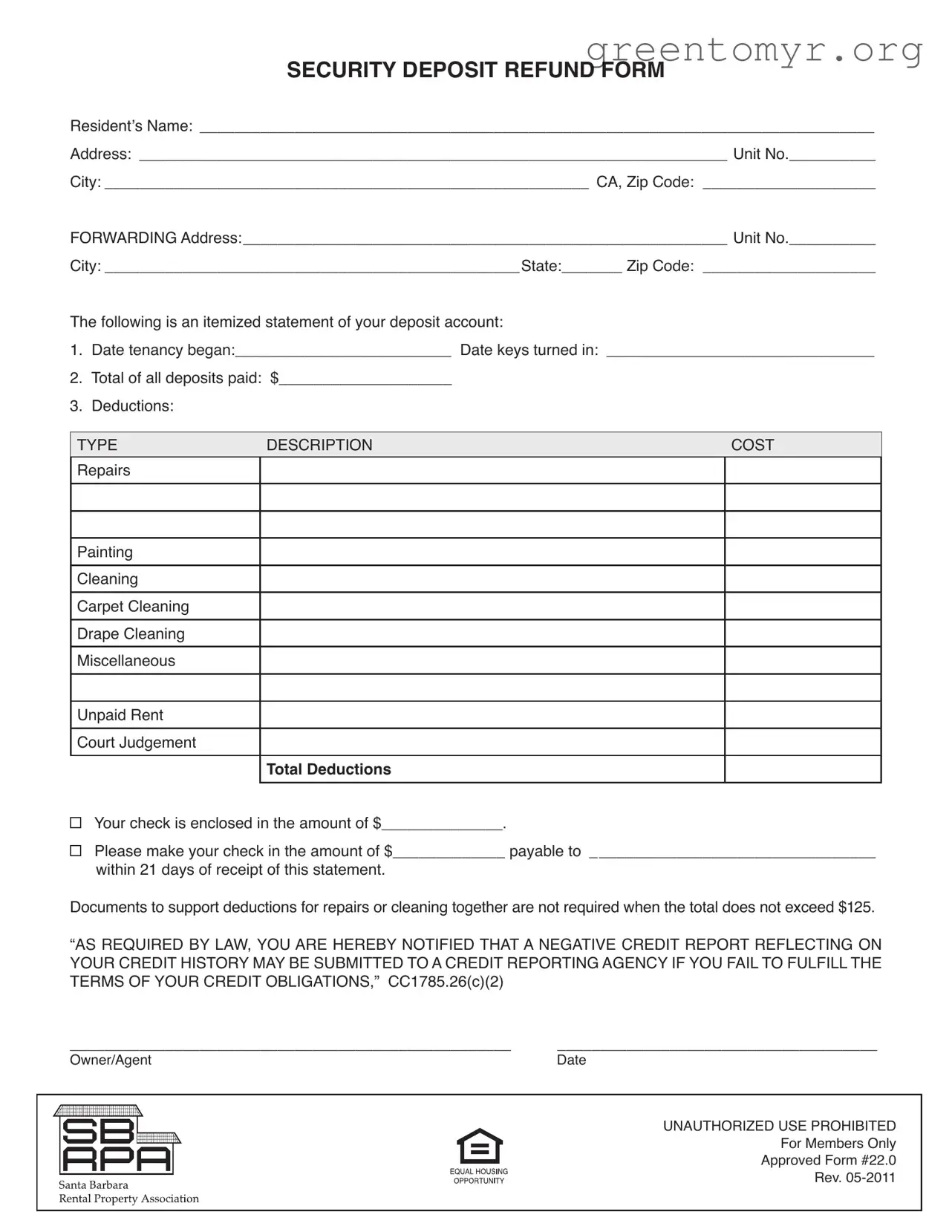
When moving out of a rental property, tenants often face the important task of managing their security deposit. The Security Deposit Deductions form serves as a vital tool in this process, allowing landlords to outline the deductions made from the tenant's deposit. This form includes essential details such as the resident's name, address, and unit number, ensuring that all information is accurately recorded. It also captures key dates, including when the tenancy began and when the keys were returned. A comprehensive breakdown of the total deposits paid and itemized deductions—ranging from repairs and cleaning to unpaid rent—is provided, giving tenants clarity on how their funds are being allocated. The form specifies the amount to be refunded, alongside instructions for payment, which must be processed within 21 days of the statement's receipt. Furthermore, it includes a legal notice regarding potential credit implications if financial obligations are not met. By using this form, both tenants and landlords can navigate the often complex landscape of security deposits with greater transparency and understanding.
SECURITY DEPOSIT REFUND FORM
Resident’s Name: ______________________________________________________________________________
Address: ____________________________________________________________________ Unit No.__________
City: ________________________________________________________ CA, Zip Code: ____________________
FORWARDING Address:________________________________________________________ Unit No.__________
City: ________________________________________________State:_______ Zip Code: ____________________
The following is an itemized statement of your deposit account:
1.Date tenancy began:_________________________ Date keys turned in: _______________________________
2.Total of all deposits paid: $____________________
3.Deductions:
TYPE |
DESCRIPTION |
COST |
|
|
|
Repairs
Painting
Cleaning
Carpet Cleaning
Drape Cleaning
Miscellaneous
Unpaid Rent
Court Judgement
TOTAL DEDUCTIONS
Your check is enclosed in the amount of $______________.
Please make your check in the amount of $_____________ payable to _________________________________
within 21 days of receipt of this statement.
Documents to support deductions for repairs or cleaning together are not required when the total does not exceed $125.
“AS REQUIRED BY LAW, YOU ARE HEREBY NOTIFIED THAT A NEGATIVE CREDIT REPORT REFLECTING ON YOUR CREDIT HISTORY MAY BE SUBMITTED TO A CREDIT REPORTING AGENCY IF YOU FAIL TO FULFILL THE TERMS OF YOUR CREDIT OBLIGATIONS,” CC1785.26(c)(2)
___________________________________________________ |
_____________________________________ |
Owner/Agent |
Date |
UNAUTHORIZED USE PROHIBITED
For Members Only
Approved Form #22.0
Rev.
| Fact Name | Description |
|---|---|
| Form Purpose | This form is used to itemize deductions from a security deposit and to facilitate the refund process to the tenant. |
| Tenancy Dates | It requires the start date of the tenancy and the date keys were returned. |
| Total Deposits | The form must include the total amount of all deposits paid by the tenant. |
| Deductions List | A detailed list of deductions is provided, including repairs, cleaning, and unpaid rent. |
| Supporting Documents | Documents for deductions are not necessary if the total does not exceed $125. |
| Payment Timeline | The landlord must issue the refund check within 21 days of sending this statement. |
| Credit Reporting Notice | A notice about potential negative credit reporting is included, as required by California law. |
| Governing Law | California Civil Code Section 1950.5 governs security deposits and their deductions. |
Filling out the Security Deposit Deductions form is a straightforward process that requires attention to detail. After completing the form, you will submit it to the appropriate party, who will review the deductions listed. Be sure to keep a copy for your records.
The Security Deposit Deductions form serves to provide tenants with a clear breakdown of any deductions made from their security deposit upon moving out. This form outlines the total deposits paid, the dates of tenancy, and specific costs associated with repairs, cleaning, or other charges. It ensures transparency in the process and helps tenants understand how their deposit was utilized.
To complete the form, start by entering your name, address, and unit number. Next, provide the dates when your tenancy began and when you returned the keys. Then, list the total amount of deposits you paid. For deductions, specify the type, description, and cost associated with each item. Finally, ensure that the forwarding address is accurate, as this is where any remaining funds will be sent.
The form allows for various types of deductions, including:
Each deduction should be itemized with a description and associated cost to provide clarity.
If the total deductions do not exceed $125, tenants are not required to provide documents to support the deductions for repairs or cleaning. This provision simplifies the process for smaller amounts, allowing for a more efficient resolution.
If you disagree with any deductions, it is advisable to communicate directly with the landlord or property management. Discussing your concerns can lead to a resolution. If necessary, you may also want to seek legal advice to understand your rights and options regarding the dispute.
The form includes a notice stating that a negative credit report may be submitted to a credit reporting agency if you fail to fulfill your credit obligations. This means that if there are outstanding amounts owed, it could impact your credit history. It is important to address any financial obligations promptly to avoid this consequence.
If you have questions regarding the Security Deposit Deductions form, it is best to contact your landlord or property management directly. They can provide clarification on the deductions, the refund process, and any other related inquiries.
Filling out the Security Deposit Deductions form can be straightforward, but mistakes often occur. One common error is leaving out the resident's name or address. This information is crucial for processing the refund. Without it, the owner or agent may struggle to identify who the refund belongs to.
Another frequent mistake is failing to provide the correct unit number. This detail helps ensure that the refund is directed to the right location. If the unit number is missing or incorrect, it could lead to delays in receiving the refund.
People sometimes overlook the dates related to their tenancy. The form requires the date the tenancy began and the date keys were returned. Missing these dates can cause confusion and may lead to complications in processing the refund.
When it comes to the deductions section, many individuals forget to list all deductions accurately. They may leave out costs for repairs or cleaning, which can affect the total amount of the refund. It's essential to include every relevant deduction to ensure the refund reflects the actual situation.
Some people also make the mistake of not providing enough detail in the description of the deductions. Simply stating "repairs" without specifying what was repaired can lead to questions or disputes. Providing clear descriptions helps clarify why the deductions were made.
Another common error involves the total deductions calculation. Individuals might miscalculate the total, which can result in an incorrect refund amount. Double-checking the math before submitting the form can prevent this issue.
Additionally, forgetting to include the correct payable name for the check is a mistake that can cause delays. The form requires the name to which the check should be made out. If this is missing or incorrect, the check may not be processed properly.
Finally, many fail to read the legal notice included on the form. Understanding the implications of failing to fulfill credit obligations is important. Ignoring this notice could lead to negative consequences, such as a negative credit report.
When dealing with security deposits, several forms and documents complement the Security Deposit Deductions form. Each serves a unique purpose in ensuring transparency and clarity for both the tenant and the landlord.
Using these documents together with the Security Deposit Deductions form promotes a fair process for both tenants and landlords. Clear communication and proper documentation can help prevent misunderstandings and disputes.
The Security Deposit Deductions form serves a specific purpose in documenting the deductions made from a tenant's security deposit. Several other documents share similarities with this form, primarily in their function and structure. Below is a list of six such documents, each with a brief explanation of how they relate to the Security Deposit Deductions form.
When filling out the Security Deposit Deductions form, attention to detail is crucial. Here are seven important dos and don'ts to consider:
Understanding the Security Deposit Deductions form is crucial for both tenants and landlords. However, several misconceptions often arise regarding this document. Below is a list of common misunderstandings.
Here are some key takeaways about filling out and using the Security Deposit Deductions form: