Content Navigation

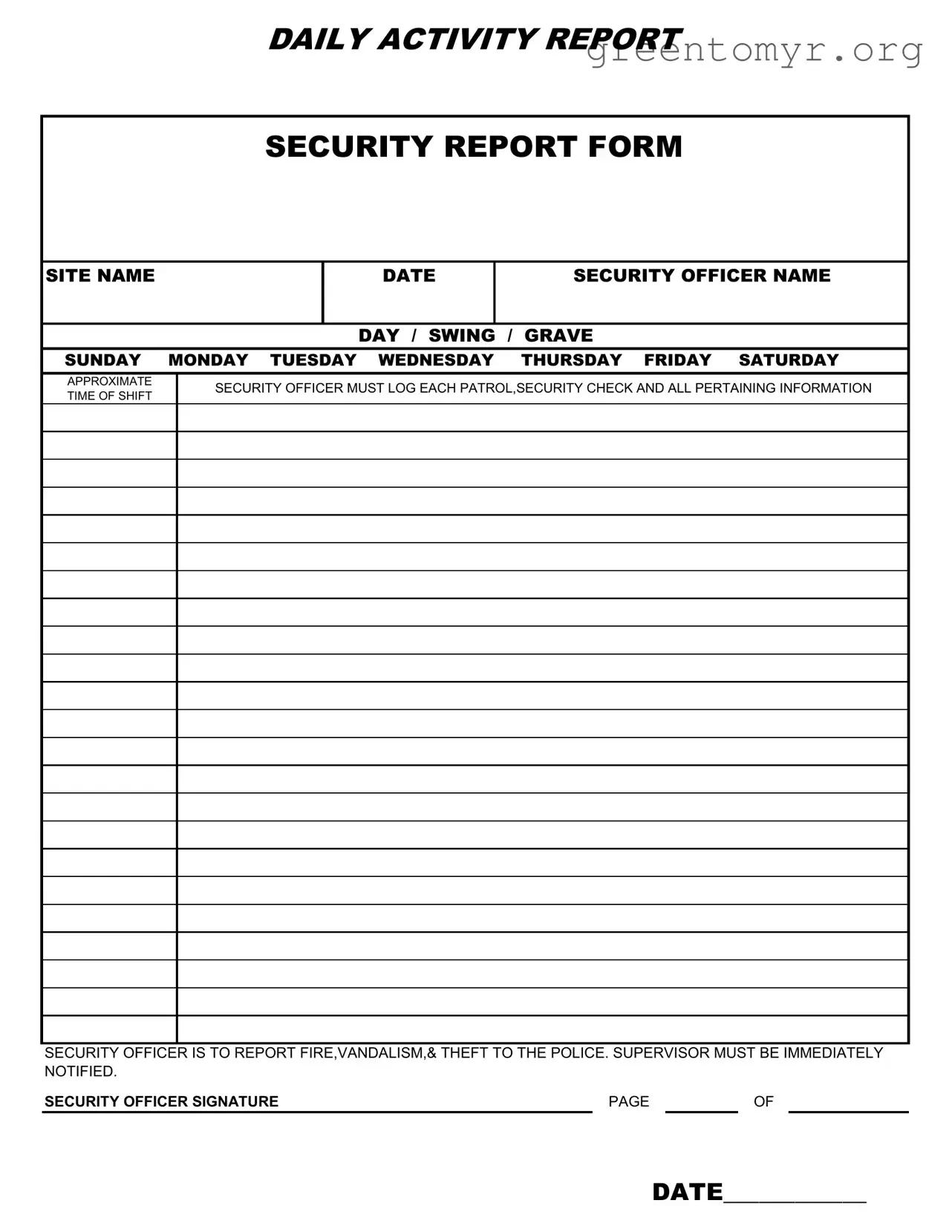
The Security Guard Daily Report Sample form serves as a vital tool for security officers, helping them document their daily activities and observations. This structured report includes essential fields such as the site name, date, and the name of the security officer on duty. It also specifies the shift type—whether day, swing, or graveyard—providing clarity on the time frame for each report. Throughout their shift, security officers are required to log each patrol and security check meticulously. This ensures that all pertinent information is captured, creating a comprehensive record of daily operations. In cases of emergencies such as fire, vandalism, or theft, the form mandates immediate reporting to the police, with a requirement for the supervisor to be notified right away. To finalize the report, the security officer must provide their signature, affirming the accuracy of the recorded information. Overall, this form is designed to enhance communication and accountability within security operations.
Security Guard Daily Report Sample Example

DAILY ACTIVITY REPORT

SECURITY REPORT FORM

SITE NAME

DATE

SECURITY OFFICER NAME

DAY / SWING / GRAVE

SUNDAY MONDAY TUESDAY WEDNESDAY THURSDAY FRIDAY SATURDAY

APPROXIMATE TIME OF SHIFT

SECURITY OFFICER MUST LOG EACH PATROL,SECURITY CHECK AND ALL PERTAINING INFORMATION

SECURITY OFFICER IS TO REPORT FIRE,VANDALISM,& THEFT TO THE POLICE. SUPERVISOR MUST BE IMMEDIATELY NOTIFIED.

SECURITY OFFICER SIGNATURE

PAGE


OF

DATE____________

File Breakdown

Fact Name Description
Form Purpose The Security Guard Daily Report Sample form is designed to document the daily activities and observations of security personnel at a specific site.
Required Information Security officers must log patrols, security checks, and any incidents, including fire, vandalism, and theft, ensuring that all relevant details are recorded.
Notification Protocol In the event of incidents such as fire or theft, the security officer is required to notify the police and inform their supervisor immediately.
Signature Requirement The form must be signed by the security officer, confirming that all information provided is accurate and complete.

Guide to Using Security Guard Daily Report Sample

Filling out the Security Guard Daily Report Sample form is essential for maintaining accurate records of daily activities and incidents. Following these steps will ensure that the report is completed thoroughly and correctly.

  1. Begin by entering the site name at the top of the form. This identifies the location where the security officer is stationed.
  2. Next, write the date of the report. Ensure the date is accurate to reflect the day’s activities.
  3. Fill in the security officer name. This should be the name of the individual completing the report.
  4. Indicate the shift type by selecting from the options: Day, Swing, or Grave. Mark the appropriate choice clearly.
  5. Record the day of the week by marking the corresponding box for Sunday through Saturday.
  6. Document the approximate time of shift. This provides context for the activities logged during the shift.
  7. Log each patrol and security check in detail. Include any relevant information regarding these activities.
  8. If there are any incidents such as fire, vandalism, or theft, report these immediately. Notify the police and inform a supervisor right away.
  9. Finally, sign the report as the security officer completing the form. This adds accountability to the document.
  10. Make sure to note the page number if applicable and the date of the report at the bottom.

Get Answers on Security Guard Daily Report Sample

What is the purpose of the Security Guard Daily Report Sample form?

The Security Guard Daily Report Sample form is designed to help security officers document their daily activities. It serves as a record of patrols, security checks, and any incidents that occur during their shift. This report is crucial for maintaining safety and accountability at the site.

What information is required on the form?

The form requires the following information:

  • Site name
  • Date
  • Security officer's name
  • Shift type (Day, Swing, or Grave)
  • Days of the week
  • Approximate time of shift
  • Details of each patrol and security check
  • Any incidents such as fire, vandalism, or theft
  • Security officer's signature

How should security officers log their patrols?

Security officers must log each patrol and security check in the designated section of the form. They should include the time of the patrol, locations checked, and any observations made during the patrol. This detailed documentation helps ensure thorough reporting.

What should be done in case of an incident like fire or theft?

If a security officer encounters an incident such as fire, vandalism, or theft, they must report it to the police immediately. Additionally, they should notify their supervisor right away. Prompt reporting is essential for effective response and documentation.

Is there a specific format for the time logged on the form?

The form does not specify a particular format for logging time. However, it is best practice to use a consistent format, such as 24-hour time or AM/PM notation, to avoid confusion. Clarity in time reporting is crucial for accurate records.

Who is responsible for signing the report?

The security officer who completed the report is responsible for signing it. This signature indicates that the information provided is accurate and complete. It also helps establish accountability for the officer's actions during their shift.

Can the form be modified for different sites?

Yes, the Security Guard Daily Report Sample form can be modified to suit the specific needs of different sites. While the core elements should remain, additional sections or details may be added to address site-specific requirements or protocols.

How often should the report be submitted?

The report should be submitted at the end of each shift. This ensures that all activities and incidents are recorded in a timely manner. Regular submission helps maintain an accurate and up-to-date security log.

What happens if an officer forgets to log an incident?

If an officer forgets to log an incident, it is important to report it as soon as possible. The officer should document the incident in a supplemental report if necessary. Accurate records are vital for ongoing security operations and incident tracking.

How can supervisors utilize these reports?

Supervisors can use the reports to monitor security officer performance and identify trends in incidents. By reviewing these reports, they can implement improvements to security protocols and ensure that officers are following procedures correctly.

Common mistakes

Filling out the Security Guard Daily Report Sample form can be straightforward, but many individuals make common mistakes that can lead to confusion or miscommunication. One frequent error is failing to provide complete information in the designated fields. For instance, leaving out the site name or date can render the report ineffective. Each piece of information is crucial for tracking activities and ensuring accountability.

Another mistake is not logging patrols and security checks accurately. Security officers are required to document every patrol and security check they perform. Omitting these details can create gaps in the report, which may hinder the response to incidents. It's essential to take the time to record each activity clearly and thoroughly.

People often overlook the importance of reporting incidents such as fire, vandalism, or theft. If an officer witnesses or becomes aware of such events, they must report them immediately. Failing to do so not only puts the site at risk but also compromises the integrity of the report. Always remember to notify the police and the supervisor as soon as possible.

Lastly, many individuals forget to sign the report. The security officer signature at the end of the report serves as a confirmation that the information provided is accurate and complete. Neglecting to sign can lead to questions about the report's validity. Always ensure that the report is signed and dated before submission.

Documents used along the form

The Security Guard Daily Report Sample form plays a crucial role in maintaining safety and security at various locations. To effectively document and manage security operations, several other forms and documents are commonly used alongside this report. Below is a list of these documents, each serving a specific purpose.

  • Incident Report Form: This form is used to document any unusual occurrences, such as accidents or disturbances. It provides detailed accounts of incidents, including time, location, and involved parties.
  • Patrol Log: A patrol log tracks the movements and activities of security personnel during their shifts. It includes timestamps and locations of patrols, helping to ensure thorough coverage of the area.
  • Visitor Log: This document records the entry and exit of visitors to a facility. It typically includes names, times, and purpose of visits, enhancing security by monitoring who is on the premises.
  • Shift Change Report: This report is used when one security officer hands over duties to another. It summarizes key events and issues that occurred during the shift, ensuring continuity in security measures.
  • Equipment Inspection Checklist: This checklist helps security personnel verify that all necessary equipment is functioning properly. Regular inspections can prevent malfunctions during critical moments.
  • Emergency Response Plan: This document outlines procedures to follow in various emergency situations, such as fires or medical emergencies. It ensures that all security personnel are prepared to respond effectively.

Utilizing these forms in conjunction with the Security Guard Daily Report Sample form enhances the overall effectiveness of security operations. Each document contributes to a comprehensive approach to safety and accountability, ensuring a secure environment for everyone involved.

Similar forms

The Security Guard Daily Report Sample form serves as a crucial tool in maintaining safety and security within various environments. Several other documents share similar purposes and structures, each tailored to specific contexts. Below are five documents that resemble the Security Guard Daily Report, along with their respective functions.

  • Incident Report Form: This document is used to record details of specific incidents, such as accidents or disturbances. Like the daily report, it requires the time, date, and nature of the incident, ensuring that all relevant information is documented for future reference.
  • Patrol Log: A patrol log tracks the activities and observations made by security personnel during their shifts. Similar to the daily report, it emphasizes the importance of logging each patrol and any notable findings, thus providing a comprehensive overview of security measures taken throughout the day.
  • Visitor Log: This document records the entry and exit of visitors to a facility. It shares similarities with the daily report in that it requires detailed information, including names, times, and purposes of visits, ensuring that security personnel maintain an accurate account of who is on the premises.
  • Daily Activity Report (DAR): Often used in various industries, this report summarizes the activities and events of a given day. Like the Security Guard Daily Report, it includes time stamps and descriptions of activities, providing a clear picture of daily operations and any incidents that may have occurred.
  • Security Incident Log: This log is specifically designed to document security-related incidents, including breaches or suspicious activities. It parallels the daily report by focusing on timely reporting and the necessity of notifying supervisors about significant events, ensuring that all incidents are recorded for analysis and follow-up.

Dos and Don'ts

When filling out the Security Guard Daily Report Sample form, attention to detail is crucial. Here’s a list of dos and don’ts to ensure the report is completed accurately and effectively.

  • Do write clearly and legibly to avoid miscommunication.
  • Do include the correct site name and date at the top of the form.
  • Do log each patrol and security check with the approximate time.
  • Do report any incidents of fire, vandalism, or theft immediately.
  • Do notify your supervisor right away in case of emergencies.
  • Don't leave any sections of the form blank; completeness is essential.
  • Don't use abbreviations that may confuse others reading the report.
  • Don't forget to sign the report at the end of your shift.
  • Don't alter any information once it has been recorded; accuracy is key.
  • Don't forget to keep a copy for your records, if required.

Following these guidelines will help maintain a clear and effective reporting process. Proper documentation supports safety and accountability in security operations.

Misconceptions

Misconceptions about the Security Guard Daily Report Sample form can lead to misunderstandings about its purpose and use. Here are seven common misconceptions:

  • It is optional to fill out the report. Many believe that completing the daily report is not mandatory. In reality, it is a crucial part of the security officer's responsibilities.
  • Only major incidents need to be reported. Some think that only significant events, like theft or vandalism, should be logged. However, all activities, including routine patrols and security checks, must be documented.
  • The report is only for the supervisor's eyes. A misconception exists that the report is solely for supervisors. In fact, it serves as a record for legal purposes and can be referenced by law enforcement if needed.
  • Filling out the report takes too much time. Many security officers feel that completing the report is time-consuming. In truth, it can be done efficiently if officers log information regularly throughout their shift.
  • Digital reports are more effective than paper reports. Some argue that electronic reporting is always superior. While digital forms can be useful, paper reports are equally valid and may be required in certain situations.
  • Only the security officer's signature is needed. There is a belief that the report is complete with just the officer's signature. However, it should also include the date and any relevant details of the incidents reported.
  • Reports are not necessary for routine activities. Some officers think that routine checks do not need to be documented. This is incorrect; all activities contribute to a comprehensive security overview and must be recorded.

Key takeaways

When filling out and using the Security Guard Daily Report Sample form, consider the following key takeaways:

  • Site Identification: Clearly indicate the site name at the top of the form to ensure proper documentation.
  • Date and Officer Information: Fill in the date and the name of the security officer responsible for the report to maintain accountability.
  • Shift Timing: Specify the approximate time of the shift to provide context for the activities logged.
  • Activity Logging: Log each patrol and security check meticulously. This information is crucial for tracking security measures.
  • Incident Reporting: Report any incidents such as fire, vandalism, or theft to the police immediately. It is essential for safety and legal compliance.
  • Supervisor Notification: Notify a supervisor without delay if any significant incidents occur. This ensures that higher authorities are informed promptly.
  • Signature Requirement: The security officer must sign the report to verify its accuracy and completeness.
  • Record Keeping: Maintain copies of the daily reports for future reference and to support any investigations that may arise.